Table of Contents
- Why inspect the entire line if damage is hidden?
- From inspector knowledge to screening
- How is the longitudinal coverage of piping evaluated with guided waves?
- Analytical criteria and CUI signal discrimination in LRUT
- How far can an LRUT inspection really reach?
- ASTM E2775: The rules behind a good inspection
- Follow-up and characterization protocol for detected indications
- Real case: Locating CUI to verify where it matters
- Wavemaker G5: A new generation for screening
- What should you demand from an LRUT inspection service?
- When inspection protects more than just piping
- References
- Frequently asked questions (FAQs)
- Does LRUT allow detecting CUI without removing all insulation?
- What is the difference between screening and scanning?
- Does LRUT directly measure pipe thickness?
- What distance can be inspected using guided waves?
- What factors can reduce LRUT reach?
- How is an indication detected by GWT confirmed?
- What does ASTM E2775 establish for Guided Wave Testing?
- Can LRUT be used to monitor corrosion over time?
Inspecting piping against corrosion under insulation poses a critical difficulty: damage can progress without being visible, while removing insulation over large extents consumes time, access, and resources.
Long Range Ultrasonic Testing (LRUT) allows screening from selected points to guide the search toward areas requiring greater attention.
Guided waves do not replace localized inspection. Their value lies in expanding coverage and turning indications into useful information to decide where to verify, intervene, or monitor.
Why inspect the entire line if damage is hidden?
In insulated piping, traditional inspection begins where experience identifies the highest susceptibility to CUI. Insulation or weather barrier damage, water ingress, supports, and other conditions allow selecting areas to remove insulation and directly examine the pipe.
This approach remains valid. The difficulty appears when external conditions do not reveal what is happening underneath or when corrosion areas exist outside the initially selected points.
The challenge lies between inspected points
Increasing inspection points provides information, but can also increase access requirements, scaffolding, insulation removal and reinstallation, man-hours, and execution time, without guaranteeing that all areas with hidden damage are identified. The challenge is to better understand a larger extent of piping without fully uncovering it.
From inspector knowledge to screening
LRUT inspection adds another level of information. Guided waves allow screening from selected points and identifying indications that justify a localized investigation.
Inspector experience remains essential for selecting positions, interpreting conditions, and verifying findings. LRUT does not replace that knowledge; it expands the extent over which it can be applied.
Both approaches complement each other: directly inspecting areas of known susceptibility and using screening to investigate what may be occurring between those points.
LRUT screening: Search first, intervene later
LRUT inspection complements the traditional selection of susceptible areas through the screening of piping that remains covered. Its purpose is not to replace direct inspection, but to provide information over a larger extent of piping.
Through guided wave inspection, an ultrasonic signal propagates along the pipe wall from an access point. The responses obtained allow recognizing line features and identifying indications that require greater attention.
Thus, experience and screening work together: one guides toward areas of known susceptibility and the other expands the search beyond those points.
Screening does not mean quantifying
In this context, screening means examining a broad extent to locate and prioritize indications. It does not mean automatically determining how much thickness has been lost.
ASTM E2775 defines Guided Wave Testing (GWT) as a screening tool. The method does not directly provide wall thickness or exact dimensions of a discontinuity; therefore, relevant findings require subsequent evaluation.
| Stage | Main question | Result |
|---|---|---|
| Susceptible areas | Where is CUI likely to be found? | Priority points |
| LRUT/GWT screening | Where do indications appear? | Location and priority |
| Localized verification | Is there metal loss? | Confirmation |
| Characterization | What is its severity? | Damage data |
| Evaluation | What should be done? | Integrity decision |
Each stage reduces a different uncertainty. Screening helps decide where to concentrate detailed inspection.
From global detection to localized characterization
An indication does not automatically mean corrosion under insulation either. Welds, supports, flanges, branch connections, and other geometric changes produce responses that must be interpreted. When a signal justifies investigation, the focus shifts from examining a broad extent to concentrating access where UT, PAUT, QSR, or another appropriate method can verify and characterize the condition.
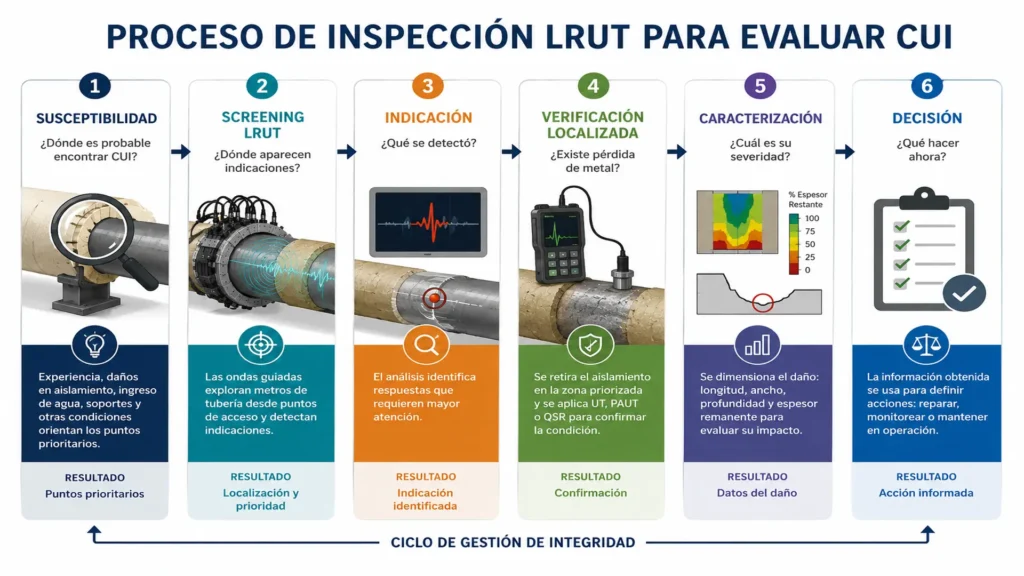
The contribution of LRUT lies in adding information to inspector experience: obvious areas remain important, and guided waves help investigate what occurs between them.
How is the longitudinal coverage of piping evaluated with guided waves?
Guided wave testing (GWT/LRUT) uses the metallic wall of the pipe as a propagation medium to transmit low-frequency ultrasonic energy along the asset. Unlike conventional ultrasound (UT), focused on point thickness measurements, LRUT technology uses wave modes that travel axially to perform screening over long segments.
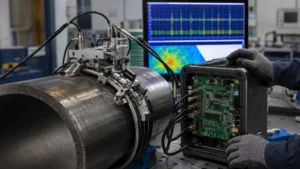
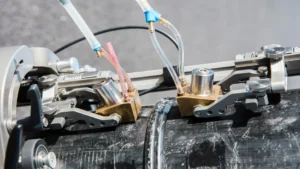
The test requires installing a transducer collar on a selected section of the pipe. This transduction system introduces ultrasonic pulses that propagate bidirectionally along the pipe axis.
Geometric confinement and propagation modes
The wall structure acts as an acoustic waveguide, confining the ultrasonic wavefront within its physical boundaries. The selection of frequencies and propagation modes (torsional or flexural) is adjusted according to diameter, wall thickness, and inspection objectives.
The ultrasonic signal does not radially penetrate the thermal insulation from the outside; instead, it is guided through the bulk of the metal. Therefore, the LRUT technique requires only a localized access window to the surface to install the equipment, allowing evaluation of the condition of adjacent segments that remain covered.
Signal reflection due to impedance variation
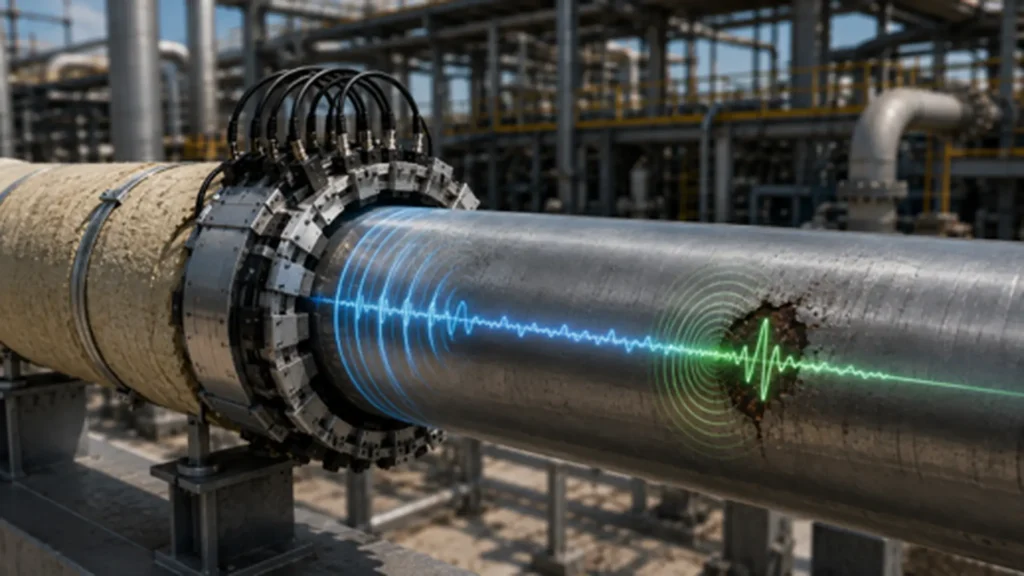
Any alteration in the cross-section of the metal or boundary conditions modifies the acoustic impedance of the system. Geometric design singularities (welds, flanges, supports, and branches) as well as degradation discontinuities (wall loss due to CUI) cause partial reflection of the ultrasonic energy.
The inspection system records the amplitude and time-of-flight of the reflected signals, allowing determination of the exact position and relative severity of indications with respect to the collar coupling point.
Analytical criteria and CUI signal discrimination in LRUT
Discontinuities caused by corrosion under insulation (CUI) and structural design singularities of the pipe (such as welds, supports, flanges, or branches) generate reflections of ultrasonic energy of a similar nature. Consequently, the presence of an indication in the echogram does not by itself constitute a confirmatory diagnosis of degradation.
Although guided wave inspection expands the spatial coverage of the asset, characterization of the finding depends on the specialist’s technical criteria. Each recorded reflection must be quantitatively correlated with its axial position (time-of-flight) and isometric drawings of the pipe, differentiating between expected geometric responses and wall-loss anomalies.
The value of the LRUT test lies not in assuming any signal return as a defect, but in interpreting the acoustic signature of the echogram to categorize responses and prioritize sectors requiring direct verification using quantitative Non-Destructive Testing (NDT).
Piping also generates known signals
Welds, supports, flanges, branches, elbows, and other geometric changes can produce reflections. Knowing their location helps associate signals with actual features of the asset.
Drawings, isometrics, inspection history, and knowledge of the piping provide context. Visible insulation damage, potential water ingress, and other conditions susceptible to CUI can also be considered. A match increases interest in an area, but does not confirm corrosion.
Detecting a signal is not characterizing damage
Metal loss locally modifies the cross-section and can generate a reflection detectable by GWT. However, LRUT does not directly determine remaining thickness or exact dimensions of deterioration.
The technique highlights positions that deserve attention. Subsequently, a localized inspection must verify the condition and, where applicable, quantify thickness loss.
OBSERVE → COMPARE → INTERPRET → VERIFY
LRUT allows applying this evaluation process over a larger extent of piping. Detecting a reflection is one thing; determining what produced it is another.
How far can an LRUT inspection really reach?
A common question when planning an LRUT inspection is how much piping can be evaluated from a single location. There is no fixed distance: the useful reach depends on how well the signal retains its capability to detect and interpret indications.
Welds, supports, fittings, coatings, and geometric changes interact with the waves. Therefore, coverage must be established based on the real conditions of the asset and not solely on the nominal capability of the equipment.
Instrumental range does not mean effective range
An instrument can record signals from long distances, but that does not mean the entire extent maintains the same inspection quality. During propagation, part of the energy is attenuated or reflected. Effective range ends where the signal no longer provides sufficient information to meet the screening objective.
GUL documented a long-range screening case where 230 meters of pipe were evaluated from a single test position. The result demonstrates an achievable coverage under specific conditions, not a universal distance.
Line configuration modifies range
Flanges, elbows, tees, supports, and diameter changes can affect the energy that continues propagating. Insulation, coatings, temperature, and other operating conditions can also influence attenuation. Knowing the line configuration allows better selection of test points and recognition of where coverage decreases.
In corrosion under insulation, the goal is not to achieve the maximum possible number of meters from one position, but to obtain technically useful coverage and establish new test points when necessary. More distance does not always mean better inspection; what matters is how far the retrieved information can be trusted.
ASTM E2775: The rules behind a good inspection
A technically defensible LRUT inspection requires more than equipment capable of generating guided waves. Method applicability, procedure, and personnel competence also determine result quality.
ASTM E2775-16(2023) establishes a standard practice for Guided Wave Testing (GWT) using piezoelectric effect transduction on aboveground steel piping. The standard also recognizes LRUT and GWUT designations associated with this technology.
What information GWT can provide
ASTM E2775 considers GWT a screening tool to locate areas where wall loss due to corrosion or erosion may exist and to perform qualitative classification of indications.
Its function is clearly defined: screening locates and prioritizes; complementary inspection verifies and characterizes. The practice does not establish acceptance criteria to determine whether piping can remain in service. That decision rests on criteria defined by the owner, user, or responsible engineering authority.
What an inspection should not promise
GWT does not directly provide remaining wall thickness or exact dimensions of a discontinuity. When an indication requires investigation, UT or another appropriate NDT method must be used to obtain additional information. Therefore, presenting LRUT as a substitute for localized characterization would exceed the method’s purpose.
Personnel, procedure, and documentation
ASTM E2775 also covers qualified personnel and specific guided wave training, equipment used, and interpretation of results.
This is critical because the inspector must distinguish known features from signals that justify further investigation.
Complying with the practice is not merely citing it in the report. Personnel, procedure, application, and interpretation must be consistent with the screening objective.
Follow-up and characterization protocol for detected indications
Finding an indication during an LRUT inspection does not close the diagnosis. It marks the point where screening must connect with techniques capable of confirming and characterizing the actual condition of the piping. The advantage is practical: investigation no longer begins over an unknown extent. There is an identified position where access and inspection can be concentrated.
Verify before deciding
An indication that cannot reasonably be linked to welds, supports, fittings, or other known features must be investigated using an appropriate technique.
In corrosion under insulation, this may require locally removing insulation and applying visual inspection, UT, PAUT, QSR, or another NDT method, depending on geometry, accessibility, and expected damage.
Quantify to evaluate
The first question is concrete: is there actually metal loss in the indicated area?
If corrosion is confirmed, the remaining thickness, extent, and distribution of deterioration must be determined where applicable. LRUT located the area; complementary techniques provide the data necessary to characterize it and subsequently apply corresponding engineering criteria.
Repair, monitor, or remain in service
With damage characterized, the information enters integrity management. Depending on results and applicable criteria, decisions can be made to continue operating, establish corrosion monitoring, evaluate further, repair, or replace.
SCREENING → INDICATION → VERIFICATION → QUANTIFICATION → EVALUATION → DECISION
The value of LRUT is realized when an indication allows directing detailed inspection and supporting a technically defensible decision.
Real case: Locating CUI to verify where it matters
A case documented by Guided Ultrasonics Limited (GUL) demonstrates how screening can guide localized inspection of corrosion under insulation without starting by removing large extents of insulation material.
An insulated Jet Fuel line
The application was performed on an 8-inch jet fuel pipeline with a painted surface, mineral wool insulation, and simple supports. Guided wave inspection used a Wavemaker G3 with an inflatable ring. As a previous generation system, the case demonstrates GWT methodology for locating an area of interest, not the specific performance of the current Wavemaker G5.
Detect first, open later
Screening identified an indication under insulation. With its position defined, insulation was specifically removed in that area to directly verify condition. The opening confirmed severe corrosion where the indication was located:
INDICATION → LOCALIZED REMOVAL → VERIFICATION
Integrity lesson: the value of screening is not in replacing localized characterization, but in helping decide where to perform it. The case summarizes a practical application of LRUT against CUI: first expanding the search and then concentrating inspection where information justifies investigation.
Wavemaker G5: A new generation for screening
The previous case used a prior generation Wavemaker. Currently, Guided Ultrasonics Limited (GUL) offers Wavemaker G5, an evolution of its platform for piping screening using Guided Wave Testing. Faced with corrosion under insulation, its function is to expand evaluation from selected points and provide information to decide where to concentrate subsequent inspection.
Acquisition and analysis from the field
Wavemaker G5 integrates 32 channels and a touchscreen computer, allowing setup, acquisition, and data analysis directly from the instrument. The system incorporates procedure-based setup and software tools that support recognition of piping features. However, distinguishing known signals from potential anomalies continues to require technical competence and interpretation.
An ecosystem for Guided Wave Testing
The G5 can be used with different GUL Screening Rings depending on the application. This integration among instrument, transduction, software, and procedure is relevant because LRUT inspection performance does not rely solely on electronic equipment. Its specification includes long-distance acquisition, but as seen previously, instrumental range and effective inspection range are not equivalent.
From portable equipment to monitoring
Wavemaker G5 can also work with permanent gPIMS sensors, allowing repeated acquisitions from known positions and comparison of condition over time.
The evolution can be summarized as follows:
PERIODIC SCREENING → REPEATABLE MEASUREMENTS → MONITORING
The question then shifts from solely where an indication exists to including whether that condition is changing.
What should you demand from an LRUT inspection service?
Hiring an LRUT inspection service should not start by asking how many meters the equipment can cover. First, it must be determined whether the technique is applicable to the piping configuration and what limitations might affect screening. To compare proposals, four aspects should be evaluated: applicability, personnel, procedure, and report quality.
Applicability before promises
Diameter, thickness, material, temperature, insulation, coatings, supports, and geometry can affect wave propagation. A proposal should define test points, expected coverage, and conditions that could limit effective reach. Maximum instrument distance alone does not constitute a coverage guarantee.
Competent personnel and documented procedure
The result of guided wave inspection also depends on who acquires and interprets the data. ASTM E2775 covers qualified personnel and specific GWT training. It is advisable to know who will perform the analysis, what procedure will be used, and how indications requiring investigation will be classified.
A report that enables decision-making
The report should explain what was found, where, with what relevance, and under what limitations. It must also identify areas requiring verification using UT, PAUT, QSR, or another appropriate technique.
FINDING → LOCATION → RELEVANCE → LIMITATIONS → FOLLOW-UP
In corrosion under insulation, an LRUT service provides value when it turns screening into defensible information for deciding where to verify and what to prioritize.
From inspecting periodically to monitoring condition
An inspection shows piping condition at a specific moment. When measurements can be repeated from known positions, information takes on another dimension: it allows observing changes over time.
In Guided Wave Testing, this approach can be supported by permanent gPIMS sensors, installed to perform repeatable acquisitions without reinstalling the transduction system for each evaluation.
Sensors that remain on the asset
gPIMS sensors can remain installed while measurements are taken periodically with Wavemaker equipment or setup dedicated to monitoring.
This is particularly advantageous where accessing piping repeatedly is complex or where an indication justifies tracking without immediate intervention.
A snapshot is not the same as a trend
An isolated measurement allows analyzing a condition. Multiple comparable measurements allow investigating whether a response remains stable or changes. That distinction is important for corrosion monitoring. The goal is not to assume any variation represents damage growth, but to identify changes requiring interpretation and, when applicable, verification.
CONDITION → CHANGE → TREND → DECISION
From trend to planned intervention
Temporal information can support decisions regarding tracking, localized inspection, or intervention, integrating with other integrity data available for the asset.
In an Inspenet TV interview, Keith Bine from GUL addressed precisely this evolution from CUI detection using Guided Wave Testing toward monitoring solutions.
The conceptual shift is significant: not only locating where to look, but having information to decide when to look again or intervene.
When inspection protects more than just piping
Corrosion under insulation detection has a purpose extending beyond locating metal loss. The information obtained must be incorporated into decisions that protect asset integrity and reduce uncertainty regarding its condition.
Integrity and reliability: When screening, verification, and corrosion monitoring are properly integrated, the integrity manager has better elements to prioritize areas, compare conditions, and plan actions.
This does not mean LRUT guarantees reliability. It means it can provide information to manage it.
Availability and maintenance: Knowing where to concentrate piping inspection allows directing resources toward technically justified areas and better planning access, complementary inspections, or repairs.
Information can also be incorporated into maintenance and integrity assessment programs.
Production and operational continuity: Decisions on integrity ultimately link to availability and operational continuity. Detecting, verifying, and tracking a condition before it reaches greater severity can support better planned interventions.
DATA → INFORMATION → DECISION → INTEGRITY → RELIABILITY → AVAILABILITY → PRODUCTION
Inspection achieves its highest value when it stops producing only data and begins producing better decisions.
From detecting CUI to deciding when to intervene: Facing corrosion under insulation, expanding coverage only makes sense if the information leads to better decisions. LRUT inspection provides value by prioritizing indications, directing localized characterization, and concentrating resources where knowing condition is truly needed.
Incorporating repeatable measurements adds the time variable:
LRUT → PRIORITIZATION → CHARACTERIZATION → DECISION → MONITORING
Knowing the condition matters; knowing where and when to act matters even more.
Do you have a CUI challenge requiring greater coverage?
If you need to evaluate piping with or without thermal insulation, expand screening coverage, investigate hard-to-access areas, or determine whether guided wave monitoring can be applied to your asset, connect directly with Guided Ultrasonics Limited (GUL) through Inspenet.
References
- ASTM International. ASTM E2775-16(2023): Standard Practice for Guided Wave Testing of Above Ground Steel Pipework Using Piezoelectric Effect Transduction. ASTM International.
- American Petroleum Institute (API). API Recommended Practice 583: Corrosion Under Insulation and Fireproofing. 3rd Edition. American Petroleum Institute.
- Guided Ultrasonics Limited. Wavemaker® G5. Guided Ultrasonics Limited.
- Guided Ultrasonics Limited. gPIMS® System. Guided Ultrasonics Limited.
- Guided Ultrasonics Limited. Data Analytics: Monitoring Technology. Guided Ultrasonics Limited.
- Guided Ultrasonics Limited. Corrosion Under Insulation: Case Study 8 – CUI. Guided Ultrasonics Limited.
- Guided Ultrasonics Limited. Long Range Screening: Case Study 1 – Long Range. Guided Ultrasonics Limited.
- Inspenet TV. (2026, 10 de junio). Guided Wave Testing: de la detección de CUI a la autonomía. Inspenet.
Frequently asked questions (FAQs)
Does LRUT allow detecting CUI without removing all insulation?
Yes. LRUT inspection can screen segments of piping that remain insulated from selected access points. Relevant indications must subsequently be verified through localized inspection.
What is the difference between screening and scanning?
Screening examines a broad extent to locate and prioritize indications. Scanning focuses on a specific area to obtain more detailed information about damage condition or geometry.
Does LRUT directly measure pipe thickness?
No. Guided Wave Testing does not directly provide remaining thickness or exact dimensions of a discontinuity. Complementary techniques such as UT are required to quantify wall loss.
What distance can be inspected using guided waves?
There is no universal distance. Effective reach depends on geometry, supports, fittings, coatings, insulation, temperature, attenuation, and other piping conditions.
What factors can reduce LRUT reach?
Flanges, elbows, tees, supports, diameter changes, coatings, and certain insulation configurations can modify or attenuate guided wave propagation.
How is an indication detected by GWT confirmed?
The indicated area must be investigated using an appropriate technique. In CUI, local insulation removal and application of visual inspection, UT, PAUT, QSR, or another NDT method may be required depending on expected damage.
What does ASTM E2775 establish for Guided Wave Testing?
ASTM E2775 establishes a standard practice for GWT using piezoelectric effect transduction on aboveground steel piping. It defines the method as a screening tool and addresses procedure, personnel, application, and limitations.
Can LRUT be used to monitor corrosion over time?
Yes. Repeatable measurements from known positions can be compared to identify changes and trends. Systems with permanent sensors, such as gPIMS, allow incorporating Guided Wave Testing into corrosion monitoring strategies.