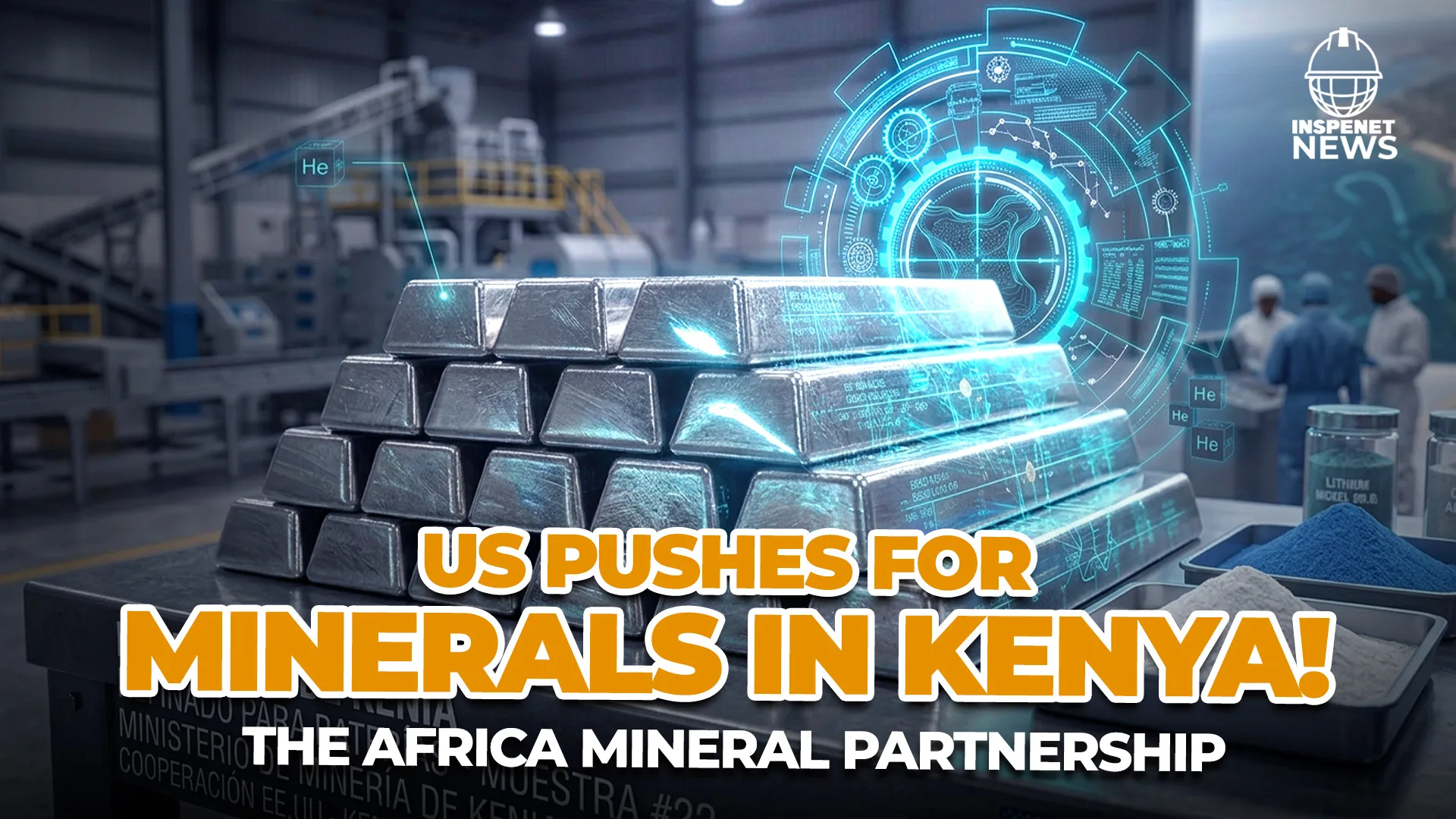
The US supports Kenya in processing its critical minerals
The United States is prepared to help Kenya develop an industry dedicated to processing critical minerals. The move highlights the African nation's resources and its capacity to process them before export.
Furthermore, US interest comes as major economies seek to secure supplies of raw materials used in industrial and technological sectors. China holds a dominant position in the global rare earth supply chain , and Washington is looking to reduce its dependence on it.
In this scenario, the Mrima Hill deposit emerges as one of the assets that could develop Kenya's mining industry. The project contains rare earth elements and niobium, whose potential value reaches tens of billions of dollars.
The United States offers support to Kenya's mining industry
During a meeting of the American Chamber of Commerce in Kenya, US Assistant Secretary of State for Africa Frank Garcia assured that critical minerals are among the priorities of the Donald Trump administration.
According to Garcia, Washington is prepared to work with Kenya as the country develops its position within this industry. The United States also proposes a model based on transparent investments, respect for communities, and more secure supply chains.
For his part, Kenyan President William Ruto welcomed the US support; his government intends to promote the exploration and responsible exploitation of resources such as rare earth elements, titanium, graphite, lithium, and niobium.
Mrima Hill is the focus of interest in rare earth elements
In particular, Mrima Hill is located on the Kenyan coast and represents one of the most prominent projects within these plans. The deposit would contain rare earth elements and niobium worth tens of billions of dollars.
Niobium has industrial applications that include aerospace manufacturing, and rare earths, for their part, are part of numerous production chains linked to technology, energy, and other industrial sectors.
Therefore, the future of Mrima Hill transcends the extraction of raw materials; the way in which Kenya develops the deposit will determine how much mineral processing and industrial activity will remain within the country.
Six companies are involved in the Mrima Hill case
Meanwhile, Kenya is studying proposals to develop the deposit. Harry Kimtai, principal secretary of the Kenyan Department of Mining, noted that six companies are on the list and that two of them are American.
US-based Critical Metals Corp. and Australian-based RareX announced in July that they had been shortlisted to compete for the development rights to Mrima Hill. The Kenyan government, however, had not officially released the full list of candidates.
Chris Kulukundis, acting U.S. Assistant Secretary of State for Southern Africa and Critical Minerals, stated that two U.S. consortiums are participating in the process. He also indicated that Washington believes they could develop the project effectively if selected.
Kenya wants to process its minerals within the country
The Ruto government wants to prevent the development of its resources from ending solely with the extraction and export of raw materials.
push to develop mineral processing facilities aims to retain a greater share of the economic activity generated by these resources. The government believes that developing this capacity can help create jobs and expand the national mining industry.
This issue makes an important difference for the future of the sector; extracting a mineral represents one part of the chain, while its treatment and transformation allow other activities to be developed before it reaches the international market.
Thus, US support could have implications that extend beyond the exploitation of Mrima Hill. If the projects include facilities and industrial capacity within Kenyan territory, the country could increase its involvement in the processing stages.
The US diversifies its supply of critical minerals
In turn, the outreach to Kenya is part of a broader US strategy in Africa.
The U.S. International Development Finance Corporation is backing a portfolio of African projects related to rare earth elements. Washington aims to diversify its sources while China maintains a significant share of global production and processing of these materials.
Chinese restrictions on certain exports in recent years have heightened attention to supply chain security. As a result, having alternative suppliers and processing facilities has become increasingly important for the United States.
Garcia specifically defended a model based on alliances with producing countries; the official also supported the idea that processing and other value-generating activities can be carried out where the resources are located.
Mrima Hill can strengthen Kenya's role in this industry
Finally, the combination of mineral resources, foreign investment, and local processing opens an opportunity to expand Kenya's role within international critical mineral supply chains.
The outcome will depend on how the Mrima Hill development process unfolds and the conditions the government sets for the selected companies. It will also be important to know what portion of the mineral processing will ultimately take place within the country.
In addition, Kenya and the United States have been negotiating an agreement related to critical minerals. Ruto indicated in June that both sides were close to finalizing it, although no new progress was reported during the September meeting.
For now, Washington's backing makes clear the growing importance of Kenyan resources. Mrima Hill could become a key component of this strategy as Kenya seeks to transform its rare earth elements and other minerals into a source of employment, industry, and greater participation in the value chain.
News of additional interest
Deepsea Bergen secures operations until 2031
Odfjell Drilling has secured three years of work for the Deepsea Bergen semi-submersible drilling rig after reaching an agreement with Vår Energi. Operations will begin in early 2028 when its current contract expires and will extend the unit's activity until the first quarter of 2031.
The agreement includes a firm order book estimated at $518 million and covers mobilization costs. This figure could increase due to inflation adjustments, additional services, and various incentives. The contract comes less than a year after Odfjell Drilling purchased the platform from Northern Ocean in December 2025 and subsequently renamed it Deepsea Bollsta to Deepsea Bergen.
Namibia sets a date for the end of its agreement with Vitol
exclusive fuel supply agreement with Vitol will end in October 2026 and ruled out any further extensions. The contract was initially established as an emergency measure between July and September to protect consumers from price increases triggered by the war in Iran. The government decided to extend it for a month before terminating it permanently.
The decision comes after criticism from opposition parties and industry groups over the country's reliance on a single supplier. Pressure mounted after Vivo Energy, a subsidiary of Vitol, recalled contaminated aviation fuel in Walvis Bay. The incident led to shortages and disrupted flights from Windhoek. The country consumes approximately 100 million liters of gasoline and diesel each month.
TotalEnergies finds more crude oil off Angola
TotalEnergies announced a new oil discovery in Block 17 off the coast of Angola. The Acacia-5 find was made in June and is expected to begin production just three months later. It is projected to contribute approximately 6,000 barrels per day via a connection to the FPSO Pazflor, utilizing existing facilities in the area.
The French oil company also expanded its exploration presence by acquiring a 40% stake and assuming operatorship of blocks 17/25 and 32/21 in the Lower Congo Basin. Both are located near areas where TotalEnergies already operates oil infrastructure. Furthermore, this is its second discovery in Angola in 2026, following the discovery of hydrocarbons in Block 0.
ClassNK strengthens the rules for transporting hydrogen
ClassNK has published version 3.1 of its guidelines for liquefied hydrogen carriers. The update incorporates recommendations adopted by the International Maritime Organization in 2026 and expands safety requirements for new designs. Key changes include standards for vacuum-insulated membrane tanks and pressure monitoring and control systems.
The new guidelines also detail how to select metallic materials and perform welding work on equipment exposed to hydrogen. The aim is to prevent problems such as damage caused by extreme temperatures and contact with this element. With clearer criteria, shipyards, designers, and shipowners will be able to evaluate projects from early stages and reduce changes during the approval processes.