Table of Contents
- AST tank turnarounds and scope control
- Pre-turnaround inspection and repair scope
- Findings during the turnaround and scope changes
- Inspections, repairs, and quality control
- Monitoring and returning the tank to service
- Documentary closure and turnaround traceability
- Conclusion
- Referencias
- Frequently asked questions (FAQs)
A tank outage is won or lost before opening the first manway. If the scope starts incomplete, every unexpected activity consumes engineering time, maintenance time, unplanned resource mobilization, and pushes back the return-to-service date. AST tank turnarounds require converting historical data, inspections, and acceptance criteria into actionable decisions. This article explains how to define the baseline, govern changes, coordinate repair and inspection, and close out documentation without sacrificing safety, quality, or availability.
AST tank turnarounds and scope control
Scope should not be a wish list, but an approved baseline linked to damage mechanisms, regulatory requirements, and operating conditions. Turnaround planning begins by gathering drawings, API 653 reports, historical thickness readings, corrosion rates, previous repairs, settlement data, service changes, leak history, and coating condition. With that information, mandatory work is separated from convenient and deferrable work.
For each activity, it is advisable to document the rationale, location, estimated quantity, acceptance criteria, inspection method, responsible discipline, materials, duration, and dependency. Outage scope control works best when the work list, budget, and schedule share the same code. This way, a technical variation can be traced back to its impact on cost, resources, and critical path, without manual reconciliations at the end.
The freeze milestone must occur when engineering has sufficient evidence and operations accepts the delivery conditions. Beyond that point, any request enters through change management. Turnaround planning establishes who proposes, who evaluates, and who authorizes. A daily, brief, data-backed scope meeting prevents parallel decision-making among contractors, authorized inspector, engineering, quality, and owner.
Pre-turnaround inspection and repair scope
Pre-turnaround inspection aims to reduce the unknown before taking the asset out of service. It must integrate external visual examination, accessible ultrasonic measurement, roof evaluation, stairs and platforms, review of nozzles, drains, and seals, foundation inspection, and settlement analysis. AST tank inspection does not replace the mandatory internal examination, but it allows directing resources toward higher probability and consequence areas.
Data must be interpreted as a system. An isolated low reading may require confirmation; a localized loss pattern near the annular ring may modify the scan map; a shell distortion may demand a topographical survey. API 653 provides the criteria for inspection, evaluation, repair, alteration, and reconstruction of tanks in service. API RP 575 complements examination practices, and API RP 651 guides bottom cathodic protection.
Decision thresholds must also be defined prior to the outage. For example: minimum thickness, allowable pit depth and extent, weld acceptance, settlement criteria, roof support condition, and response to relevant indications. In AST tank turnarounds, a previously approved threshold reduces the time between a finding, the API 653 inspector’s evaluation, and the issuance of the repair drawing.
Findings during the turnaround and scope changes
Upon opening the tank, uncertainty does not disappear: it changes shape. MFL scanning may reveal bottom thickness loss; UT confirms depth and profile; cleaning exposes pitting, cracks, shell-to-bottom joint corrosion, or support damage. AST tank inspection must use an agreed-upon sequence so that each technique answers a question and does not produce disconnected data.
Every finding requires a single record with photo, coordinate, component, damage mechanism, measurement, applicable criterion, and disposition. Outage scope control begins with that record. If different groups maintain separate lists, the same defect may be duplicated, left undecided, or turned into a field order without engineering backing. A common dashboard displays status, priority, responsible party, and response deadline.
The recommended classification is: accept as-is, repair before service, evaluate by engineering, monitor, or formally defer. The decision must consider fitness for service, remaining life, intended service, and consequences, not just whether labor is available. For storage tank repair, each change must describe the solution, applicable code, required inspection, materials, and impact on the critical path.
A small change committee available multiple times a day avoids delays. The authorized inspector interprets API 653; engineering validates design and calculation; operations defines consequences; planning evaluates schedule and cost; quality sets inspection points. In AST tank turnarounds, this workflow must have maximum response times and delegated authority so that a technical question does not stall multiple workfronts.
Upon opening the tank, uncertainty does not disappear: MFL scanning can reveal thickness losses that must be confirmed with UT or other NDT techniques. Cleaning can also expose pitting, cracks, or corrosion at the shell-to-bottom joint. AST tank inspection must follow a sequence that allows locating, confirming, and sizing each indication.
Each finding needs a single record with location, evidence, measurement, damage mechanism, applicable criterion, and disposition. Outage scope control must differentiate between accept, repair, evaluate, monitor, or defer. For storage tank repair, each change must indicate the solution, applicable standard, materials, required inspections, and impact on the critical path.
An integrated committee comprising the API 653 inspector, engineering, operations, planning, and quality must resolve changes within defined deadlines. In AST tank turnarounds, this coordination avoids parallel decisions, maintains traceability, and allows emerging findings to not unnecessarily stall other workfronts.
Inspections, repairs, and quality control
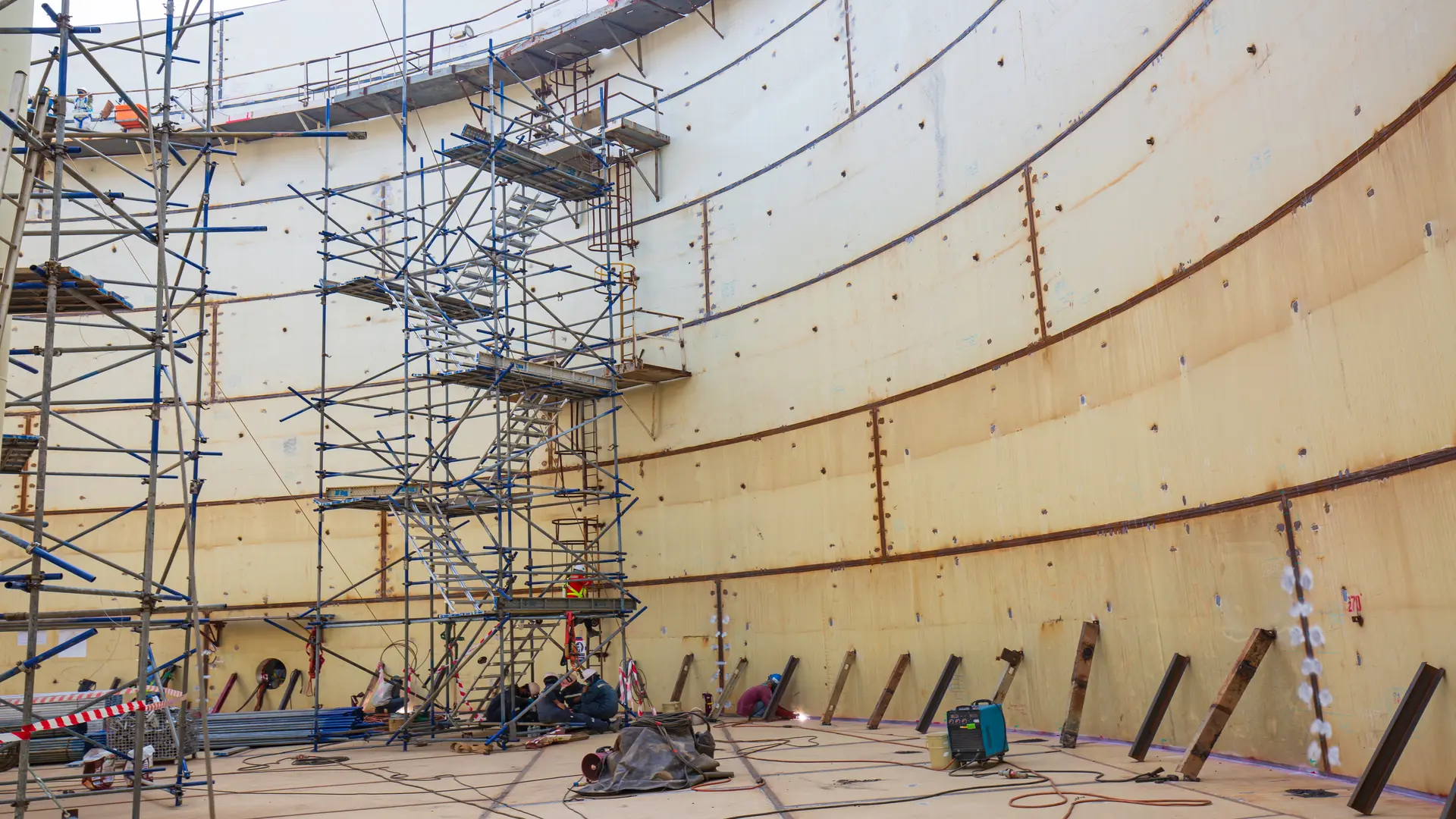
Execution must be organized into releasable workfronts: bottom, critical joint, shell, roof, nozzles, appurtenances, and corrosion protection. Each front advances through a visible chain: safe access, initial inspection, disposition, preparation, repair, NDT, correction, final inspection, and release. This coordination makes AST tank maintenance measurable and prevents paint, welding, or assembly from covering surfaces pending acceptance.
The inspection and test plan must distinguish review, witness, and hold points. Welds require qualified procedures and personnel, controlled consumables, recorded variables, and NDT per API 653, API 650, and the approved scope. AST tank inspection can combine VT, UT, MT, PT, MFL, vacuum box, leak testing, and advanced techniques, selected based on geometry, damage mechanism, and required sensitivity.
Quality is not verified at the end. A daily dossier must link every repair to the drawing, welder, WPS, material heat number/batch, NDT report, and acceptance. For a storage tank repair, the traceability of a plate or patch is as important as its physical execution. If record-keeping is delayed, locating data after shutdown increases the risk of documentary gaps and delays service authorization.
The integration of companies like HMT LLC is relevant at this point because their turnaround service connects activities that are often fragmented: planning and scheduling, pre-outage evaluation, execution-phase inspection, tracking of findings, repair plans, quality management, and documentary closure. Their technical proposal illustrates a useful model: the same information structure accompanies the defect from detection to disposition, without replacing the owner’s or authorized inspector’s responsibility.
Monitoring and returning the tank to service
Progress must be measured by accepted quantities: released plates, approved welds, closed indications, and completed coatings. Outage scope control must differentiate between approved, emerging, under evaluation, and deferred work to prevent apparent progress from masking pending decisions.
The daily meeting must review open findings, approved changes, delays/holds, weld rejections, critical path, and pending documentation. In AST tank maintenance, these key indicators allow reassigning inspectors, adjusting shifts, and prioritizing engineering responses before a delay impacts the return-to-service date.
Release requires confirming accepted repairs and NDT, cleanliness, component reinstallation, grounding, cathodic protection, coatings, and safety conditions. Required tests must be defined according to the code and engineering evaluation. In AST tank turnarounds, filling must include criteria to stop or proceed; storage tank repair does not end without evidence supporting its safe return to service.
Documentary closure and turnaround traceability
Closure begins during planning, with a delivery index and designated document owners. The dossier must contain final scope, as-built drawings, inspection reports, thickness maps, calculations, dispositions, material certificates, WPS/PQR, qualifications, NDT, testing, coatings, and deferred recommendations. Turnaround planning must assign cutoff dates so that the file does not depend on reconstructing emails weeks later.
Outage scope control links every decision to AST tank inspection, AST tank maintenance, and AST tank turnarounds.
HMT documentation covers asset history, results, repairs or replacements, NDT techniques, associated reports, deferred recommendations, and final closure. This scheme is useful as a reference to define contractual deliverables starting from the bidding phase. In AST tank turnarounds, asking for a “final report” is insufficient: the contract must specify index, format, metadata, links, review owners, and deadlines for each package.
As a world leader in aboveground storage tank (AST) technologies, HMT LLC offers comprehensive solutions for the energy and industrial sector ranging from advanced engineering, fabrication, and technical inspection (API 653 and non-destructive testing NDT), to repair, maintenance, and full turnaround support. Their specialized portfolio includes primary and secondary seal systems, internal and external floating roofs, aluminum geodesic domes, and drain systems, specifically designed to maximize operational capacity, minimize VOC emissions, and ensure regulatory and environmental compliance throughout the asset lifecycle. To learn more about their portfolio of specialized products and services, visit their official website.
As a final control, AST tank turnarounds must verify that turnaround planning matches the executed scope. AST tank inspection supports every decision; outage scope control explains every variation; storage tank repair preserves its evidence; and AST tank maintenance receives actionable data. This discipline also prepares subsequent AST tank turnarounds and reinforces turnaround planning.
Are you looking to optimize traceability and operational integrity for your AST assets?
Guarantee rigorous documentary closures, efficient scope control, and international-level inspection and maintenance standards for your storage tanks. Connect with HMT LLC. and receive guidance from specialists in comprehensive turnaround management.
Conclusion
AST tank turnarounds are controlled when scope, inspection, engineering, repair, and documentation operate as a single decision flow. Preparation bounds uncertainty, and quality control demonstrates compliance. Integrating these functions with specialized support like HMT allows protecting the critical path without compromising safety. Success is not closing fast, but returning a reliable, traceable, safe tank fit for its intended service.
Referencias
- American Petroleum Institute. (2020). API Standard 653: Tank inspection, repair, alteration, and reconstruction (6th ed.).
- American Petroleum Institute. (2020). API Standard 650: Welded tanks for oil storage (13th ed.).
- American Petroleum Institute. (2020). API Recommended Practice 575: Inspection practices for atmospheric and low-pressure storage tanks (4th ed.).
- American Petroleum Institute. (2014). API Recommended Practice 651: Cathodic protection of aboveground petroleum storage tanks (4th ed.).
- HMT LLC. (2026). Turnaround inspection services.
- Occupational Safety and Health Administration. (n.d.). Storage tanks: Hazard solutions.
Frequently asked questions (FAQs)
What standard guides an AST tank major turnaround?
API 653 is the primary reference for inspection, repair, alteration, and reconstruction of in-service steel tanks. It must be complemented by the original code, API 650 when applicable, legal requirements, owner specifications, and safety practices. AST tank inspection must be directed and approved by competent personnel within that framework.
How can findings be prevented from delaying the turnaround?
Through pre-turnaround evaluation, quantity scenarios, contingency materials, decision thresholds, and a change committee with authority and response times. Outage scope control requires a single record linking each defect to its disposition, impact, and responsible party.
What should be included in a repair package?
It must include location, drawing, design criteria, materials, welding procedure, sequence, safety controls, NDT, hold points, and acceptance criteria. Thus, storage tank repair can be executed and released without improvised field interpretations.
When should inspection and turnaround management be integrated?
When there are multiple contractors, many likely findings, limited internal resources, or a tight critical path. An integrated service like HMT’s can connect evaluation, inspection, repair plans, quality, and documentation, while the owner retains technical governance.
What documents are essential prior to return to service?
At minimum, the final scope, closed dispositions, accepted NDT reports, welding and material records, required testing, as-built drawings, safety releases, and deferred recommendations list. Turnaround planning must define these deliverables before starting.