Table of Contents
- Why Phased Array is redefining industrial inspection
- Real limitations of conventional UT in field conditions
- What truly changes with phased array in operation
- Field experience: Decisions under real uncertainty
- Common mistakes in field ultrasonic inspection
- Technical trade-offs in integrity decisions
- Open NDT platforms: When architecture defines performance
- Innovation in compact equipment for advanced inspection
- How the Pioneer platform is redefining inspection
- Compact NDT equipment: Portability without compromise
- Operational advantages in remote or critical inspections
- Technical limitations of compact equipment
- FMC and TFM: Evolution in ultrasonic data processing
- Robotic integration in automated ultrasonic inspection
- Benefits in safety and repeatability
- Real barriers to implementation
- Operational and economic impact on mechanical integrity
- Where industrial ultrasonic inspection is heading
- Conclusions
- References
- Frequently Asked Questions (FAQs)
- How does coupling quality affect PAUT reliability?
- What factors determine the choice between manual and automated inspection?
- How does component geometry affect ultrasonic beam propagation?
- What role does operator training play in advanced techniques like FMC and TFM?
- How is ultrasonic inspection integrated into integrity management programs?
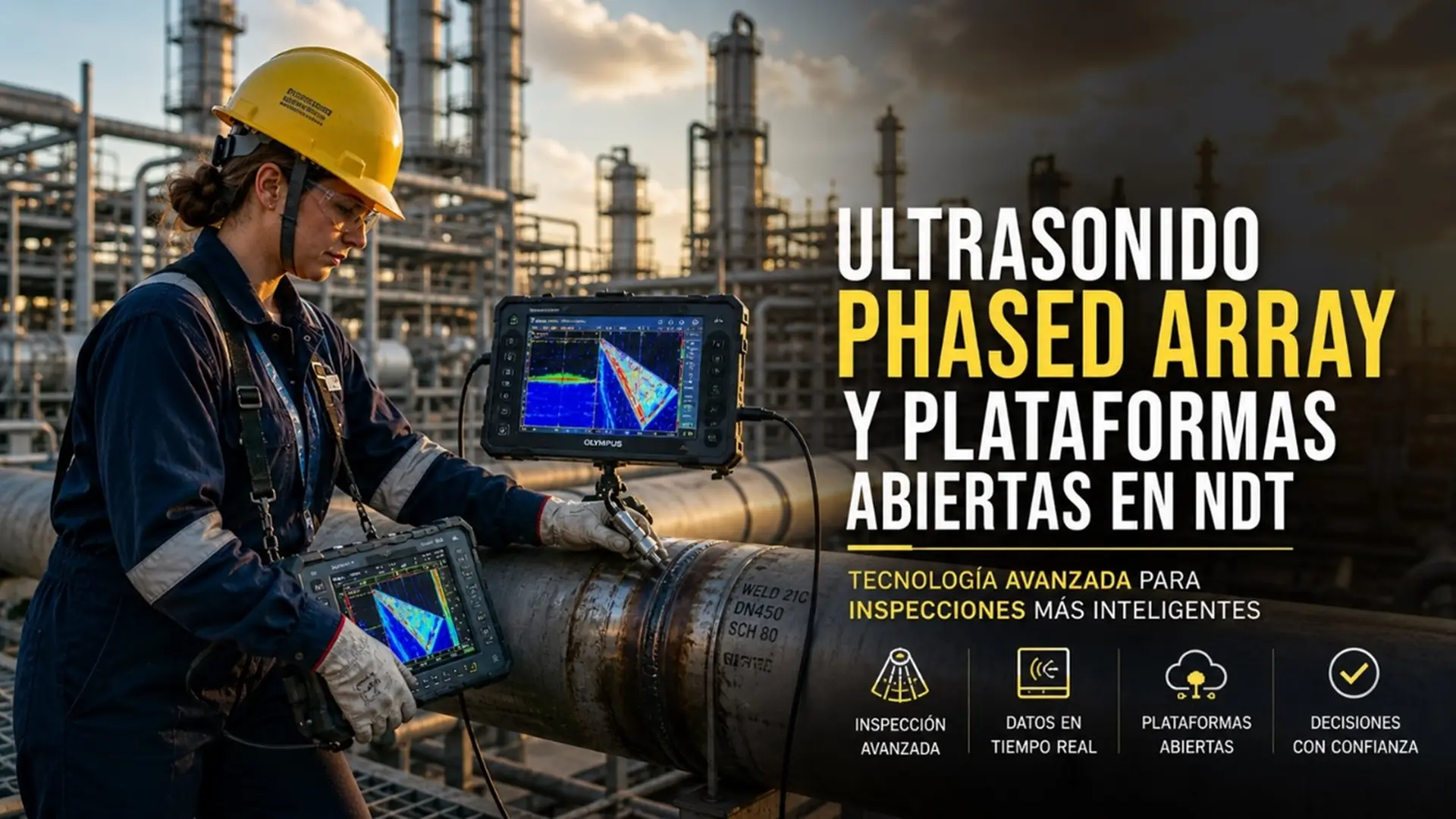
In environments such as refineries, storage terminals, and operating process units, nondestructive testing and ultrasonic inspection rarely take place under controlled conditions. Hot surfaces, restricted access, structural interferences, and limited intervention windows force integrity teams to operate under constant operational pressure. In this context, conventional ultrasonic testing (UT) has been a reliable tool for decades, but with evident limitations when it comes to coverage, repeatability, and data traceability.
The introduction of phased array ultrasound and phased array ultrasonic testing (PAUT), together with the advancement of open platforms and compact ultrasonic equipment, has begun to transform how these inspections are approached. It is no longer just about detecting discontinuities, but about generating more robust information to support critical decision-making. This marks a transition toward scenarios where technology selection and data interpretation become as decisive as the inspection itself.
Why Phased Array is redefining industrial inspection
The transition from conventional ultrasonic testing to phased array is not driven solely by technological improvement, but by an operational need. While traditional UT relies on a fixed beam and manual movements to cover an area, PAUT introduces the ability to electronically modify the beam angle, focus, and path without repositioning the transducer.
In the field, this completely changes inspection dynamics. Where multiple passes and setups were previously required, it is now possible to inspect an entire volume from a single position, using different angles of incidence. This not only increases the probability of detection, but also reduces inspection time in scenarios where every minute of downtime has an economic impact.
However, the real value of phased array does not lie only in its technical capability, but in how it reduces uncertainty in critical integrity decisions.
Real limitations of conventional UT in field conditions
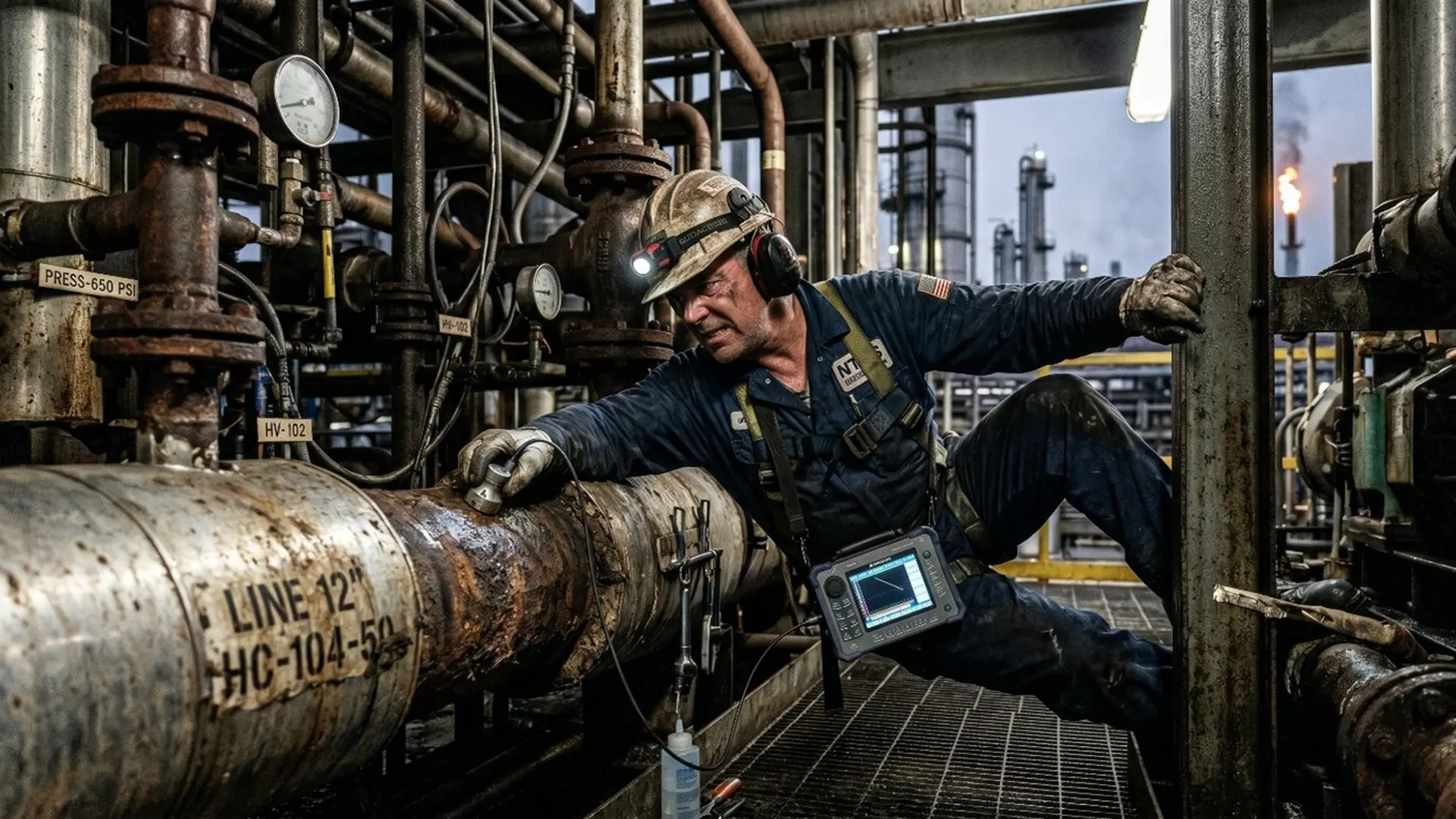
In theory, conventional ultrasonic testing can cover most industrial applications. In practice, field conditions introduce limitations that directly affect the reliability of results.
- Difficult access: In in-service pipelines, elevated weld joints, or areas near structural supports, transducer manipulation becomes restricted. This limits the ability to maintain proper coupling and a consistent beam path.
- Operator dependency: Conventional UT is highly dependent on the technician’s skill. Variations in pressure, angle, or scanning speed can lead to significant differences in interpretation. In teams with multiple operators, this variability becomes even more pronounced.
- Limited coverage: Each inspection requires multiple passes to cover different angles. In time-constrained scenarios, this can result in areas that are not fully evaluated, increasing the risk of undetected indications.
In most cases, the problem is not the technique itself, but the difficulty of executing it consistently under real-world conditions.
What truly changes with phased array in operation
Phased array does not eliminate field challenges, but it introduces tools that allow them to be managed more effectively.
Reduction of uncertainty
By generating multiple inspection angles from a single point, PAUT increases the likelihood of intercepting defects with complex orientations. This is particularly relevant in welds, where discontinuities do not always follow predictable patterns.
Additionally, the ability to visualize data in real time allows the operator to adjust the inspection strategy based on what is being observed, rather than relying solely on post-analysis results.
Data digitalization
Unlike conventional UT, phased array produces complete inspection records. This enables:
• Post-inspection review by specialists
• Historical comparisons
• Technical audits
Within mechanical integrity programs, this traceability becomes a critical asset. Inspection is no longer just about detection—it becomes part of building a technical history of the asset.
That said, phased array introduces new demands: increased setup complexity, more advanced data interpretation, and the need for equipment capable of processing large volumes of data without compromising field operations.
Ultimately, the shift is not only technological—it represents a change in how industrial inspection is understood and managed.
Field experience: Decisions under real uncertainty
In real industrial environments, non-destructive inspection is rarely performed under fully controlled conditions. In scenarios such as plant shutdowns, where time is strictly limited, or during in-service (hot) inspections, where thermal conditions directly affect material behavior and ultrasonic response, integrity teams are forced to make decisions based on partial information. This is further complicated by complex geometries, such as nozzles, dissimilar welds, or areas with structural interferences, where beam propagation does not follow ideal paths.
The challenge is not only technical, but operational: incomplete data and time pressure often force teams to prioritize speed over thoroughness. In this context, interpretation becomes as much an exercise of judgment as it is of technique.
The most relevant insight from field experience is clear:
“It’s not about having more data, but about trusting the data available.”
Common mistakes in field ultrasonic inspection
One of the most frequent mistakes is assuming that a standard setup is sufficient for all conditions. In reality, each asset presents unique characteristics that require specific adjustments in parameters such as angle, gain, or focusing.
It is also common to underestimate the impact of coupling on degraded or coated surfaces, which introduces noise and affects signal quality. In many cases, misinterpretations arise from not accounting for these variables.
Another critical issue is the lack of cross-verification. Indications are often accepted or dismissed without applying complementary techniques or reviewing the data from multiple perspectives, increasing the risk of incorrect decisions.
Technical trade-offs in integrity decisions
In real conditions, there is no perfect solution. Every decision involves trade-offs. For example, increasing sensitivity may improve the detection of small defects, but it also raises the likelihood of false indications.
Similarly, expanding inspection coverage can reduce unexamined areas, but requires more time and resources, something not always feasible during critical shutdowns.
Integrity teams must balance accuracy, time, cost, and risk. This balance depends not only on the technology used, but also on the team’s experience and the quality of the available data.
Open NDT platforms: When architecture defines performance
An open NDT platform is an inspection system designed to integrate with multiple technologies, equipment, and software, enabling solutions to adapt to different operational scenarios without being constrained by a closed architecture.
For many years, ultrasonic inspection relied on closed systems, where hardware and software operated within proprietary environments with limited flexibility. While these systems offered stability, they restricted the ability to adapt to evolving inspection needs.
Today, the shift toward open NDT platforms reflects an operational reality: the need to integrate multiple technologies within a single workflow. The difference between closed and open systems is not only technical—it is strategic.
An open architecture enables integration with external systems, scalability to new applications, and adaptability to different inspection scenarios. This becomes essential in environments where each asset presents unique challenges.
Limitations of traditional closed systems
Closed systems often restrict compatibility with other devices or software, making integration with automated scanners, robotics, or advanced analysis tools more difficult.
Additionally, any update or modification depends on the manufacturer, limiting responsiveness to new operational requirements. In the field, this translates into reduced flexibility and, in some cases, suboptimal solutions.
Technical advantages of an open architecture
Open platforms enable tailored configurations, combining techniques such as PAUT, FMC, and TFM within a single environment. This enables better adaptation to complex geometries and varying conditions.
They also facilitate integration with robotic systems and advanced analysis software, improving data consistency and reducing operator dependency.
Below is a practical example of how these solutions are evolving in the industry:
This type of technology reflects a shift in approach, from isolated equipment to integrated inspection ecosystems, where system architecture becomes a decisive factor in the quality of results.
TPAC and the modern approach to open ultrasonic platforms
In the recent evolution of ultrasonic inspection, one of the most significant shifts has not been purely technological, but conceptual: moving from standalone equipment to configurable inspection ecosystems. In this context, companies like TPAC have built their approach on a clear premise: inspection tools should adapt to the asset, not the other way around.
Rather than focusing on conventional equipment, TPAC has positioned itself as a reference in the development of open platforms, where integration between hardware, software, and automation enables more flexible responses to complex inspection scenarios. This becomes particularly relevant in environments where conditions constantly change and rigid solutions can limit data quality.
Their approach is built on three key pillars: open architecture, compact equipment, and automation. These elements are not independent; they function as part of a system designed to adapt to different inspection configurations, from manual applications to fully automated environments.
From an operational standpoint, this philosophy introduces a critical shift: the ability to configure solutions based on the problem, rather than being constrained by equipment limitations. In scenarios where integration with robotic systems or specialized scanners is required, this approach acts as a technical enabler rather than a restriction.
In complex industrial environments, this often requires specialized platforms developed by companies with deep expertise in advanced ultrasonic technologies, capable of meeting real field demands without compromising data quality or operational efficiency.
To better understand how these concepts are implemented in real industrial environments, the following Inspenet TV interview presents TPAC’s approach to phased array ultrasound, open platforms, and advanced inspection solutions.

Innovation in compact equipment for advanced inspection
One of the most visible developments within this approach is the evolution of compact ultrasonic equipment with advanced capabilities. Traditionally, portability implied sacrificing power or functionality. Today, the challenge has been to bridge that gap.
Compact systems developed under this philosophy allow the execution of techniques such as PAUT—and even advanced configurations—directly in the field, without relying on complex infrastructure. This is particularly valuable in inspections at height, confined spaces, or operating assets, where logistics become a critical factor.
As an example of this compact and integrable approach, the following Inspenet TV video presents TPAC’s Explorer, a compact ultrasonic inspection solution designed for NDT applications, robotic integration, and industrial environments.
However, the true value lies not only in the size of the equipment but in its ability to integrate within a broader system. In this context, portability is no longer an isolated feature, but part of a more flexible and efficient inspection strategy.
How the Pioneer platform is redefining inspection
Within this framework, the Pioneer platform stands as a clear example of how open architecture can translate into real operational advantages. Beyond its technical capabilities, its value lies in its ability to adapt to multiple inspection configurations, integrating different techniques and tools within a single environment.
This enables, for instance, the combination of manual and automated inspection workflows or the integration of robotic systems without the need to completely redesign the process. In practical terms, this results in improved operational continuity and reduced adaptation time in the field.
The ability to handle multiple techniques, process large volumes of data, and maintain a consistent interface for operators makes this type of platform a key component in modern integrity programs.
Ultimately, what redefines inspection is not just the available technology, but how it is integrated and adapted to real-world conditions. In that sense, open platforms like Pioneer represent a shift toward more dynamic inspection models, where flexibility and integration capability are just as important as technical precision.
Compact NDT equipment: Portability without compromise
In the field, inspection is not defined solely by the technique used, but by the ability to execute it under real conditions. In many industrial facilities, access to the inspection point represents the main challenge: elevated structures, operating lines, and restricted areas limit the use of traditional equipment.
In this context, compact NDT equipment has become a key enabler. Its value lies not only in size but in the ability to bring advanced capabilities directly to the asset, reducing dependence on complex setups or additional infrastructure.
Typical scenarios include work at height, where mobility and weight directly impact safety and efficiency, and confined spaces, where equipment size can determine whether the inspection is feasible.
In practical terms, these systems enable faster deployment, reduced logistics, and better adaptation to changing environments. However, their implementation requires balancing portability and performance, particularly in critical applications where data quality cannot be compromised.
Operational advantages in remote or critical inspections
In inspections with limited access or elevated risk, compact equipment offers clear advantages. It reduces setup time, minimizes personnel exposure, and enables inspection in conditions where larger systems would not be operationally viable.
Additionally, it facilitates integration with portable scanners or lightweight automated systems, improving repeatability and data consistency. In offshore operations or in-service assets, this capability can determine whether an inspection is feasible.
Another important aspect is decision speed. With equipment that can be deployed directly in the field, the time between detection and evaluation is reduced, directly impacting risk management.
Technical limitations of compact equipment
Despite their advantages, compact systems present limitations that must be considered. One of the main constraints is processing capability, especially when using advanced techniques such as FMC or TFM, where data volume can be significant.
There may also be limitations in connectivity or integration in certain models, restricting their use within more complex systems. Additionally, ergonomics and interface design play a critical role: in field conditions, any operational difficulty can directly affect inspection quality.
Ultimately, the challenge is not only to reduce equipment size, but to maintain a level of performance that supports reliable decision-making under real conditions.
FMC and TFM: Evolution in ultrasonic data processing
The evolution of phased array ultrasound has led to more advanced techniques such as Full Matrix Capture (FMC) and Total Focusing Method (TFM), representing a shift in how ultrasonic data is acquired and processed.
FMC captures the complete dataset from all transducer elements, recording every possible transmit-receive combination. From this dataset, TFM reconstructs a fully focused image at each point within the material, enabling more precise visualization of discontinuities.
The key difference from conventional PAUT is that PAUT relies on predefined focal laws, while FMC/TFM enables total post-processing focusing. This significantly improves resolution and defect characterization, particularly in complex geometries.
When to use TFM instead of conventional PAUT
The use of TFM is not always necessary or efficient. In many applications, conventional PAUT provides sufficient results with lower complexity. However, in scenarios where defect characterization is critical—such as small cracks, lack of fusion, or defects in heterogeneous materials—TFM provides a higher level of detail.
It is also particularly useful when defect orientation is uncertain, as it allows evaluation from multiple angles without relying on predefined configurations.
The decision to use TFM should be based on asset criticality, geometry complexity, and the need to reduce uncertainty in interpretation.
Real challenges in data processing
The main challenge of FMC and TFM lies not in data acquisition, but in processing. The volume of generated data can be substantial, requiring equipment with high computational and storage capabilities.
In field conditions, this translates into operational constraints: longer processing times, the need to optimize configurations, and reliance on specialized software.
Additionally, interpreting TFM images requires a higher level of expertise. Increased resolution also means more complex data, which, without proper judgment, can lead to overinterpretation or incorrect conclusions.
Therefore, the value of these techniques lies not only in their technical capabilities, but in how they are integrated into inspection workflows that consider both field conditions and operator experience.
Robotic integration in automated ultrasonic inspection
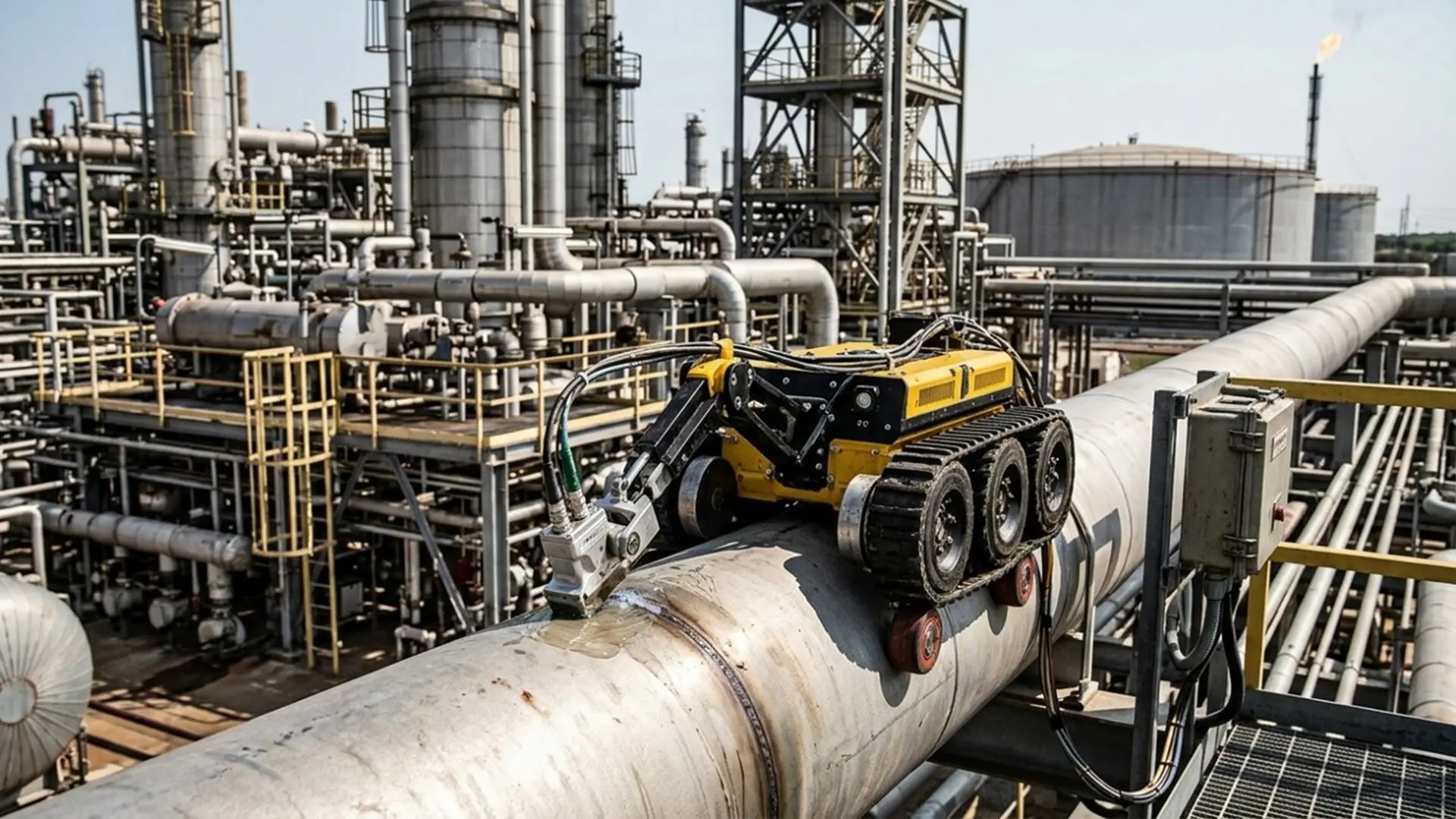
Automation in ultrasonic inspection has evolved from an experimental concept to an operational reality in critical assets. Robotic integration is not about replacing the operator, but about extending inspection capabilities into areas where manual intervention is limited, risky, or inconsistent.
In industry, automation is already applied across multiple scenarios. In storage tanks, robotic systems enable continuous scanning over large surfaces while maintaining consistent speed and contact pressure. In pipelines, particularly in in-service lines or hard-to-access areas, automated systems ensure repeatable paths and uniform coverage. In offshore environments, where operational and environmental conditions increase risk, robotics become essential to reduce personnel exposure.
Beyond the technology itself, the value lies in data consistency. In inspections where small variations can change interpretation, repeatability becomes a decisive factor.
Benefits in safety and repeatability
One of the most evident benefits of robotic integration is improved operational safety. By reducing the need for direct intervention in high-risk areas—such as working at height, confined spaces, or high-temperature zones—personnel exposure is minimized, especially when implementing robotic inspection solutions in nondestructive testing.
From a technical perspective, robotics delivers repeatability. Unlike manual inspection, where each operator introduces variability, automated systems maintain consistent parameters: scanning speed, contact pressure, and path trajectory. This enhances data quality and enables reliable comparisons in periodic inspections.
Additionally, integration with advanced ultrasonic systems allows the generation of more consistent datasets, strengthening decision-making in mechanical integrity programs.
Real barriers to implementation
Despite its advantages, implementing robotic systems presents significant challenges. One of the main issues is technical integration between the ultrasonic system and the robotic platform. Proper synchronization is critical to ensure data quality.
There are also economic barriers. Initial investment can be substantial, particularly in applications where automation is not continuously utilized. This requires careful evaluation of return based on asset type and inspection criticality.
Another challenge is adaptation to real environments. Irregular surfaces, coatings, and variable environmental conditions can impact system performance, requiring field-specific adjustments.
Ultimately, robotics does not eliminate inspection complexity, but it provides tools to manage it in a more controlled and consistent way.
Operational and economic impact on mechanical integrity
The value of advanced ultrasonic inspection technologies is not measured solely in technical terms, but in their impact on operations and associated costs. In industrial environments, where decisions carry significant consequences, reducing uncertainty translates directly into economic value.
From a return on investment (ROI) perspective, adopting advanced techniques and automated systems allows better resource utilization, reduced inspection time, and fewer unplanned corrective interventions.
Risk reduction is another critical factor. Detecting a discontinuity at an early stage can prevent major failures, with consequences ranging from production losses to safety incidents.
At the same time, inspection optimization is not just about doing more with less, but doing it better: prioritizing critical areas, adjusting inspection intervals, and improving the quality of data available for analysis.
Impact on plant shutdowns
During plant shutdowns, time is one of the most critical resources. Technologies that enable faster inspection with greater coverage directly reduce downtime duration.
This has a direct impact on operational costs and planning. More efficient inspections allow earlier release of resources and reduce pressure on maintenance and operations teams.
In many cases, the ability to obtain reliable results within a shorter timeframe determines the feasibility of a maintenance strategy.
Reduction of undetected failures
One of the greatest risks in mechanical integrity is the presence of undetected defects. These latent failures can evolve into critical events if not identified in time.
The use of advanced techniques and more consistent systems significantly reduces this probability. By improving coverage, resolution, and data traceability, inspection reliability increases.
However, the real impact is not just about detecting more defects, but detecting them better. Higher-quality information enables more precise decision-making, reducing unnecessary interventions and focusing on resources where they are truly needed.
Where industrial ultrasonic inspection is heading
Industrial ultrasonic inspection is entering a phase where differentiation no longer depends solely on the technique itself, but on how multiple capabilities are integrated into a unified ecosystem. Current trends clearly point toward automation, integrated platforms, and the progressive incorporation of artificial intelligence (AI) in data analysis.
Automation will continue to expand beyond repetitive applications into complex environments where data consistency is critical. At the same time, integrated platforms will enable seamless connections between equipment, software, and integrity management systems, reducing data fragmentation.
As for AI, its value lies not in replacing specialists, but in supporting pattern recognition, indication prioritization, and the analysis of large datasets, particularly in advanced techniques such as FMC and TFM.
The most significant shift, however, is not technological but conceptual. There is a clear change in mindset: from inspection as an execution task to inspection as a data-driven decision-making process.
Conclusions
The evolution of phased array ultrasound, combined with the development of open platforms, compact equipment, and automated solutions, is redefining the role of inspection within mechanical integrity programs. In environments where field conditions impose constant constraints, the ability to generate reliable and actionable data becomes the true differentiator.
Selecting the right technology is no longer based solely on technical specifications, but on its ability to adapt to real-world scenarios, integrate with other systems, and reduce uncertainty in decision-making. In this context, approaches developed by specialized manufacturers in open-platform architectures, capable of combining portability, automation, and advanced integration, are shaping the direction of the industry toward more flexible, data-driven inspection models.
References
- American Society for Nondestructive Testing. (2022). NDT overview: An introduction to phased array ultrasonic testing. ASNT. https://www.asnt.org/standards-publications/blog/ndt-overview-an-introduction-to-phased-array-ultrasonic-testing
- International Organization for Standardization. (2019). ISO 13588:2019 — Non-destructive testing of welds — Ultrasonic testing — Use of automated phased array technology. ISO.
- ASTM International. (2023). ASTM E2491-23: Standard guide for evaluating performance characteristics of phased-array ultrasonic testing instruments and systems. ASTM International.
- American Society for Nondestructive Testing. (n.d.). Ultrasonic testing (UT): PAUT, TOFD & NDT inspection. ASNT.
- American Petroleum Institute. (n.d.). API 570 — Piping inspector certification. API.
Frequently Asked Questions (FAQs)
How does coupling quality affect PAUT reliability?
In field conditions, coupling is often one of the most underestimated variables. Corroded surfaces, coatings, or irregular geometries can introduce noise and reduce ultrasonic energy transmission. In PAUT, this impacts not only signal amplitude but also the quality of the reconstructed image. Poor coupling can lead to false indications or mask real discontinuities, making it a critical factor for reliable results.
What factors determine the choice between manual and automated inspection?
The decision is not based solely on asset size, but on a combination of factors: accessibility, component criticality, required repeatability, and operating conditions. Manual inspection offers flexibility in variable scenarios, while automation provides consistency and coverage in critical assets. In many cases, the most effective strategy is a hybrid approach, combining both methods depending on the context.
How does component geometry affect ultrasonic beam propagation?
Complex geometries such as nozzles, thickness transitions, or dissimilar welds alter beam paths, generating reflections and refractions not present under ideal conditions. This can complicate signal interpretation and require specific inspection setups. Understanding this behavior is essential to avoid mischaracterization.
What role does operator training play in advanced techniques like FMC and TFM?
As techniques evolve, operator dependency does not disappear; it shifts. FMC and TFM generate larger and more complex datasets, requiring advanced interpretation skills. Without proper training, the risk is not only missing defects but also overinterpreting irrelevant indications.
How is ultrasonic inspection integrated into integrity management programs?
Inspection is no longer an isolated process. The data collected is integrated into integrity models that define inspection intervals, prioritize interventions, and assess risk. The quality, traceability, and consistency of this data are essential to ensure technically sound and economically justified decisions.