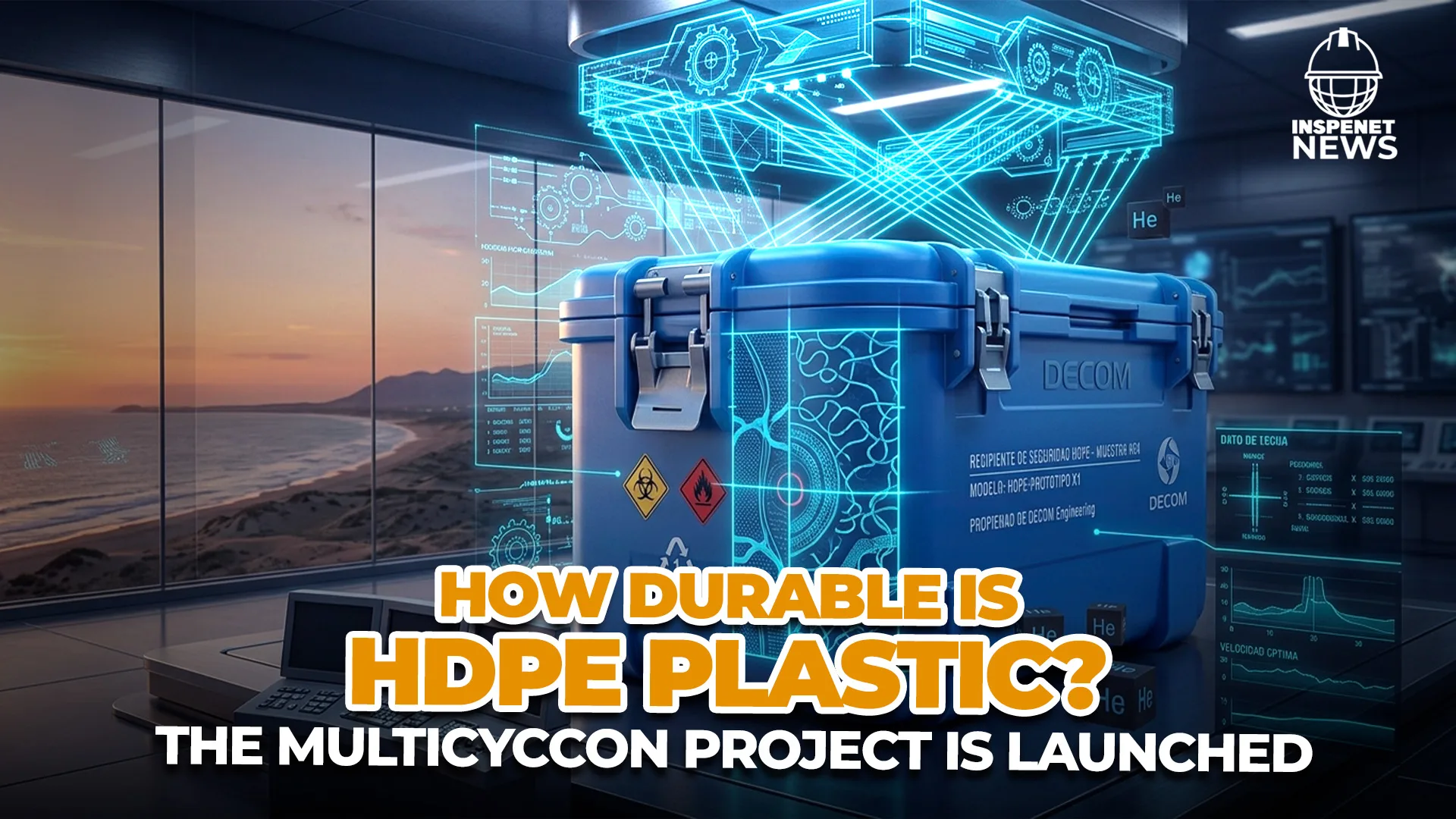
MultiCycCon will study how repeated recycling affects HDPE
The recycled HDPE will undergo successive aging and reprocessing processes to determine the extent to which it retains its resistance to stress cracking. The Fraunhofer Institute for Structural Durability and Systems Reliability (LBF) and the German Federal Institute for Materials Research and Testing (BAM) will address this issue through the MultiCycCon project.
Specifically, the research will focus on high-density polyethylene used in transport containers and hazardous materials. In these applications, understanding the behavior of the plastic after several recycling cycles is especially important due to the safety requirements that the containers must meet.
In addition, MultiCycCon will seek to develop a rapid method for inspecting recycled HDPE materials. The intention is to make it easier for manufacturers, processors, and recyclers to assess their quality before using them in new applications.
Fraunhofer LBF and BAM test recycled HDPE
To study the effects of reprocessing, Fraunhofer LBF will work with three HDPE materials that will undergo up to ten extrusion stages. Researchers will then be able to observe the changes that occur as the number of processes increases.
Additionally, some of the samples will be aged using thermo-oxidative processes or exposure to ultraviolet radiation. They will then be reprocessed to reproduce in the laboratory some of the conditions that plastic may experience during its use and subsequent recycling.
In this way, the project will study two related phenomena: firstly, the deterioration caused by the aging of the material; and secondly, the effects of repeated processing.
The comparison will allow us to determine to what extent both factors contribute to the degradation of HDPE and when their properties could limit its reuse.
What happens to HDPE after several recycling cycles?
The problem MultiCycCon is trying to solve goes beyond simply checking if a plastic can be reprocessed. The researchers want to understand how certain properties evolve after this process is repeated multiple times.
Among them is resistance to environmental stress cracking ; this phenomenon can produce cracks when HDPE is subjected to stress and certain external conditions for prolonged periods.
Therefore, the research will analyze how successive processes affect the structure and behavior of the material. This information will allow researchers to relate the changes observed in HDPE to its ability to resist the appearance and propagation of cracks.
In turn, understanding this evolution can help determine when a recycled material retains the necessary properties to be reused in a specific application.
Ten extrusion cycles will measure the degradation of the HDPE
Once the different stages of the process have been defined, Fraunhofer LBF will analyze the mechanical properties of the samples, their molecular weight distribution, their behavior in the molten state, and the chemical changes.
Meanwhile, BAM will examine aspects such as crystallinity, stability against oxidation, and resistance to stress cracking.
The researchers will also use full-notch creep tests and study the fracture surfaces. These procedures will help them observe how cracks appear and propagate through the material.
In addition to samples processed and aged in the laboratory, the study will incorporate various recycled materials from practical applications. Comparing these materials will allow researchers to determine the extent to which the simulated conditions reproduce the deterioration observed outside the laboratory.
Crack resistance is the focus of the tests
Resistance to environmental stress cracking is a particularly relevant property when HDPE needs to maintain its integrity for extended periods.
In the case of recycled HDPE, an additional difficulty arises: the material's history may include exposure to heat, UV radiation, stresses during use, and successive transformation operations.
For this reason, MultiCycCon will attempt to establish the relationship between this history and the subsequent behavior of the plastic. The results could help determine whether aging or multiple processing ultimately restricts its safe reuse, and at what point this occurs.
Thus, the research seeks to obtain more precise criteria for evaluating recycled materials intended for applications where a crack could compromise the functioning of the container.
A rapid method would allow the detection of unsuitable materials
Another objective of MultiCycCon will be to translate the results obtained into a faster inspection procedure for recycled HDPE.
Currently, according to project information, available verification methods do not explicitly consider the tensile crack resistance of recycled materials. Furthermore, type testing can require lengthy processes for batches of up to 25 metric tons.
Therefore, having a faster evaluation would allow for earlier identification of those batches that do not have the necessary characteristics.
This could reduce the risk of incorporating unsuitable materials into production and avoid certain subsequent checks that require more time.
At the same time, manufacturers and processors would have more information to decide where to use each material. The number of recycling cycles would no longer be the only factor to consider, since the condition and performance of the samples could be analyzed directly.
Packaging for hazardous materials puts the focus on 2030
The research takes on particular relevance given the requirements set for the coming years. From 2030 onwards, according to the project data, mandatory minimum recycled content requirements will also apply to packaging intended for hazardous materials.
However, incorporating recycled plastic into these applications raises questions about the cumulative effect of use, aging, and reprocessing.
MultiCycCon aims to provide data to answer some of these questions; the purpose is that the use of recycled HDPE can be evaluated based on its properties and the behavior observed after successive processes.
Therefore, the results will be of interest to producers of recycled materials, processors, and container manufacturers who need to combine resource utilization with the protection requirements applicable to their products.
MultiCycCon seeks to expand the safe use of recycled HDPE
The project's findings could facilitate a more precise selection of materials before incorporating them into new products. Detecting batches with excessive deterioration early on can also prevent problems during manufacturing.
In the long term, this knowledge can help keep HDPE within the materials cycle for longer when its properties allow for reuse. It can also help identify when HDPE degradation makes it advisable to allocate it to other applications.
Furthermore, the researchers hope that the knowledge gained can be applied to other uses of HDPE . This would broaden the scope of the tests beyond containers used for transporting hazardous materials.
Industrial Collective Research (IGF) program, under grant number 01IF25124N. The program aims to facilitate access for small and medium-sized enterprises to practical and pre-competitive research results.
The project will now determine how recycled HDPE evolves after multiple processes and how long its resistance to cracking can be maintained. Its results will provide a better understanding of what happens to the material when it repeatedly goes through the recycling process.
News of additional interest
Shell electrifies industrial heat in Germany
Shell, Schneider Electric, and Axens have installed an industrial-scale electric tubular heater at Shell's Rheinland chemical and energy complex in Germany. The equipment is part of the R3 base oil project and replaces traditional combustion systems with electric heating. Its design allows it to operate without direct CO₂ and nitrogen oxide emissions during heating.
The facility combines Shell's industrial expertise with Axens' heating technology and Schneider Electric's electrical and control systems. Schneider Electric supplied transformers, distribution equipment, and integrated power controls that work seamlessly with the existing infrastructure. The system can precisely regulate the energy required for processes such as base oil distillation.
Emerson expands turbomachine surveillance
Emerson has updated its AMS 6500 ATG system and AMS Machine Works software to improve the protection and monitoring of critical turbomachinery. The new versions allow for continuous, uninterrupted data transmission between the two systems. This enables operators to observe complete start-up and shutdown cycles that can last for hours or days, rather than analyzing only brief periods.
The improvements allow for real-time trend tracking, linking data to alarms, and more detailed analysis of each piece of equipment's behavior. The AMS 6500 ATG also incorporates programmable dashboards accessible via a web browser for viewing measurements, alarms, and machine components. Emerson has also added standalone Modbus connectivity and cybersecurity enhancements.
Repsol tests a cheaper route for green hydrogen
Power to Hydrogen and Repsol completed over 1,250 hours of testing with an AEM electrolyzer to produce green hydrogen. The equipment operated with variable loads between 40% and 100% and pressures up to 30 bar to simulate the behavior of renewable energy sources. During the tests, it achieved a hydrogen purity of up to 99.9% and showed limited degradation.
Power to Hydrogen estimates that its system could produce hydrogen for around €3.86 per kilogram, approximately 16% less than current technologies, according to its calculations. Under optimized energy conditions, the price could drop to €2.82 per kilogram. The technology also avoids the use of iridium and PFAS. Following these results, both companies are considering a larger demonstration project of between 500 kW and several MW.
Meta launches Muse, an AI that acts for the user
Meta introduced Muse, an AI agent capable of performing tasks for extended periods even after the app is closed. The service can send emails, fill out forms, and book trips. It can also make purchases after receiving user authorization. Muse is launching in the United States for iOS, Android, and web, with a future release planned for Meta's AI glasses.
The agent uses a cloud-based virtual machine to store data and credentials, and a separate system called Sentinel reviews actions before they reach the internet. For payments, Muse integrates with Stripe's Link using single-use virtual cards. Meta assures that conversations and data stored in the virtual machine will not be shared with its advertising systems.