Table of Contents
- What Is HTHA and How Does It Develop Within Steel?
- What Makes Equipment Susceptible to HTHA?
- HTHA and API RP 941: Assessing Susceptibility Is Not the Same as Inspecting for Damage
- HTHA: Detection Challenges Using Ultrasonic Testing
- From AUBT to Imaging: What the Standard Allows and What the Industry Uses Today
- HTHA Detection, Characterization, and Sizing: Distinct Inspection Objectives
- Advanced HTHA Training for Ultrasonic Inspection
- Integration of Ultrasonic Results into HTHA Integrity Assessment
- Frequently Asked Questions (FAQs)
- Are HTHA and hydrogen embrittlement the same mechanism?
- Can PAUT detect HTHA on its own?
- What information should be reviewed before an HTHA inspection?
- What is API RP 941 used for in an HTHA assessment?
- Why does an HTHA inspector need advanced ultrasonic training?
- What Does TFM Offer Compared With PAUT for HTHA?
- Can HTHA Be Detected at Its Earliest Stage?
- References
HTHA (High Temperature Hydrogen Attack) is a critical damage mechanism that can affect equipment in refineries and petrochemical plants exposed to hydrogen at elevated temperature and pressure. Its complexity lies in the fact that degradation can begin at a microscopic scale within the steel and evolve through decarburization, methane formation, cavitation, and the development of internal cracking before becoming a clearly identifiable discontinuity.
In this context, detecting an ultrasonic indication does not necessarily mean that the damage has been correctly characterized. The inspector must differentiate responses consistent with HTHA from inclusions, metallurgical discontinuities, and other sources of false positives, while also establishing their location, extent, and stage of degradation. For this reason, advanced ultrasonic testing, including PAUT, TOFD, backscatter, and other ultrasonic response analyses, becomes especially relevant.
The key question is: how can advanced UT training improve the detection, characterization, and sizing of HTHA in susceptible equipment?
What Is HTHA and How Does It Develop Within Steel?
HTHA (High Temperature Hydrogen Attack) is a metallurgical degradation mechanism associated with the prolonged exposure of certain steels to hydrogen at elevated temperature and pressure. API RP 941 is specifically used to establish selection and operating criteria for carbon and low-alloy steels in this type of service, considering variables such as temperature, hydrogen partial pressure, and equipment metallurgy.
Unlike other damage mechanisms, HTHA can initially develop within the material without immediate surface evidence. This characteristic explains why its detection represents an inspection challenge: deterioration can progress from very small microstructural changes to cavities, microcracks, and subsequently more extensive cracks capable of affecting the mechanical strength of the component.
Mechanism: Hydrogen Diffusion and Methane Formation
HTHA originates from a chemical reaction within the steel. At elevated temperatures, molecular hydrogen from the process dissociates into atomic hydrogen, which, because of its small size, readily diffuses through the crystal lattice. Once inside the material, this hydrogen reacts with the carbon in iron carbides and forms methane.
The consequence is significant: unlike atomic hydrogen, the methane molecule is too large to diffuse out of the steel. It becomes trapped, accumulates preferentially at grain boundaries and interfaces, and generates localized internal pressure. This pressure nucleates microscopic cavities and, when sustained over time, causes them to grow.
Two simultaneous consequences arise from this reaction and should not be confused. The first is decarburization: the steel loses carbon from its carbides and its microstructure is altered, with a corresponding reduction in strength and ductility. The second is internal cavitation and cracking: the cavities increase in number and size, coalesce to form microcracks and, at advanced stages, interconnect into more extensive discontinuities capable of compromising the load-bearing capacity of the component.
This chemistry also explains why chromium provides resistance to HTHA. Chromium carbides are thermodynamically more stable than cementite, reducing the carbon available for the reaction and shifting the damage threshold toward more severe conditions. This is the metallurgical basis for the material hierarchy reflected in the Nelson curves.
API RP 941 recognizes decarburization and internal cracking as characteristic manifestations of high temperature hydrogen attack. However, the actual presence and severity of the damage must be determined through an appropriate inspection strategy.
From an inspection standpoint, the progression is just as important as the mechanism. The ultrasonic response depends on the stage, distribution, and morphology of the damage: dispersed microscopic cavities do not generate the same response as a network of interconnected microcracks or a developed crack. Understanding where the component lies within this evolution is what makes it possible to select the appropriate technique, configuration, and interpretation criteria.

What Makes Equipment Susceptible to HTHA?
Susceptibility to HTHA cannot be established based on a single process variable. In refinery and petrochemical plant equipment, the assessment must jointly consider the actual service conditions, the metallurgy of the component, and its fabrication, operating, and repair history. API RP 941 specifically uses the relationship between temperature, hydrogen partial pressure, and steel type to define resistance conditions against high temperature hydrogen attack.
Temperature, Hydrogen Partial Pressure, and Metallurgy
Temperature largely controls hydrogen mobility within the steel and the rate of reactions associated with damage, while hydrogen partial pressure influences the amount of hydrogen available to penetrate the material. However, actual susceptibility also depends on chemical composition, carbide stability, heat treatment, and the metallurgical condition of the component.
For this reason, the assessment must be based on the conditions actually experienced throughout the equipment’s service life and not solely on its nominal design parameters. Changes in service, thermal excursions, variations in hydrogen concentration, or previous repairs may alter the susceptibility scenario and must form part of the integrity assessment.
Welds, HAZ, and PWHT Condition
Welded joints require particular attention because the weld metal and the heat-affected zone (HAZ) exhibit microstructures and residual stress levels that differ from those of the base metal. API has documented cases of HTHA-related cracking in carbon steel equipment and piping operating in hydroprocessing services under conditions in which the material had previously been considered to have sufficient resistance.
In those documented cases, the reported equipment involved carbon steel components that had not received post-weld heat treatment (PWHT). API also notes that welds without PWHT may retain higher residual stresses and exhibit lower carbide stability in the HAZ, factors that may increase susceptibility to HTHA.
This does not mean that the absence of PWHT, by itself, constitutes a diagnosis of damage. Its condition must be evaluated together with temperature, hydrogen partial pressure, metallurgy, stress level, and the operating history of the component before defining the inspection strategy.
HTHA and API RP 941: Assessing Susceptibility Is Not the Same as Inspecting for Damage
API RP 941, 8th Edition (February 2016), with Errata 1 (2016), Errata 2 (2018), and Addendum 1 (2020), is the primary reference for evaluating the resistance of carbon and low-alloy steels in hydrogen service at elevated temperature and pressure. Its value lies in establishing operating criteria based on industrial experience and experimental data, considering variables such as temperature, hydrogen partial pressure, and equipment metallurgy.
However, there is a fundamental difference between assessing susceptibility and confirming the presence of HTHA. API RP 941 allows the identification of service conditions under which certain materials may be vulnerable to high temperature hydrogen attack, but that assessment does not replace inspection of the component. The practice also recognizes the need to apply inspection methods to determine whether damage is actually present.
Why the Curves Changed: The Tesoro Anacortes Case
The modern discussion of HTHA cannot be understood without the accident that reshaped it. On April 2, 2010, the catastrophic rupture of a heat exchanger at the Tesoro refinery in Anacortes, Washington, killed seven workers. The U.S. Chemical Safety and Hazard Investigation Board determined that the responsible damage mechanism was high temperature hydrogen attack and concluded that facility management had not effectively evaluated the potential for this damage.
The most technically troubling fact is the following: the equipment was operating in the region considered safe, where API RP 941 did not predict that HTHA would occur. This was not a case of operation outside the operating envelope, but rather damage occurring where the assessment tool had not anticipated it.
In response to the CSB findings, API introduced, in the 8th Edition of RP 941, published in February 2016, a specific curve for carbon steel without post weld heat treatment. That same edition documents thirteen new reported failures below the carbon steel curve. The carbon steel curve was lowered as part of that revision.
The Warning the Industry Tends to Overlook
It is important to accurately reproduce the conclusion of the investigating agency because it qualifies the scope of any inspection program. The CSB concluded that inspection should not be relied upon to identify and control HTHA, given that successful identification depends heavily on the specific techniques used and the skill of the inspector, and determined that the use of inherently safer materials represents the best approach to prevention. The agency further stated that the Nelson curve for carbon steel has repeatedly proven unreliable for predicting HTHA.
This does not invalidate inspection; it invalidates inspection as the sole control. In an existing facility, with equipment that cannot be replaced immediately, advanced ultrasonic evaluation remains the available tool for determining the actual condition of the asset, and its quality directly determines the quality of the decision. However, the proper framework is the hierarchy of controls. When HTHA is credible, replacement with resistant materials is the fundamental measure; inspection manages the risk while that replacement has not yet occurred, which is why its reliability is not a minor issue.
Reading API RP 941 without this context leads to a common mistake: treating the position relative to a curve as a verdict. The recommended practice provides guidance on where to focus attention; it does not replace either inspection or engineering judgment.
The Role of Nelson Curves
Nelson curves relate operating temperature, hydrogen partial pressure, and material type to establish practical service limits with respect to HTHA. From a mechanical integrity standpoint, their function is to help determine whether the operating conditions of a piece of equipment fall within or outside regions historically associated with satisfactory resistance to damage.
Nevertheless, their interpretation must be based on sound engineering judgment. API has documented cases of HTHA-related cracking in carbon steel operating under conditions previously considered resistant, particularly in equipment without PWHT and with other susceptibility factors.
Nelson curves help assess susceptibility; they do not detect HTHA within the component.
Assessment of Thermal History and Hydrogen Exposure
The position of a piece of equipment relative to a reference curve should not be evaluated solely on the basis of its nominal design conditions. For a more representative assessment, actual operating temperatures, thermal excursions, variations in hydrogen partial pressure, changes in service, process modifications, material replacements, repairs, PWHT condition, and previous inspection results should be considered.
API also notes that factors such as high stresses, heat treatment, chemical composition, and cladding can influence the resistance of steel to HTHA. Therefore, susceptibility should be understood as the combined result of service conditions, metallurgy, and asset history.
This approach avoids an overly simplified interpretation of API RP 941: the practice helps identify where attention should be focused, but the actual condition of the component can only be established through a technically appropriate inspection strategy.
HTHA: Detection Challenges Using Ultrasonic Testing
Detection of HTHA presents a particular challenge for inspection methods because the morphology of the damage changes significantly as degradation progresses. In incipient stages, cavities may be microscopic, distributed in localized regions of the material, and produce ultrasonic responses that are less evident than those generated by a developed crack. For this reason, the reliability of the assessment depends not only on the method used, but also on the examination setup, the sensitivity achieved, the quality of the data, and the inspector’s ability to interpret signal behavior.
This does not mean that conventional ultrasonic testing lacks usefulness. The technical point is that, when small, distributed, or morphologically complex damage must be evaluated, advanced ultrasonic testing and complementary techniques for the early detection of HTHA can provide additional information that may improve detection, characterization, and subsequent sizing. API RP 941 includes inspection methods for evaluating equipment susceptible to HTHA, and API has specifically emphasized the importance of adjusting inspection plans when susceptibility conditions exist.
Ultrasonic Response of Incipient HTHA Damage
In early stages, the damage may appear as microscopic cavities or clusters that locally modify sound propagation within the material. These alterations may produce scattering, amplitude changes, attenuation variations, and modifications in other parameters of the ultrasonic response.
The challenge is that these signals may be weak, distributed, or poorly defined, particularly when compared with the response of a developed planar discontinuity. Therefore, HTHA assessment requires considering not only the presence of an indication, but also its behavior, spatial distribution, and consistency with the expected damage mechanism.
Indication Discrimination and False Positives
Interpretation is equally critical because certain metallurgical conditions or discontinuities may generate responses that resemble those associated with HTHA. Inclusions, indications related to other forms of hydrogen damage, weld features, or conditions associated with cladding may complicate classification of the result.
In this context, the inspector’s role is not limited to recording amplitudes, but rather to discriminating between relevant responses and signals of a different origin by correlating ultrasonic data with metallurgy, geometry, weld location, and component history. The quality of this interpretation is decisive, since UT data provide an important basis for subsequent integrity, FFS, or RBI decisions. API specifically recognizes the relevance of the quality and accuracy of ultrasonic data in this type of assessment.
From AUBT to Imaging: What the Standard Allows and What the Industry Uses Today
It is important to distinguish between two aspects that the debate often conflates: what is formally outlined in best practices and what the industry actually uses in the field.
API RP 941:2016 accepts advanced velocity ratio (AVR), classic TOFD, and AUBT techniques for field inspection of HTHA. The standard itself limits their use: it specifies that velocity ratio is applicable to the detection of advanced-stage HTHA, that pattern recognition and the frequency dependence of AUBT are recommended as complementary techniques or in conjunction with other techniques, and that TOFD is used to detect developed cracks rather than the microcracks characteristic of HTHA. The 2020 update incorporated more recent techniques—TOFD, PAUT, and TFM—beyond the previous manual approaches.
This clarification sets the expectations straight. AUBT is not a sizing method: its procedure begins with backscattering based on patterns—as an initial screening on a surface prepared with a 200-grit flap wheel—and, depending on the observed pattern, leads to follow-up techniques such as frequency-dependent backscattering, velocity ratio, spectral analysis, and spatial averaging. It is a rapid screening method that does not provide quantitative information on the level of HTHA.
TFM and FMC: High Resolution Imaging for Early Damage
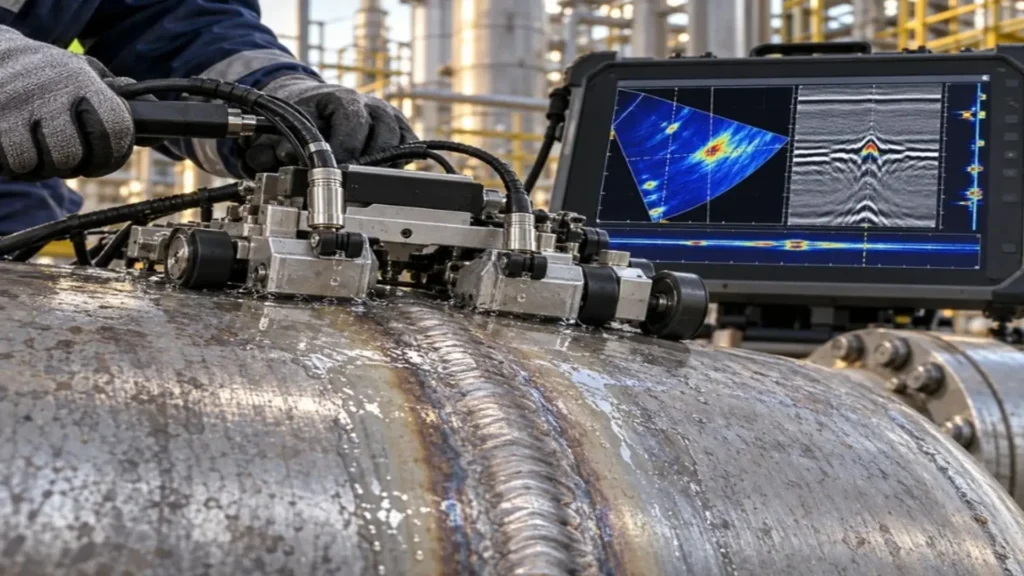
The Total Focusing Method (TFM), obtained through post processing of data acquired with Full Matrix Capture, represents the most significant technical change of the last decade in this application. Unlike previous approaches, it focuses at every point within the region of interest, improving the ability to detect and separate small discontinuities. It also eliminates the need for multiple configurations inherent to PAUT by allowing the maximum number of elements to be used directly while maintaining a fully focused image.
Evidence from actual samples supports its adoption. In studies where vessels suspected of HTHA were removed from service, inspected using multiple array techniques, and subsequently evaluated destructively for comparison with metallographic images, it was concluded that FMC/TFM/ATFM techniques and algorithms improve the detectability, characterization, and sizing of early stage HTHA damage compared with PAUT.
Resolution in the passive plane deserves specific attention. Early discontinuities may be located very close to one another; with poor resolution in that plane, indications appear elongated and the interpretation of coalescence becomes less reliable. In other words, insufficient resolution can cause a group of cavities to be interpreted as a crack, or vice versa.
Real Limitations That Must Be Disclosed
Presenting TFM as the definitive solution would repeat the same mistake criticized in AUBT. The FMC scheme transmits relatively little energy into the material, so the signal to noise ratio of HTHA indications may be limited by the capabilities of the equipment when amplification limits are reached. In addition, TFM image reconstruction involves significant spatial averaging, with the risk of masking small scatterers.
The fundamental limitation is physical and should be stated numerically. Detection capability has been placed at discontinuities above the 500 to 1000 µm range, corresponding to small cracks, leaving the initial stage of degradation beyond reach, given that the steel grain size is approximately 50 µm. No integrity program should be built on the assumption that incipient HTHA can be reliably detected.
TULA: Primary Detection
Ultra Low Angle TOFD (TULA) uses ultrasonic transducers with a very low angle and deserves to be included among the available options. In comparative evaluations performed on carbon steel samples extracted from a refinery heat exchanger, TULA proved to be the most appropriate method for primary detection of hydrogen damage, while TFM was recommended for precise evaluation of the extent of the detected cracking. This division of functions — one technique for finding and another for sizing — is a useful operational criterion when designing the inspection plan.
One finding from the same study is worth retaining: the AVR technique did not reveal any damage in the samples investigated because the degraded zone was thin relative to the total thickness. This confirms that the velocity ratio loses sensitivity when the damage does not extend across a significant fraction of the thickness.
Comparison of Techniques
| Technique | Primary Contribution | Role in HTHA | Limitation That Must Be Disclosed |
| AUBT | Pattern based backscatter, with frequency and spectral monitoring | Initial screening on a prepared surface | Does not quantify the level of damage; highly operator dependent |
| AVR (velocity ratio) | Relative longitudinal to transverse velocity comparison | Advanced stages | Loses sensitivity if the degraded zone is thin relative to the thickness |
| Conventional TOFD | Diffracted signals | Developed cracks | Not well suited for cracking characteristic of HTHA |
| TULA | Ultra low angle TOFD | Primary detection | Requires specific transducers and procedure |
| PAUT | Multiple angle coverage | Volumetric examination of suspected areas | Lower detectability at an early stage than FMC/TFM |
| FMC / TFM / ATFM | Focusing throughout the entire region of interest | Detection, characterization, and sizing of early damage | SNR limited by the low energy of FMC; spatial averaging may mask small scatterers |
| Frequency analysis | Spectral content of the signal | Complementary | Should not be interpreted in isolation |
This combination of techniques is precisely what enables the transition from an inspection focused solely on locating an indication to an assessment aimed at characterizing its origin, establishing its distribution, and, when conditions allow, sizing the extent of HTHA damage.
HTHA Detection, Characterization, and Sizing: Distinct Inspection Objectives
In the ultrasonic evaluation of HTHA, detecting an indication does not mean that the condition of the component has been fully understood. Detection seeks to establish whether a relevant ultrasonic response exists in a susceptible region; characterization attempts to determine whether that response is consistent with HTHA, what its morphology may be, and what stage of degradation it represents; while sizing seeks to establish its location and extent within the material.
This distinction is important because an isolated signal may indicate the presence of an anomaly, but it does not necessarily allow its structural significance to be determined. To do so, the inspector must integrate the obtained response with component geometry, metallurgy, location relative to welds or HAZ, operating conditions, and the results of complementary techniques.
Influence of Sizing on Integrity Assessment
From a mechanical integrity standpoint, knowing the extent of the damage is fundamental for interpreting its severity and determining whether the available data are sufficient to support an engineering decision. An indication without information regarding depth, length, distribution, or relationship to critical areas may be insufficient for a subsequent assessment.
Sizing becomes particularly relevant when the results of advanced ultrasonic testing must support processes such as a Fitness-For-Service assessment, an RBI review, or a decision regarding continued operation, monitoring, or intervention. In these scenarios, the quality of the decision depends directly on the reliability with which the damage has been detected, characterized, and sized.
Advanced HTHA Training for Ultrasonic Inspection
The complexity of HTHA does not end with the selection of an appropriate ultrasonic technique. Even when PAUT, TOFD, backscatter, or other advanced methods are available, the reliability of the results depends to a large extent on the inspector’s competence in configuring the examination, acquiring quality data, and correctly interpreting the responses obtained.
This requirement increases when the damage is in its early stages or presents a distributed morphology. Under these conditions, relatively small differences in acquisition parameters, sensitivity, frequency, acoustic path, or interpretation can influence the ability to distinguish an HTHA-related response from inclusions, metallurgical conditions inherent to the material, or other damage mechanisms.
For this reason, advanced ultrasonic testing training should focus not only on instrument operation, but also on mechanism recognition, evaluation of different stages of degradation, comparison of complementary techniques, and discrimination of false positives. The objective is for the inspector to be able to relate the ultrasonic response to the actual condition of the material and produce technically defensible information for subsequent integrity assessments.
Lavender International HTHA Detection & Sizing Program
Within this field of specialization, Lavender International has developed the HTHA Detection & Sizing program, aimed at inspectors with experience in advanced ultrasonics who seek to deepen their knowledge of specific methodologies for detecting, characterizing, and sizing damage associated with high temperature hydrogen attack.
The training integrates TOFD and backscatter with the array techniques that currently support early damage assessment: PAUT and FMC/TFM, incorporated as complementary methods. It also includes velocity ratio analysis, attenuation, and frequency content analysis.
The program also covers inspection parameter adjustments, data acquisition across different thicknesses and stages of degradation, damage characterization, and recognition of responses that may produce false positives, including inclusions, stepwise cracking (SWC), HIC, and certain conditions related to weld back cladding.
The program is delivered in a forty-hour format and has qualified more than eighty NDT technicians from twelve companies across five continents through data files and ex-service samples. Lavender International uses this practical approach to expose inspectors to different stages of degradation and strengthen the interpretation of ultrasonic responses under representative HTHA scenarios.
The training integrates PAUT, TOFD, and backscatter, together with velocity ratio, attenuation, and frequency-content analysis. It also covers adjustment of inspection parameters, data acquisition across different thicknesses and stages of degradation, damage characterization, and recognition of responses that may produce false positives, including inclusions, stepwise HICC, and certain conditions related to weld back cladding.
Specialization in advanced ultrasonic techniques requires combining knowledge of the damage mechanism with practical experience in data acquisition and interpretation. In this Inspenet TV interview, Tim Armitt, President of Lavender International, explains the company’s background in advanced NDT training and its experience with ultrasonic methods applied to challenges such as high temperature hydrogen attack.

E2G HTHA JIP and Training with Representative Samples
One of the elements that adds technical value to the program is its relationship with the E2G HTHA Joint Industry Project (JIP). Lavender states that part of the training methodology is based on experience and industrial testing obtained within that project and that it maintains in its custody samples used for training and certification.
Working with materials representing different stages of degradation allows the inspector to observe how the ultrasonic response changes as HTHA evolves, from microscopic damage to conditions with more developed cracking. This practical exposure facilitates the development of interpretation criteria and strengthens a fundamental competency: differentiating an indication consistent with HTHA from signals originating from other material characteristics.
Integration of Ultrasonic Results into HTHA Integrity Assessment
The evaluation of HTHA should not end with the identification of an ultrasonic indication. For inspection results to have value within a mechanical integrity program, they must be interpreted together with material susceptibility, actual service conditions, damage location, morphology, extent, and stage of evolution.
The assessment strategy begins with a review of variables such as temperature, hydrogen partial pressure, metallurgy, operating history, weld condition, and previous inspection history. Based on this context, the most appropriate ultrasonic techniques are selected, acquisition parameters are established, and the responses obtained through complementary methods such as PAUT, TOFD, backscatter, attenuation analysis, or frequency-content analysis are compared.
The technical value of the data increases when indications can be characterized and sized with sufficient reliability. This information makes it possible to establish whether the damage corresponds to the expected mechanism, determine its distribution within the component, and assess whether the results are adequate to support a subsequent engineering assessment, a Fitness-For-Service review, an RBI program update, or a decision regarding monitoring, repair, or continued operation.
None of these techniques, by itself, completes the assessment. Confirmation of the damage mechanism usually requires complementary methods: in situ metallographic replication, hardness measurement and, when justified by the decision at hand, sample extraction for destructive examination. Validation studies of advanced ultrasonic techniques were developed precisely by comparing the ultrasonic response against metallography of material removed from service.
When the results feed into a Fitness-For-Service assessment according to API 579-1/ASME FFS-1, the quality of the sizing determines the quality of the model output. HTHA is also one of the damage mechanisms least adequately addressed by FFS procedures because the damage does not behave as an isolated planar discontinuity, but rather as distributed degradation that alters the material properties within the affected region. Reporting an indication without its extent, depth, or distribution does not enable an engineering assessment; it merely transfers the uncertainty to the next step.
The reliability of these decisions depends directly on the quality of the inspection and on the technical competence with which the results are interpreted. An isolated indication, without metallurgical context or knowledge of its extent, may be insufficient to define the actual condition of the asset.
The challenge of HTHA is not simply to locate an indication, but to generate sufficiently reliable evidence to understand what damage exists, how far it has progressed, and what decision should be made regarding the asset.
Frequently Asked Questions (FAQs)
Are HTHA and hydrogen embrittlement the same mechanism?
No. HTHA is a degradation mechanism associated with prolonged exposure to hydrogen at elevated temperature and pressure, involving internal methane formation, decarburization, and cracking. Hydrogen embrittlement involves different mechanisms and may occur under other service conditions.
Can PAUT detect HTHA on its own?
PAUT can provide valuable information for locating and characterizing indications, but it should not be considered a standalone solution for all stages of HTHA. Reliability increases when its results are integrated with other ultrasonic techniques and with the metallurgical and operational context of the component.
What information should be reviewed before an HTHA inspection?
Among other factors, the material, actual operating temperature, hydrogen partial pressure, thermal history, welds, PWHT condition, repairs, service changes, and results of previous inspections should be reviewed. This information helps direct the inspection strategy toward the areas of greatest susceptibility.
What is API RP 941 used for in an HTHA assessment?
API RP 941 provides criteria for evaluating the resistance of steels in hydrogen service at elevated temperature and pressure. It helps identify susceptibility conditions and select appropriate materials, but it does not replace the inspection required to confirm the actual presence of damage.
Why does an HTHA inspector need advanced ultrasonic training?
Because the assessment may involve weak signals, distributed damage, microcracking, and responses similar to false positives. Advanced training strengthens the ability to properly configure the examination, compare techniques, interpret data, and distinguish relevant indications from other material responses.
What Does TFM Offer Compared With PAUT for HTHA?
The Total Focusing Method focuses at every point within the region of interest, improving the ability to detect and separate small discontinuities. In studies involving destructive metallographic verification of material removed from service, FMC/TFM/ATFM techniques demonstrated better detectability, characterization, and sizing of early stage damage than PAUT. However, it has its own limitations: the low energy of the FMC scheme may restrict the signal to noise ratio, and spatial averaging during reconstruction may mask small scatterers.
Can HTHA Be Detected at Its Earliest Stage?
Not reliably. Detection capability has been placed at discontinuities above the 500 to 1000 µm range, while the steel grain size is approximately 50 µm. No integrity program should be built on the assumption that incipient damage will be detected.
References
- American Petroleum Institute (API). API RP 941 — Steels for Hydrogen Service at Elevated Temperatures and Pressures in Petroleum Refineries and Petrochemical Plants, Eighth Edition, February 2016, including Errata 1 (2016), Errata 2 (2018), and Addendum 1 (2020).
- American Petroleum Institute (API). API TR 941-A — The Technical Basis Document for API RP 941, including Addendum 1.
- American Petroleum Institute (API). Carbon Steel Degradation in High Temperature Hydrogen Service — Industry Alert.
- U.S. Chemical Safety and Hazard Investigation Board (CSB). Catastrophic Rupture of Heat Exchanger, Tesoro Anacortes Refinery, Report 2010-08-I-WA, May 2014.
- U.S. Chemical Safety and Hazard Investigation Board (CSB). Safety Alert: Preventing High Temperature Hydrogen Attack (HTHA).
- Lozev, M. et al. Assessment of High-Temperature Hydrogen Attack Using Advanced Ultrasonic Array Techniques, 2020.
- Early detection of high temperature hydrogen attack using ultrasonic full matrix capture and advanced post-processing methods, 2022.
- Comparative Analysis of Ultrasonic NDT Techniques for the Detection and Characterisation of Hydrogen-Induced Cracking (TFM, AVR, AUBT, TULA).
- Lavender International. HTHA Detection & Sizing.