Table of Contents
- Loss of containment: The problem before the repair
- High-pressure leak repair: What must be known
- On-line leak sealing: Pressure, temperature, and geometry
- On-stream leak repair: Clamps and enclosures
- ASME PCC-2 and industrial leak sealing
- Leak repair in industrial piping without shutdown
- When geometry demands a customized solution
- From repairing a leak to managing its cause
- Conclusions
- References
- Frequently Asked Questions (FAQs)
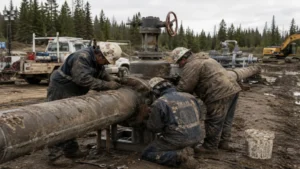
When a pressurized line begins to leak, response time matters, but speed alone does not solve the problem. Maintaining production requires knowing what failed, what mechanical capacity the component retains, and what conditions any repair installed with the system active will have to withstand.
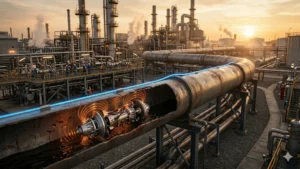
On-line leak sealing can restore containment without immediately removing piping, valves, or service equipment. Its application integrates field data, engineering, materials, manufacturing, and execution. At high pressure and temperature, a poorly selected repair can introduce additional loads on an already degraded area.
Loss of containment: The problem before the repair
A visible leak does not explain by itself what is happening. In a flange, gasket degradation or improper bolt loading may exist; in piping, corrosion, erosion, or localized wall loss.
In valves, the leak may appear in the packing, the bonnet, or connections subjected to thermal cycling. Loss of containment can be the manifestation of a damage mechanism that must be identified before selecting the repair.
Severity does not depend solely on the size of the leak either. The fluid, pressure, temperature, phase, location, and potential for defect growth modify the risk.
Before considering a clamp, it is advisable to determine where the fluid is escaping, what caused the condition, and what capacity the material retains. Restoring tightness controls the release; preserving mechanical integrity requires verifying how the component will respond after installing the solution.
High-pressure leak repair: What must be known
Before intervening, engineering needs to know how much margin the component retains and what service conditions it will have to withstand. A pressure reading or a single spot thickness measurement is not enough.
Operations and process provide current conditions and their potential variations. Inspection pinpoints the extent and nature of the damage, while engineering evaluates whether the area can receive the repair and what loads the installed solution will assume.
| Evaluation | Information that must be known | Decision supported |
|---|---|---|
| Process condition | Pressure, temperature, flow rate, phase, and transients | Defines the operational range of the repair |
| Remaining integrity | Material, wall thickness, extent, and location of damage | Determines the available capacity of the component |
| Damage mechanism | Corrosion, erosion, fatigue, vibration, or wall loss | Establishes whether deterioration can continue |
| Leak and contained fluid | Location, composition, phase, and hazard level | Dictates materials, sealants, and safety controls |
| Geometry and installation | Configuration, loads, access, and interferences | Defines whether a standard or engineered solution is required |
| Limits and acceptance | Operational limits, testing, monitoring, and removal | Defines acceptance, permanence, or replacement |
With these data, it is no longer a matter of selecting a clamp of the right size. Engineering can determine whether the condition allows an on-stream repair, requires operational restrictions, or demands a specifically designed solution.
On-line leak sealing: Pressure, temperature, and geometry
Working with an active line under severe conditions requires more than selecting a clamp compatible with the diameter. Pressure, temperature, fluid, tolerances, and geometry dictate the materials, installation method, and capacity that the repair must retain.
TEAM Inc. documents experience from vacuum to 11,300 psi (780 bar) and from -196 °C to 1,000 °C, as well as services with fluids ranging from inert to highly hazardous. These ranges show a broad depth of experience, although the feasibility of each intervention depends on the condition of the component, the damage mechanism, and operational variables.
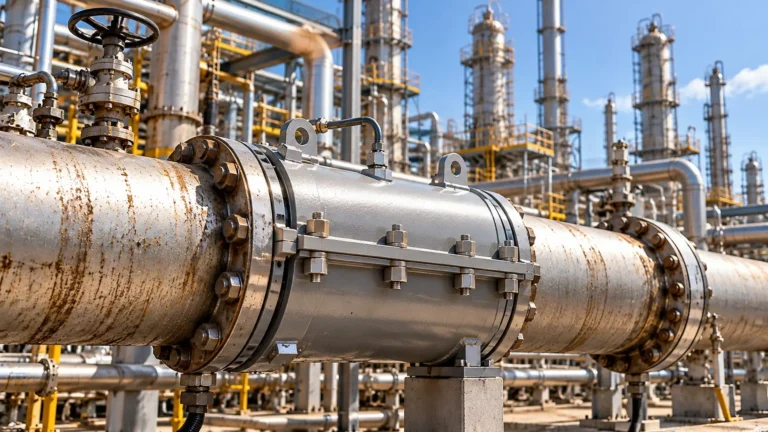
For known configurations, previously developed flange clamps or piping enclosures can be used. In complex geometries, restricted spaces, or specific thermal and mechanical conditions, the solution may require specialized engineering, 3- and 5-axis CNC machining, and qualified manufacturing.
Thus, on-line leak sealing depends on how design, manufacturing, and installation integrate to respond to real field conditions.
On-stream leak repair: Clamps and enclosures
Geometry and the actual leak path determine much of the solution. A clamp on straight piping, an enclosure around a flange, or an intervention on a valve receive different loads and present their own assembly challenges.
Conditions that a drawing may not show also play a role: insulation, limited access, nearby structures, line movement, surface temperature, and leak direction. In an operating leak repair, the design must be capable of being installed without compromising the existing wall or increasing personnel exposure.
When sealant injection is used, the compound, its compatibility, injection pressure, and work sequence must be controlled. Other cases may require a sleeve, a special enclosure, or another mechanical solution designed for the condition found.
ASME PCC-2 and industrial leak sealing
When a repair must be executed on equipment or piping in service, technical judgment needs to rely on recognized practices for design, materials, manufacturing, examination, and testing. ASME PCC-2 provides methods for repairing components after the need for intervention has been established through proper flaw inspection and evaluation.
Within industrial leak sealing, this reference helps define how to design, manufacture, examine, and test a repair, as well as its temporary or permanent nature depending on circumstances.
TEAM Inc. documentation indicates that members of its personnel participate in mechanical repair articles of ASME PCC-2. It also notes that the pressure equipment it manufactures is designed and manufactured in accordance with ASME Section VIII, Division 1, with finite element analysis under Division 2 criteria when applicable.
This participation aligns with two of its stated values, Safety First/Quality Always and Innovation: recognizing when an intervention can be executed within acceptable limits and developing a specific alternative when conditions rule out a conventional solution.
Leak repair in industrial piping without shutdown
Avoiding an immediate shutdown can protect production and provide time to prepare a definitive intervention, but that advantage depends on operating within defined limits.
In a piping leak repair without shutdown, monitoring variables and their frequency must be established. New leaks, bolt condition, displacements, temperature, vibration, and evolution of the damage mechanism can be part of the monitoring process.
If the solution is temporary, an exit condition must also exist: next shutdown, deadline, change of service, or reevaluation/removal criteria.
Calculations, materials, dimensions, procedures, installation records, and acceptance criteria make it possible to verify later why the repair was accepted and under what conditions it remains valid.
When geometry demands a customized solution
A documented technical background by TEAM Inc. in Cook Inlet, Alaska shows what happens when field configuration rules out a conventional repair. On a 10-inch riser carrying natural gas from a platform, the damage was located approximately 120 feet below the surface. The structure and the presence of gussets prevented the installation of a conventional enclosure.
The solution required an insert sleeve with seals capable of being remotely activated. Before field deployment, a measuring device and a mock-up were fabricated to validate the installation and train divers under zero-visibility equivalent conditions.
During testing, a hand entrapment risk was identified, leading to a procedure modification using guide rails. The assembly was tested at 1.5 times the maximum operating pressure and remained pressurized overnight with zero leakage. The system was dispatched two days ahead of schedule and, according to project documentation, avoided significant production loss.
The value of the case lies in the methodology: measure actual conditions, design for the geometry encountered, validate the installation, and modify the procedure when a test reveals a risk. That sequence demonstrates the level of engineering that may be required when pressure, access, and configuration prevent the use of standard solutions.
From repairing a leak to managing its cause
An on-stream intervention adds more value when lessons learned return to the integrity program. The identified mechanism, observed condition, and subsequent performance can guide new inspections and help prepare the definitive intervention.
In refineries and petrochemical plants, connecting inspection, detection, and repair avoids treating each leak as an isolated event. The collected data helps decide which components to inspect, which conditions to monitor, and what work to schedule during the next maintenance window.
Conclusions
When a leak appears in a critical system, controlling product loss is a priority to reduce operational and environmental risks. The decision does not end there: it is also necessary to know what condition the component retains and under what limits it can continue operating after the intervention.
On-line leak sealing can restore containment and sustain operational continuity when the repair has been evaluated, designed, and executed for the actual asset conditions. Its value lies in creating a controlled operating window for the next integrity decision, maintaining sufficient traceability to know what was installed, why it was accepted, and when it should be re-evaluated.
Is your facility facing a leak in a pipe, valve, flange, or pressurized equipment that cannot be immediately removed from service? Connect with TEAM Inc., which offers on-stream repair solutions ranging from clamps and enclosures for known geometries to engineered and manufactured repairs for specific conditions.
References
- American Society of Mechanical Engineers. ASME PCC-2, Repair of Pressure Equipment and Piping, 2022.
- TEAM Inc. On-Line Leak Sealing and Mechanical Repair: Keeping Critical Pressurized Equipment On-Line.
- TEAM Inc. TEAM Designs Customized Expert Solution for Unocal’s Sub-Sea Platform Repairs.
- TEAM Inc. Refining, Petrochemical and Chemical360: Inspection, Detection and Repair Services.
Frequently Asked Questions (FAQs)
What is on-line leak sealing?
It is a repair performed on an in-service system to control a leak using a solution designed according to pressure, temperature, fluid, geometry, and component condition.
Can all losses of containment be repaired without a shutdown?
No. Feasibility depends on the damage mechanism, component condition, pressure, temperature, fluid, access, and the ability to execute the intervention within safe limits.
Is a clamp or enclosure always a permanent repair?
No. Its lifespan depends on technical evaluation, the applied method, and service conditions. ASME PCC-2 addresses temporary or permanent repairs depending on the circumstances.
What should be checked after an on-stream repair?
Tightness, mechanical condition, operational variables, and the evolution of the damage mechanism that caused the leak.