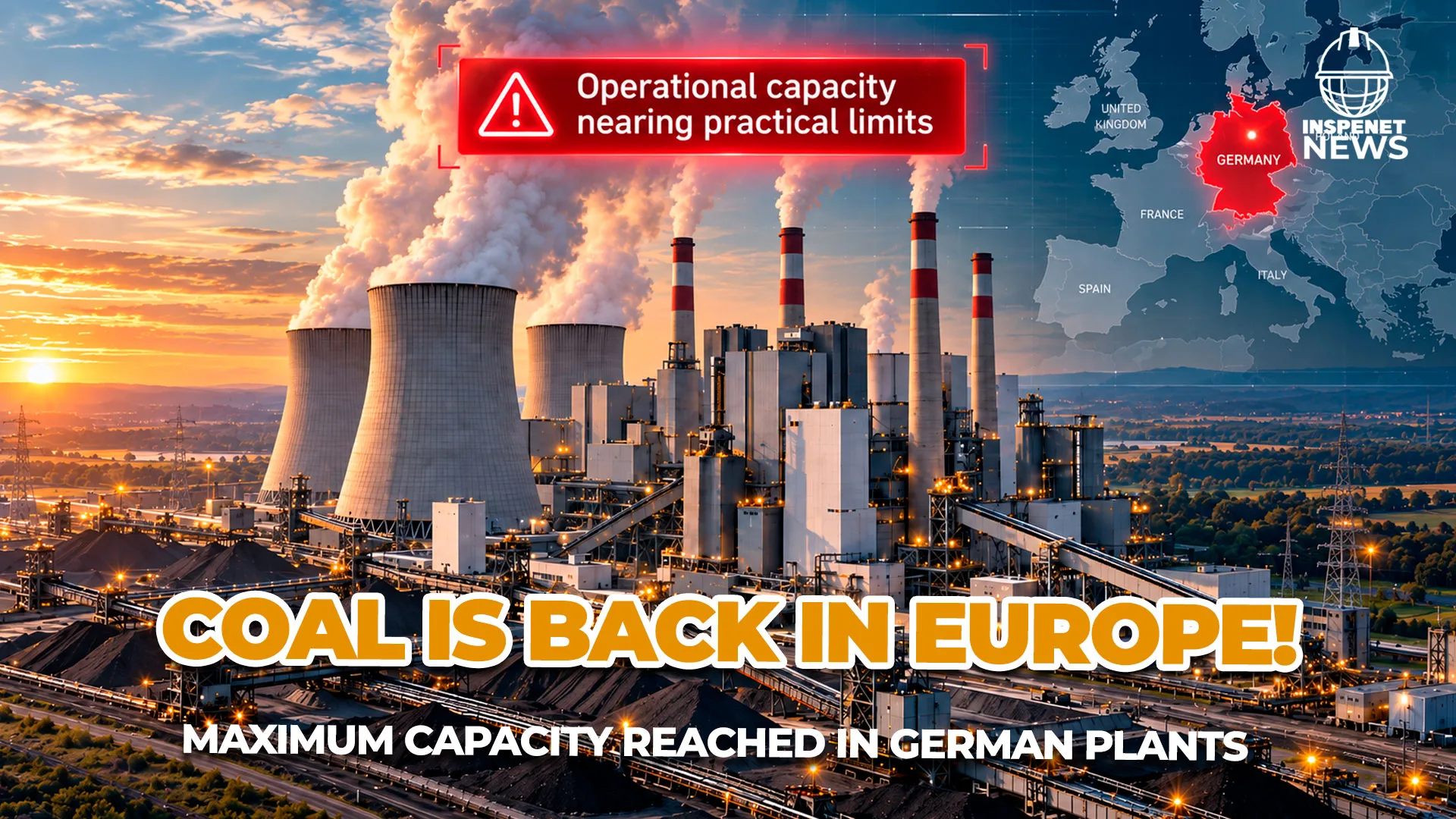
Gas prices are pushing Europe to generate more electricity with coal
The price of gas is changing the way the European electricity market works; the sharp increase in fuel costs is making coal-fired power plants more profitable again than many plants that run on natural gas.
According to estimates compiled by Reuters, electricity generation from coal could grow by about 25% over the next six months. At the same time, production from gas-fired power plants is expected to decline by a similar amount.
Behind this change lies the increase in the cost of European gas following restrictions on liquefied natural gas (LNG) shipments crossing the Strait of Hormuz. The European benchmark price exceeded €80 per megawatt-hour in September, reaching its highest level in three years.
The price of gas changes the accounts of European electricity companies
The increase in gas prices has altered the relative profitability of thermal power plants; producing electricity using coal and lignite is now more profitable on average than using natural gas, according to data from the firm ICIS cited by Reuters.
This situation represents a change from the dynamics observed in recent years; lower gas costs, along with the growth of renewable energies, had contributed to a gradual reduction in the share of coal in European electricity generation.
However, power companies still need plants capable of producing energy when solar, wind, or hydroelectric generation does not meet demand. Therefore, the cost of fossil fuels continues to influence production decisions.
Europe could increase its coal-fired power generation by about 25%.
On the other hand, the cost differences could quickly translate into changes within the electrical system.
Analysts anticipate an increase of nearly 25% in coal-fired power generation over the next six months. Conversely, electricity generated from gas could fall by a similar proportion.
This move comes after a long decline in coal's share of the European energy market. In 1990, coal accounted for more than a third of the electricity produced in the European Union; by 2025, its share had fallen to a record low of 9.2%, according to Eurostat.
In turn, renewable energies accounted for around 47% of the EU's electricity production during 2025. Coal thus fell far short of sources such as wind, solar, hydroelectric and nuclear within the European electricity mix.
Why is coal once again proving more profitable than gas?
In this scenario, electricity companies compare how much they can earn from electricity against the cost of fuel and the emissions associated with its production.
For coal-fired power plants, there is an indicator known as the clean dark spread; for gas-fired power plants, the clean spark spread is used. Both allow for an assessment of the approximate profitability of producing electricity after considering certain costs.
Since the conflict between Iran and the United States began in late February, the indicator for coal has risen sharply. The equivalent indicator for gas-fired power plants has followed the opposite trend.
As a result, some coal-fired power plants that remained available are once again offering better economic conditions for producing electricity.
Renewable energies do not eliminate the need for thermal power plants
Meanwhile, the high share of renewable energy reduces the need to use fossil fuels for extended periods. However, its production depends in part on weather conditions.
The availability of solar energy decreases during certain periods of winter, while wind and hydroelectric generation can also vary.
For this reason, natural gas and coal-fired power plants continue to act as backup when renewable production is insufficient to meet demand.
The data shows the growing importance of renewable energy sources; in the first quarter of 2026, they contributed 45.5% of the electricity generated in the EU. Wind power accounted for the largest share of that renewable production.
Germany is nearing the limit of its coal-fired power generation capacity
Germany represents one of the clearest examples of the change brought about by the price of gas; the country is the largest electricity market in Europe and a major consumer of natural gas.
According to Veyt data cited by Reuters, coal-fired power generation could approach its practical limit during the fourth quarter of 2026. Production would reach levels close to the quarterly highs recorded by the plants that are still operational.
The problem would no longer be solely related to costs; much of the additional capacity available depends on the conditions and availability of the power plants themselves.
This means that a further increase in the price of gas would have an increasingly less capacity to trigger another shift towards coal.
Europe has less room to replace natural gas with coal.
Unlike previous energy crises, Europe now has fewer coal-fired power plants capable of rapidly increasing their output.
For years, governments and power companies have been retiring thermal capacity as generation from other sources has increased. The European Commission notes that since 2012, total coal-fired generation has fallen by almost a third in the EU.
The trend also appears in consumption; during 2025, the consumption of hard coal and lignite reached historic lows within the European Union.
Therefore, even if the price of gas continues to rise, power companies cannot indefinitely increase coal-fired generation. The available infrastructure imposes a physical limit on this substitution.
A gas price of 100 euros per MWh would have a limited effect
Specifically, ICIS believes that even a gas price of 100 euros per megawatt hour would have a relatively small additional effect on fuel switching within the electricity sector.
The reason lies in the available capacity; if the coal-fired power plants that can operate are already producing close to their limits, a further increase in the price of natural gas does not automatically create new power plants capable of replacing it.
This restriction could increase the sensitivity of the European electricity market to further supply disruptions.
Europe also maintains a high level of dependence on external sources to meet its gas needs. Preliminary data from Eurostat indicate that 88% of the gas available in the European network in 2025 came from imports.
Coal could maintain its advantage over gas until 2028
Ultimately, the change could last longer than the immediate interruption of LNG shipments.
Veyt's estimates, reported by Reuters, suggest that generating electricity with coal could remain cheaper than using gas for the next year. This advantage could potentially extend until March 2028.
Prices for longer-term gas contracts indicate that the market anticipates supply restrictions for an extended period.
In Germany there is also another factor: the closure of its last nuclear power plants in 2023 reduced one of the sources of generation available to meet electricity demand.
Thus, Europe is entering a period in which renewable energies maintain a significant share while coal regains economic appeal compared to natural gas. The extent of this shift will depend on both the price of gas and the capacity of the coal-fired power plants that remain operational.
News of additional interest
Revolution Wind completes its 65 turbines in the USA.
Ørsted and Skyborn Renewables have completed the installation of all 65 turbines at Revolution Wind, a 704 MW offshore wind farm in the United States. The project uses Siemens Gamesa SG 11.0-200 DD turbines and is now proceeding with commissioning. According to Ørsted, the goal is to begin commercial operations by the end of 2026.
Revolution Wind began sending electricity to the New England grid this spring and continues to ramp up its generating capacity. When fully operational, it will be able to produce enough electricity to power more than 350,000 homes in the region. The first turbine was installed in September 2024, so completing all 65 units marks the end of one of the major construction phases.
Germany opens its largest offshore wind farm
Germany has inaugurated He Dreiht, a 960 MW offshore wind farm located approximately 85 kilometers northwest of Borkum in the North Sea. With 64 wind turbines, the complex is the largest in the country in terms of installed capacity. The project required an investment of nearly €2.4 billion and is led by EnBW, which owns 50.1%, along with a consortium of investors that controls the remaining 49.9%.
Construction began in May 2024, and the installation of the wind turbines was completed in August. He Dreiht uses 64 Vestas V236-15.0 MW turbines, each with a capacity of 15 MW, a model that made its offshore debut with this project. Furthermore, the wind farm was awarded to EnBW in 2017 without state funding, and its economic model relies on long-term power purchase agreements.
The US is accelerating oil and gas drilling
US energy companies increased the number of active oil and gas rigs for the second consecutive week. According to Baker Hughes, four rigs were added, bringing the total to 595 in the week ending September 18, the highest figure since May 2014. This total also exceeds the number of rigs recorded during the same period last year by 53 rigs.
The number of oil platforms increased by two to 452, while gas platforms added two more, reaching 134. This rebound breaks with several years of equipment reduction, a period in which companies prioritized profitability and debt repayment over increasing production. The EIA projects that U.S. crude oil production will rise from 13.7 million barrels per day in 2025 to 13.8 million in 2026.
NSORe adds another 2 GW contract in Germany
Neptun Smulders Offshore Renewables (NSORe) has been selected by 50Hertz to build a 2 GW offshore converter platform for LanWin3, a connection that will bring North Sea wind power to the German grid. This agreement follows the contract secured in June 2026 for LanWin6, also a 2 GW project. Neptun Werft estimates NSORe's share of both projects to be worth approximately €2.5 billion.
NSORe will handle system design, procurement, construction, installation, and commissioning of the platform. The upper structure will be manufactured in Rostock-Warnemünde, Germany, while Smulders will produce the steel base in Vlissingen, the Netherlands. Siemens Energy will provide the high-voltage technology. LanWin3 and LanWin6 will be connected to the NordOstLink HVDC corridor to transport large quantities of electricity to consumption centers.