Table of Contents
- The critical link: From operational inefficiency to solutions
- Operational inefficiencies due to inadequate workshop design
- Turnkey industrial workshops from layout to equipment
- Equipment selection and installation according to workshop operations
- Commissioning, training, and support after installation
- Conclusions
- References
Within the framework of turnkey industrial workshops, mechanical integrity is the backbone that sustains business continuity across industries. Every refined barrel, every cubic meter of compressed gas, and every kilometer of pipeline directly depends on the structural health of the equipment and infrastructure involved in that value chain. The efficiency of maintenance, repair, and critical component manufacturing becomes the deciding factor between a seamless, profitable operation and a scenario dominated by unscheduled downtime.
The critical link: From operational inefficiency to solutions
Historically, optimization efforts in the energy sector have focused massively on field process facilities: offshore platforms, refineries, and compressor stations. However, there is a key link that frequently remains in the shadows of strategic design: industrial workshops.
In these workspaces, the most expensive and sensitive assets in the industry are diagnosed, repaired, reconditioned, assembled, and certified—for example, ranging from subsurface valves and drilling tools to large centrifugal pumps. If an industrial workshop operates inefficiently, it will inevitably trigger a domino effect that, depending on the case, can paralyze the operational response of the business.
Modern engineering in the Oil & Gas sector is adopting a definitive paradigm shift: the transition from fragmented equipment procurement to comprehensive solutions. This is where SKS Group becomes paramount through the concept of turnkey industrial workshops (turnkey workshop solutions). By covering the entire project life cycle—ranging from the initial assessment of requirements, workshop layout plan design, selection of industrial workshop equipment, equipment installation for workshops, commissioning of industrial workshops, to specialized training—this holistic approach eradicates inefficiencies at their root.
Operational inefficiencies due to inadequate workshop design
The origin of most bottlenecks and financial losses in Oil & Gas maintenance and engineering operations does not lie in the personnel’s lack of technical capability. Quite the contrary, it lies in the poor design of the physical infrastructure where they work. Industrial workshop design executed haphazardly or through the disorganization of equipment sourced from different suppliers generates unperceived operational inefficiencies and, in most cases, chaotic improvisations that harm overall productivity.
A common mistake is the absence of a detailed process flow analysis, resulting in a workshop layout design disconnected from actual work sequences. When a workshop layout fails to respect the operational logic of component flow, unnecessary movement of heavy materials and personnel multiplies.
In an environment where multi-ton parts are handled, moving a valve or a section of pipe from one end of the workshop to the other simply because the cleaning area or test bench is poorly located not only wastes hundreds of man-hours per year, but also exponentially increases the risk of safety incidents and mechanical damage to critical components. Collisions on internal pathways, overhead crane saturation, and the accumulation of work-in-progress (WIP) inventory are clear symptoms of defective spatial layout.
Likewise, operational inefficiencies due to inadequate workshop design manifest in the sub-optimization of essential auxiliary utilities. This lack of foresight in sizing compressed air networks, industrial gas, high-power electricity, fume extraction, and lubrication systems causes pressure drops and constant shutdowns in work tools. Furthermore, poor lighting or neglected ergonomics at workstations degrade technicians’ precision during measurement and fine-tuning tasks, increasing rework rates. Ultimately, a poorly designed workshop directly compromises the mechanical integrity of repaired assets, exposing the company to premature field failures.
Turnkey industrial workshops from layout to equipment
The turnkey industrial workshop model emerges as the definitive methodological response to ensure operational excellence. A turnkey project implies that a strategic partner, in this case, SKS Group, assumes total responsibility for the project, from the initial concept on paper to the delivery of a fully operational facility ready for production.
The starting point of this model is the evaluation of the client’s operational requirements. In this phase, specialist engineers analyze the typology of components to be processed, taking into account the projected work volumes. Added to this in the project are the applicable regulatory specifications and production cycle time targets.
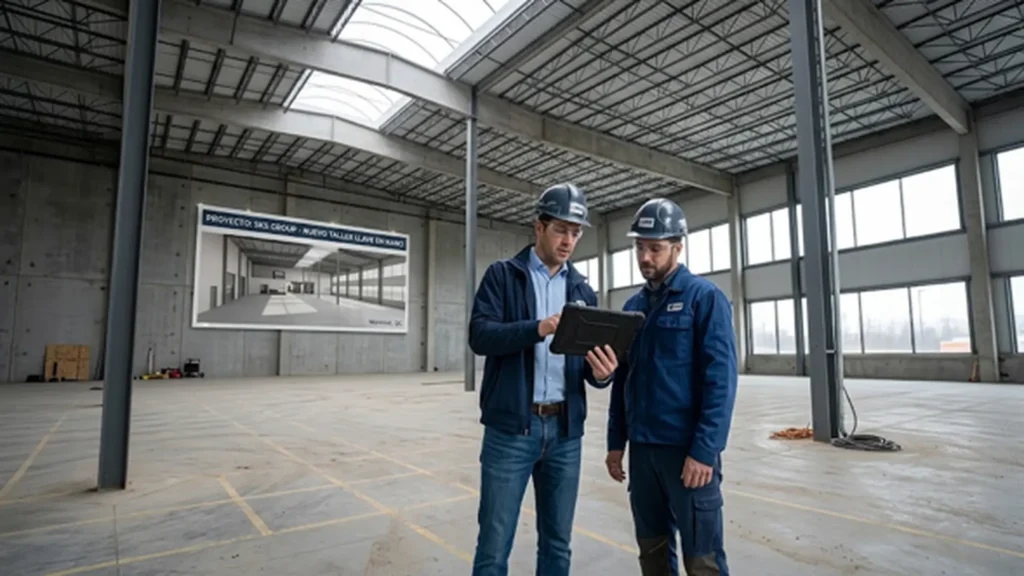
With this baseline of real data, the workshop layout design is addressed using advanced three-dimensional simulation and BIM modeling tools. The seamless transition from layout to industrial workshop equipment ensures that every square meter is optimized for maximum productivity. The turnkey approach integrates tailored infrastructure solutions. By centralizing engineering and supply with SKS Group, the process and complete technical compatibility within the operational workflow of all workshop subsystems are guaranteed.
Equipment selection and installation according to workshop operations
Machinery selection in the industrial sector must not respond to isolated criteria of cost or immediate commercial availability; it must be the strict result of analyzing workshop operations. Every maintenance process in the industry—whether re-threading drill pipes, resurfacing flange faces, or reconditioning turbomachinery—demands extremely rigorous manufacturing tolerances and inflexible quality standards. Acquiring equipment decoupled from actual needs inevitably leads to overinvestment in unutilized capacity or to bottlenecks due to a lack of power and precision.
SKS Group selects and installs equipment according to workshop operations following a rigorous detailed engineering protocol. Load capacity, dimensional accuracy ranges, process automation, and compliance with international industrial safety standards (ISO, OSHA, API) are analyzed. Each selected piece of equipment is harmoniously integrated into the planned workflow.
Subsequently, the workshop equipment installation phase represents a critical step where assembly precision determines the machinery’s service life and reliability. In this regard, SKS Group deploys multidisciplinary teams of engineers and technicians to execute special civil works (foundations with vibration isolation), precision anchoring, laser leveling of machine beds, and interconnection with energy and fluid supply networks, among other design requirements. Professional assembly ensures that equipment operates at peak efficiency from day one. Faulty installation can induce parasitic vibrations and misalignments that degrade machining accuracy and accelerate equipment wear.
Commissioning, training, and support after installation
The turnkey model culminates in three indivisible phases that ensure effective technology transfer and return on investment. These phases are: commissioning of industrial workshops, training of operating personnel, and post-delivery technical support.
Commissioning is not a simple machine startup; it is a rigorous testing and integration process where all workshop systems are verified under simulated and real load conditions.
During commissioning, SKS Group specialists carry out fine calibration of equipment, test safety interlocks, verify energy consumption parameters, and execute machining tests on master parts to validate that the tolerances required by industry standards are achieved.
Once the technical performance of the facility is validated, attention shifts to the human factor through a comprehensive personnel training program. Client technicians and engineers receive theoretical and practical instruction in safe machinery operation, first-level preventive maintenance, CNC programming, and fault diagnosis protocols.
Finally, the partner company’s commitment extends over time through a structured post-delivery support framework. The availability of original spare parts, periodic preventive maintenance audits, software updates, and remote or on-site technical support ensure that the workshop maintains its high operational availability rates over the years. It is a continuous support that protects the client’s investment and consolidates mechanical integrity as a corporate culture ingrained at all levels of the organization.
Conclusions
Poor workshop design or fragmented machinery procurement represent operational inefficiencies that cause an unsustainable hidden cost in today’s competitive environment.
The solution is the transformation of industrial workshops into centers of operational excellence through a continuous value cycle ranging from workshop layout design, scientific equipment selection, and expert installation to human talent training. Only then will we achieve the results everyone expects and aspires to.
References
- American Petroleum Institute [API]. (2021). Recommended Practice for Occupational Safety for Oil and Gas Well Drilling and Servicing Operations (API RP 54). API Publishing.
- International Organization for Standardization [ISO]. (2018). Occupational health and safety management systems. Requirements with guidance for use (ISO 45001:2018). ISO.
- SKS Group. (2024). Integrated solutions for turnkey industrial workshops: Design, equipment, and commissioning. SKS Group Engineering Solutions