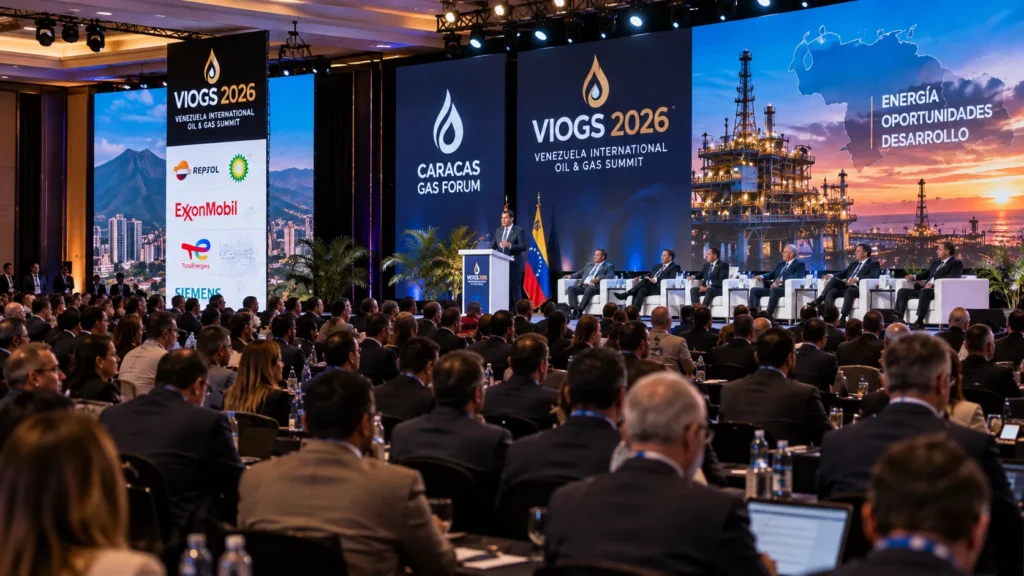
VIOGS 2026 begins its executive sessions this Tuesday, September 29, at the JW Marriott Caracas, bringing together more than 600 senior delegates, 250 companies, and representatives from more than 30 countries. The agenda will place upstream investment, production recovery, infrastructure, oilfield services, and natural gas development at the center of the debate, at a time when international companies are once again evaluating opportunities in the Venezuelan energy industry.
The Venezuela International Oil & Gas Summit takes place from September 28 to 30 and this year integrates the discussions of the Caracas Gas Forum. Monday includes technical activities, while beginning Tuesday the program moves to the JW Marriott Caracas to address the commercial, operational, and financial conditions needed to turn Venezuela’s resources into executable projects.
VIOGS 2026 Focuses on Investment and New Barrels
The first executive day will be marked by a fundamental question for the industry: what does Venezuela need to recover oil production at scale?
The plenary session on the revival of the Venezuelan oil sector will analyze international markets, capital allocation, reforms, and the conditions needed to restore investment. Confirmed participants include Hunter Hunt, co-chairman and co-CEO of Hunt Consolidated and president and CEO of Hunt Energy Holdings; Martín Terrado, COO of GeoPark; Erik Keskula, Upstream CEO of UCC Oil and Gas; and Luis Xavier Grisanti Cano of IESA.
The discussion will then move from capital to assets. The Rebuild: The Project Pipeline: Where the Next Barrels Come From panel will examine facility rehabilitation, reliability, the capacity of service companies, and the technologies needed to increase production. The agenda uses as a discussion scenario the challenge of moving from approximately 700,000 barrels per day to 2 million bpd, a reference presented by the organizers and not a guaranteed production forecast.
This approach makes infrastructure recovery one of the key issues at the summit. Reactivating fields does not depend solely on drilling new wells: it requires surface facilities, artificial lift systems, electricity, pipelines, storage, terminals, and a supply chain capable of executing multiple projects simultaneously. This challenge is already reflected in the development of 17 strategic fields to boost Venezuela’s oil production, where infrastructure rehabilitation and operational capacity emerge as determining factors for transforming investment into new barrels.
Oilfield Services and Supply Chain Enter the Recovery
A sustained expansion of upstream activity would also require contractors, engineering, equipment, and specialized services. The movement can already be seen in the agreements between SLB and Hunt to boost Venezuela’s oil production, combining field development, integrated services, digitalization, and artificial intelligence. For this reason, Tuesday’s agenda includes a session dedicated to service companies, local content, and supply chain readiness. The meeting will examine procurement, partnerships between national and international companies, and the capabilities required to support future upstream, midstream, and gas projects.
The discussion coincides with recent corporate developments. On September 21, Halliburton announced, from Houston, agreements with Eneva and WESCA to identify and develop energy opportunities in Venezuela. With WESCA, the work includes field evaluation and development planning through digital technologies and subsurface interpretation. The U.S. company also highlights that it has accumulated nearly nine decades of operating experience in Venezuela.
The connection with Houston therefore exists as part of the recent business context, although it should not be interpreted as evidence that a specific Halliburton delegation is traveling from Houston to attend VIOGS. For the Texas oilfield services ecosystem, developments in the Venezuelan market could be relevant if the announced opportunities subsequently translate into drilling, reservoir evaluation, completion, engineering, maintenance, or infrastructure rehabilitation contracts.
Natural Gas Expands the Scope of VIOGS 2026
The second major focus will be gas. On Wednesday, September 30, the agenda includes a plenary session titled Venezuela’s Natural Gas Opportunity: From Resource to Regional Energy Hub, focused on how Venezuelan gas resources could be used to strengthen domestic supply and develop opportunities for regional energy integration.
The program also includes gas-fired power generation, critical infrastructure, and grid resilience. A specific workshop examines how to transform Venezuelan gas resources into reliable electricity, with participation from specialists from InterEnergy, Siemens Energy, AES Corporation, and IESA.
This considerably broadens the energy discussion. Gas monetization does not depend solely on producing molecules: it requires processing, transportation, consumer markets, power generation, export infrastructure, and contracts capable of supporting long-term investments.
The possibility of connecting gas production with electricity also introduces a potential domestic market that can coexist with projects aimed at the Caribbean and other regional destinations.
More Than 250 Companies Turn Their Attention to Caracas
The scale of VIOGS 2026 is one of the elements that distinguishes this year’s edition. Organizers report 600+ senior delegates, 250+ participating companies, more than 30 countries, and 40+ sponsors and exhibitors. More than the number of attendees, the real test for the market will begin when the conferences end.
The challenge will be determining how many conversations about resources, assets, and opportunities can be transformed into committed capital, contracts, infrastructure rehabilitation, and additional production. The agenda itself recognizes that years of underinvestment have left equipment and facilities under pressure and that increasing production will require a combination of asset rehabilitation, service capacity, technology, and operational execution.
For this reason, announcements emerging on September 29 and 30 will be particularly relevant: agreements between operators and contractors, investment decisions, upstream projects, gas infrastructure, financing, and new business partnerships could become the real news of the summit.
With hundreds of executives gathered in Caracas and an agenda connecting oil, gas, electricity, infrastructure, services, and capital, VIOGS 2026 will serve this week as a barometer of renewed business interest in Venezuela’s energy sector. The decisive point will be determining how much of that interest can move from conference rooms toward executable projects in the field.
Primary source: VIOGS 2026 / Official VIOGS 2026 Program