Table of Contents
- Custom design based on the product's actual properties
- Bulk solids handling and storage equipment requirements
- Mass flow and funnel flow
- Industrial silo manufacturing according to material and capacity
- Useful capacity and production strategy
- Bins and hoppers: Different functions, but not absolute
- Chutes and material transfer
- Manufacturing materials and service conditions
- Custom manufacturing as an integration between process and structure
- Combustible dust and NFPA 660
- The value of custom manufacturing
- References
Bulk solids handling represents one of the most complex challenges within numerous industrial processes because these materials rarely behave uniformly. A solid can flow freely under certain conditions and subsequently compact, segregate, absorb moisture, generate dust, adhere to surfaces, or block a discharge. For this reason, a silo, bin, hopper, or chute should not be understood merely as a vessel or metallic component. It is part of a system whose reliability depends on the interaction between the material, the process, and operational conditions.
Custom design based on the product’s actual properties
The performance of this equipment is conditioned by variables such as bulk density, particle size distribution, moisture, cohesion, internal friction, wall friction, temperature, abrasiveness, and storage time. Schulze (2021) notes that the flow properties of bulk solids have a direct relationship with the design of silos, hoppers, feeders, and other storage and discharge systems. In a complementary manner, ASTM D6128-22 establishes procedures to determine properties such as cohesive strength, internal friction, bulk density, and wall friction, information that can be used to reduce arching and ratholing issues during discharge (ASTM International, 2022).
Consequently, the custom design and manufacturing of storage and transfer systems for bulk solids must stem from the actual behavior of the material and the operational requirements of the process, rather than solely from volumetric capacity or standardized geometries. When this relationship is not properly studied, an apparently simple piece of equipment can become a recurring point of production loss, maintenance, and operational risk.
Bulk solids handling and storage equipment requirements
It should be highlighted that the design of a storage system begins before the material enters the silo. Engineering must understand how the product is received, transported, stored, discharged, and dosed, in addition to identifying the modifications it may undergo during each stage.
Dry sand with a relatively uniform grain size distribution, for example, can exhibit significantly different behavior than a fine, cohesive, or hygroscopic powder. The latter can develop sufficient strength to form stable arches over an outlet or remain adhered to the walls.
Here two phenomena deserve special attention. The first is arching or bridging, in which the solid develops a structure stable enough to prevent material from passing through the discharge opening. The second is ratholing, characterized by the formation of a flow channel while a significant portion of the inventory remains stagnant around it.
These problems do not depend exclusively on the size of the silo. ASTM International (2022) indicates that the analysis of flow properties can be used precisely to determine design conditions capable of reducing interruptions caused by arching and ratholing. Therefore, selecting equipment solely by nominal volume or based on a catalog geometry may prove insufficient for certain materials.
Storage capacity must also be analyzed from an operational perspective. It is not enough to answer how many tons fit inside the vessel. It is necessary to determine how much useful inventory the process requires, how frequently replenishment takes place, how long the product will remain stored, and what consequences may occur if its moisture increases, or if it compacts or segregates. The goal is to achieve a balance between storage, operational continuity, and reliability.
Mass flow and funnel flow
One of the fundamental concepts in the design of silos and hoppers is the discharge pattern.
In a mass flow system, practically all of the stored material is in motion when discharge occurs. To achieve this, the geometry, wall inclination, friction between the solid and the surface, and outlet opening must be compatible with the product’s properties.
In funnel flow, on the other hand, the solid circulates mainly through a channel located above the outlet, while static regions may remain along the walls. This does not mean that funnel flow is necessarily incorrect for all applications. Its suitability depends on the stored material, the required discharge sequence, residence time, risk of degradation, and other operational criteria.
Jenike & Johanson (n.d.) explains that mass flow allows the contents to mobilize during discharge and can reduce problems such as stagnant zones and ratholing. Schulze (2021), for his part, highlights that flow pattern selection should be linked to the measured properties of the solid and not based solely on geometric criteria.
This consideration alters the design logic: the question is no longer simply “which hopper fits in the available space?”, but rather “which configuration allows this material to behave in the way the process requires?”.
Industrial silo manufacturing according to material and capacity
An industrial silo must be sized based on the stored product and the service it will provide. Geometric volume constitutes only part of the problem. Useful capacity also depends on bulk density, maximum fill level, safety margins, discharge geometry, instrumentation, internal components, and material behavior during filling and emptying.
For fine products, such as certain cements, limes, ashes, or flours, measures aimed at promoting stable discharge or reducing material accumulation may be necessary. Depending on the product and design, these measures may include aeration systems, flow aids, level instrumentation, extraction devices, or specifically selected feeders.
For abrasive materials, such as minerals, aggregates, or certain pellets, the problem may be different. Impact and transfer zones can experience accelerated erosion and wear, forcing designers to consider thicknesses, replaceable liners, and geometries aimed at controlling material trajectory.
Structural design constitutes another essential dimension. A silo may be subjected to its own structural weight, actions generated by the stored solid, wind, seismic forces where applicable, loads on platforms, ladders, and supports, as well as local stresses produced by nozzles, feeders, filters, vibrators, or conveyors.
Consequently, manufacturing a silo does not consist solely of forming and welding steel plates. The equipment must transform process needs into a configuration that can be manufactured, erected, inspected, maintained, and operated safely.
Useful capacity and production strategy
A common mistake is assuming that greater capacity is always an advantage. However, oversizing can also lead to unwanted consequences.
Let’s see: an excessively large silo can increase investment, prolong residence time, and foster phenomena such as compaction, segregation, product degradation, or the formation of stagnant zones. Conversely, insufficient capacity can cause process interruptions, greater reliance on emergency deliveries, or limitations in logistical planning.
Therefore, capacity should be determined based on variables such as consumption rate, supply frequency, required autonomy, process variability, and contingency margin. From this perspective, the silo ceases to be merely a physical reserve and functions as a regulating element between different plant stages.
Bins and hoppers: Different functions, but not absolute
The terms bin and hopper are often used with different meanings depending on the industry, region, and equipment configuration. Therefore, it is technically impractical to establish a rigid distinction where every bin has a flat bottom and every hopper necessarily has a conical bottom.
In functional terms, a bin is usually associated with temporary or intermediate storage, while a hopper is usually related to a converging section intended to facilitate or control discharge into another piece of equipment. However, a single installation can integrate both functions within a single structure.
A more precise comparison would be the following:
| Aspect | Bin | Hopper |
| Common function | Storage or process buffer | Reception, conveyance, or discharge |
| Geometry | Variable depending on application | Frequently features a converging section |
| Material residence | Can be intermediate or prolonged | Usually shorter, depending on process |
| Discharge | Can be gravity-driven or assisted | Can be gravity-driven or work with a feeder |
| Integration | Can be part of silos and storage systems | Often integrated with feeders, conveyors, or process equipment |
| Primary criterion | Capacity and solid behavior | Solid behavior and process feeding |
The distinction should therefore be used as a functional reference rather than a universal geometric rule.
Even OSHA, in its documentation related to combustible dust, frequently groups silos, bins, and hoppers together when analyzing storage operations, recognizing that industrial configurations can vary considerably (Occupational Safety and Health Administration [OSHA], 2009).
Chutes and material transfer
Chutes constitute another critical part of the system because they control the transition of solids between equipment. Material can pass from one conveyor belt to another, from an elevator into a silo, from a hopper into a feeder, or from a discharge point to a downstream process stage. When a transfer point is poorly designed, spillage, dust emissions, product degradation, accelerated wear, and internal buildup can occur. Impact loads on belts, skirts, liners, and support structures can also increase.
A properly designed chute must take into account solid trajectory, velocity, entry angle, impact point, particle size, abrasiveness, and available space. The intention should not simply be to provide a conduit between two pieces of equipment, but to ensure that the material changes direction or elevation without creating a new operational problem.
Custom manufacturing is particularly useful in existing facilities because it allows the component to adapt to real elevations, interferences, structures, and maintenance clearances. Inspection doors, replaceable liners, deflectors, skirts, stiffeners, and connections for dust collection systems can also be incorporated.
For highly abrasive materials, for example, reducing direct impact on a surface can be just as important as selecting a wear-resistant liner.
Manufacturing materials and service conditions
The choice of construction material must address the expected deterioration mechanism during operation. Abrasion, erosion, corrosion, impact, fatigue, temperature, and thermal cycling can act individually or in combination.
For this reason, indiscriminately increasing thickness alone does not guarantee higher reliability. Carbon steel can be used in numerous dry services, while certain sanitary, corrosive, or contamination-sensitive applications may justify the use of stainless steel or other materials and coatings. Zones subjected to severe abrasion can also incorporate liners or replaceable components.
The final selection must derive from the specific characteristics of the product and the operating environment.
Equipment dimensions also influence manufacturing, transport, and assembly. A tall silo can provide significant capacity within a small footprint, but it can increase the complexity of rigging, transport, and construction. A rectangular geometry can facilitate integration with certain buildings, although it introduces unique considerations regarding flow and load distribution.
Thus, optimization cannot be achieved by considering a single variable.
Custom manufacturing as an integration between process and structure
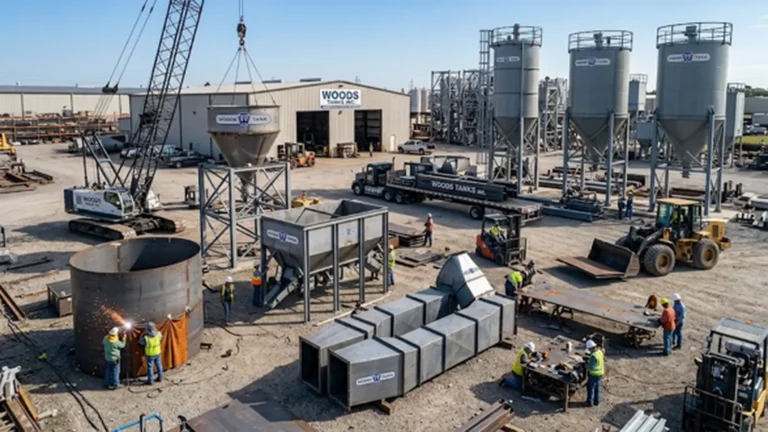
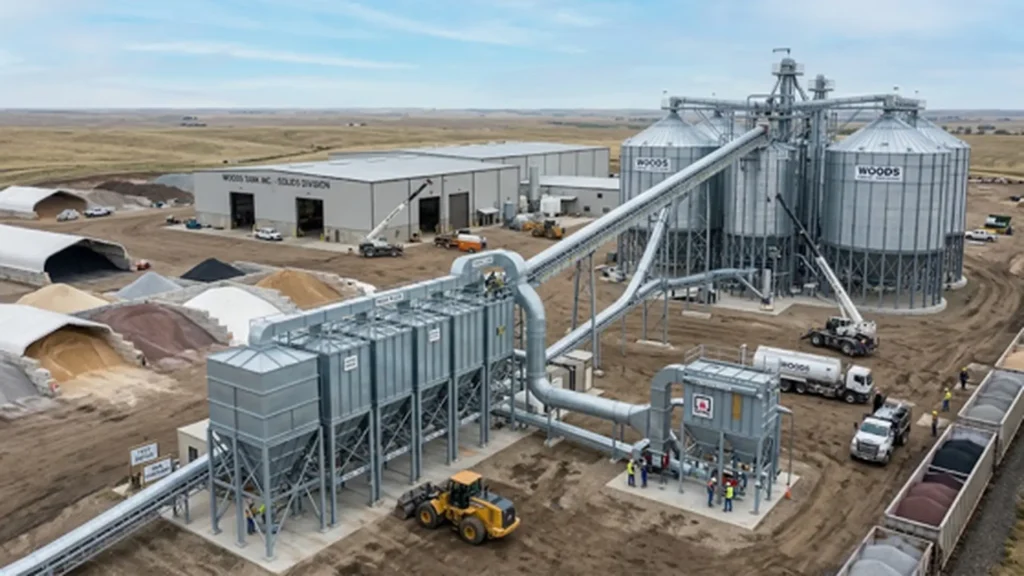
The main advantage of custom manufacturing is not that it allows for building equipment of unusual dimensions, but that it facilitates integration between process needs, structural conditions, and physical constraints of the facility. Under this context, the company Woods Tank Inc offers its comprehensive services for the manufacturing, construction, and repair of storage tanks, provided by certified welders who prioritize safety and excellent customer service.
Woods Tank Inc. constitutes an example of a manufacturer offering this type of capability. The company includes bins, hoppers, silos, chutes, ductwork, platforms, and other structural elements among its specialized fabrication services (Woods Tank Inc., n.d.).
Its relevance to bulk solids handling resides in the possibility of addressing several related components within the same scope of fabrication. A hopper, for instance, may require supports, platforms, access structures, chutes, and connections to other equipment. However, the quality of such a solution does not depend exclusively on the supplier’s manufacturing capability.
The engineering specification must clearly define the material to be stored, available flow properties, capacity, design conditions, geometry, loads, materials of construction, welding, tolerances, inspection, coatings, instrumentation, and safety requirements.
It is this information that transforms custom fabrication into an engineering solution rather than merely a special metallic part.
Combustible dust and NFPA 660
Safety takes on additional importance when the handled solid can generate combustible dust.
Organic materials such as flour, sugar, starch, wood, and coal, as well as certain metals and chemical products, can present fire or deflagration hazards when sufficiently fine particles are dispersed in the air under specific conditions. OSHA warns that even materials that do not burn easily in bulk form can exhibit explosive behavior when finely divided and suspended in adequate concentrations (OSHA, 2009).
The risk is not limited to the interior of a silo. Transfer points, elevators, conveyors, filters, dust collectors, and surfaces where dust accumulates are also focal points.
The historical magnitude of the problem demonstrates its importance. The U.S. Chemical Safety and Hazard Investigation Board (CSB, 2006) identified 281 combustible dust-related incidents in the United States between 1980 and 2005, resulting in 119 fatalities and 718 injuries.
The 2025 edition of NFPA 660, Standard for Combustible Dusts and Particulate Solids, serves as a central reference for facilities that process or handle combustible particulate solids. The standard consolidates requirements into a single document that were previously distributed across different NFPA combustible dust standards (National Fire Protection Association [NFPA], 2025).
One of the fundamental concepts is the Dust Hazard Analysis (DHA). Its purpose is to evaluate where combustible dust can be generated or accumulate, what ignition sources might be present, what scenarios could develop, and what prevention or protection measures are appropriate.
Depending on the process and evaluation results, measures such as dust collection, ignition source control, housekeeping, grounding and bonding, explosion isolation, venting, suppression, or other applicable safeguards may be considered. Therefore, it would be incorrect to state that all silos require the exact same protection system. The equipment’s structural and design characteristics must derive from actual service conditions.
The value of custom manufacturing
Bulk solids handling demonstrates that apparently simple equipment can involve complex engineering challenges. A silo is not merely an enclosed volume; a hopper is not simply a metal cone; and a chute should not be conceived solely as a transition between two pieces of equipment.
Properties such as cohesion, friction, bulk density, moisture, particle size distribution, and abrasiveness dictate the required geometry, flow pattern, discharge dimensions, materials of construction, and maintenance requirements. When these variables are ignored and selection is based solely on capacity or initial cost, the likelihood of blockages, reduced useful capacity, segregation, wear, and process shutdowns increases.
Custom manufacturing gains value precisely because it transforms engineering information into a configuration tailored to a specific facility. Companies with capabilities to manufacture silos, bins, hoppers, chutes, and related structures, such as Woods Tank Inc., can participate in that construction phase; however, the success of the equipment still depends on engineering having correctly defined the requirements.
References
- ASTM International. (2022). ASTM D6128-22: Standard test method for shear testing of bulk solids using the Jenike shear tester. https://doi.org/10.1520/D6128-22
- Jenike & Johanson. (s. f.). Mass flow or funnel flow—What do you have? Retrieved September 23, 2026, from https://jenike.com/mass-flow-funnel-flow/
- National Fire Protection Association. (2025). NFPA 660: Standard for combustible dusts and particulate solids. https://www.nfpa.org/codes-and-standards/nfpa-660-standard-development/660
- Occupational Safety and Health Administration. (2009). Hazard communication guidance for combustible dusts (OSHA 3371-08 2009). U.S. Department of Labor. https://www.osha.gov/publications/3371combustible-dust
- Schulze, D. (2021). Powders and bulk solids: Behavior, characterization, storage and flow (2.ª ed.). Springer. https://doi.org/10.1007/978-3-030-76720-4
- U.S. Chemical Safety and Hazard Investigation Board. (2006). Combustible dust hazard study (Report No. 2006-H-1). https://www.csb.gov/combustible-dust-hazard-investigation/
- Woods Tank Inc. (s. f.). Specialty fabrication in Louisiana. Retrieved September 23, 2026, from https://woodstank.net/specialty-fabrication-in-louisiana/


