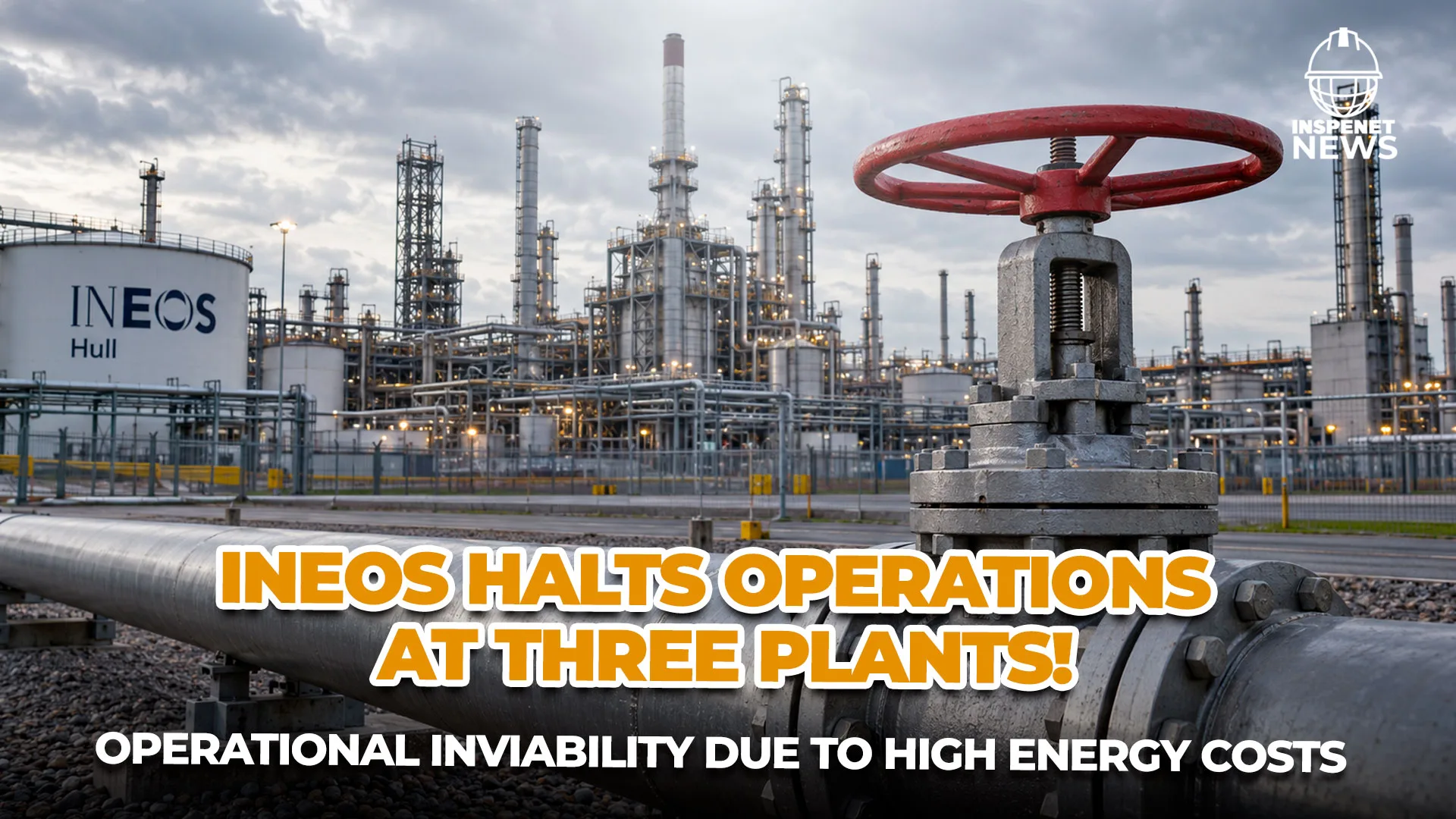
Ineos halts three chemical plants due to high energy costs
Ineos announced the suspension of operations at three chemical plants in Hull, UK, due to rising energy costs impacting industrial production in Europe. The decision reflects the pressure faced by companies with high gas and electricity consumption .
In addition, the facilities are involved in the manufacture of products used in pharmaceuticals, clothing, cosmetics, detergents, construction materials, and explosives. The three plants together employ nearly 4,000 people.
Ineos halts production at three Hull facilities
The company explained that high operating costs have reduced the ability of these plants to compete with producers located in the United States and China.
The problem is also linked to the sharp rise in energy prices in Europe in recent years. The energy crisis stemming from the Russian invasion of Ukraine increased the cost of gas and electricity for much of European industry.
Subsequently, tensions in the Middle East added pressure on energy markets ; this scenario has particularly affected sectors that need large amounts of energy to maintain their production processes.
Gas prices increase pressure on Ineos
Furthermore, the data cited in the report show a significant difference between the British and American markets.
British gas futures are trading around $23.51 per million British thermal units (MMBTU). Meanwhile, the US benchmark Henry Hub gas is around $2.84 per MMBTU.
Thus, the energy difference affects the production costs of companies like Ineos and reduces the margin to compete on price against manufacturers from other regions.
Europe is losing ground to the United States and China
Jim Ratcliffe, president of Ineos, pointed out that the price of gas paid by European industry is much higher than that recorded in its main competitor markets.
According to Ratcliffe, gas currently costs about 12 times more than in the United States and around eight times more than in China. The company believes this difference is weakening the position of European manufacturing.
However, these comparisons represent Ineos' assessment of the conditions facing its business. Price differences may vary depending on the market, the contract used, and the period analyzed.
Chemical plants supply various industries
Furthermore, the suspension has implications that extend beyond Ineos' direct operations. The products manufactured at these facilities are part of supply chains used by various sectors.
These include the pharmaceutical industry, clothing manufacturing, cosmetics, detergents, and construction materials.
For this reason, a prolonged reduction in production could increase dependence on supplies from other regions if European demand remains strong.
Thousands of jobs are linked to the facilities
At the same time, the labor component represents another relevant aspect of the decision; the three facilities related to the announcement employ almost 4,000 people.
Although the shutdown directly affects production activity, the ultimate impact on employment will depend on how long the suspensions last and the alternatives the company can find.
In this context, Ineos is exploring options to reduce its exposure to European energy prices. Among the possibilities mentioned is the supply of liquefied natural gas from the United States.
Ineos questions energy costs and carbon taxes
On the other hand, Ratcliffe directed his criticism towards European energy policy ; the businessman believes that the combination of high energy costs and emissions-related taxes increases the pressure on manufacturers.
From Ineos' perspective, these costs make it difficult to maintain certain industrial operations within Europe when other regions offer cheaper energy conditions.
At the same time, the debate poses a challenge for European governments, as authorities seek to reduce emissions while trying to prevent energy-intensive industries from shifting production or investment to lower-cost markets.
The European chemical industry faces increasing pressure
Ultimately, Ineos' decision reflects a broader problem for the European chemical industry. The price of gas has a significant impact on processes that require heat, electricity, and raw materials derived from hydrocarbons.
When that cost increases for extended periods, companies can reduce production, suspend facilities, or seek new sources of supply.
In the case of Ineos, the shutdown of three chemical plants in Hull shows how energy costs can alter industrial decisions and affect competitiveness against the United States and China.
News of additional interest
Dialog activates US$81 million oil project
Malaysian company Dialog Resources has given the green light to the development of the RAJA Cluster, an offshore project valued at US$81 million off Terengganu. The company made the final investment decision after confirming the project's technical and commercial viability. Furthermore, it received approval for the development and abandonment plan from Malaysia Petroleum Management, an entity affiliated with Petronas.
RAJA has estimated reserves of 6.1 million barrels and will be operated entirely by Dialog. The contract has a 14-year term and includes two years of development before the planned start of commercial production. To execute the project, the company plans to use its own resources and external financing. Dialog already has experience with this type of field and also operates the Baram Junior and Mutiara clusters in Malaysia.
EU and Norway clash over Arctic oil
The European Union plans to maintain its rejection of new oil and gas projects in the Arctic despite pressure from Norway. Oslo advocates for new exploration to sustain supply for the next decade. The debate is gaining momentum because the Nordic country was projected to supply 31% of the EU's gas imports in 2025 and has become more important following the sharp reduction in Russian energy purchases.
Norway warns that several of its fields are maturing and that production could decline during the 2030s without new developments. For this reason, it expanded its 2026 licensing round with 70 blocks or parts of blocks, including 38 in the Barents Sea. Brussels holds a different view: these projects would take years to produce, and Europe should need less gas thanks to renewable energy, electrification, and greater efficiency. According to the Commission, European gas demand fell by 19% between August 2022 and January 2026.
Tokyo is preparing its large port terminal for 2035
The Port of Tokyo is preparing a major renovation of its Oi Container Terminals with a target completion date of 2035. The plan includes automation, artificial intelligence, and digital processes to streamline cargo handling. Measures include automated cranes, truck access reservations, and the use of digital platforms to reduce turnaround times and improve operations.
The project also proposes expanding the terminal by approximately 40% by incorporating nearby land. The docks will be deeper to accommodate container ships of up to 150,000 deadweight tons. This is complemented by the electrification of equipment, the use of green electricity, and the installation of solar power. With these measures, Tokyo aims to reduce CO₂ emissions associated with cargo handling by more than 90%.
AI monitors hidden corrosion in oil plants
CorrosionRADAR received an award at the 2026 Oil & Gas Saudi Awards for its technology to monitor corrosion under insulation in oil and gas facilities. The solution combines sensors with artificial intelligence and predictive analytics to detect conditions that can promote deterioration in pipelines and equipment. This type of corrosion is difficult to identify because it progresses beneath the insulation and can remain unseen during operation.
The technology is already in use at Aramco facilities in Saudi Arabia. According to CorrosionRADAR, continuous monitoring covers approximately 50% of the Ju'aymah plant, including pipes, risers, and cooling units. Furthermore, Aramco began incorporating sensors as part of the construction of a new facility in 2026. The coverage and performance data disclosed so far is primarily from the vendor and should be considered in light of that information.