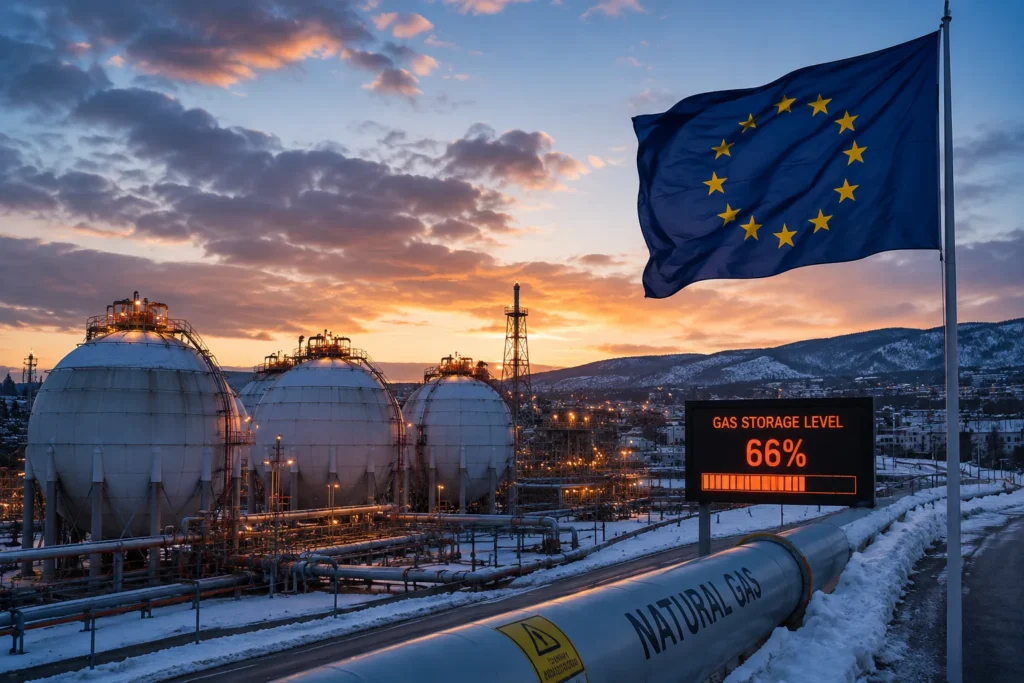
Europe gas storage is entering a critical phase of the injection season. European Union facilities are approximately 66% full, the lowest level for this time of year in nearly two decades and considerably below the five-year average of more than 80%.
The gap increases the need to secure additional gas molecules ahead of the 2026–2027 winter. However, Europe must do so while international liquefied natural gas (LNG) availability remains tight and Asian buyers are also preparing for the seasonal increase in demand. The result is a market in which storage, prices, and cargo availability are becoming increasingly interconnected.
Why is Europe gas storage so low?
The current situation is the result of several factors that accumulated throughout 2026. The demand required to rebuild inventories coincided with high electricity consumption during periods of hot weather and constraints on international LNG availability.
Price dynamics have also played a role. During much of the summer, gas contracts for immediate delivery traded above later-dated contracts, a market structure that reduced the economic incentive to buy gas in the present and store it for use several months later.
Pressure had already begun to emerge months earlier. Inspenet reported that European natural gas prices increased as pressure to replenish storage intensified, in a scenario shaped by international LNG availability.
Europe needs to accelerate injections before winter
A storage level of 66% does not mean that Europe is close to running out of gas. The issue lies in the available safety margin for dealing with months of high consumption.
According to calculations cited by OilPrice, Europe would need to purchase more than USD 8.1 billion worth of gas at current prices just to reach a storage level of 75%. The need to accelerate injections introduces an additional variable: the closer winter gets, the less time remains to rebuild inventories.
A particularly cold season could accelerate withdrawals, while an insufficient recovery in reserves would force the market to rely even more heavily on continuous imports during the months of highest demand.
LNG becomes the main balancing variable
Europe has domestic production, pipeline gas, and imports from different sources, but LNG provides essential flexibility when the system needs to rapidly increase supply.
The challenge is that these cargoes are part of a global market. Inspenet previously analyzed how Europe increased its dependence on U.S. LNG following disruptions in the international market. U.S. shipments came to represent around 60% of European LNG imports in that scenario.
This availability becomes particularly important when flows from other major exporters decline. Restrictions affecting supply from the Middle East have reduced the volume of LNG available to the spot market, while maritime routes continue to influence the ability to move cargoes. The issue takes on greater significance because Qatar and the United Arab Emirates together account for a substantial share of global LNG trade that normally transits the Strait of Hormuz.
Europe and Asia compete again for LNG cargoes
Current economic conditions favor sending some spot cargoes to Europe rather than Asia. That advantage, however, can change rapidly.
As the Northern Hemisphere winter approaches, both markets need to secure supplies for heating, power generation, and industry. If global availability remains limited, buyers will have to offer sufficiently attractive prices to redirect flexible cargoes toward their terminals.
This competition has already been observed. Inspenet reported that LNG prices in Asia exceeded USD 18 per MMBtu while Europe competed for spot cargoes in a constrained international market.
Therefore, the spread between European and Asian benchmarks will be a determining factor in deciding where available cargoes ultimately sail.
Winter will test the flexibility of the European system
The risk facing Europe does not depend exclusively on the storage percentage. The speed at which inventories can be replenished, LNG availability, regasification capacity, pipeline flows, and, ultimately, the severity of the winter also matter.
Below-average storage reduces the buffer available to withstand periods of high demand or new supply disruptions.
European infrastructure has demonstrated its ability to reorganize gas flows, but growing dependence on the international LNG market introduces a different type of exposure: Europe must compete for molecules that can be redirected to other buyers when they offer better economic conditions.
Europe gas storage will therefore be one of the key energy indicators to watch over the coming months. Rather than simply reaching a specific percentage, the challenge will be to enter winter with enough flexibility to respond to changes in temperature, prices, and global availability without compromising continuity of supply.
Source: Oil Price