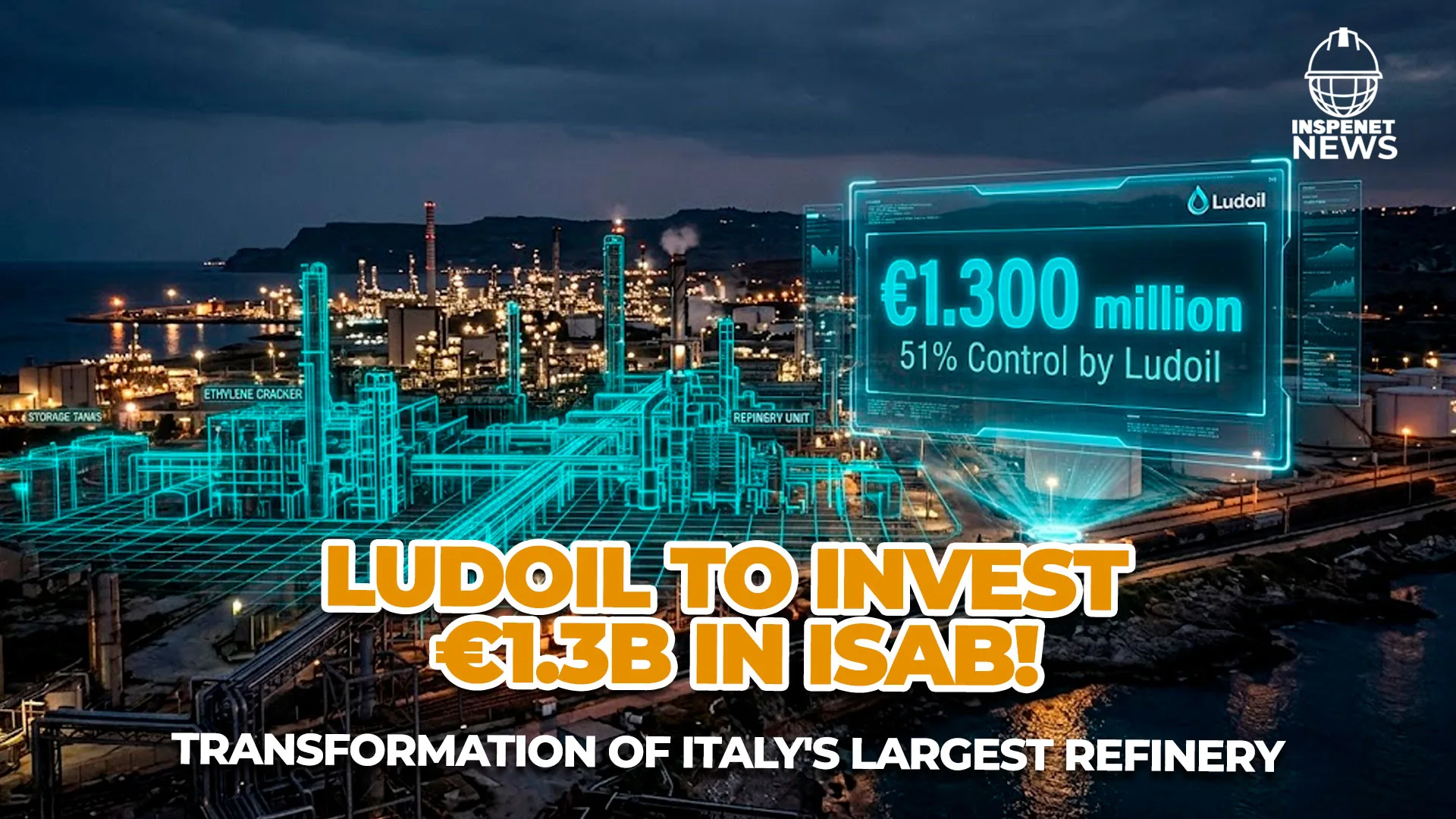
ISAB Refinery: Ludoil allocates €1.3 billion to its modernization
The ISAB Refinery enters a new industrial phase after Ludoil acquired 51% of the complex. The company plans to invest around €1.3 billion over the next five years to recover processing capacity, modernize facilities and expand its production towards renewable fuels.
The program will take place at the facilities located between Priolo, Melilli and Syracuse, in Sicily. ISAB concentrates more than 20% of Italy's refining capacity, so the execution of the project will be relevant both for the complex and for the country's refined product supply system.
Furthermore, the plan combines two lines of action: Ludoil intends to recover conventional units that were out of service while preparing part of the infrastructure to produce SAF, HVO and other biofuels.
Ludoil will allocate €1.3 billion to the ISAB Refinery
The industrial program comes after Ludoil Capital completed its acquisition of 51% of ISAB from GOI Energy. The transaction gives the company industrial management of the Sicilian complex.
Based on this new structure, Ludoil plans to invest approximately €1.3 billion in CAPEX over five years. The program will primarily focus on existing infrastructure, allowing for the refurbishment of facilities without developing a new refining complex from scratch.
In this way, refinery modernization takes center stage in the strategy. Instead of replacing conventional facilities, the project seeks to leverage existing assets, improve their operation, and progressively adapt some of them to new energy market needs.
Which ISAB units will be reactivated and modernized?
Part of the investment will be directed to units that can modify the capacity and production profile of the complex.
At Priolo Norte, the reactivation and modernization of the primary distillation unit and the hydrodesulfurization (HDS) unit are planned. The latter allows for the reduction of sulfur content in certain streams through processes using hydrogen.
Meanwhile, the planned interventions for the southern area include solvent deasphalting (SDA) and a thermal cracking unit. These facilities allow for the treatment and valorization of heavy fractions within the refining scheme.
However, restoring these assets requires more than simply putting the equipment back into operation. The units must undergo mechanical condition checks, auxiliary systems inspections, instrumentation tests, industrial service checks, and commissioning procedures before being reintegrated into the process.
The ISAB Refinery will expand its SAF and HVO production
At the same time, the program envisions progressively increasing the presence of renewable fuels within ISAB.
co-processing renewable raw materials in the Priolo Norte FCC unit in July 2026. This scheme allows the introduction of certain renewable raw materials into infrastructure that is already part of the conventional refining system.
The products under consideration include biogasoline and sustainable aviation fuel (SAF). The new industrial program also incorporates hydrocarbons (HVO) into its diversification strategy.
The roadmap proposes leveraging existing equipment first and then moving towards dedicated facilities. This will allow ISAB to maintain some of its traditional operations while incorporating new processing lines.
The investment seeks to restore existing capacity.
Unlike building a completely new facility, Ludoil proposes to develop brownfield assets. This approach can leverage infrastructure, connections, and services already available within the complex.
In addition, primary distillation recovery, HDS, SDA, and thermal cracking can expand ISAB's processing options. Each unit fulfills a different function within the conversion and treatment of the streams that pass through a refinery.
The expected result is a complex with a greater capacity to process raw materials and obtain distillates with lower sulfur content while gradually increasing the presence of products with lower carbon intensity.
However, the €1.3 billion corresponds to investments planned for a period of five years, therefore, the additional capacity will depend on the progress of the works, the commissioning of the units and their subsequent operational performance.
ISAB maintains its presence in the Italian energy supply.
Furthermore, the size of the complex amplifies the implications of the project; the ISAB Refinery represents more than a fifth of Italy's refining capacity, so recovering units could influence the availability of refined products within the market.
The acquisition also went through the corresponding regulatory procedures in Italy and Europe, including the Italian Golden Power mechanism, used to review certain operations related to assets considered strategic.
On the other hand, the change of control does not mean that ISAB will cease to be linked to international markets; the complex maintains a long-term supply and marketing agreement with Trafigura until 2033.
Under this agreement, Trafigura supplies crude oil and other raw materials to the facility and purchases approximately 90% of its refined petroleum products. Therefore, the new industrial phase will remain connected to international supply and marketing chains.
The program will have effects on industrial employment
The execution of the works will require personnel for engineering, construction and logistics activities, according to the plan released by Ludoil, the investments could involve around 1,000 additional workers during the five years of development.
Once the interventions are completed, the operation of the new facilities and the recovered units could require approximately 100 additional specialized technicians and operators.
The impact on employment will be linked to the pace of each project's execution and the commissioning of the facilities. The recovery of industrial assets will also require personnel with experience in operation, maintenance, safety, and process control.
Modernization will gradually change ISAB's profile
Finally, Ludoil's program proposes that the ISAB Refinery maintain conventional refining while expanding its participation in chains associated with SAF, HVO and other renewable fuels.
This combination will allow for the use of existing infrastructure instead of relying exclusively on new plants. It can also extend the use of certain assets while the European market increases its requirements regarding emissions and fuel characteristics.
Over the next five years, progress can be measured through the effective reactivation of the announced units, the recovery of processing capacity, and the increase in production associated with renewable raw materials.
Therefore, the program's ultimate scope will depend on its implementation. The €1.3 billion establishes the scale of the planned investment, while the commissioning and performance of the units will determine how much ISAB's capacity and production profile actually change.
News of additional interest
Aphrodite is back in the game: Shell is aiming for 2027
Shell and the National Gas Company (NGC) have reached a commercial agreement that will allow the reactivation of the Aphrodite gas field in Trinidad and Tobago. The project had been delayed due to disagreements over gas prices. With that issue resolved, the companies expect to receive their first gas during the second quarter of 2027. The field could reach a peak production of approximately 107 million cubic feet per day.
Aphrodite was discovered in 2022 and will utilize an offshore well connected to existing facilities in the area. This will allow the gas to be delivered via the Dolphin A platform without developing a completely new pipeline. The project complements other sources that NGC is seeking to secure, including approximately 300 billion cubic feet (Bcf) from the Coconut project. Some of these new volumes will help supply the local petrochemical industry as Trinidad and Tobago attempts to recover its gas supply after years of declining production.
Aramco is preparing new routes to protect its oil.
Saudi Aramco asserts it can restore operations within days in the event of potential disruptions and maintain supply to its customers. Chairman and CEO Amin Nasser explained that the oil company is exploring the possibility of establishing a fourth and fifth crude oil export route. It is also considering increasing its storage capacity outside of Saudi Arabia, including in Japan, to provide more alternatives in the event of short-term problems.
Currently, Aramco can transport oil through the Strait of Hormuz and use the East-West pipeline to access the Red Sea. From there, it also has the option of using the Sumed pipeline, which crosses Egypt and connects the Red Sea to the Mediterranean. Nasser indicated that the company is conducting technical and feasibility studies for new routes while also holding discussions to expand its storage capacity in Japan.
New York adds 1.7 GW of energy and storage
New York awarded eight energy storage projects and 13 renewable energy developments that will add nearly 1.7 GW of capacity. According to NYSERDA , the package will mobilize more than $3.7 billion in private investment and create over 1,000 jobs. The renewable projects will contribute more than 719 MW through solar, onshore wind, and hydroelectric power, enough to supply more than 230,000 homes annually.
Storage will play a significant role in the plan. Eight lithium-ion battery storage facilities will add up to 950 MW and have discharge times of between four and eight hours. They will be distributed from New York and Long Island to the Hudson Valley and western New York State. All must be operational by the end of 2030 and comply with the storage safety codes that went into effect in January 2026. NYSERDA is also preparing another call for bids to move toward contracting 3 GW of large-scale storage.
Petronas LNG adds a new LNG carrier to its fleet
Petronas LNG took delivery of the Puteri Kelantan , a new liquefied natural gas carrier built by Hudong-Zhonghua Shipbuilding in China. The vessel was delivered on September 24 and belongs to a joint venture led by the Japanese shipping company “K” LINE. This is the third vessel of its type delivered to Petronas LNG in 2026, following two others commissioned between May and June.
The expansion will continue in November with the scheduled delivery of the sister ship Puteri Negeri Sembilan . The new vessels will allow Petronas LNG to expand its LNG transport capacity and better serve its customers. For K LINE, these additions are also part of its strategy to increase long-term gas transport contracts.