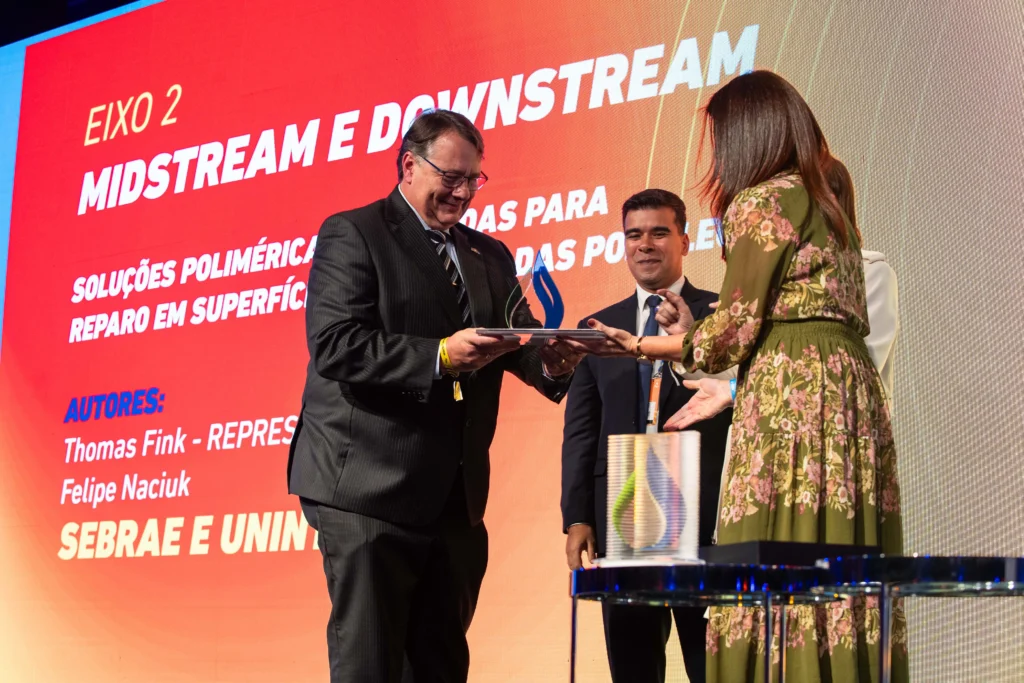
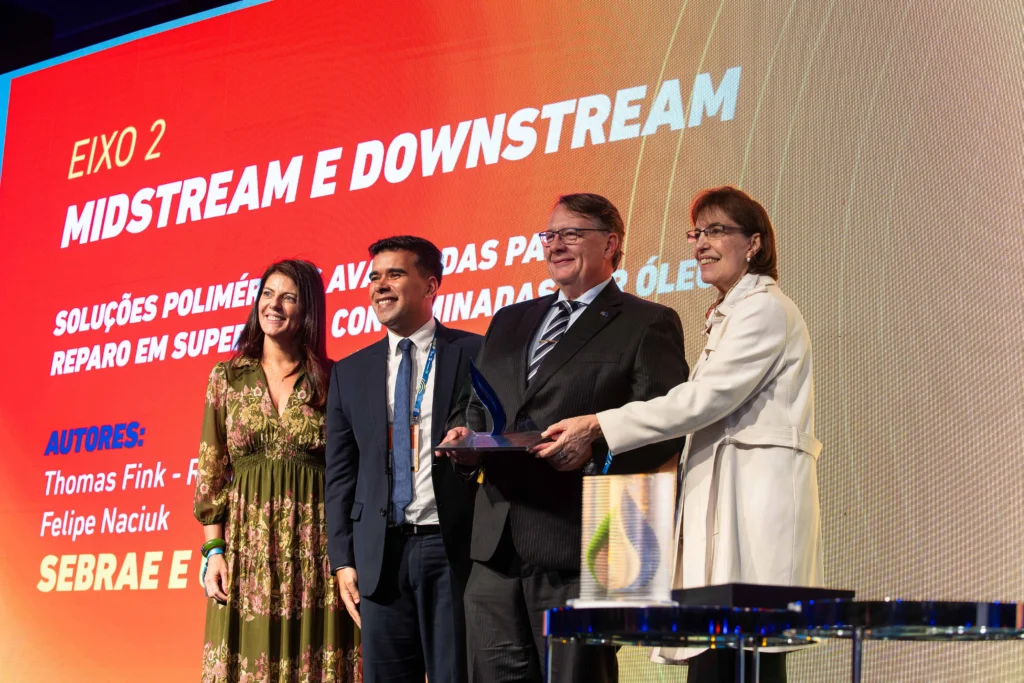
The ADA technology (Active Direct Adhesion) received the Plínio Cantanhede Award during ROG.e 2026 this Thursday, September 24, in Rio de Janeiro, for a development focused on composite material repairs on oil-contaminated surfaces. The recognition highlights a Brazilian solution that aims to reduce the challenges associated with surface preparation and downtime during certain mechanical integrity interventions.
The work Soluções Poliméricas Avançadas para Reparo em Superfícies Contaminadas por Óleo was developed by Thomas Fink, founder and CEO of TecnoFink, with engineer Felipe Naciuk, an anticorrosive coatings specialist and Global Technical Manager at PowerPoxi, as co-author. Before the result was announced, TecnoFink had confirmed that the research was among the finalists for the award.
The award presented during the closing day of ROG.e makes the recognition the main newsworthy development of the story. The Brazilian Petroleum, Gas and Biofuels Institute (IBP) states that the Plínio Cantanhede Award recognizes the best works presented at the ROG.e Congress, following an evaluation process that considers aspects such as relevance, applicability, maturity and alignment with industry needs.
ADA Technology Enables Repairs on Oil Contaminated Surfaces
One of the main challenges of a repair using polymeric systems is achieving adequate adhesion between the material and the substrate. The presence of oil, grease and other contaminants can affect this bond and require cleaning and surface preparation operations before the intervention can be performed.
ADA technology was developed specifically to address this problem. Its objective is to enable epoxy polymer based systems to develop adhesion on contaminated surfaces, reducing the need for intensive prior surface preparation.
The technology has technical precedents that predate ROG.e 2026. A paper presented by Felipe Naciuk at AMPP LATINCORR + Panamerican Corrosion describes ADA as a technology incorporated into epoxy polymers to achieve a strong bond on contaminated substrates. The system studied also incorporates ceramic and metallic fillers to improve mechanical properties and resistance to abrasion and erosion.
Thomas Fink and Felipe Naciuk had also presented research at AMPP Conference 2025 specifically focused on the possibility of repairing contaminated surfaces that cannot be cleaned using conventional procedures.
Tank Repair Reportedly Reduced From 15 Days to Less Than One Hour
The operational potential of the technology is reflected in one of the cases reported by its developers. A repair on an oil storage tank that could have required approximately 15 days using a conventional intervention was reportedly completed in less than one hour using the developed solution.
In that specific case, the estimated cost of a conventional intervention, which could have reached approximately R$1.5 million, was reportedly reduced to a range of R$10,000 to R$15,000, according to information provided by those responsible for the technology.
These figures correspond to the specific case reported by the developers and do not represent times or costs automatically applicable to other repairs. The scope of an intervention depends on variables such as the type and extent of damage, geometry, operating conditions, pressure, temperature, loads and engineering requirements.
The industrial relevance lies in another variable: downtime. In certain scenarios, a conventional repair may require taking the asset out of service, draining it, decontaminating it, preparing the surface and mobilizing resources before beginning the repair. Reducing some of these stages could significantly decrease the total duration of an intervention.
How Does Active Direct Adhesion Work?
ADA seeks to modify one of the traditionally limiting conditions of bonded repairs: substrate contamination. Published technical research on Active Direct Adhesion explains that the system aims to achieve a durable bond directly on contaminated substrates without relying on intensive prior cleaning. The studies presented include performance test results and applications focused on equipment and pipelines in industries such as Oil & Gas, petrochemicals and energy.
TecnoFink had also indicated before ROG.e that the work presented at the congress includes field applications and laboratory tests involving repairs performed under conditions in which the presence of oil makes material adhesion difficult.
This does not mean that surface preparation ceases to be relevant for all repairs. The innovation focuses on expanding the conditions under which certain polymeric systems can develop adhesion when contamination represents an operational limitation.
ISO 24817 and ASME PCC-2 Maintain a Fundamental Role
Reducing the challenges associated with adhesion does not replace the engineering required to determine whether an in-service repair is suitable for an asset.
International references such as ISO 24817 and ASME PCC-2 establish methodologies used in the design and application of composite material repairs for piping and equipment. Among other variables, a solution must consider defect characteristics, substrate properties, geometry, loads, pressure, temperature and operating conditions.
Therefore, ADA technology can be understood as a tool aimed at overcoming a specific challenge related to adhesion on contaminated surfaces, while integrity assessment and repair design remain fundamental for determining its suitability for a specific application.
Award Recognizes a Technology Focused on Asset Integrity
The Plínio Cantanhede Award has a significant technical component. According to IBP, after three evaluation stages for the works submitted to the ROG.e Congress, a committee composed of industry professionals reevaluates the papers and their in-person presentations to select the winners.
The congress documentation itself defines the recognition around the technical contribution of the works presented for the oil and gas industry.
The recognition obtained by ADA therefore takes the discussion beyond the speed of a repair. For the Oil & Gas industry, the technical question is to determine the extent to which technologies capable of operating under adverse contamination conditions can reduce downtime, simplify interventions and lower costs while maintaining the engineering requirements necessary to protect asset integrity.
In operations where every hour out of service can have significant economic consequences, the possibility of expanding repair alternatives represents an area of development with a direct impact on maintenance, reliability and operational continuity.
Sources: IBP — Plínio Cantanhede Award | TecnoFink — ADA at ROG.e 2026 | AMPP LATINCORR — Active Direct Adhesion technical study | ROG.e — Congress documentation