Mechanical and asset integrity: technologies that transform inspection
Mechanical and asset integrity is undergoing a transformation driven by the digitization of inspections, the use of real-time data, and the incorporation of artificial intelligence into decision-making processes.
The change isn't just about inspecting with new tools. The goal is to transform technical data into reliable evidence that allows us to determine where to intervene, which risks to prioritize, and how to best utilize available resources throughout the asset lifecycle.
What is mechanical and asset integrity?
Mechanical and asset integrity is the set of technical processes used to maintain equipment and facilities in safe and reliable condition, through inspection, evaluation, risk management, maintenance, and evidence-based engineering decisions.
Its scope is evolving; it is no longer limited to verifying compliance with requirements or detecting discontinuities: it must also provide traceable information for decisions on reliability, operational continuity, maintenance, and risk management.
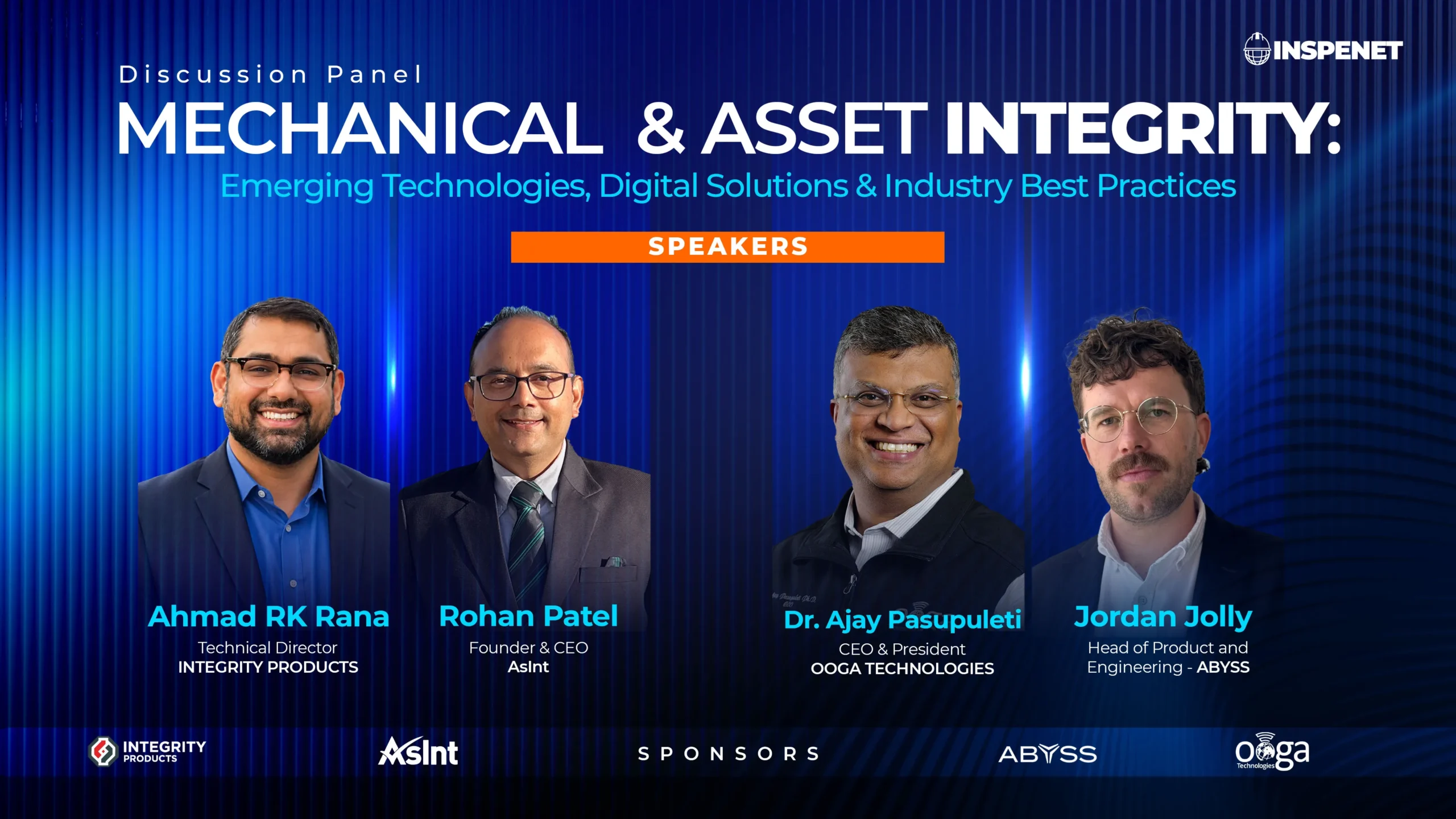
During a panel organized by Inspenet, specialists from UGA Technologies, AsInt, Integrity Products and Supplies and Abyss Solutions analyzed how this evolution is changing the way industrial assets are managed.
From inspection to a decision-making infrastructure
One of the main transformations occurs in non-destructive testing (NDT/NDE).
Traditionally, an inspection might conclude with a report documenting the acceptance or rejection of a condition. However, the information obtained can be much more valuable when integrated with engineering, maintenance, and risk management.
Ajay Pasupuleti, CEO and president of UGA Technologies , stated during the panel that reliable inspection evidence allows for more confident engineering decisions.
In a pipeline, for example, records obtained during construction can support subsequent decisions related to acceptance, repairs, critical engineering analyses, and regulatory oversight.
The challenge lies in ensuring the quality of that evidence.
Factors such as staff experience, working conditions, image quality, equipment knowledge, and human variability can affect results. Therefore, digital systems allow for secondary reviews and remote support in near real-time.
Remote inspection and faster decisions
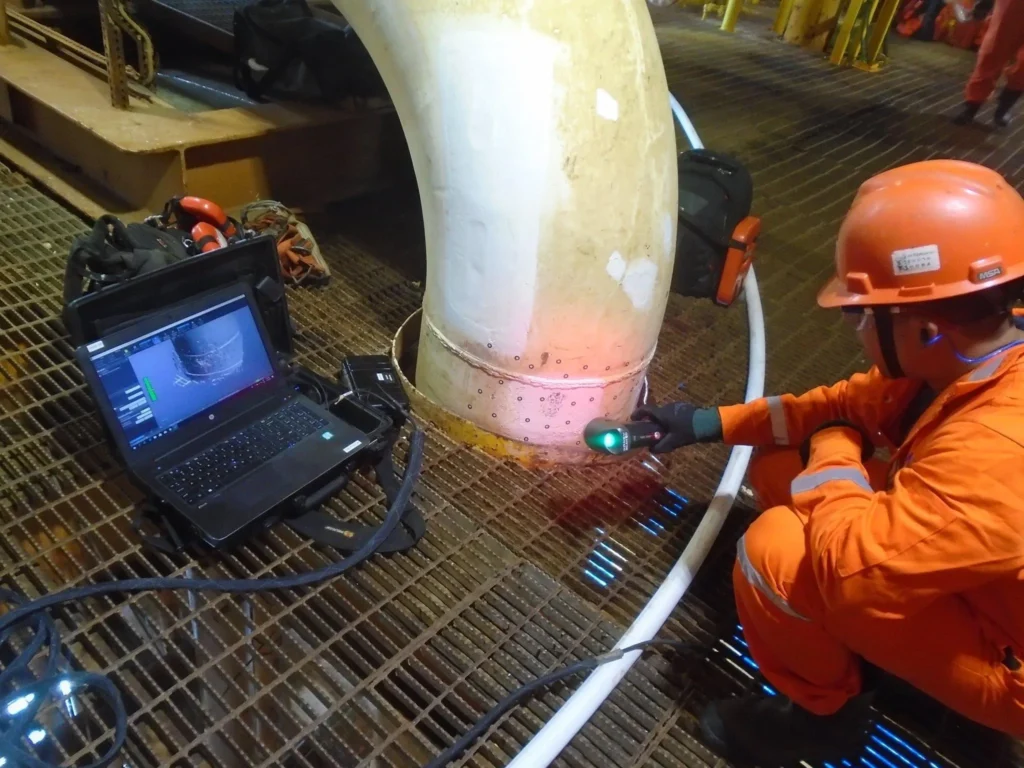
A connected model allows information captured in the field to be sent electronically for a second independent review.
In pipe weld radiography, for example, the data can be reviewed remotely by specialized personnel and even supplemented using artificial intelligence tools.
The operational advantage is significant: detecting a problem while personnel and equipment are still in the field makes it easier to repeat a takeover or correct a condition before construction progresses.
Digital inspection, therefore, does not only modify the capture of information. It reduces the distance between detection, review, and decision.
Artificial intelligence applied to asset integrity
The amount of information available presents another challenge.
Inspection histories, ERP systems, technical documents, P&IDs, condition data, and risk analysis can be found distributed across different platforms.
Rohan Patel, founder and CEO of AsInt, emphasized the importance of integrating this information into a centralized layer that facilitates asset decisions. The availability of structured data is a prerequisite for effectively leveraging artificial intelligence.
Within this environment, different applications can be distinguished:
- Predictive AI: uses historical information to identify patterns and make forecasts.
- Generative AI: synthesizes information and facilitates access to large volumes of knowledge.
- Agent AI: can execute sequences of tasks within predefined limits.
The difference is important because each application requires different controls and levels of supervision.
AI does not replace the engineer's judgment
One of the points of greatest consensus among the specialists was the role of people in this transformation.
Artificial intelligence can process information, reduce repetitive tasks and shorten the path to a decision, but technical responsibility must remain within a clearly defined engineering framework.
Patel summarized the principle by noting that AI can take over routine work, but not professional judgment; systems need clear boundaries, traceability of every step, and a person responsible for the outcome.
This is particularly relevant in asset integrity, where a decision can affect safety, production, maintenance, and operational availability.
Connected data to manage risk
Digitization becomes more valuable when data ceases to function as isolated records.
A management system can link inspection information with damage mechanisms, equipment condition, RBI strategies, Fitness-for-Service (FFS) assessments, and enterprise systems.
According to Patel, bringing engineering decisions closer to the data contained in ERP platforms allows integrity strategies to be connected with work orders and financial decisions.
This creates a more integrated sequence:
Inspect → centralize data → assess condition → analyze risk → decide → execute → provide feedback to the system.
The purpose is not to indiscriminately automate decisions, but to provide the specialist with better organized and contextualized information.
CUI: a challenge to mechanical integrity
Corrosion under insulation (CUI) continues to be one of the relevant deterioration mechanisms in thermally insulated assets.
Ahmad Rana, technical director of Integrity Products and Supplies, noted during the panel that CUI has been recognized for decades as a problem for various industrial sectors. He also explained the importance of properly maintaining condition monitoring points (CMLs) due to their influence on the reliability of data used in integrity programs.
The problem arises when moisture enters the insulation system.
An access point used for measurements can become a moisture entry point if it is not properly sealed. The resulting corrosion could develop even outside the area directly measured, reducing the representativeness of the measurements.
Therefore, the quality of a mechanical and asset integrity program depends not only on taking measurements, but also on maintaining the necessary conditions for those measurements to accurately represent the condition of the equipment.
CUI protection beyond the coating
Protective coatings are a widely used defense against CUI, although their performance depends on system conditions.
During the panel, Integrity Products and Supplies presented a multi-layered approach consisting of a PTFE separating membrane and an insulation ventilation system designed to facilitate drying.
The philosophy consists of acting on a fundamental variable: the presence of moisture.
Rana presented the case of pipes used in SAGD operations in Canada where the insulation remained damp despite high operating temperatures. After installing a ventilation system, the moisture could be physically observed escaping in sub-zero ambient conditions.
This type of solution shows how asset integrity can combine materials science, insulation design, and monitoring to manage degradation mechanisms.
Digital inspection to expand coverage
Another fundamental problem is how much of the asset can actually be observed during an inspection.
An inspector performing a conventional tour has physical limitations in observing elevated surfaces, areas behind equipment, or places with complex access.
Jordan Jolly, product and engineering manager at Abyss Solutions, explained how digital inspection using terrestrial laser scanners can complement the inspector's walkthrough and increase available coverage.
The goal is not to replace the inspector.
Digital systems allow for the recording of additional areas of the asset and the preservation of spatial information that can be analyzed again later.
This introduces two important features: repeatability and comparability.
AI to detect and classify corrosion
The combination of images, scanning, and artificial intelligence allows us to move from capture to condition classification.
Abyss explained that its models can use visual information to identify coating deterioration and subsequently analyze the substrate's condition. With appropriate sensors, the information can also support the characterization of areas requiring further evaluation.
However, detecting corrosion is only one part of the process.
The information must be related to the corresponding asset, engineering documentation and operational criticality in order to become a concrete action.
Therefore, the flow can be structured as follows:
| Stage | Aim |
|---|---|
| Digital capture | Record surfaces and conditions |
| Coverage | Determine which areas were observed |
| AI analysis | Identify conditions of interest |
| Contextualization | Linking results to equipment and documentation |
| Prioritization | Select areas based on condition and criticality |
| Specialized assessment | Apply NDE or other techniques where appropriate |
| Decision | Define inspection, repair, or maintenance |
The result is a digital inspection aimed at directing resources to the areas where they add the most value.
Measure how the asset changes over time
An additional advantage appears when digital inspections are repeated periodically.
Instead of only having independent photographs of the asset's condition, equivalent areas can be compared over several years.
Jolly presented a case where periodic evaluation allowed for linking maintenance investments to measurable changes in the condition of an offshore asset. According to the data shown during the presentation, the new deterioration of the analyzed coating decreased from approximately 30% to 14%.
The relevance lies not only in identifying deterioration.
Monitoring allows us to answer another question: Is the overall condition of the asset improving or worsening?
This perspective transforms asset integrity into a continuous process where inspection, maintenance, and condition can be analyzed together.
Technology and people: the new model of integrity
The interventions of the specialists converged on one principle: modernizing mechanical and asset integrity requires simultaneous investment in technology and human knowledge.
Remote inspection can increase the speed of the review process. Artificial intelligence can process amounts of information impossible to analyze manually. Digital inspection can expand coverage and improve repeatability.
But none of these tools eliminates the need for professionals capable of interpreting damage mechanisms, understanding the limitations of the data, and taking responsibility for decisions.
At the close of the meeting, the panelists emphasized the need to train teams and use emerging technologies as a complement to existing programs.
Mechanical and asset integrity is moving from programs based primarily on periodic inspections to connected systems capable of integrating NDT evidence, historical data, spatial information, artificial intelligence, and engineering decisions.
The value of this transformation lies not in fully automating asset management. It lies in generating more reliable evidence, expanding coverage, identifying trends, and enabling inspectors and engineers to focus their efforts where risk and condition truly demand it.