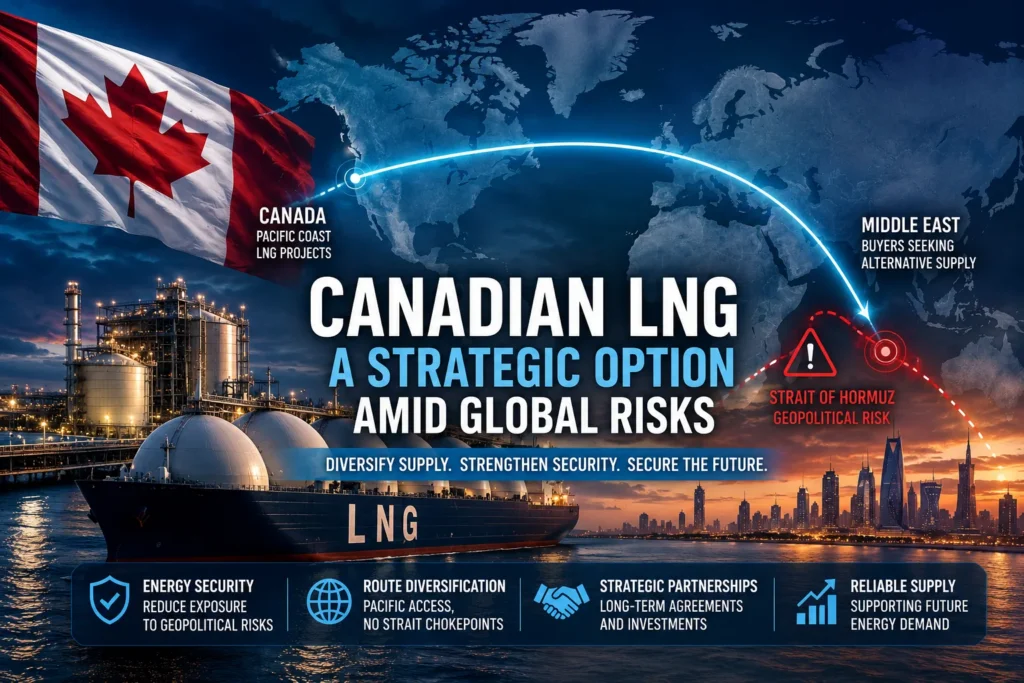
Canadian LNG is gaining unexpected strategic value in the international market. Middle Eastern buyers have begun exploring cargoes from Canada as an alternative to diversify their supply sources and reduce exposure to potential disruptions along critical routes such as the Strait of Hormuz.
The interest was confirmed by Ratnesh Bedi, president of Pacific Energy, the company that owns a 70% stake in Woodfibre LNG, a project currently under construction on Canada’s Pacific Coast. According to Bedi in comments to Reuters, the company is receiving inquiries from potential Middle Eastern buyers even though Woodfibre’s 2.1 million tonnes per annum (Mtpa) of capacity is already contracted to bp.
The development is significant because the Middle East is home to some of the world’s largest LNG producers and exporters. However, recent tensions associated with the conflict involving Iran and disruptions in the Strait of Hormuz are prompting buyers and suppliers to evaluate alternative routes capable of maintaining supply if a crisis affects traditional energy corridors.
Canadian LNG offers a route away from the Strait of Hormuz
Canada’s advantage does not depend solely on its abundant natural gas reserves. The location of projects in British Columbia provides direct access to the Pacific Ocean, allowing LNG to be transported to Asian markets without passing through some of the major geopolitical chokepoints that influence global energy trade.
This characteristic is becoming increasingly important as buyers incorporate contingency scenarios into their supply strategies.
According to Bedi, the shift involves securing commercial relationships and alternative sources before an emergency occurs, rather than relying exclusively on the spot market once a disruption has already triggered shortages or price volatility. Reuters reports that the Canadian government has also received expressions of interest from Middle Eastern companies seeking both to purchase LNG and participate through equity investments and offtake agreements.
For Canada, this trend could expand the commercial reach of an export industry that has primarily looked toward Asia and, more recently, Europe.
Woodfibre LNG attracts interest despite fully contracted capacity
Woodfibre LNG is being built near Squamish, British Columbia, and will have a production capacity of 2.1 Mtpa. The project is 70% owned by Pacific Energy and 30% by Enbridge. The company reported in March that all 19 of its major modules were expected to be on site during the spring and continues to target completion of construction in 2027.
Bedi said the current goal is to ship the first cargo in December 2027. The fact that potential customers continue to inquire about capacity even though the project’s planned output is already contracted highlights the growing interest in new sources of LNG supply.
However, these inquiries do not mean that Woodfibre currently has additional volumes available for sale. Nor has a decision been made to expand the facility. Pacific Energy acknowledged that an expansion could be considered in the future, but its immediate priority is to complete the project and bring it into operation.
The attention surrounding Woodfibre therefore serves as an indicator of a broader trend: buyers are evaluating not only LNG prices, but also geographic location, shipping routes, and the physical security of supply.
Canada expands its presence in the global LNG market
Woodfibre is not the only project attracting international interest. Ksi Lisims LNG, a proposed 12 Mtpa facility on the northwestern coast of British Columbia, reached an agreement in May with Germany’s SEFE to supply 1 Mtpa for up to 20 years. In June, Uniper signed a letter of interest covering another 2 Mtpa under a potential future long-term sales and purchase agreement.
European interest confirms that diversification is not limited to the Middle East. For buyers seeking to reduce their dependence on specific producers or maritime corridors, Canada’s west coast represents a new potential source of supply.
The Canadian government itself has made this expansion part of its energy strategy. Ottawa says LNG Canada is already exporting, while Woodfibre LNG and Cedar LNG remain under construction. It is also working with British Columbia and LNG Canada’s partners toward a potential final investment decision on Phase 2 during 2026.
Foreign investment is also increasing. MidOcean Energy agreed to acquire an interest in PETRONAS’ Canadian assets that includes indirect exposure to LNG Canada. MidOcean is backed by EIG and Saudi Aramco, adding Middle East-linked capital to the expansion of Canada’s LNG sector.
Supply security reshapes the appeal of Canadian LNG
Canada still faces obstacles in turning this growing interest into new projects. Developers continue to point to costs and lengthy regulatory processes as factors that can affect competitiveness and delay investment decisions. At the same time, the federal government is seeking to accelerate projects considered strategic for expanding energy exports.
However, the international landscape is changing the equation.
Competition among LNG suppliers no longer depends exclusively on production costs or the delivered price paid by buyers. The security of shipping routes, the political stability of suppliers, and the ability to access alternative cargoes during a crisis are becoming increasingly important factors in commercial decisions.
In this context, the fact that buyers from an exporting region such as the Middle East are evaluating Canadian supply is a significant signal. It does not mean that Canada will replace the large volumes originating from the Gulf, but rather that the market is beginning to assign greater value to the geographic diversification of LNG supply.
If Woodfibre LNG succeeds in starting exports in 2027 and projects such as Ksi Lisims and the expansion of LNG Canada continue to advance, Canada’s Pacific Coast could consolidate its position as a new strategic route within the global gas trade.
Sources: BOE Report / Reuters; Woodfibre LNG; Natural Resources Canada; Ksi Lisims LNG; MidOcean Energy.