Table of Contents
- Hidden risks in critical materials
- Why metallurgical quality matters?
- Limitations of conventional UT
- How immersion inspection works
- Sensitivity and automation in inspection
- Standards and traceability in QA/QC
- Operational and economic benefits
- Applications in energy and heavy industry
- What does this mean in practice?
- The future of automated metallurgical inspection
- Conclusions
- References
- Frequently asked questions
Immersion inspection has become an increasingly important solution for improving quality assurance and mechanical integrity in critical manufacturing processes. In industries such as metallurgy, Oil & Gas, and heavy manufacturing, internal discontinuities in bars and billets and forged components can evolve into operational failures, unplanned downtime, and costly reliability issues.
As industrial standards demand greater repeatability, traceability, and inspection consistency, advanced immersion inspection offers a more stable ultrasonic coupling method and improved inspection sensitivity. Its compatibility with automated scanning and advanced ultrasonic technologies also supports more reliable quality assurance practices for critical materials used in high-risk industrial environments.
Hidden risks in critical materials
In critical industrial environments, the reliability of a component often depends on discontinuities that cannot be detected visually during manufacturing. Small defects generated during the metallurgical process may remain hidden until the material is exposed to pressure, vibration, cyclic loads, or corrosive conditions in service. In sectors such as Oil & Gas and heavy manufacturing, these hidden risks directly affect operational safety, reliability, and long-term asset performance.
How internal defects can reach operation
Defects such as inclusions, porosity, laminations, internal cracking, and other metallurgical discontinuities may remain undetected inside critical metallic materials, forgings, piping systems, pressure vessels, valves, and subsea components if inspection quality is insufficient. Under demanding operating conditions, these discontinuities can propagate and eventually compromise the performance of critical equipment.
Impact on integrity and reliability
Undetected defects can affect mechanical integrity, increase operational risk, and generate unplanned downtime or premature failures. In many industrial operations, rejected materials, production delays, and indirect repair costs are linked to insufficient inspection repeatability and traceability. This is why advanced immersion inspection and reliable metallurgical quality control practices are becoming increasingly important for reducing uncertainty in critical manufacturing environments.
Why metallurgical quality matters?
The reliability of critical industrial assets often depends on the metallurgical consistency of materials throughout the metallurgical process and manufacturing stages. In sectors such as Oil & Gas, power generation, and heavy industry, even minor internal discontinuities in raw materials can compromise long-term performance, safety, and inspection reliability. This is why advanced inspection reliability practices, and traceability practices have become essential throughout the supply chain.
The role of bars and billets in critical manufacturing
Bars and billets are widely used as base materials for manufacturing valves, pressure-containing components, piping systems, forgings, and structural parts exposed to demanding operational conditions. Their metallurgical integrity directly influences the mechanical performance of the final component, especially in applications involving pressure, cyclic loading, or corrosive environments.
Metallurgical quality and traceability
Modern QA/QC programs increasingly rely on material traceability, manufacturing records, heat numbers, and quality dossiers to validate compliance and reduce operational uncertainty. In this context, advanced immersion ultrasonic testing technologies help improve inspection consistency and support more reliable verification of critical materials before they enter service in industrial operations.
Limitations of conventional UT
In the context of non-destructive testing, as manufacturing environments demand higher inspection consistency and production efficiency, conventional ultrasonic testing methods can present significant operational limitations. Manual inspection processes often depend heavily on operator technique, coupling stability, and inspection conditions, creating variability that affects repeatability and overall QA/QC reliability in critical applications.
Variability of manual coupling
Conventional UT inspections frequently rely on manual couplants and direct probe contact, making signal quality sensitive to operator pressure, surface conditions, geometry, and coupling consistency. These variations can generate inconsistent ultrasonic responses and reduce inspection repeatability, particularly when evaluating complex geometries or large volumes of semi-finished metallic materials. In critical manufacturing environments, limited repeatability may affect defect detection reliability and increase uncertainty during industrial QA/QC processes.
Restrictions for industrial automation
Traditional UT methods may also face limitations in high-throughput manufacturing environments where automated inspection and inline integration are increasingly required. Inspection speed, scanning consistency, and robotic compatibility can become difficult to maintain when manual positioning and variable coupling conditions are involved. As industrial operations move toward digital QA/QC and smart manufacturing, these restrictions create challenges for achieving stable inspection performance and scalable automation.
Table 1. Conventional UT vs. Immersion Inspection
| Characteristic | Conventional UT | Immersion inspection |
| Coupling | Manual and variable | Stable water coupling |
| Repeatability | Operator dependent | High repeatability |
| Automation | Limited | Compatible with automated scanning |
| Sensitivity | Variable | More consistent |
| Inline integration | Complex | More efficient |
How immersion inspection works
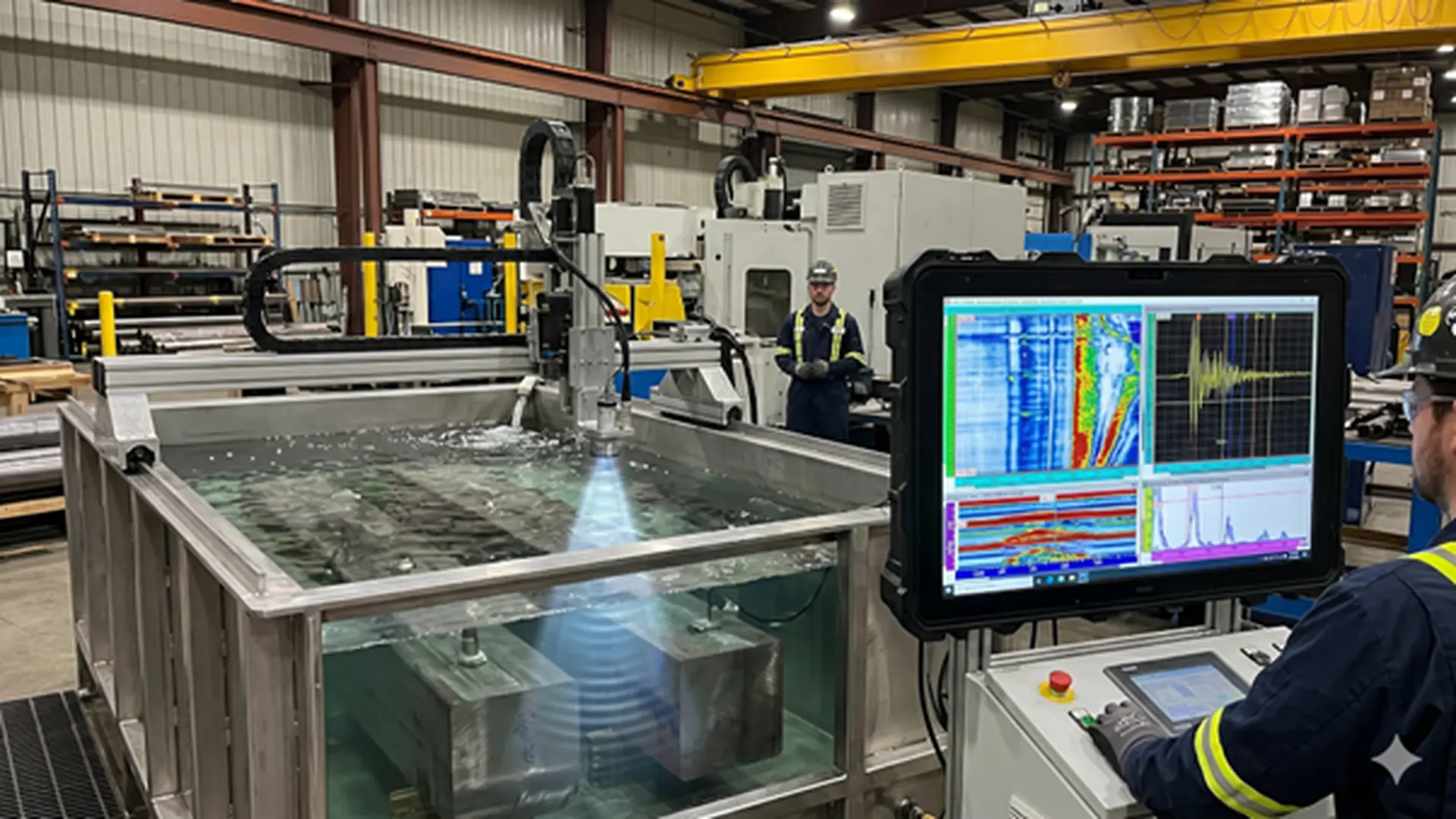
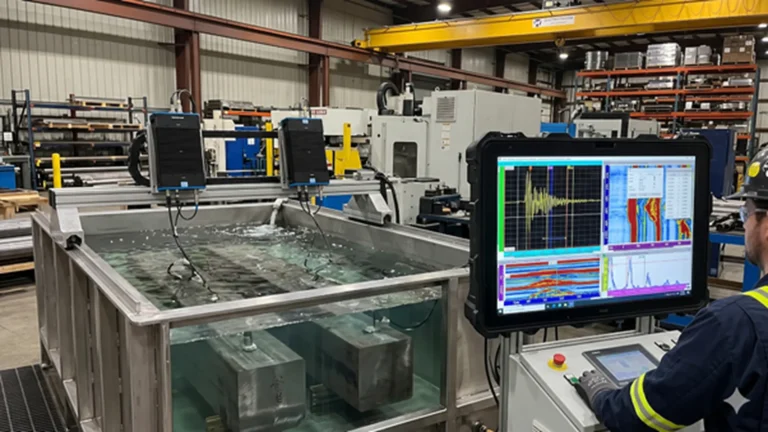
Unlike conventional ultrasonic testing methods that rely on direct probe contact, immersion inspection uses water as a controlled transmission medium between the transducer and the inspected component.
This approach improves coupling stability, inspection consistency, and scanning repeatability, especially when evaluating complex geometries or large volumes of critical materials in automated manufacturing environments.
Immersion coupling and stable ultrasonic transmission
In immersion ultrasonic testing, the transducer and the inspected component remain separated by a water path that acts as a stable acoustic medium. This immersion coupling method minimizes signal variability caused by inconsistent probe pressure or surface conditions, allowing more reliable ultrasonic transmission throughout the inspection process.
Stable coupling conditions are particularly important when inspecting bars and billets, forgings, and pressure components where inspection repeatability directly affects defect detection reliability. By reducing coupling inconsistencies, immersion systems help improve sensitivity and maintain more uniform inspection coverage across the scanned material.
Automation and high-precision scanning
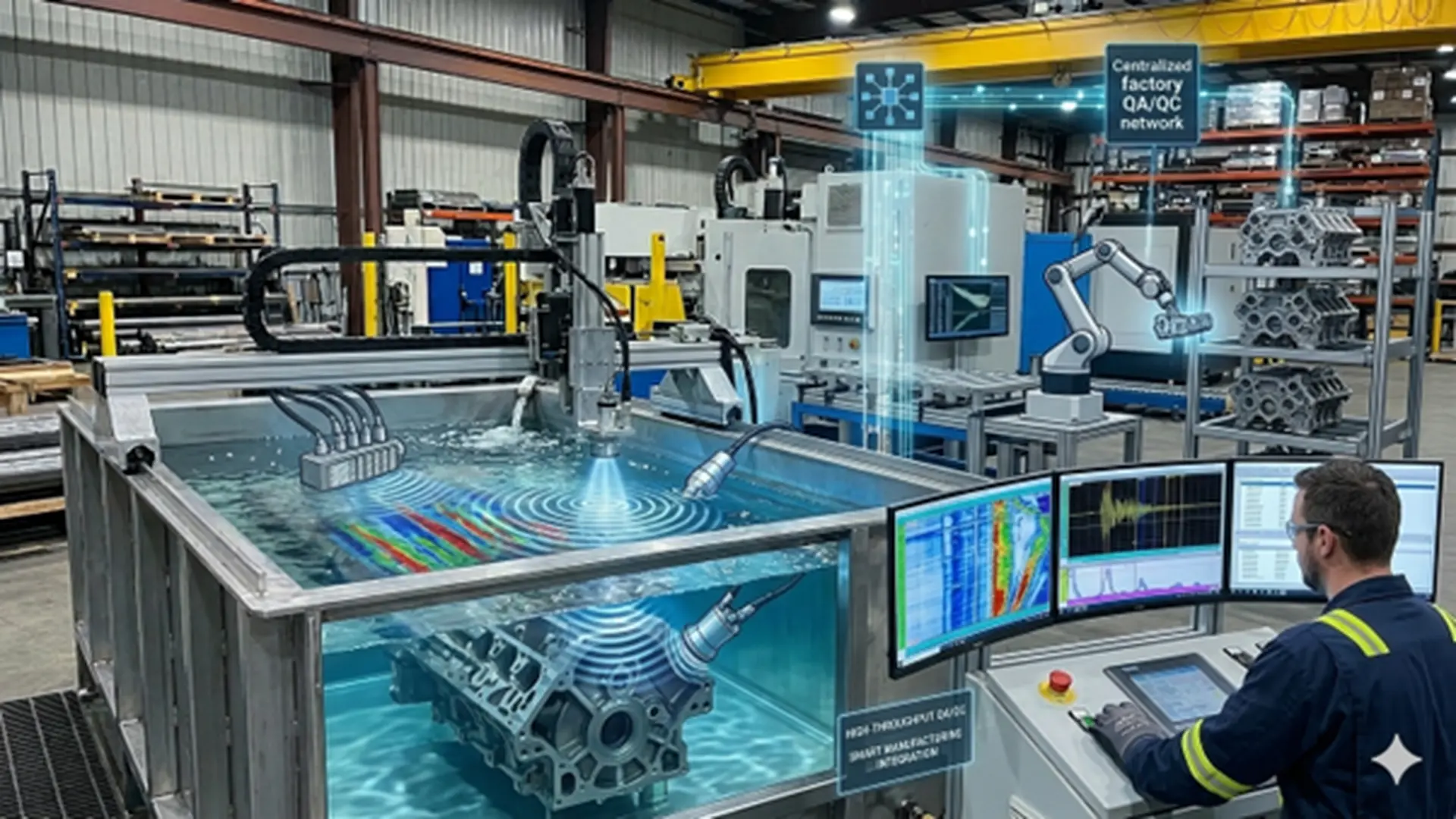
Modern immersion inspection systems are also designed to support automated scanning and advanced ultrasonic technologies such as phased array ultrasonics (PAUT), Full Matrix Capture (FMC), and the Total Focusing Method (TFM).
These capabilities improve imaging quality, increase inspection precision, and provide more consistent evaluation of internal discontinuities.
Automated immersion scanning allows uniform coverage and high repeatability during inspections, making it suitable for high-throughput manufacturing environments and digital QA/QC processes.
Combined with high-speed data acquisition systems, this approach supports more efficient inspection workflows and better integration with industrial automation and smart manufacturing strategies.
The following TPAC video demonstrates how automated immersion ultrasonic inspection systems improve sensitivity, repeatability, and data acquisition in critical metallurgical and industrial applications.
Sensitivity and automation in inspection
As industrial manufacturing moves toward higher reliability and digital QA/QC processes, inspection sensitivity and automation have become essential for detecting internal discontinuities with greater consistency. Modern immersion inspection systems are designed not only to improve ultrasonic performance, but also to support high-throughput manufacturing environments where repeatability, traceability, and inspection speed directly impact operational efficiency.
Detection of internal discontinuities
One of the main advantages of automated immersion inspection is its ability to improve sensitivity and repeatability during inspections of critical materials. Using reference reflectors such as Flat Bottom Holes (FBH), immersion systems can evaluate detection performance under controlled and stable coupling conditions. This approach supports more reliable defect detection and helps reduce signal variability during inspections of critical metallic components, forgings, and pressure-containing components.
High-speed data acquisition
Modern automated inspection platforms increasingly incorporate high-speed acquisition technologies to improve scanning efficiency and inspection consistency. Solutions such as the TPAC Explorer Max combine automated immersion scanning with 10G throughput capabilities, enabling rapid ultrasonic data acquisition for demanding industrial applications. This type of integration supports faster inspections, improved repeatability, and more efficient evaluation of critical components within automated manufacturing environments.
Integration with advanced manufacturing
Automated immersion inspection is also becoming part of Industry 4.0 and smart manufacturing strategies. Its compatibility with inline inspection systems, robotics, and digital QA/QC workflows allows manufacturers to improve inspection consistency while supporting scalable industrial automation and more efficient production processes.
Table 2. Industrial capabilities of immersion inspection
| Function | Industrial benefit |
| Stable coupling | Higher repeatability |
| Automated scanning | Increased productivity |
| High sensitivity | Improved internal defect detection |
| 10G throughput | Faster data acquisition |
| Robotic integration | Advanced manufacturing compatibility |
Standards and traceability in QA/QC
As industrial sectors demand greater inspection reliability and material traceability, compliance with recognized ultrasonic testing standards has become essential for QA/QC programs and critical manufacturing processes.
In industries such as Oil & Gas, metallurgy, and heavy manufacturing, inspection procedures must demonstrate repeatability, sensitivity, and documented consistency to support safe operation and regulatory compliance.
Compliance with codes and standards is key to supporting procedures, acceptance criteria, and document traceability.
Standards applicable to ultrasonic inspection
Several international standards establish technical requirements for ultrasonic inspection and material evaluation in industrial environments. ASTM E127 is commonly used for Flat Bottom Hole (FBH) reference blocks and sensitivity verification, while ASTM A388 defines ultrasonic examination practices for steel forgings. ASME Section V provides requirements for industrial non-destructive examination procedures, and ISO 16810 establishes general principles for ultrasonic testing applications.
For automated immersion inspection systems, these standards are especially relevant because stable coupling conditions and controlled scanning improve inspection repeatability and support more consistent defect detection during critical inspection processes.
QA/QC and validation of critical materials
Modern QA/QC programs increasingly rely on documented inspection processes to validate critical materials before they enter service. Acceptance testing, supplier qualification, procurement QA/QC, and audit readiness all depend on reliable inspection records and traceable manufacturing documentation.
In this context, advanced immersion inspection technologies support more consistent evaluation of critical raw materials and forgings, and pressure components by improving inspection repeatability and reducing variability.
This contributes to stronger quality dossiers, improved supplier confidence, and more reliable verification of materials used in high-risk industrial applications.
The selection of the NDT technique depends on the material, the type of defect, the geometry, and the acceptance criteria
Table 3. Standards to industrial ultrasonic inspection
| Standard | Application | Relation to immersion inspection |
| ASTM E127 | FBH reference blocks | Sensitivity verification |
| ASTM A388 | Steel forgings | Internal discontinuity detection |
| ASME Section V | Industrial NDT | QA/QC procedures |
| ISO 16810 | UT principles | Inspection requirements |
Operational and economic benefits
Beyond inspection performance, modern immersion inspection technologies can deliver measurable operational and economic advantages across industrial manufacturing environments. By improving inspection consistency, repeatability, and automation, manufacturers can reduce uncertainty during QA/QC processes while strengthening reliability in critical production stages.
Operational benefits
One of the main operational advantages of immersion ultrasonic testing is the reduction of inspection variability during the evaluation of critical materials. Stable inspection conditions and automated scanning help minimize rejected components, reduce rework, and improve repeatability across high-volume inspections of critical materials, forgings, and pressure components.
Automated inspection workflows also contribute to higher productivity by supporting faster scanning speeds and more uniform inspection coverage. In industries where manufacturing continuity and quality assurance are critical, improved inspection consistency can strengthen inspection consistency and support more reliable production processes.
Economic benefits and risk reduction
More reliable inspection processes can also reduce operational risk and improve long-term cost efficiency. Early detection of internal discontinuities helps prevent unplanned downtime, premature failures, and costly material rejection during manufacturing or commissioning stages.
In addition, improved traceability and inspection repeatability support stronger acceptance testing and more reliable supplier validation processes. By reducing uncertainty during QA/QC and procurement activities, advanced immersion inspection technologies contribute to lower quality-related costs and greater confidence in critical materials used in demanding industrial applications.
Table 4. Operational impact of immersion inspection
| Area | Expected impact |
| QA/QC | Higher repeatability |
| Production | Reduced rejection rates |
| Mechanical integrity | Lower operational uncertainty |
| Procurement | More reliable material validation |
| Manufacturing | Improved automation efficiency |
Applications in energy and heavy industry
The growing demand for reliable materials and traceable manufacturing processes has expanded the use of immersion inspection across multiple industrial sectors. Industries operating under high pressure, cyclic loads, and strict QA/QC requirements increasingly rely on automated ultrasonic inspection technologies to improve defect detection, repeatability, and material validation throughout critical manufacturing stages.
Applications in Oil & Gas
In the Oil & Gas sector, immersion ultrasonic testing is commonly applied to the inspection of OCTG materials, piping systems, valves, subsea equipment, and pressure-containing components. These assets operate under demanding environmental and mechanical conditions where internal discontinuities can compromise long-term reliability and operational safety.
By improving inspection sensitivity and repeatability, immersion systems help strengthen QA/QC processes and support more reliable evaluation of materials before installation or service.
Applications in metallurgy and heavy manufacturing
In metallurgy and heavy manufacturing, immersion inspection is widely used for evaluating forgings, bars and billets, structural materials, and critical aerospace alloys. Steel mills, heavy fabrication facilities, and advanced manufacturing environments increasingly integrate automated inspection systems to improve production consistency and support more reliable metallurgical quality control processes.
Table 5. Industrial applications of immersion inspection
| Industry | Typical components |
| Oil & Gas | OCTG, valves, piping |
| Petrochemical | Pressure systems |
| Metallurgy | Billets and bars |
| Aerospace | Critical alloys |
| Energy | Structural components |
What does this mean in practice?
For industrial operators and manufacturers, the quality of the raw materials or products supplied to their customers directly affects the mechanical integrity of industrial assets subjected to pressure, corrosion, or cyclic loads, and the value of immersion inspection goes far beyond ultrasonic performance. Its real impact is reflected in greater QA/QC reliability, improved traceability, and increased confidence in the validation of critical materials before they enter service.
In sectors where operational continuity and compliance are essential, inspection consistency becomes directly connected to risk reduction and long-term asset reliability.
What changes for QA/QC and procurement
For QA/QC and procurement teams, advanced immersion ultrasonic testing improves repeatability and supports more reliable material acceptance processes. Stable inspection conditions and automated scanning contribute to stronger quality dossiers, better supplier validation, and more consistent traceability records during manufacturing and procurement activities involving bars and billets and other critical components.
What changes for operational integrity
From an operational perspective, improved inspection consistency helps reduce uncertainty related to internal material discontinuities. This strengthens mechanical integrity, lowers the risk of premature failures, and improves confidence in components operating under demanding industrial conditions such as pressure systems, subsea applications, and critical process equipment.
The future of automated metallurgical inspection
As industrial manufacturing continues evolving toward digitalization and smart production environments, automated inspection technologies are becoming increasingly important for improving reliability, traceability, and quality assurance.
In this context, immersion inspection is no longer viewed only as a specialized NDT method, but as part of a broader industrial strategy focused on operational efficiency and data-driven QA/QC processes.
Digitalization and intelligent inspection
Modern inspection systems increasingly integrate digital acquisition, automated analysis, and advanced ultrasonic imaging technologies to improve decision-making and inspection consistency. Combined with automated scanning and stable coupling conditions, these capabilities support more efficient metallurgical quality control processes and help manufacturers strengthen traceability across critical production stages.
Automation and industrial reliability
The integration of robotics, inline inspection, and smart manufacturing technologies is also transforming how industries approach quality assurance. Automated immersion inspection systems allow manufacturers to improve repeatability, reduce operational uncertainty, and support more reliable evaluation of critical materials used in high-performance industrial applications.
Conclusions
Modern industrial operations require inspection technologies capable of improving repeatability, traceability, and reliability throughout critical manufacturing processes.
In this context, immersion inspection has evolved beyond a conventional non-destructive testing method and is now considered a strategic tool for strengthening QA/QC programs, supporting mechanical integrity, and reducing operational uncertainty in high-risk industrial environments.
By combining stable ultrasonic transmission, automated scanning, and advanced ultrasonic technologies, immersion systems help manufacturers improve the evaluation of bars and billets, forgings, and pressure components used in Oil & Gas, metallurgy, and heavy industry.
These capabilities contribute to more reliable metallurgical quality control, stronger documentation practices, and improved material validation before components enter service.
As industries continue adopting digital QA/QC and smart manufacturing strategies, companies such as TPAC are helping advance automated immersion ultrasonic inspection for critical industrial applications.
Are you looking to improve the traceability and reliability of your critical materials? Discover how TPAC’s automated immersion inspection solutions enhance QA/QC in critical manufacturing.
References
- ASTM International. ASTM E127-20: Standard practice for fabrication and control of flat-bottomed hole ultrasonic standard reference blocks. ASTM International.
- ASTM International. ASTM A388/A388M-23: Standard practice for ultrasonic examination of steel forgings. ASTM International.
- International Organization for Standardization. ISO 16810:2024: Non-destructive testing — Ultrasonic testing — General principles. ISO.
- The Welding Institute. (n.d.). What is ultrasonic immersion testing? TWI Global.
- The Phased Array Company. (n.d.). Non destructive testing in metallurgy. TPAC. https://thephasedarraycompany.com/industries/metallurgy/
- The Phased Array Company. (n.d.). Ultrasonic testing equipment: TPAC NDT products. https://thephasedarraycompany.com/products/
- Inspenet. (2025, October 8). Explorer de TPAC: ultrasonido compacto para inspección NDT. https://inspenet.com/inspenet-tv/explorer-inspeccion-ultrasonica-compacta/
Frequently asked questions
What is immersion ultrasonic testing?
Immersion ultrasonic testing is a non-destructive testing method that uses water as a stable transmission medium between the transducer and the inspected component to improve inspection consistency and sensitivity.
Why are billets inspected with UT?
Bars and billets are inspected to detect internal discontinuities such as inclusions, porosity, laminations, and cracks before the material is used in critical industrial components.
How does immersion coupling improve inspection quality?
Immersion coupling provides more stable ultrasonic transmission, reducing signal variability and improving repeatability during automated inspections.
What industries use immersion inspection?
Industries such as Oil & Gas, metallurgy, petrochemical, aerospace, energy, and heavy manufacturing use immersion inspection for critical material evaluation and QA/QC processes.
What is the difference between conventional UT and immersion UT?
Conventional UT uses direct probe contact and manual coupling, while immersion ultrasonic testing uses water coupling for more stable, automated, and repeatable inspections.
Why is repeatability important in metallurgical QA/QC?
High repeatability improves inspection consistency, reduces uncertainty, and supports more reliable metallurgical quality control and material validation processes.