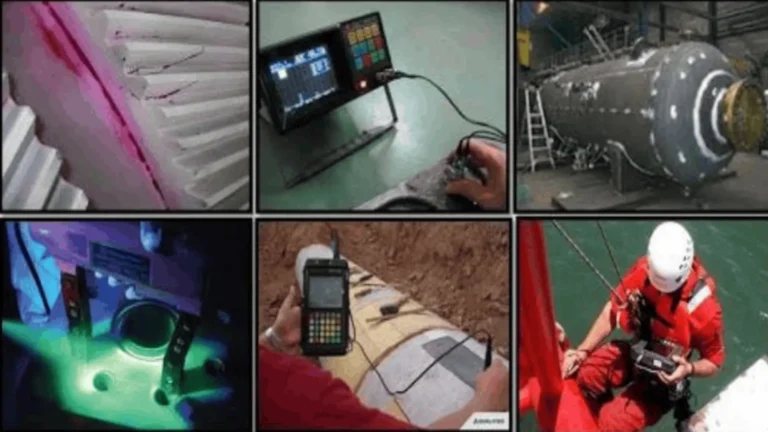
The types of Non Destructive Testing in industry form the technical foundation for evaluating the integrity of materials and equipment without compromising their operation. These techniques allow the detection of defects, monitoring of degradation, and ensuring the reliability of assets in highly demanding sectors.
In the context of asset integrity, corrosion prevention, and industrial maintenance, understanding the different types of NDT is essential for selecting the appropriate technique and optimizing inspection processes.
Classification of Non Destructive testing types
The types of Non Destructive Testing in industry are classified according to the physical principle they use to detect discontinuities or changes in materials.
Among the main categories are methods based on mechanical waves, electromagnetic radiation, electrical properties, and capillary phenomena. Each offers specific advantages depending on the type of defect and material being evaluated.
This classification allows engineers to select the most appropriate technique according to the damage mechanism, whether it is corrosion, fatigue, erosion, or structural cracks.
Ultrasound (UT): internal measurement precision
Ultrasound is one of the most widely used types of Non Destructive Testing in industry due to its high precision in thickness measurement and detection of internal discontinuities.
It works by propagating acoustic waves through the material, allowing the identification of changes in internal structure. It is widely applied in corrosion prevention in pipelines and pressure vessels.
Its main advantage is the ability to generate reliable quantitative data, essential for condition-based industrial maintenance programs.
Industrial Radiography (RT): volumetric inspection
Industrial radiography allows visualization of the interior of materials using ionizing radiation, making it key for detecting internal defects such as porosity or inclusions.
This method is highly valued in welds and critical components where structural integrity is essential for operational safety.
Although it provides detailed inspection, it requires strict radiological safety measures, which may limit its use under certain operational conditions.
Penetrant Testing (PT): surface detection
Penetrant testing is an effective method for detecting surface-breaking discontinuities, such as fine cracks or porosity.
This type of NDT is based on capillarity, allowing a visible or fluorescent liquid to penetrate surface defects, making them easier to identify.
It is widely used in fast and low-cost inspections, complementing other techniques in asset integrity programs.
Magnetic Particle Testing (MT): high sensitivity
Magnetic particle testing allows the detection of surface and near-surface discontinuities in ferromagnetic materials.
The method consists of applying a magnetic field to the material and observing the accumulation of particles in areas where discontinuities exist.
Its high sensitivity makes it a key tool for inspecting critical components subjected to cyclic stresses.
Eddy Current Testing (ECT): advanced inspection
Eddy current testing is mainly used for inspecting conductive materials, especially in heat exchangers and tubing.
This method allows defect detection without direct contact, making it ideal for fast and automated inspections.
In addition, it is highly effective in detecting corrosion and wear, contributing to process optimization and reduced inspection times.
Comparison table of NDT types
| Technique | Type of defect | Main application | Advantage |
|---|---|---|---|
| UT (Ultrasound Testing) | Internal | Pipes, tanks | High precision |
| RT (Radiographic Testing) | Internal | Welds | Complete internal image |
| PT (Penetrant Testing) | Surface | Metal components | Low cost |
| MT (Magnetic Particle Testing) | Surface / subsurface | Steels | High sensitivity |
| ECT (Eddy Current Testing) | Surface / internal | Tubes | Fast inspection |
This table clearly illustrates the capabilities of each technique within the types of Non Destructive Testingn industry.
Selection of technique according to application
The selection of Non Destructive Testing types in industry depends on multiple factors: material type, accessibility, damage mechanism, and operating conditions.
For example, ultrasound is ideal for thickness measurement, while radiography is preferred for volumetric inspection. In contrast, PT and MT are more suitable for surface defects.
A correct selection allows maximizing inspection efficiency and improving the reliability of industrial maintenance programs.
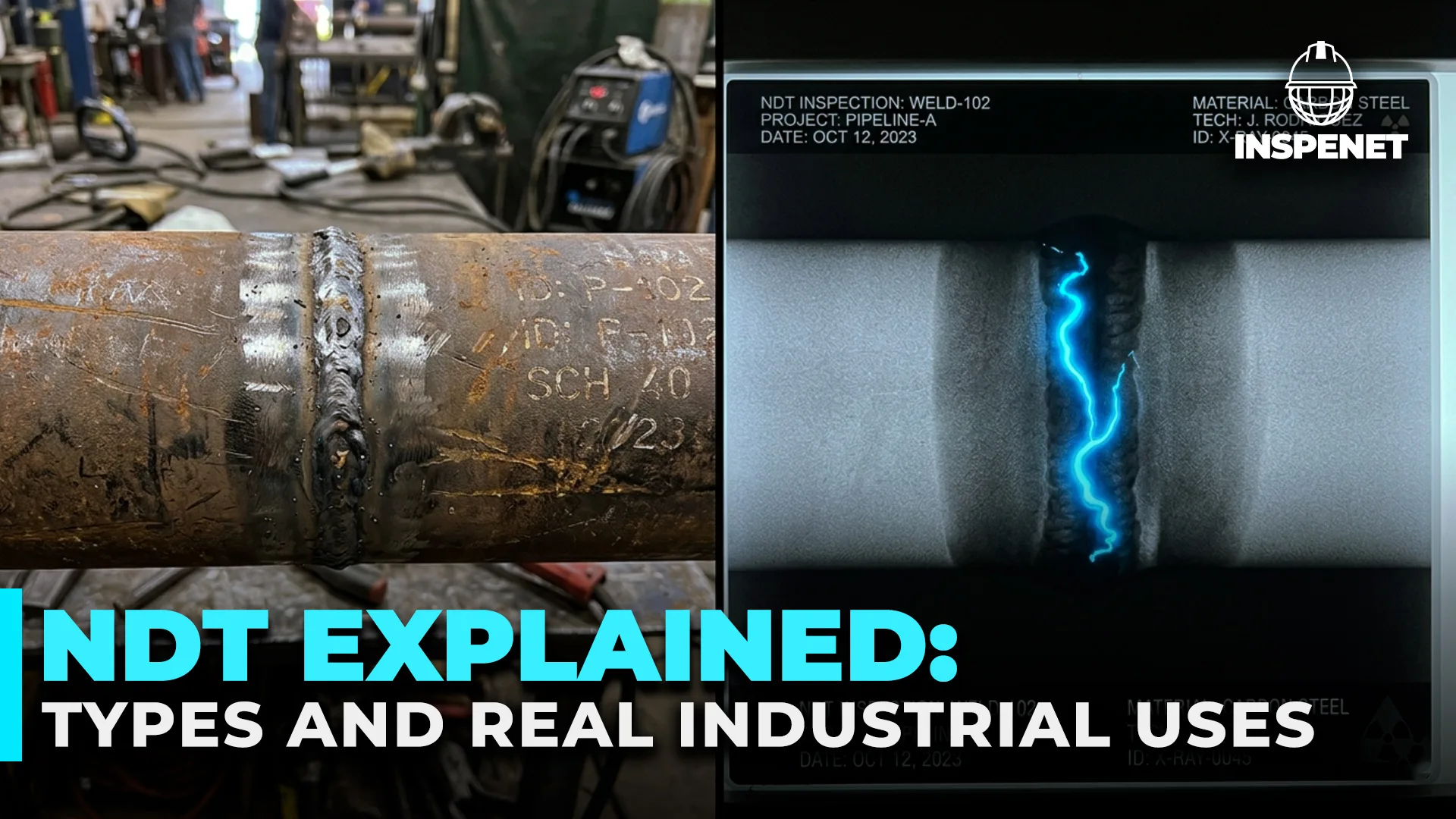
Mastering the various types of non-destructive testing (NDT) in the industry requires specialized technical training and an understanding of their practical application.
Conclusions
The types of Non Destructive Testing in industry are fundamental tools for ensuring the safety, reliability, and efficiency of industrial assets. Their correct application improves corrosion prevention, strengthens industrial maintenance, and supports process optimization.
In an environment where failure anticipation is key, specialized training in NDT becomes a strategic investment for both professionals and organizations.
Ready to lead Non-Destructive Testing management in your company?
The integration of non-destructive testing in process optimization allows inspection to be aligned with strategic production goals. It is not only about detecting failures, but also about understanding how and why they occur.
References
- https://www.astm.org/
- Hellier, C. (2012). Handbook of nondestructive evaluation (2nd ed.). McGraw-Hill Education.
- ASNT. (2021). Non destructive testing handbook: Introduction and overview (4th ed.). American Society for Nondestructive Testing.
- Raj, B., Jayakumar, T., & Thavasimuthu, M. (2012). Practical non-destructive testing. Woodhead Publishing.