Table of Contents
- Risks of H2S in industrial equipment and piping
- How to prevent cracking in environments with sulfide
- What is NACE MR0175/ISO 15156?
- What NACE MR0175 requires for material selection
- How to prevent failures in sour service environments
- Common errors when specifying materials for sour service
- Conclusions
- References
- Frequently Asked Questions (FAQs)
To mitigate the catastrophic risks associated with this highly toxic and corrosive gas, the global standard par excellence is the ISO 15156 standard, historically developed and recognized under the designation NACE MR0175. Complying with this standard is an indispensable requirement to guarantee that exposed metals do not suffer unforeseen failures that compromise lives, the environment, and business continuity.
In the oil and gas industry, operational safety and asset integrity depend critically on the correct selection of materials. One of the most severe and destructive challenges faced by production equipment and infrastructure is the presence of hydrogen sulfide (H2S), a condition known technically as sour service.
Risks of H2S in industrial equipment and piping
The presence of H2S, even in concentrations of parts per million (ppm), drastically alters the chemical behavior of the operating environment. The main danger lies in how this chemical compound interacts with the surface of steels, triggering severe phenomena of sulfide corrosion.
Unlike generalized or uniform corrosion (where the metal loses thickness predictably), H2S promotes the absorption of atomic hydrogen into the crystalline lattice of the steel. This phenomenon drastically reduces the ductility of the material and leads to brittle and sudden failure mechanisms. Among the greatest risks of H2S in industrial equipment and piping are massive leaks, explosions, and total loss of containment in pressure vessels, wells, and transport lines.
How to prevent cracking in environments with sulfide
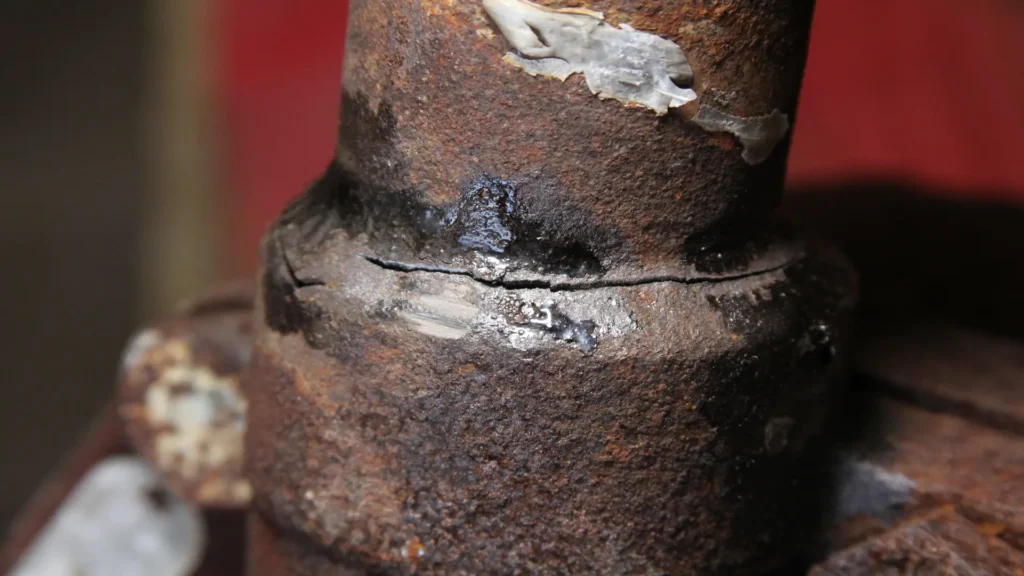
Premature cracking is the most destructive consequence of sour service. The mechanism most feared in the industry is sulfide stress cracking (SSC). It occurs when a susceptible material is under the simultaneous influence of tensile stresses (whether operational loads or residual welding stresses) and a wet H2S environment. The following image shows this type of damage in a carbon steel pipe caused by sulfide stress cracking (SSC).
To understand how to prevent cracking in environments with sulfide, the three factors that cause it must be targeted:
- Control the environment: Mitigate the presence of liquid water or adjust the process pH when operationally viable.
- Eliminate residual stresses: Apply post-weld heat treatments (PWHT) to relieve internal mechanical stresses in the joints.
- Use resistant materials: Employ alloys whose metallurgy and hardness have been strictly controlled to resist embrittlement.
What is NACE MR0175/ISO 15156?
NACE MR0175/ISO 15156 is a globally recognized standard that provides guidelines for selecting materials resistant to sulfide stress cracking (SSC) and other forms of hydrogen-induced cracking in environments containing hydrogen sulfide (H2S). This standard is essential to guarantee the reliability and safety of equipment used in the oil and gas industry, particularly in sour service environments.
The following video discusses the selection of materials (carbon steel and corrosion-resistant alloys) for applications in corrosive environments (containing H2S). Source: Engineering Services.

What NACE MR0175 requires for material selection
The ISO 15156 / NACE MR0175 standard is structured into three fundamental parts that guide the risk assessment step by step. It is not a simple list of permitted alloys, but rather a rigorous engineering framework.
Strict hardness limits
For carbon and low-alloy steels, the standard establishes a general maximum hardness limit of 22 HRC (Rockwell C). It has been scientifically proven that steels exceeding this hardness threshold are highly susceptible to sulfide stress cracking.
Chemical restrictions and heat treatments
The standard requires specific controls on the chemical composition of the steel (such as very low sulfur and phosphorus contents to avoid non-metallic inclusions) and prescribes specific thermal manufacturing processes, such as normalizing or quenching and tempering, to ensure a homogeneous microstructure.
Environmental limits
It defines severity zones (Sour Service Severity Regions) based on the partial pressure of H2S and the pH of the produced water. A material may be suitable for a region of low severity but fail catastrophically in a more severe one.
How to prevent failures in sour service environments
The effective prevention of failures goes beyond buying certified NACE materials; it requires an integrity management approach that covers the entire asset lifecycle.
- Accurate fluid characterization: Determine with exact precision the maximum expected partial pressure of H2S, chloride content, pH, and operating temperature.
- Qualification of welding procedures: Heat-affected zones (HAZ) during welding tend to harden. It is critical to qualify welds by measuring microhardness to ensure that no zone exceeds the limits required by the standard.
- Supply chain control: Implement audits and laboratory tests (such as hydrogen-induced cracking – HIC tests) to verify that the materials delivered by suppliers comply with the metallurgical properties promised in the certificates.
Common errors when specifying materials for sour service
Despite the widespread dissemination of the standard, in-service failures still occur due to misinterpretations. One of the common errors when specifying materials for sour service is assuming that the “NACE compliant” label is a blank check. A stainless steel can be excellent against SSC at low temperatures but suffer chloride stress corrosion cracking at elevated temperatures in the same sour environment.
Another common mistake is ignoring internal components or fastening hardware. Bolts, nuts, valve springs, and instrumentation are often specified without NACE criteria, becoming the weakest links in the industrial facility.
Conclusions
The NACE MR0175/ISO 15156 standard should not be interpreted as a static catalog of permitted materials, but rather as a dynamic engineering framework. The suitability of a material depends strictly on the correlation between its metallurgical properties and the specific operational limits of the environment (H2S, pH, temperature, and chlorides); therefore, a generic specification increases the risk of in-service failure.
Maintaining strict hardness limits (such as the 22 HRC threshold for carbon steels) and the rigorous application of post-weld heat treatments (PWHT) constitute the primary defense against sulfide stress cracking (SSC). The success of the standard relies on ensuring microstructural homogeneity not only in the base metal but also in the heat-affected zones (HAZ) following joining processes.
Preventing catastrophic failures in sour service environments requires an approach that spans from design and supply chain control to operational monitoring using Integrity Operating Windows (IOW). Ensuring the quality of smaller internal components (bolts, springs, and instrumentation) is just as vital as the selection of the main pipelines to avoid weak links in the facility.
References
- American Petroleum Institute. (2018). API Technical Report 938-C: Use of duplex stainless steels in the oil refining industry (3rd ed.). API Publishing Services.
- International Organization for Standardization. (2020). ISO 15156-1:2020 Petroleum and natural gas industries ,Materials for use in H2S-containing environments in oil and gas production, Part 1: General principles for selection of cracking-resistant materials. ISO.
- International Organization for Standardization. (2020). ISO 15156-2:2020 Petroleum and natural gas industries,Materials for use in H2S-containing environments in oil and gas production,Part 2: Cracking-resistant carbon and low-alloy steels, and the use of cast irons. ISO.
- International Organization for Standardization. (2020). ISO 15156-3:2020 Petroleum and natural gas industries, Materials for use in H2S-containing environments in oil and gas production,Part 3: Cracking-resistant CRAs (corrosion-resistant alloys) and other alloys. ISO.
- NACE International. (2016). NACE SP0472: Methods and controls to prevent in-service environmental cracking of carbon steel weldments in corrosive petroleum refining environments. NACE International.
Frequently Asked Questions (FAQs)
What does NACE MR0175 cover in sour service?
It covers the requirements and recommendations for the selection and qualification of metallic materials intended for equipment used in oil and gas production, and in natural gas treatment plants in environments containing wet H2S.
What failures does this standard seek to prevent?
It primarily seeks to prevent environmental cracking failures, including sulfide stress cracking (SSC), hydrogen-induced cracking (HIC), stress-oriented hydrogen-induced cracking (SOHIC), and stress corrosion cracking (SCC).
How does H2S affect materials?
The H2S reacts with the metal surface, producing iron sulfides and releasing atomic hydrogen. This hydrogen penetrates the steel structure, weakens its atomic bonds, and makes the material more likely to crack and fail in a brittle manner under moderate mechanical stresses.
What materials comply with the NACE MR0175 standard?
Carbon steels, low-alloy steels, stainless steels, and exotic alloys (such as Nickel- or Titanium-based) comply if they have been manufactured, heat-treated, and controlled in their hardness level (e.g., max. 22 HRC for carbon steels) under the specific chemical and metallurgical conditions described in the three parts of the standard.