Table of Contents
- Why PTFE is used in critical industrial systems
- Chemical resistance in harsh environments
- How PTFE helps prevent industrial leaks
- Standards for PTFE sealing systems
- Industry perspective: Reliability before failure
- PTFE gaskets vs traditional sealing materials
- PTFE in industrial valves and fluid systems
- What does this mean in practice?
- Conclusions
- References
- Frequently Asked Questions (FAQs)
PTFE in valves and gaskets plays a critical role in preventing industrial leaks across sectors where chemical compatibility, safety, and equipment reliability are non-negotiable. From refineries and petrochemical plants to offshore terminals and chemical processing facilities, this fluoropolymer is widely used for sealing performance under demanding operating conditions.
When leaks occur, consequences extend beyond product loss. They can affect safety, environmental compliance, maintenance costs, and operational continuity. Understanding how PTFE supports leak prevention helps engineers and asset managers make better decisions when selecting sealing materials for critical industrial systems.
Why PTFE is used in critical industrial systems
Key Properties of PTFE
Polytetrafluoroethylene (PTFE), commonly known as industrial Teflon, is widely used in critical sealing applications because it combines chemical stability, thermal resistance, and mechanical durability.
Unlike many conventional materials, this fluoropolymer can maintain performance under demanding operating conditions. This makes it valuable for gaskets, seals, valve seats, and fluid handling components exposed to aggressive media.
Its low coefficient of friction helps reduce wear between contacting surfaces. In industrial valves, this property supports smoother operation and helps preserve sealing performance during repeated opening and closing cycles.
The material also offers strong thermal stability across a broad temperature range. This allows sealing components to perform reliably in processes where heat, cold, or temperature variation can affect material behavior.
Another advantage is its resistance to moisture, weathering, and environmental degradation. These characteristics can extend service life and reduce maintenance frequency in industrial systems.
For engineers and maintenance teams, selecting PTFE sealing materials supports operational reliability by reducing premature degradation and strengthening long-term equipment integrity, where reliability affects safety, uptime, and lifecycle costs.
Chemical resistance in harsh environments
Resistance to acids and solvents
Chemical resistance is one of the strongest reasons this material is selected for demanding sealing applications. Many industrial processes expose gaskets and valve components to acids, solvents, hydrocarbons, and aggressive fluids that can rapidly weaken conventional materials.
When a sealing material is incompatible, degradation may appear as swelling, hardening, cracking, or loss of compression. These changes reduce sealing force and increase the probability of leakage, emissions, and unplanned maintenance.
PTFE remains stable against many corrosive substances, helping preserve sealing performance in refineries, petrochemical units, chemical plants, and offshore fluid handling systems. This stability is valuable where equipment operates continuously and shutdowns are costly.
Performance in oil and gas applications
In oil and gas applications, chemical exposure is rarely isolated from pressure, temperature, vibration, and operational cycling. For that reason, material selection must consider the full service environment, not only the fluid being handled.
By improving compatibility between the process medium and the sealing system, PTFE supports safer operation, lower maintenance frequency, and stronger equipment integrity over the lifecycle.
How PTFE helps prevent industrial leaks
Common causes of seal failure
Industrial leaks often begin with small changes in sealing performance. A gasket may lose compression, a valve seat may wear, or a seal may degrade after exposure to chemicals, temperature variation, pressure cycling, or incorrect installation.
In many facilities, these failures are not isolated events. They can lead to fugitive emissions, product loss, contamination, safety incidents, environmental exposure, and unplanned shutdowns that affect production and maintenance planning.
How PTFE improves leak prevention
PTFE helps reduce these risks by maintaining chemical stability and dimensional performance in aggressive service conditions. When properly selected and installed, PTFE gaskets can preserve sealing force and resist degradation longer than many conventional materials.
In industrial valves, these components can support tight sealing, smoother movement, and lower friction between contact surfaces. This is useful in systems that require frequent operation or handle chemically aggressive fluids.
However, industrial leak prevention does not depend on material selection alone. Pressure, temperature, flange condition, bolt load, installation practices, and inspection intervals all influence sealing reliability.
For critical assets, the material should be evaluated as part of a broader mechanical integrity strategy. This approach helps reduce failure probability, improve safety, and protect operational continuity in demanding industrial environments.
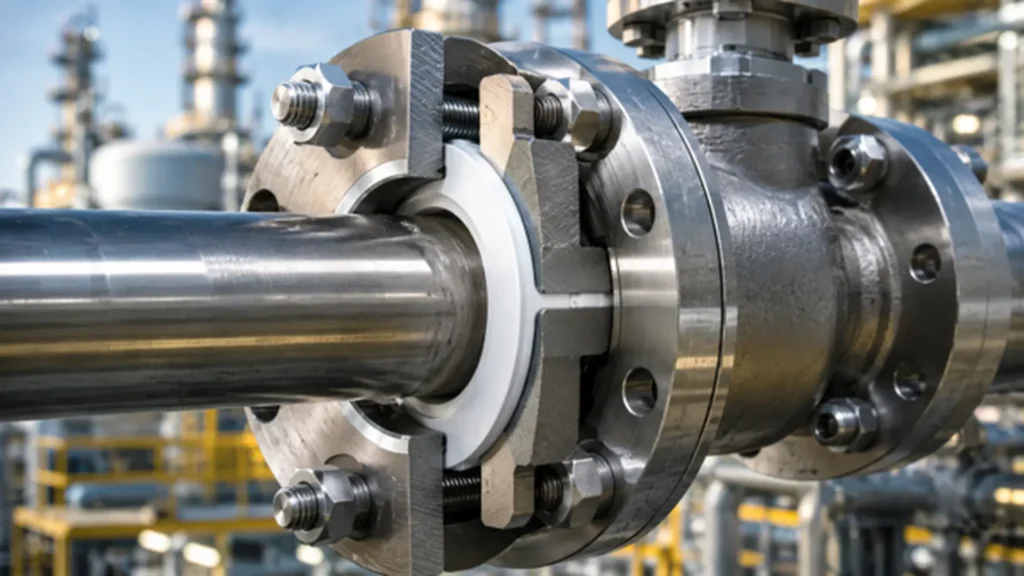
A PTFE gasket installed between metallic flanges helps maintain sealing integrity and reduce leakage risk in pressurized industrial piping systems.
Standards for PTFE sealing systems
Key standards for valves and gaskets
Standards help engineers move from material selection to verified sealing performance. In PTFE applications, the gasket, valve, flange, bolts, assembly method, and operating conditions must be evaluated as one pressure boundary system.
Table 1: PTFE Sealing Standards
| Standard | Main focus | Why it matters for sealing |
| ASME B16.21 | Nonmetallic flat gaskets for pipe flanges | Supports the specification of PTFE gaskets where dimensional control and material compatibility are essential. |
| ASME PCC-1 | Bolted flange joint assembly | Helps reduce industrial leaks caused by incorrect torque, poor alignment, uneven bolt load, or improper gasket installation. |
| API 6D | Pipeline and piping valves | Provides requirements for industrial valves used in oil and gas systems, including design, testing, documentation, and pressure integrity. |
| ISO 15848 | Fugitive emissions in industrial valves | Connects valve sealing performance with emissions control and environmental compliance. |
These references are relevant when industrial leak prevention, process safety, and environmental compliance are part of the operating risk. They also reduce ambiguity between engineering, procurement, and field maintenance teams.
In practice, PTFE sealing materials should be selected with documented compatibility, proper torque control, installation discipline, and traceability across the asset lifecycle. For teams reviewing flanged assemblies, flange and bolting components for oil and gas applications should also be evaluated with the same technical discipline.
Industry perspective: Reliability before failure
Asset integrity beyond material selection
In industrial sealing, the correct material is only the first layer of protection. Leak prevention also depends on installation discipline, inspection planning, operating data, and how early a facility can identify degradation trends.
This is where the IOCS perspective from SLOM 2025 becomes relevant. In the video, Davide Contino emphasizes reliability, monitoring, asset optimization, and failure prevention as part of a broader operational strategy.

For readers evaluating PTFE in valves and gaskets, this industry voice adds practical context. A gasket or valve component may perform well by design, but its real value appears when it supports predictable operation under field conditions.
The lesson is clear: material selection should connect with maintenance strategy. PTFE can contribute to industrial leak prevention, but long-term reliability also requires condition awareness, risk control, trained personnel, and decisions based on asset integrity across demanding service environments.
PTFE gaskets vs traditional sealing materials
Table 2: Advantages and limitations
| Property | PTFE | Rubber | Graphite |
| Chemical resistance | Very high | Moderate | High |
| Temperature behavior | Broad range | Limited by compound | Strong at high heat |
| Flexibility | Lower | High | Moderate |
| Typical use | Aggressive fluids | Water, air, mild chemicals | High-temperature service |
PTFE gaskets are often preferred when compatibility and low friction are priorities. They can resist many aggressive fluids that may degrade rubber or other elastomeric materials.
Rubber remains useful in less aggressive systems where flexibility and compression are more important than broad resistance to chemicals. Graphite can perform well at high temperatures, but it may not be ideal for every fluid environment.
The practical decision depends on fluid, pressure, temperature, flange condition, and required service life. PTFE is valuable, but it should not be treated as universal. For critical assets, compatibility testing and installation quality remain essential to sealing reliability over time.
PTFE in industrial valves and fluid systems
Critical applications in process industries
PTFE is widely used in industrial valves because sealing surfaces must resist chemical attack while allowing controlled movement. Valve seats, stem seals, packing elements, and gasket interfaces can all influence leak tightness.
In fluid handling systems, these components may appear in pumps, piping connections, transfer lines, loading systems, and process equipment. Their role is to maintain containment when fluids are corrosive, volatile, or difficult to seal.
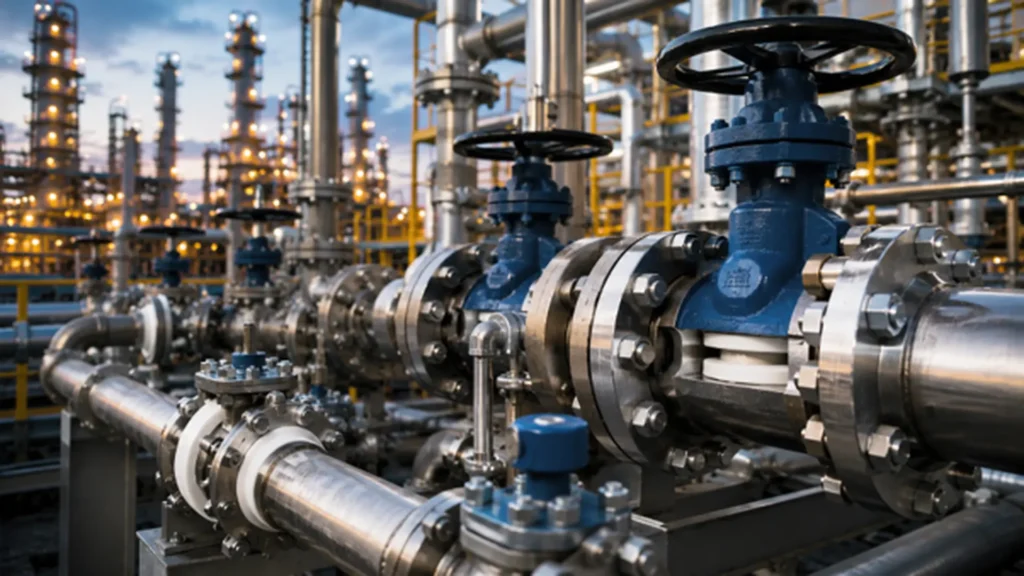
Industrial valves and fluid handling systems depend on reliable PTFE sealing materials to maintain containment and operational continuity.
For refineries, petrochemical plants, chemical processing units, and offshore terminals, this becomes especially relevant. A small leak in a valve or flange can affect safety, production, environmental compliance, and maintenance schedules.
PTFE sealing materials are also valuable in systems exposed to frequent cycling. Lower friction helps reduce mechanical stress while chemical resistance protects against degradation from aggressive media.
In practice, the selection process must take into account pressure, temperature, fluid composition, valve design, and required inspection. For related systems and field components, IOCS-e offers auxiliary equipment for oil and gas systems.
What does this mean in practice?
Selecting PTFE should begin with the service conditions, not with the material name alone. Engineers need to evaluate the fluid, concentration, temperature, pressure, flange design, valve function, and expected operating cycles.
This material is often a strong option when compatibility and leak tightness are priorities. It can help reduce degradation risks in aggressive environments, especially where conventional elastomers may fail prematurely.
However, this material also has limitations. Depending on design and load conditions, issues such as creep, cold flow, or improper compression can affect sealing performance if the joint is not correctly engineered or assembled.
In practice, the best results come from combining material compatibility with correct installation, torque control, inspection planning, and maintenance records. This is where sealing decisions connect directly with mechanical integrity.
For operators, the key question is not only whether a material can seal a system. The question is whether the complete sealing arrangement can maintain reliable performance throughout the asset lifecycle.
Conclusions
PTFE in valves and gaskets is not only a material choice. It is part of a broader strategy for leak prevention, compatibility, process safety, and long-term equipment reliability.
When specified correctly, PTFE can help protect critical systems from degradation, leaks, and unplanned maintenance. Yet performance also depends on standards, installation quality, inspection practices, and operating context.
For companies such as IOCS, this connection between materials, reliability, and asset integrity reflects a practical approach to protecting industrial operations where leakage risks affect safety, uptime, and lifecycle costs.
Evaluate your sealing systems, valve applications, and fluid handling components with an asset integrity mindset. Visit the IOCS-e commercial platform to explore industrial solutions for critical environments.
References
- American Petroleum Institute. (2021). API Spec 6D: Specification for valves (25th ed.). API Webstore.
- American Society of Mechanical Engineers. (2019). ASME PCC-1: Pressure boundary bolted flange joint assembly. ASME.
- American Society of Mechanical Engineers. (2021). ASME B16.21: Nonmetallic flat gaskets for pipe flanges. ASME.
- International Organization for Standardization. (2015). ISO 15848-1:2015: Industrial valves — Measurement, test and qualification procedures for fugitive emissions — Part 1: Classification system and qualification procedures for type testing of valves. ISO.
- Inspenet. (2025). Efficient and safe offshore systems with IOCS technology. Inspenet TV.
- Inspenet. (n.d.). IOCS Srl: Italian engineering for offshore Oil & Gas. Inspenet Business Directory.
- Offshore Technology Conference. (2025). IOCS SRL: Exhibitor profile, OTC 2025. OTC Exhibitor Directory. https://exhibits.otcnet.org/OTC2025/Public/eBooth.aspx?BoothID=245811&Nav=False
Frequently Asked Questions (FAQs)
Why is PTFE used in industrial gaskets?
PTFE is used because it offers chemical resistance, low friction, and stable performance across demanding conditions. These properties help gaskets maintain sealing effectiveness in critical industrial systems.
Is PTFE resistant to chemicals?
Yes. PTFE resists many acids, solvents, hydrocarbons, and corrosive fluids, making it useful in chemical processing, refineries, petrochemical units, and oil and gas applications.
Can PTFE help prevent industrial leaks?
PTFE can help reduce industrial leaks when properly selected and installed. Its resistance to chemical attack and degradation supports stronger sealing performance over time.
What industries use PTFE valves and gaskets?
PTFE valves and gaskets are used in oil and gas, petrochemical, chemical processing, power generation, pharmaceuticals, food processing, and other fluid handling industries.
Is PTFE suitable for Oil and Gas applications?
Yes. It can be suitable for oil and gas applications involving aggressive fluids, valves, flanges, and transfer systems, provided pressure and temperature limits are verified through engineering review and applicable industry standards before service.