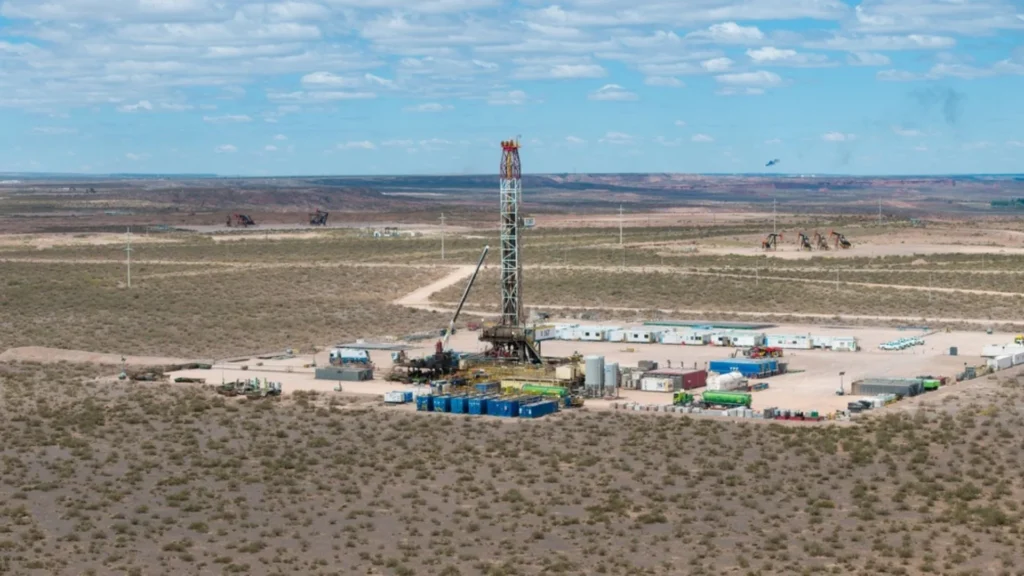
Vaca Muerta production exceeded the threshold of 50% of Argentina’s national oil and natural gas production in 2026, consolidating the formation as the country’s energy backbone. In February 2026, crude oil from Neuquén reached 603,800 barrels per day, 30.3% more than in the same month of 2025, according to data from the Ministry of Economy. This figure positions Argentina as the most significant unconventional extraction case outside of North America.
Vaca Muerta production: a structural milestone, not a cycle
“The change is more structural than cyclical, driven by Vaca Muerta’s unconventional oil exports,” noted Martín Castellano, an economist at the Institute of International Finance, to the Buenos Aires Times in April 2026. Argentina closed 2025 with an energy surplus of $12.7 billion and projects exceeding $14 billion in 2026. The country’s energy security shifted in five years from a structural deficit to a sustained positive balance, with Vaca Muerta production as the primary engine.
The formation holds recoverable reserves of 16 billion barrels of oil and 308 trillion cubic feet of gas—the world’s second-largest shale gas reserve and fourth-largest shale oil reserve—according to Rystad Energy.
Vaca Muerta production already exceeds basins such as Permian, Bakken, and Eagle Ford in productivity per well, according to Rystad data cited by OilPrice.com in May 2026.
YPF and international operators increase Vaca Muerta production
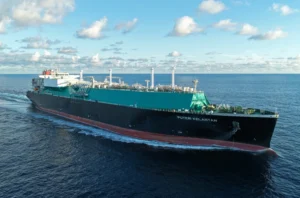
YPF leads the expansion with a budget of $5.5 to $5.8 billion for 2026, allocating 70% to shale. CEO Horacio Marín projected to analysts cumulative infrastructure investments of $130 billion through 2031 and energy exports of $50 billion during that period. YPF is moving forward with the Argentina LNG project alongside ENI and ADNOC/XRG to export liquefied natural gas starting in 2027.
Tecpetrol is investing $2.4 billion in Los Toldos II East to contribute 70,000 barrels per day in 2027. Chevron, Pampa Energía, and Shell are participating in the basin’s evacuation consortia, including the Vaca Muerta Sur pipeline. Asset management in an accelerating shale play—well densification, compressor maintenance, associated gas networks—demands operational standards that the sector is adopting at an increasing pace.
Infrastructure: the bottleneck conditioning Vaca Muerta production
The main limit to Vaca Muerta production is not geological but logistical. Crude oil transport capacity will increase from 555,000 to 750,000 barrels per day with the expansion of the Oldelval pipeline, and is expected to reach 930,000 barrels in the second half of 2026 with the Vaca Muerta Sur pipeline—437 km to Punta Colorada, Río Negro—according to Deloitte. Total investment exceeds $2.5 billion, backed by YPF, Vista, Pan American Energy, Pampa Energía, Chevron, and Shell.
The Perito Moreno pipeline increased gas capacity to 23 million cubic meters per day. The second phase will reach 39 million cubic meters per day, opening access to the industrial belts of southern Brazil. Reuters has covered these investments as a key signal of Argentina’s export positioning.
Associated gas reached a peak of 26.7 million cubic meters per day in January 2026, 45% more than in 2024, according to consultant Nicolás Arceo of Economía y Energía. Monetizing that volume through LNG could turn Argentina into a global exporter and displace the soybean complex as the main generator of foreign exchange before the end of the decade.