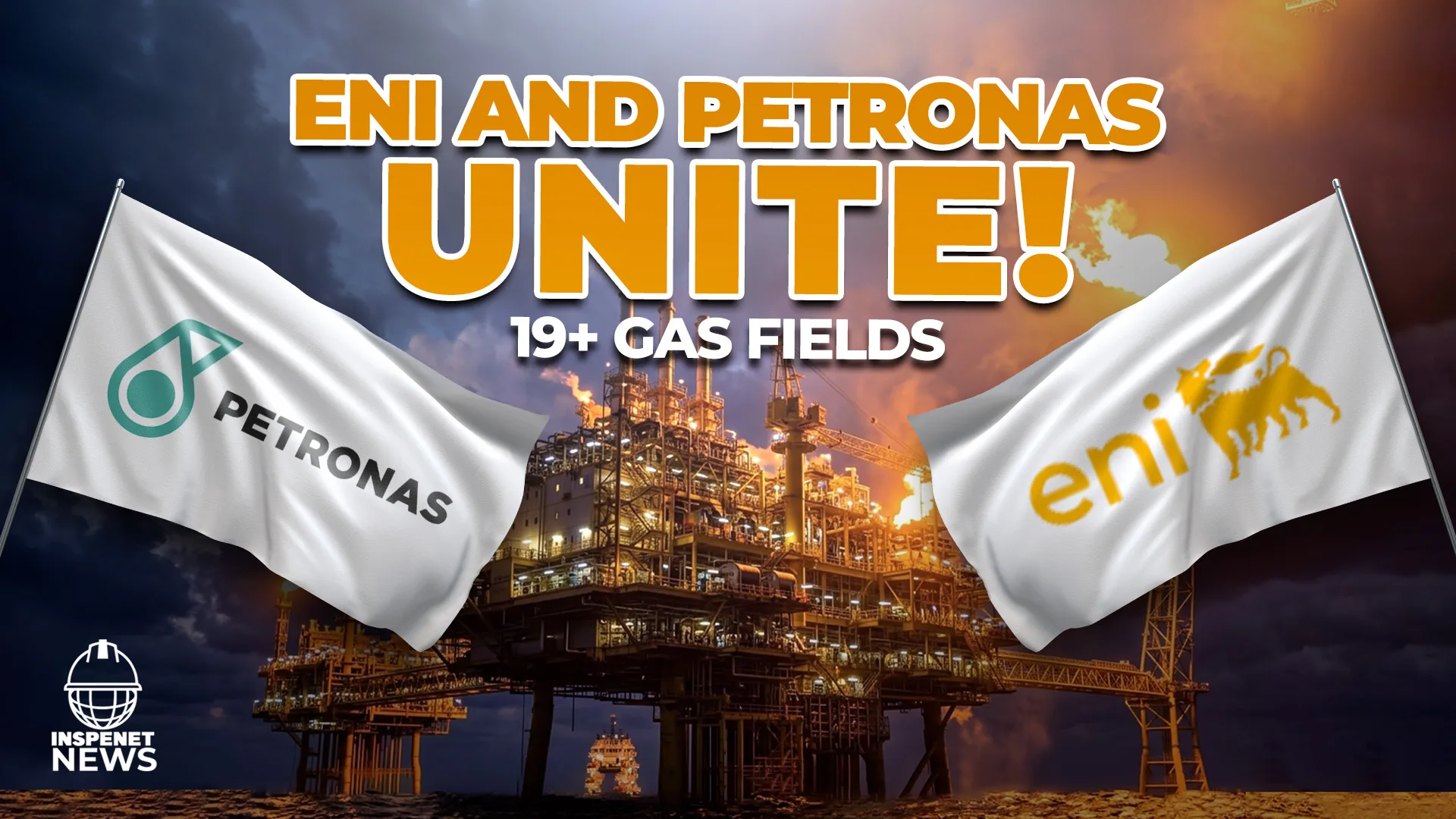
Searah begins activities to expand gas production in Asia
The new joint venture created by Eni and PETRONAS is now a reality. After obtaining all regulatory authorizations and fulfilling the conditions established by both parties, Searah officially began operations with the aim of becoming one of the largest independent energy players in Southeast Asia.
The company was founded with an asset portfolio focused on Indonesia and Malaysia and with growth plans backed by significant financial capacity and an extensive base of already discovered gas resources.
Why are Eni and PETRONAS betting on Searah?
Firstly, the creation of Searah responds to the strategy of both companies to concentrate resources, operational experience and technical capabilities in an independent structure capable of accelerating the energy development of the region.
The new company is 50% owned by Eni and PETRONAS and brings together assets considered strategic for the growth of energy production in two of the most important markets in Southeast Asia.
Furthermore, the operation strengthens the regional presence of both companies and allows them to optimize resources to tackle larger-scale projects in the coming years.
An energy company with a solid operational base
Currently, Searah integrates 19 production and development assets, of which 14 are located in Indonesia and five in Malaysia.
Thanks to this portfolio, the company begins operations with production exceeding 300,000 barrels of oil equivalent per day. The goal set by its shareholders is to sustainably surpass 500,000 barrels of oil equivalent per day within the next three years.
Furthermore, the designed operating model seeks to generate synergies in areas such as logistics, technology and resource management, factors that could improve the efficiency of operations in both countries.
Million-dollar investments to accelerate growth
Searah also begins its operations backed by a $6 billion revolving credit facility obtained in international financial markets.
This financial backing will allow the promotion of an investment portfolio projected at more than $20 billion over the next five years.
The resources will be allocated to the development of more than 3 billion barrels of oil equivalent of discovered resources and to the identification of new opportunities arising from future gas exploration activities .
According to the companies' forecasts, these investments will serve to expand production capacity and strengthen the security of energy supply in Indonesia and Malaysia.
The gas discoveries behind the Searah expansion
On the other hand, the launch of Searah coincides with a series of relevant advances in energy development.
Eni recently announced final investment decisions for several projects in Indonesia, including the Gendalo, Gandang, Geng North, and Gehem developments. These fields contain approximately 10 trillion cubic feet of gas initially present and around 550 million barrels of associated condensate.
Forecasts indicate that production will begin in 2028 and reach a capacity of close to 2 billion cubic feet per day of gas along with 90,000 barrels per day of condensate during the following year.
Added to this is the discovery of Geliga-1 in the Kutei basin, a structure that could contain approximately 5 trillion cubic feet of gas and 300 million barrels of condensate in situ.
Impact on Indonesia and Malaysia
Meanwhile, Indonesia and Malaysia are consolidating their position as the pillars on which Searah's growth will be based.
The company aims to contribute to local economic development through new investments, the creation of specialized jobs, and the strengthening of the supply chain linked to the energy industry.
Similarly, Eni and PETRONAS have expressed their intention to maintain aligned objectives in environmental and sustainability matters, integrating these considerations into the development of future projects.
A new player in the regional energy market
Finally, the launch of Searah marks a new chapter for both companies in Southeast Asia. With a broad asset portfolio, financial backing, and a strategy focused on gas production and exploration, the company begins operations with the intention of expanding its production capacity and strengthening the energy supply of a region whose demand continues to grow year after year.
News of additional interest
Qualitas Energy strengthens its solar expansion in the US.
Qualitas Energy announced the acquisition of a 164 MWp solar photovoltaic project in Illinois, USA, strengthening its presence in one of the country's most dynamic energy markets. The asset is in an advanced stage of development and already has the necessary permits, full land control, and the support of the local community after receiving unanimous approval from county authorities.
The company will now focus on optimizing the commercial strategy, construction planning, and financial structuring of the project. Furthermore, the facility could incorporate up to 64 MWac of battery storage in a later phase, expanding its commercialization options and enabling it to offer combined solar and storage solutions to corporate clients, utilities, and public bodies.
Eco Wave Power unites waves and AI for data centers
Eco Wave Power has begun discussions with Florida Atlantic University and the University of Michigan to develop solutions that combine wave energy and artificial intelligence. The initiative includes advancing WaveGPT , a platform designed to analyze the performance of wave energy installations in real time using prediction, monitoring, and operational optimization tools.
In parallel, the organizations are studying the creation of coastal data centers powered by ocean waves. The project aims to integrate renewable energy generation, energy storage, advanced cooling systems, and digital simulation technologies to meet the growing electricity demand associated with the development of artificial intelligence. The proposal also includes the use of intelligent models capable of anticipating sea conditions, computing needs, and energy requirements to improve system efficiency.
Acta Gemini strengthens support for offshore wind power
Acta Marine has taken delivery of the Acta Gemini , a new operations and service vessel designed to support the construction and maintenance of offshore wind farms. Built in Turkey as part of a series of four units, the vessel is equipped to safely transport technical personnel at sea and provide accommodation for up to 88 people during offshore operations.
Following its delivery, the vessel will begin a long-term contract at the Sofia offshore wind farm, located in the UK and operated by RWE. From the port of Grimsby, the Acta Gemini will provide access services to the facilities and logistical support for the project's operation and maintenance. It also features engines designed to run on methanol, a feature aimed at reducing emissions and facilitating a future transition to more sustainable fuels.
OPAL Fuels and GFL expand their biogas production
OPAL Fuels and GFL Environmental are moving forward with the construction of two new renewable natural gas plants in Alabama and Georgia. Both projects, developed at landfills operated by GFL, will have a combined capacity of nearly 2 million MMBTU and will be jointly owned by the two companies. The resulting production will be marketed and distributed by OPAL Fuels through its natural gas supply network for transportation.
The facilities will transform methane generated by the decomposition of organic waste into a renewable fuel primarily intended for heavy transport. According to the companies, the projected capacity would allow for the fueling of approximately 800 Class 8 trucks. This initiative comes at a time of growing interest among fleets in alternatives to diesel due to the volatility of traditional fuel prices and greater regulatory clarity regarding combustion engine technologies.