Table of Contents
- Causes of emergencies in ast tanks
- External and internal floating roof tanks
- Fixed cone roof tanks
- Initial response and event control
- Damage evaluation according to api 653
- Emergency repair of ast tanks to recover service
- Technical response capacity in the field
- Tank integrity and prevention of new failures
- Conclusions
- References
- Frequently asked questions
The collapse of the floating roof is one of the most visible emergencies in an AST tank. A tilted roof can leave product on the deck, open gaps in the perimeter seal, and increase vapor emissions. In another area, a bottom leak may appear just as a stain next to the foundation ring, while the deterioration remains hidden under the plates.
Ast tank emergencies also include overfills, shell deformations, and vacuum collapses. Tank inspection allows determining the extent of the damage, while tank repair under API 653 coordinates engineering, fabrication, welding, NDT, and field work to recover service.
Causes of emergencies in ast tanks
An emergency can originate from insufficient maintenance, prolonged inspection intervals, accumulated degradation, operational deviations, or several mechanisms acting at the same time. The visible sign—a leak, a tilted roof, or a deformation—rarely shows the extent of the deterioration on its own.
Common failures in tanks vary according to their configuration, operational conditions, and the deterioration mechanisms present. The diagnosis must consider the type of storage tank, previous repairs, the foundation, and prior operations. The dynamics of the emergency depend directly on the tank configuration. Understanding the root cause in the field constitutes the first step to defining the scope of the repair.
External and internal floating roof tanks
These roofs follow the product level and reduce the liquid surface exposed to the vapor space. Although both depend on their ability to move freely and maintain buoyancy, the causes of sinking vary depending on whether it is an external or internal roof.
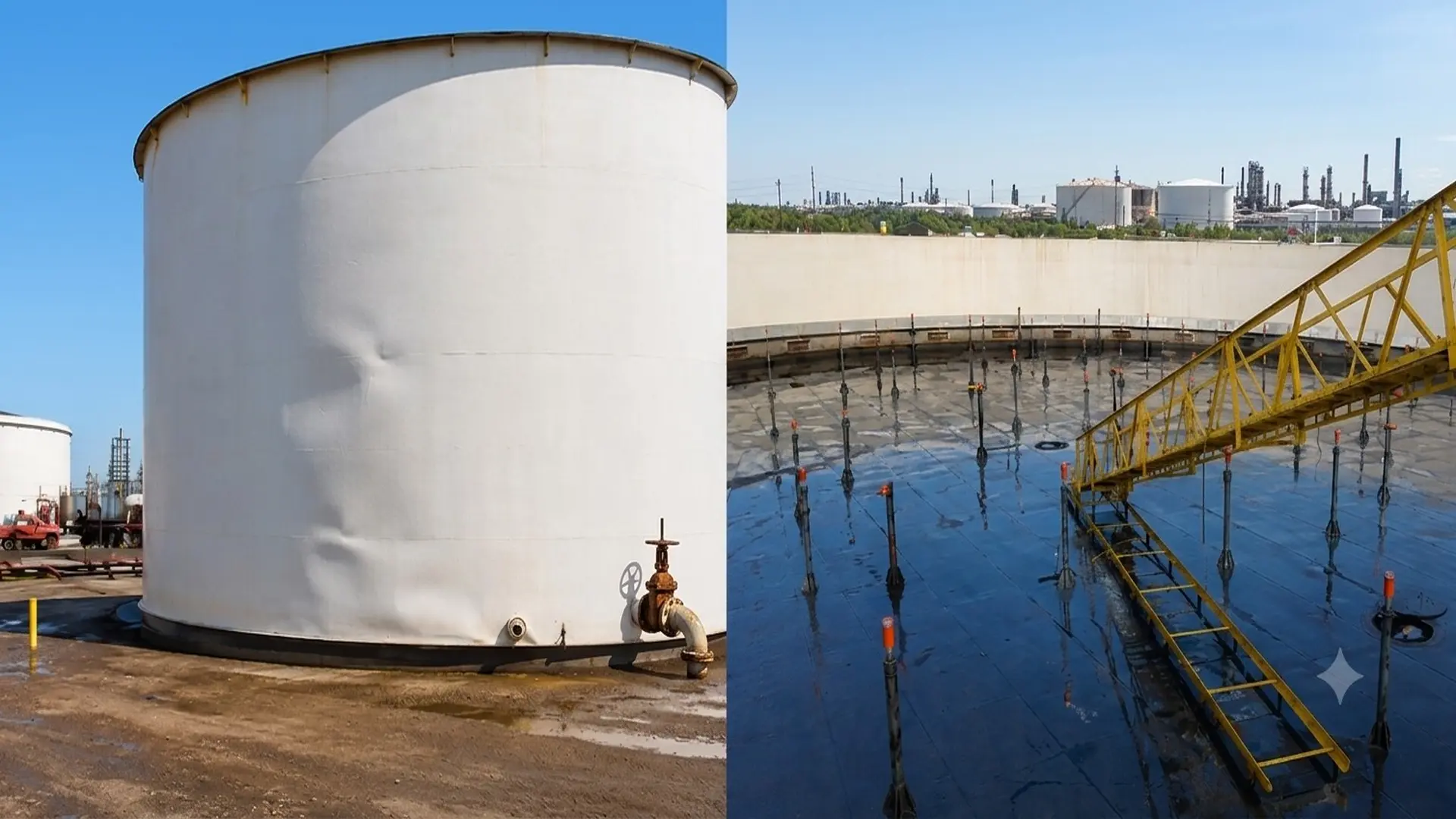
Sinking or tilting of the external floating roof. Puncturing of pontoons, ingress of product, or water accumulation due to obstruction or failure of the primary drain can unbalance the roof. The product can spread over the deck and, if the condition continues to advance, compromise the stability of the roof and increase the risk of emissions, fire, and loss of containment.
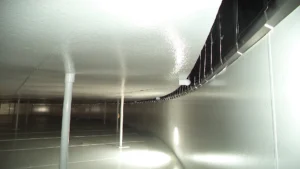
Collapse of the internal floating roof. In fixed roof tanks, the internal floating roof (called an internal membrane in some facilities) can lose buoyancy, tilt, or remain partially submerged without the damage being visible from the outside. The loss of tightness in pontoons or panels, the deterioration of supports, and interference with columns, guides, or seals can leave product on the roof, increase emissions, and deform its components. Permanent repair usually requires taking the tank out of service, emptying it, and degassing it to recover the leveling, tightness, and free mobility of the roof.
Jamming during filling or emptying. Shell ovalization, deformed guides, misaligned legs, or interference with accessories can prevent a floating roof from moving. On an external roof, continuing the transfer can cause structural damage or a top spill; on an internal roof, it can deform panels, damage seals, and leave product exposed within the vapor space.
Fixed cone roof tanks
A blocked pressure-vacuum valve can prevent air entry during a rapid discharge. The external atmospheric pressure deforms the roof, the upper rings, and, in severe cases, the support structure.
Insufficient venting, an internal reaction, an instrumentation failure, or an overfill can raise the pressure and damage the roof, the top ring, or the roof-to-shell joint.
Corrosion of beams, braces, gussets, and columns can produce localized sinking or the fall of elements into the product.
Failures in bottom, ring and nozzles
Soil-side corrosion, retained moisture, microbiological activity, and deficient cathodic protection can perforate the plates. Internally, water, chlorides, sediments, H₂S, CO₂, and organic acids increase the corrosivity of sour crudes, brines, production waters, and slop streams.
The leak can appear in a detection drain, next to the foundation ring, or inside the dike. Differential settlement concentrates stresses in the shell-to-bottom joint; the lower nozzles can also crack due to piping loads or foundation movements.
Initial response and event control
The first decision consists of preventing the damage from continuing to advance. The response must control the product loss, stabilize the storage tank, and create safe conditions to inspect.
Step-by-step response to an emergency
- Stop the condition that aggravates the damage. Transfers that increase the level, pressure, vacuum, or leak must be suspended.
- Isolate the area. The emergency plan must control ignition sources, access, atmosphere, and secondary containment.
- Manage the inventory. Operations must decide whether the product can be transferred, reduced to a safe level, or kept under surveillance.
- Preserve evidence. Before cleaning or dismantling, the level, alarms, valves, pressure, and state of the roof must be recorded.
- Define and execute the repair. The scope must indicate components, materials, welds, assembly, NDT, and acceptance criteria.
- Verify and return to service. Release requires NDT, leak tests, dimensional controls, and hydrotesting when applicable. Filling is done in stages.
Tanks with backup and without backup
When available storage exists, the product can be transferred and the intervention has more margin for emptying, cleaning, internal inspection, and procurement.
In an asset without backup, or whose output limits production, reception, or dispatch, the time available to diagnose and execute the repair decreases. The urgency requires coordinated mobilization and fabrication, but does not modify the API 653 acceptance criteria.
The response needs executors capable of linking engineering, shop, and field. Speed is useful when it reduces wait times and rework while maintaining qualified welding, NDT, safety, and traceability.
Damage evaluation according to api 653
API 653 establishes requirements for the inspection, repair, alteration, relocation, and reconstruction of steel tanks in service. The evaluation must cover the affected components and have the participation of the owner, the authorized inspector, and the required specialists.
Field diagnosis by mechanism
Visual inspection locates leaks, deformations, and interferences. UT measures thicknesses; MFL and ultrasonic mapping support the bottom review; MT or PT examine surface discontinuities; RT or volumetric UT are selected according to the joint.
On a tilted floating roof, pontoons, deck, legs, seals, guides, and drainage are checked. On a collapsed cone roof, plates, rafters, columns, roof-to-shell joint, and vents are inspected. Topography or laser scanning quantifies geometry and settlement.
Structural acceptance and restrictions
Section 4 of API 653 provides criteria for minimum thicknesses, pitting, corroded areas, and maximum filling height. Annex B addresses settlements and bottom deformations.
When the damage requires analysis outside the direct criteria, API 579-1/ASME FFS-1 can be applied. The evaluation must end in a decision: repair, limit the level, monitor the condition, or retire the tank.
Emergency repair of ast tanks to recover service
The repair of AST tanks must restore the containment, strength, geometry, and operation of the asset. Before cutting steel, engineering must classify the intervention, because this decision defines the repair details, NDT, the need for a hydrostatic test, and the closing documentation.
Bottom and shell-to-bottom joint
Solutions can include replacement plates, inserts, permitted patches, partial replacement of the annular ring, or a new bottom. Location, thickness, and spacing with respect to existing welds must comply with the contractual edition of API 653.
Closing a perforation without resolving voids, water ingress, loss of support, or deterioration of the foundation can cause another leak.
Shell, nozzles and accessories
A deformed, cracked area, or one with severe thickness loss may require an insert plate, the partial replacement of a shell course, or the repair of a joint. The cutting and welding sequence must limit distortions.
In nozzles and manways, welds, reinforcements, corrosion, and piping loads are checked before closing the repair.
Floating and cone roofs
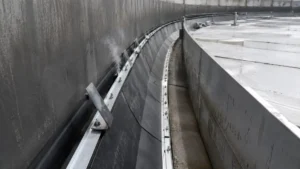
In floating roofs, pontoons, decks, legs, seals, guides, and drains can be repaired. Acceptance must confirm tightness, buoyancy, and free travel.
In cone roofs, plates, rafters, columns, and venting accessories can be replaced. Repairing the steel without correcting the cause of the vacuum or overpressure would leave the failure mechanism active.
Inspection of ast tanks before return to service
Once the repair is finished, the tank must be inspected to confirm that the intervened components comply with the approved scope and that the work did not introduce deformations, discontinuities, or loss of tightness. This verification includes visual review, dimensional control, NDT, and specific tests for each repaired component.
Welds must be executed according to WPS supported by PQR and be performed by qualified welders or operators. Traceability must link the plates, consumables, repaired joints, and inspection results with the tank’s final file.
Ndt, leak tests and hydrostatic test
The NDT plan depends on the type of joint, the intervened component, and the sought discontinuity. VT, MT, PT, RT, and UT can be combined according to the applicable requirements. Bottom welds can be verified using a vacuum box or another accepted method, while pontoons and drainage components require tightness tests in accordance with their design.
Certain major repairs or alterations require a hydrostatic test. Its exemption proceeds only when the applicable requirements of API 653 are met and documented approval exists from the owner or operator. The urgency to recover production or the lack of water do not, in themselves, constitute sufficient technical reasons to omit it.
Controlled filling and operational release
Before introducing product, the vents, pressure-vacuum valves, level measurement, overfill alarms, drains, grounding, and fire protection systems must be restored. API 2350 establishes criteria for alarm management and response times during transfers.
The filling plan must define the transfer rate, wait levels, required measurements, and those responsible for accepting each stage. During the operation, possible leaks, changes in settlement, nozzle displacements, and the movement of the floating roof must be monitored.
Operational release requires updated drawings, material traceability, welding records, NDT results, leak tests, dimensional controls, and approval from the authorized inspector and the owner.
Technical response capacity in the field
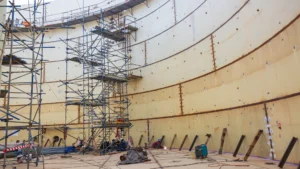
An emergency or a scheduled shutdown in AST tanks links diagnosis, fabrication, steel supply, welding, assembly, and NDT. A late plate, a poorly formed component, or a pending approval halts crew operations, driving up downtime costs and extending the asset’s out-of-service period. Closing the gap between on-site diagnosis and shop fabrication is critical to meeting operational windows without compromising API 653 acceptance criteria.
In this context, companies like Woods Tank Inc. integrate fabrication and on-site execution to respond swiftly to critical events. Their operational scope is consolidated through their storage tank services: comprehensive storage tank fabrication, construction, and repair services provided by certified welders who prioritize safety and excellent customer service, linking engineering with field work to ensure traceability, qualified welding, and a safe return to production.
Woods Tank Inc., an Inspenet partner, provides repairs or replacements for shells, bottoms, roofs, and floating systems. This capability streamlines transitions between shop and assembly, fitting each repair into the planned operational window under API 653.
Tank integrity and prevention of new failures
The root cause analysis must end in verifiable actions. A bottom leak may require drainage, coating, or cathodic protection improvements; a jammed roof may require correcting geometry, guides, or seals; a vacuum collapse forces a review of vents and transfers.
The results must update inspection plans, risk-based inspection, spare parts, and functional tests. In assets with little redundancy, it is advisable to anticipate steel, seals, drains, and components with long fabrication times.
Conclusions
AST tank emergencies begin with concrete signs: a roof that loses level, a plate that deforms, or product that appears next to the foundation ring. From that moment, every decision must contain the damage and bring the tank closer to a verifiable condition.
API 653 organizes the evaluation, repair, NDT, testing, and return to service. Field experience connects those stages with fabrication, assembly, and operation. An effective repair returns the asset to production, restores its protection systems, and corrects the condition that could once again become an emergency.
References
- API Standard 653. Tank Inspection, Repair, Alteration, and Reconstruction.
- API Recommended Practice 575. Inspection Practices for Atmospheric and Low-Pressure Storage Tanks.
- API Standard 2000. Venting Atmospheric and Low-Pressure Storage Tanks.
- API Standard 2350, 5th Edition. Overfill Prevention for Storage Tanks in Petroleum Facilities.
- Woods Tank Inc. Storage Tank Services and Expedited Tank Repairs.
Frequently asked questions
What to do if the floating roof gets jammed?
The movement of product must be suspended and the level, roof position, guides, seals, and shell geometry evaluated. Resuming the operation without a diagnosis can cause a spill or structural damage
Can a bottom leak be repaired with product inside?
There may be temporary measures designed for a specific condition. A permanent welded repair normally requires isolation, emptying, cleaning, degassing, and safe conditions for hot work.
Does every repair require a hydrostatic test?
No. It depends on the classification and scope of the work. An exemption requires complying with the applicable requirements of API 653 and documenting the corresponding approval.
Does the lack of a backup tank change API 653?
No. It changes the logistics, mobilization, and sequence of execution. The engineering, welding, NDT, and acceptance requirements remain applicable.