Table of Contents
- The importance of tank measurement in terminals
- What is a gauge tank?
- Main functions and practical example
- Evolution of the tank measurement system
- Manual tank measurement: advantages and limitations
- Automatic tank measurement and digital transformation
- Sources of uncertainty: level, temperature, and density
- Api mpms: world reference for measurement
- Tank calibration: the foundation of accuracy
- What factors increase error in tank gauging?
- How to reduce uncertainty when measuring tanks?
- How to validate an atg for terminal custody?
- Inventory management based on reliable measurements
- Good practices for modern terminals
- Technological trends in tank measurement
- Conclusions
- References
Precision in liquid inventory measurement is an essential part of the profitability and reliability of storage terminals. In product reception, dispatch, and transfer operations, small deviations in level, temperature, or density can translate into significant economic differences.
For this reason, tank measurement has evolved from traditional manual methods toward automated systems capable of providing more accurate, traceable, and reliable data. Reducing measurement uncertainty not only improves inventory management but also strengthens commercial transparency and regulatory compliance.
The importance of tank measurement in terminals
Storage terminals play a strategic role within the logistics chain of hydrocarbons, fuels, and chemicals. Each loading or unloading operation depends on reliable information regarding stored volumes.
Tank measurement allows for determining the actual quantity of available product, controlling losses, performing operational reconciliations, and supporting commercial transactions. When precision is insufficient, discrepancies between buyers and sellers, difficulties in inventory management, and even contractual conflicts can arise.
Consequently, the tank measurement system becomes a crucial tool for ensuring the accuracy of data used in decision-making, where the concept of “gauge tank”, a fundamental element in tank gauging activities and inventory control, takes on special importance.
What is a gauge tank?
A gauge tank is a calibrated tank designed to accurately measure the volume or mass of stored fluids. Its operation is based on measuring the liquid level and using calibration tables that convert the observed height into volume. It can incorporate level, temperature, and density sensors to improve precision.
Main functions and practical example
This type of infrastructure fulfills a multifunctional role in the industry: it acts in production measurement by determining the amount of oil or water produced by a well to evaluate its performance; it serves as a reference for the calibration and verification of the accuracy of other measurement equipment; it records stored or transferred volumes for inventory control; and it facilitates sampling and technical analysis to evaluate the quality, density, and water content of the fluid.
As a practical example of its application, to know the production of a well over a 24-hour period, the flow is directed straight into the gauge tank. Subsequently, the initial and final liquid level is measured, the corresponding calibration table is consulted, and finally, the volume produced during the period is accurately calculated.
Difference with a storage tank
| Characteristics | Gauge tank | Storage tank |
|---|---|---|
| Main design | Designed for precise measurement | Designed for mass storage |
| Calibration | Has detailed calibration | Measurement accuracy is usually lower |
| Volume | Relatively small capacities | Much larger capacities |
| Application | Used for testing and production control | Used for inventory and dispatch |
Evolution of the tank measurement system
For decades, manual tank measurement was the predominant method in industrial facilities. The use of certified measuring tapes, plumb bobs, and thermometers allowed for determining the stored volume with an acceptable precision for the time. However, the growth of international trade and the need to improve accuracy drove the development of more advanced technologies.
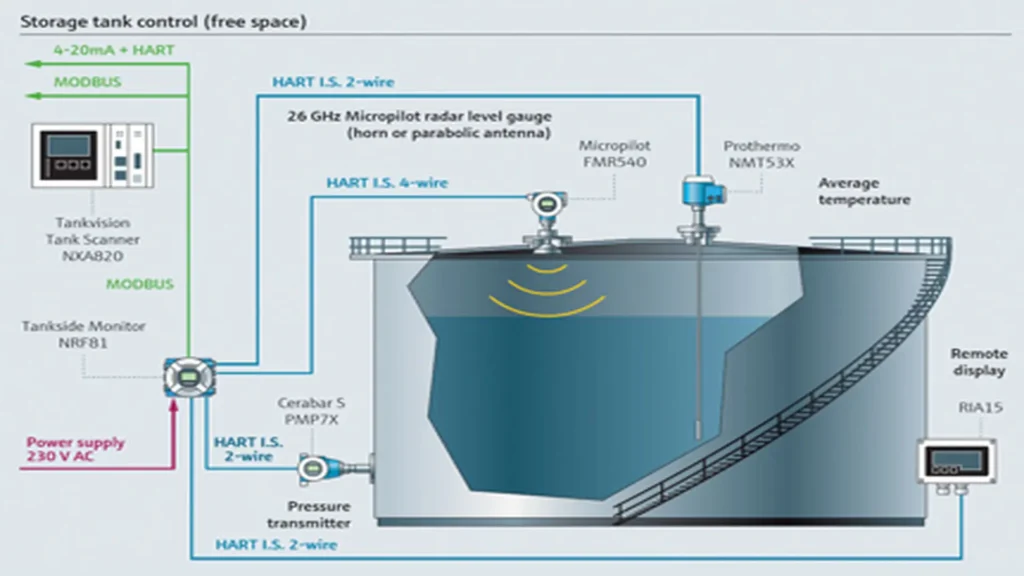
Currently, a modern tank measurement system integrates state-of-the-art components such as high-precision level radars, automatic servo gauges, and multipoint temperature sensors. These devices are complemented by density analyzers, SCADA systems, dedicated platforms for inventory management, and data analytics tools. The integration of these technologies allows for more reliable automatic tank measurement that is less dependent on human intervention.
Manual tank measurement: advantages and limitations
Although automation continues to expand, manual tank measurement is still used in numerous facilities around the world due to its low initial cost, ease of implementation, and total independence from complex electronic systems, which facilitates its applicability in remote locations.
However, this methodology presents significant limitations that restrict its efficiency. Its greater dependence on operator skill and the inherent risk of reading errors stand out, coupled with a lower frequency of measurements. Likewise, it involves the direct exposure of personnel to adverse operational conditions and offers less data traceability. For these reasons, many terminals have migrated to automatic systems to minimize measurement uncertainty and improve operational reliability.
Automatic tank measurement and digital transformation
Automatic tank measurement is a significant advancement in modern terminal management. ATG (Automatic Tank Gauging) systems allow for continuously monitoring product levels and transmitting the information in real time to supervision and control platforms.
The digital transition toward this model offers continuous and precise readings that eliminate human transcription errors. Furthermore, it achieves native integration with enterprise systems, visibility through remote monitoring, greater operational safety, and a substantial optimization in information traceability. This digitalization of processes has made automatic tank measurement a highly important element for optimizing inventory management and reducing operational losses.
Sources of uncertainty: level, temperature, and density
Measurement uncertainty is the parameter that quantifies the degree of confidence associated with a result. In the field of tank measurement, the largest contributions come from three fundamental variables:
- Level: It constitutes the most influential variable in determining volume. Errors in this section can originate from the intrinsic movement of the liquid, foam formation, structural vibrations, tank inclination, or misalignment of the reading instrument.
- Temperature: This variable directly affects the volume of hydrocarbons due to thermal expansion. Main sources of error include uncalibrated sensors, inadequate location of measuring elements, thermal stratification, and an insufficient number of reading points. Its correction is indispensable for obtaining normalized and comparable volumes.
- Density: Critically influences mass calculations and volumetric correction factors. Errors are usually related to unrepresentative sampling, product stratification, poor instrumentation, or unforeseen variations in fluid composition.
The combination of errors associated with level, temperature, and density constitutes one of the main causes of measurement uncertainty in modern terminals.
Api mpms: world reference for measurement
The API MPMS (Manual of Petroleum Measurement Standards) family of standards constitutes one of the main international benchmarks for the measurement of hydrocarbons and derivative products. These technical documents provide strict guidelines for level measurement, temperature determination, density sampling and analysis, tank calibration, custody transfer, and the methodological evaluation of uncertainty. The rigorous application of API MPMS contributes to improving the consistency of results and facilitates the international acceptance of commercial measurements.
Tank calibration: the foundation of accuracy
Volumetric calibration is one of the most important factors to guarantee precision. The tank calibration process establishes the exact relationship between the height of the liquid and the contained volume using techniques such as geometric calibration, volumetric calibration with water, three-dimensional laser scanning, or various hybrid methods.
The obtained tables must be kept up to date, especially after major repairs, structural modifications, or tank settlements, since an incorrect calibration table can generate systematic errors that affect all subsequent measurements.
What factors increase error in tank gauging?
Measurement errors rarely have a single cause; they are generally the result of multiple factors interacting simultaneously. Firstly, out-of-calibration instruments directly increase uncertainty by losing accuracy in the primary sensors. Added to this are installation deficiencies, which can diminish the performance of highly precise equipment, and insufficient maintenance that favors the gradual deterioration of the entire system.
On the other hand, environmental factors such as sudden temperature changes, strong winds, and vibrations affect the stability of the readings. Likewise, human errors due to inadequate procedures remain a frequent cause of deviations, especially in manual measurement. Finally, poor tank calibration leads to incorrect volumetric tables that directly alter the actual inventory.
How to reduce uncertainty when measuring tanks?
Reducing uncertainty requires a comprehensive strategy involving technology, procedures, and organizational culture through the following essential actions:
- Implement automatic technologies: The use of automatic tank measurement improves repeatability and substantially reduces human error.
- Maintain calibration programs: The periodic verification and adjustment of instruments guarantees consistent and reliable results.
- Update volumetric tables: Tank calibration must be thoroughly reviewed when there are physical modifications or signs of geometric changes in the structure.
- Apply recognized standards: The formal adoption of API MPMS guidelines provides standardized and globally accepted procedures.
- Train personnel: Continuous technical training optimizes the quality of field operations and reduces execution failures.
- Manage uncertainty: The periodic evaluation of all error sources allows for precisely identifying improvement opportunities in the terminal.
How to validate an atg for terminal custody?
The validation of an Automatic Tank Gauge used in custody transfer requires conclusively demonstrating that the system meets the accuracy levels required for commercial operations.
This process begins with installation verification, where the mechanical conditions, alignment, and configuration of the equipment are evaluated. Subsequently, functional tests are performed to verify the correct behavior of alarms, communication channels, and data logs. The core of the validation lies in the comparison with traceable standards, contrasting the readings against certified references, followed by a detailed uncertainty evaluation of the system’s total error. The entire procedure must ensure regulatory compliance, rigorously aligning with API MPMS criteria and applicable regulatory requirements.
Inventory management based on reliable measurements
Efficient inventory management depends directly on the quality of the data obtained during measurement. When terminal information is accurate, organizations manage to reduce apparent losses, improve reconciliation processes, optimize the logistics chain, increase overall profitability, strengthen the company’s position during audits, and substantially improve strategic decision-making. Conversely, inventories based on poor measurements can generate significant economic deviations that compromise the terminal’s competitiveness.
Good practices for modern terminals
To maintain high levels of precision, leading organizations apply a combined strategy of operational best practices. This philosophy includes the mandatory implementation of automatic tank measurement, the execution of periodic calibrations of the vessels, and the scheduled verification of each instrument. They are also based on the strict application of API MPMS standards, the analytical management of metrological indicators, the continuous training of operational personnel, the comprehensive digitalization of inventories, and the performance of regular audits on all measurement processes.
Technological trends in tank measurement
Technological evolution is continuous and drives disruptive improvements in the precision of storage systems. Among the industry’s most notable trends are high-resolution FMCW radars and smart sensors directly connected to the IoT (Internet of Things) ecosystem.
Similarly, there is an adoption of digital twins for entire terminals, the use of artificial intelligence for advanced inventory analysis, the use of laser scanning for volumetric tank calibration, and the deployment of cloud platforms for real-time monitoring. These innovations minimize the margin of error, optimize operational management, and strengthen trust in custody transfer processes.
Conclusions
Tank measurement is a critical process for the efficient operation of storage terminals. Reducing measurement uncertainty depends on proper calibration, the application of API MPMS, the validation of instruments, and the control of variables such as level, temperature, and density. The incorporation of automatic measurement technologies, along with metrological management programs and good operational practices, allows for obtaining more reliable inventories, optimizing custody transfer, and strengthening the competitiveness of organizations.
References
- American Petroleum Institute. (2024). Manual of Petroleum Measurement Standards (MPMS), Chapter 3.1A: Standard Practice for the Manual Gauging of Petroleum and Petroleum Products (3rd ed., Reaffirmed 2024). API Publishing Services.
- American Petroleum Institute. (2021). Manual of Petroleum Measurement Standards (MPMS), Chapter 3.1B: Standard Practice for Level Measurement of Liquid Hydrocarbons in Stationary Tanks by Automatic Tank Gauging. API Publishing Services.
- American Petroleum Institute. (2022). Manual of Petroleum Measurement Standards (MPMS), Chapter 3.3: Standard Practice for Level Measurement of Liquid Hydrocarbons in Stationary Pressurized Storage Tanks by Automatic Tank Gauging. API Publishing Services.
- American Petroleum Institute. (2021). Manual of Petroleum Measurement Standards (MPMS), Chapter 7.3: Temperature Determination, Fixed Automatic Tank Temperature Systems (2nd ed., Reaffirmed 2021). API Publishing Services.
- American Petroleum Institute. (1994). Manual of Petroleum Measurement Standards (MPMS), Chapter 16.2: Mass Measurement of Liquid Hydrocarbons in Vertical Cylindrical Storage Tanks by Hydrostatic Tank Gauging. API Publishing Services.
- International Organization for Standardization. (2018). ISO 7507-1: Petroleum and liquid petroleum products, Calibration of vertical cylindrical tanks, Part 1: Strapping method. ISO.