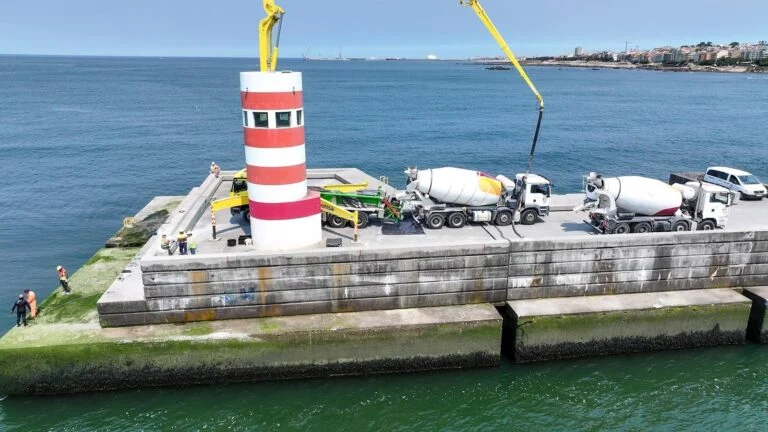
The rehabilitation of the Barra do Douro breakwater in Oporto has begun as a preliminary step for the development of a 1 MW wave energy installation by Eco Wave Power.
The works are being executed by the Administration of the Ports of Douro, Leixões and Viana do Castelo (APDL), responsible for the maintenance and reinforcement of port infrastructure.
The project had been conditioned by damage caused by a storm to the breakwater. The recovery of the infrastructure will enable subsequent advancement with the installation of the wave energy conversion system.
Eco Wave Power has also requested an extension of the regulatory deadline for grid connection of the first 1 MW phase. APDL will support this request through a formal letter to Portuguese authorities.
The Breakwater Becomes an Energy Asset
The most interesting technological feature of the project is that Eco Wave Power does not propose building a specific marine structure to capture waves.
Its technology is designed to leverage existing artificial coastal infrastructure, such as breakwaters, jetties, and piers. This considerably changes the traditional concept of a marine wave energy project.
Instead of installing equipment directly on the seabed through foundations or independent offshore structures, the devices are integrated into infrastructure that already serves a port function.
The breakwater continues to protect the port, but certain elements of its structure can additionally become energy capture points.
From an engineering standpoint, this introduces a fundamental condition: the port infrastructure must be capable of simultaneously supporting its original loads and the new loads associated with the wave energy system.
The Storm Reveals a Critical Variable
The rehabilitation of Barra do Douro demonstrates why wave energy cannot be analyzed solely from the converter’s efficiency.
The ocean imposes significant dynamic loads. Wave action, impacts, load cycles, marine corrosion, and extreme phenomena directly affect any structure located in the breaking zone.
A wave energy installation integrated into a breakwater additionally adds mechanical, hydraulic, and electrical components that must remain operational after severe environmental events.
The structural resistance of the breakwater conditions the generator’s availability. And, conversely, the forces transmitted by the capture system must be incorporated into the structural analysis of the existing infrastructure.
How It Converts Waves into Electricity
Eco Wave Power’s technology uses elements installed on coastal structures that respond to wave motion. The mechanical movement produced by wave action is transmitted to a hydraulic system.
The hydraulic circuit transforms that movement into pressure and flow, which can subsequently be used to drive an electrical generator.
This architecture has an important difference compared to numerous offshore wave energy systems. The main equipment can remain in infrastructure accessible from land.
This can reduce the logistical complexity associated with offshore operations and facilitate certain maintenance activities. It does not mean that marine environment problems disappear.
Corrosion, load cycles, impacts, and permanent exposure to saltwater remain design factors.
Maintenance: A Potential Advantage
In a system located directly at sea, an intervention may require vessels, suitable weather windows, access equipment, and maritime logistics.
In contrast, when the main components are linked to a breakwater, some work can be executed from land or port infrastructure. This can significantly modify the maintenance model.
Wave energy continues to face a significant challenge: surviving the same resource it seeks to harness. The conditions that produce electricity are the same ones that subject the equipment to the greatest loads.
That balance between energy capture and structural survival is one of the major problems in marine energy engineering.
Multidisciplinary Engineering in Oporto
Eco Wave Power plans to work with Portuguese companies specialized in different areas. Execution requires civil engineering, metal structures, hydraulic systems, electrical installations, grid connection, and manufacturing.
Additionally, each discipline must consider the particular conditions of a coastal environment. The structure must withstand. The hydraulic system must operate in the presence of humidity and saline atmosphere. Electrical equipment must be protected against aggressive environmental conditions.
And the connection must meet Portuguese grid requirements.
SOURCE and PHOTO: https://www.offshore-energy.biz/