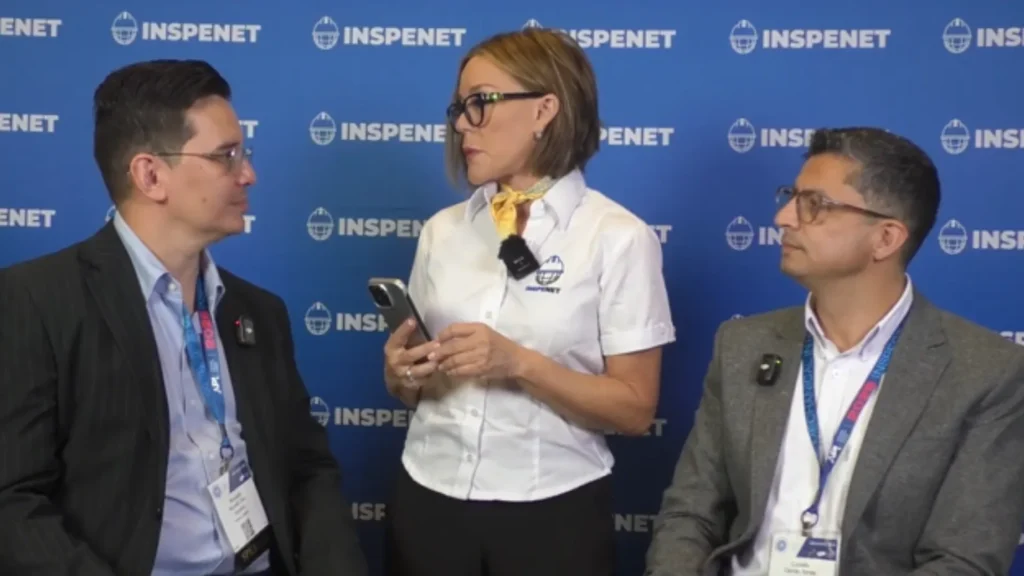
During an interview conducted at the API conference, representatives from Penspen highlighted the role probabilistic assessment is playing in the evolution of pipeline integrity programs.
Camilo Torres, the company’s Technical Manager, and Ronald Díaz Ortega, Product Integrity Engineer, explained how the use of advanced analytics and statistical simulations allows operators to optimize inspection planning, reduce unnecessary excavations, and prioritize repairs based on risk.
Penspen: From Deterministic Analysis to Risk-Based Management
Camilo Torres explained that Penspen is a company specializing in pipeline integrity assurance through advanced analytical methodologies that transform inspection data into useful information for decision-making.
According to the specialist, one of the main challenges currently faced by operators is the growing volume of pending maintenance activities, caused by budgetary constraints, logistical difficulties, and the operational complexity involved in intervening a pipeline in service.
Given this scenario, the probability of exceedance methodology allows for understanding the future behavior of detected anomalies, projecting their evolution, and estimating the risk of failure, thus facilitating the prioritization of repairs and more efficient scheduling of future in-line inspections.
Monte Carlo Simulation to Improve Model Reliability
For his part, Ronald Díaz Ortega explained that Monte Carlo simulations are a fundamental tool within these probabilistic models. However, he noted that the reliability of the results directly depends on the correct selection of the statistical distributions used as input data.
The specialist indicated that these distributions are validated using both information provided by in-line inspection tool manufacturers and experimental studies on the actual behavior of pipelines, including burst pressure tests and rupture tests. This approach allows for a more accurate representation of the behavior of corrosion and other anomalies present in pipeline transportation systems.
A Methodology Aligned with Modern Integrity Programs
During the conversation, Torres highlighted that the industry is progressively migrating towards management schemes based on probabilistic analyses, a trend driven by operators themselves and by corporate risk management policies.
In this context, he explained that probabilistic assessments are already part of the processes used to establish maintenance priorities, optimize resources, and strengthen asset integrity management programs.
He also indicated that new analytical tools allow for evaluations that previously required months of work to be completed in a matter of hours or a few days, significantly accelerating technical decision-making.
A Trend Towards Standardization
Penspen representatives agreed that probabilistic corrosion assessment is already a requirement within many operating organizations, although its implementation was previously limited by the absence of sufficiently robust computational tools.
Thanks to the development of new data analysis capabilities, it is now possible to execute more rigorous probabilistic models adjusted to the actual behavior of assets, an evolution that, according to specialists, could progressively consolidate within future revisions of major international standards related to pipeline integrity.
With this approach, Penspen seeks to provide the industry with tools that strengthen risk management, optimize maintenance programs, and improve the operational reliability of hydrocarbon transportation infrastructure.
Source and photo: Inspenet