Table of Contents
- Obstructions in offshore pipelines can be located using pressure waves
- An obstruction was detected 11 kilometers from the launch point
- PipeScan achieved an approximate accuracy of ±30 meters
- Why does an obstruction pose a problem for pipeline integrity?
- Technology expands the pipeline integrity toolkit
- From onshore monitoring to offshore pipelines in Angola
- Accuracy will need to prove its value under new offshore conditions
Obstructions in offshore pipelines can become a critical problem when they affect the transportation of oil, gas, or multiphase fluids and their exact location cannot be determined from outside the pipeline. PipeSense deployed its PipeScan technology in offshore operations for the first time and successfully located restrictions in two pipeline systems using pressure pulses and wave analysis, including one case in which it identified the position of an obstruction with an approximate accuracy of ±30 meters under field conditions.
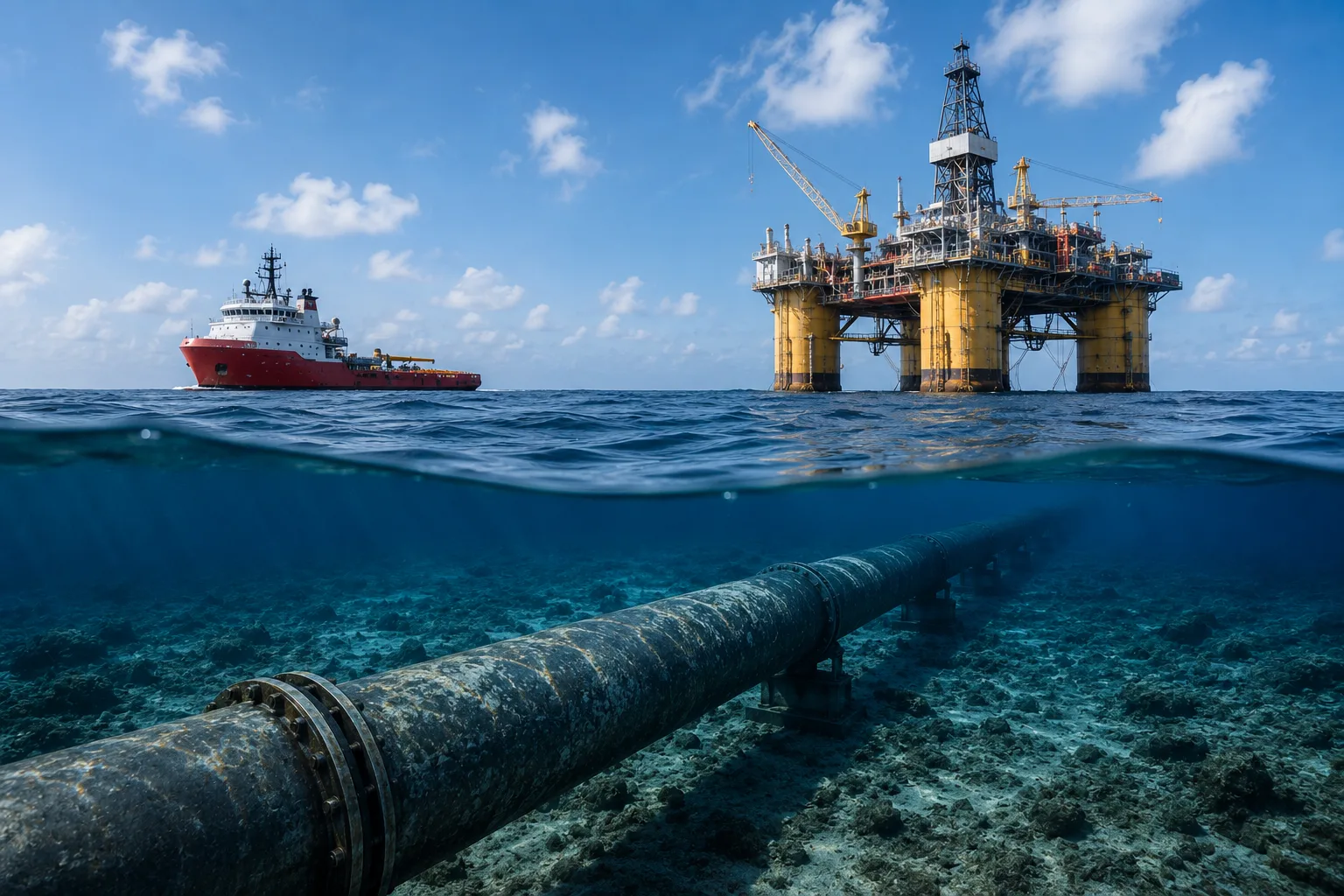
The deployment was carried out in Angola alongside a multinational Oil & Gas operator and involved two different scenarios: a 20-inch natural gas pipeline and a 16-inch offshore pipeline used to transport crude oil and multiphase flow. The latter was flooded with seawater during testing.
Beyond the specific results, the experience introduces an alternative for addressing one of the challenges of pipeline integrity: determining where a restriction is located before deciding how to intervene. More precise localization can reduce uncertainty when dealing with stuck pigs, hydrate accumulations, debris, or other conditions capable of restricting flow.
Obstructions in offshore pipelines can be located using pressure waves
PipeScan operates on a principle different from physically tracking a tool inside the pipeline. The system induces controlled pressure pulses and records how these disturbances travel through the fluid.
When a wave encounters a significant change within the system—such as an obstruction—part of its energy can be reflected. High-speed pressure acquisition makes it possible to record these responses and analyze their characteristics.
The distance to the anomaly can then be estimated using the temporal behavior of the signals and the properties of the system.
The concept can be compared, while recognizing the respective physical differences, with the principle used by other wave-based techniques: a known signal is generated, its interaction with a discontinuity is observed, and the response is interpreted to obtain information about its location.
In an offshore pipeline, however, the analysis must consider variables that can alter wave propagation, including fluid properties, pressure, pipeline configuration, length, and operating conditions. For this reason, data processing represents a fundamental part of the diagnosis.
An obstruction was detected 11 kilometers from the launch point
The first scenario involved a 20-inch natural gas pipeline. PipeSense conducted multiple pressure-pulse tests to obtain repeatable signals and determine the location of a restriction. The analysis placed the obstruction approximately 11 kilometers downstream of the operator’s launch facility.
Repeating the tests is important in this type of diagnosis. A single pressure variation can be influenced by different system conditions; obtaining consistent responses increases confidence that the observed signal actually corresponds to a physical feature within the pipeline.
The result also demonstrates the potential range of the technique. Eleven kilometers represents a considerable distance when the objective is to locate an internal condition from accessible points within offshore infrastructure.
Knowing that distance before beginning an intervention allows the operator to narrow the area where subsequent diagnostic or recovery activities should be concentrated.
PipeScan achieved an approximate accuracy of ±30 meters
The second project involved different conditions and produced the most technically significant result of the deployment. PipeSense installed instrumentation at both ends of a 16-inch offshore pipeline used for crude oil and multiphase flow, which was flooded with seawater during the work.
Controlled pressure releases were performed from both locations. These generated repeatable reflection signatures that made it possible to identify an obstruction approximately 700 meters from the launcher. Under the field conditions encountered, the calculated location achieved an approximate accuracy of ±30 meters.
Instrumentation at both ends provides additional information for comparing the responses obtained and narrowing down the possible location of the anomaly. Instead of knowing only that a restriction exists somewhere within kilometers of pipeline, the operator can identify a considerably smaller area on which to plan subsequent actions.
That level of accuracy does not necessarily mean that the system can independently determine the exact nature of the object detected. Locating an obstruction and characterizing what is causing it are two different problems. However, establishing where it is located provides essential information before selecting an intervention strategy.
Why does an obstruction pose a problem for pipeline integrity?
Internal restrictions can have different origins. A pig can become stuck during a cleaning or inspection operation, while conditions that make pigging difficult in offshore pipelines can significantly increase the complexity of integrity operations; hydrates can form plugs under certain combinations of pressure, temperature, and fluid composition; accumulations of debris or other materials capable of partially or completely reducing the available cross-sectional area may also occur.
The consequences depend on the nature and severity of the condition. A restriction can reduce transportation capacity, alter pressure profiles, affect operational stability, or prevent certain maintenance and inspection activities from being performed. When flow becomes completely blocked, restoring the pipeline can become a technically complex operation.
Offshore and subsea installations also present an additional challenge: access. Intervening on kilometers of pipeline beneath the sea is considerably different from working on an onshore installation. For this reason, knowing more precisely where an anomaly is located can have direct implications for planning, resources, intervention time, and operational exposure.
Technology expands the pipeline integrity toolkit
The value of the deployment lies not only in the ±30-meter accuracy achieved in one of the cases. It also demonstrates that the combination of induced pressure pulses, high-speed data acquisition, and dynamic pressure-wave reflection analysis can be applied in offshore environments under different operating conditions.
PipeSense positions this capability as an additional tool within pipeline integrity strategies, particularly for locating stuck pigs, hydrate plugs, debris, and other flow restrictions.
The word additional is important. The technology does not automatically replace other inspection, monitoring, or integrity assessment methods. On the contrary, combining different inspection and monitoring technologies can expand the information available about pipeline condition. Its usefulness will depend on the problem that needs to be addressed, the characteristics of the pipeline, fluid conditions, and the information available.
In this case, its primary function is to reduce a very specific uncertainty: where the obstruction is located. That information can subsequently be combined with operational data, pipeline history, and other techniques to define the next steps.
From onshore monitoring to offshore pipelines in Angola
The project also represents a shift in operating environment for PipeSense. Over the past three years, the company had accumulated applications and developments primarily associated with onshore energy and utility operators. In 2026, it also expanded its activities into the South American mining sector, introduced a pig tracking system with its corresponding dashboard, and worked on advanced leak detection for CO₂ applications and networks.
The deployment carried out in Angola now brings some of those capabilities into offshore and subsea infrastructure. For operators, this type of technological evolution is particularly relevant because subsea systems combine operational criticality, access difficulties, and high intervention costs. A technology capable of providing additional information without relying exclusively on specialized tracking tools can broaden the options available before more invasive work is carried out.
Accuracy will need to prove its value under new offshore conditions
The results obtained from these two projects show that PipeScan can identify reflections associated with restrictions and use them to estimate their position within offshore pipelines. However, the next challenge will be to demonstrate how reproducible that performance is across other pipeline configurations, fluids, lengths, diameters, and operating conditions.
The Angola experience provides an initial reference: one restriction was located approximately 11 kilometers downstream in a 20-inch natural gas pipeline, while another was identified approximately 700 meters away in a 16-inch pipeline, with the latter achieving an approximate accuracy of ±30 meters.
For managing obstructions in offshore pipelines, this capability can be particularly useful when the initial question is not yet how to remove the blockage, but something much more fundamental and decisive: at what exact point along kilometers of subsea infrastructure it is located. The answer to that question can transform how everything that follows is planned.
Source: Pipeline & Gas Journal.