Table of Contents
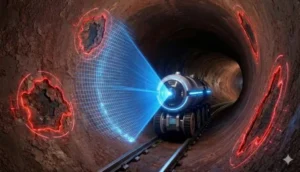
- What does in-line inspection solve in modern pipelines?
- Operating principles of In-Line Inspection (ILI)
- ILI tool types and detection capabilities
- Detection of corrosion, cracks, and deformation
- What fiber optics adds to continuous pipeline monitoring?
- Fundamentals of Distributed Fiber Optic Sensing (DFOS)
- Applications: leaks, intrusion, and operational events
- Advantages over traditional point-based monitoring
- How anomalies are assessed in difficult to inspect pipelines?
- Classification of unpiggable pipelines and technical challenges
- Emerging technologies for complex pipeline geometries
- Use of self-propelled tools in critical pipeline segments
- Why integrating ILI and fiber optics improves pipeline integrity?
- From periodic inspection to intelligent continuous monitoring
- Synergy between discrete (ILI) and continuous (fiber) data
- Impact on decision-making and risk reduction
- Use cases in H2, CO2 pipelines, and critical infrastructure
- Integrity challenges in hydrogen transportation pipelines
- Monitoring CO2 pipelines in carbon capture systems
- Conclusions
- References
- Frequently Asked Questions (FAQs)
The rapid expansion of hydrogen (H₂) and carbon dioxide (CO₂) transportation networks is pushing pipeline systems beyond the conditions they were originally designed for. In the field, this is not just a theoretical concern, it shows up as inspection limitations, uncertain data, and segments that operators simply cannot assess with conventional tools.
In pipelines with tight bends, diameter restrictions, or low-flow conditions, traditional inspection methods quickly reach their limits. This is where the real risk begins: corrosion, cracking, or mechanical damage may continue developing without reliable visibility, directly impacting overall pipeline integrity and increasing operational risk across the system.
In response, the industry is shifting toward more advanced and integrated inspection strategies. In-Line Inspection (ILI) technologies continue to evolve, offering increasingly precise detection capabilities, while fiber-optic monitoring systems introduce a new dimension of continuous, real-time surveillance across entire pipeline networks. Together, these technologies are transforming how operators detect, assess, and respond to integrity threats.
This article explores how the combination of ILI and fiber-optic monitoring enhances pipeline integrity, particularly in difficult-to-inspect pipelines, enabling more informed decisions, improved risk management, and greater operational resilience.
What does in-line inspection solve in modern pipelines?
In-Line Inspection (ILI) has become a core tool in pipeline integrity programs because it delivers something operators cannot obtain any other way: direct insight into the internal condition of the pipeline without shutting it down. In practice, this level of visibility is critical when dealing with aging assets or pipelines operating under new service conditions such as hydrogen or CO₂.
However, ILI is not without limitations. Its effectiveness depends heavily on pipeline geometry, flow conditions, and tool selection. For example, ultrasonic tools perform extremely well in liquid pipelines but lose effectiveness in gas environments, while magnetic flux leakage tools may struggle with signal interpretation in complex corrosion scenarios. These constraints mean that even high-quality ILI data must be interpreted carefully.
In many real-world scenarios, operators must make critical decisions with incomplete information or data that carries significant uncertainty. This is particularly common in aging pipelines or in segments where full inspection is not feasible, increasing the need to combine multiple data sources to effectively reduce risk.
Moreover, ILI supports the transition from reactive maintenance to predictive integrity strategies, allowing operators to monitor degradation trends over time, estimate remaining life, and prioritize interventions based on actual condition rather than assumptions. This is particularly valuable in high-consequence areas and in pipelines where failure can result in significant environmental or economic impact.
Operating principles of In-Line Inspection (ILI)
ILI systems operate by deploying instrumented tools, commonly referred to as “pigs”, that travel through the pipeline driven by the product flow. These tools are equipped with advanced sensor technologies designed to capture detailed information about the internal condition of the pipe wall.
Depending on the inspection objective, ILI tools may use magnetic flux leakage (MFL), ultrasonic testing (UT), electromagnetic acoustic transducers (EMAT), or a combination of these methods. As the tool moves through the pipeline, it records high-density data related to wall thickness, material loss, crack presence, and geometric deformation.
The collected data is then processed using specialized algorithms to reconstruct a digital representation of the pipeline’s condition. This allows engineers to accurately locate anomalies, characterize their severity, and assess their potential impact on structural integrity. The result is a data-driven foundation for integrity management that significantly enhances inspection reliability and decision-making.
ILI tool types and detection capabilities
ILI technologies have evolved significantly to address a wide range of degradation mechanisms and pipeline configurations. Modern ILI tools are typically categorized based on their sensing technology and inspection focus.
Magnetic Flux Leakage (MFL) tools are widely used for detecting metal loss due to corrosion, providing reliable volumetric measurements of wall thinning. Ultrasonic Testing (UT) tools offer high-resolution measurements of wall thickness and are particularly effective for crack detection in liquid pipelines. Meanwhile, EMAT-based tools enable crack detection without requiring liquid coupling, making them suitable for gas pipelines.
In addition to these, geometry tools, often referred to as caliper pigs, are used to identify mechanical deformations such as dents, ovalities, and buckling. Advanced multi-technology tools now combine several sensing methods in a single run, improving inspection efficiency and data correlation.
Detection of corrosion, cracks, and deformation
ILI enables precise detection and characterization of key integrity threats. Corrosion is identified through wall thickness variations, while cracks, such as stress corrosion cracking (SCC) or fatigue cracking, are detected using ultrasonic or electromagnetic methods. Mechanical deformations, including dents and bends, are captured through geometry measurements. Together, these capabilities provide a comprehensive understanding of pipeline condition, forming the basis for accurate anomaly assessment and risk mitigation.
What fiber optics adds to continuous pipeline monitoring?
Fiber Optic Pipeline Monitoring introduces a step-change in how operators achieve continuous, long-range visibility over pipeline systems, significantly advancing modern pipeline monitoring capabilities. Unlike periodic inspections, Distributed Fiber Optic Sensing (DFOS / DAS) converts a standard telecom fiber into a dense array of virtual sensors, enabling real-time detection of events along tens to hundreds of kilometers from a single interrogator. This capability is particularly valuable in remote corridors, high-consequence areas, and segments where access is limited or conditions evolve rapidly.
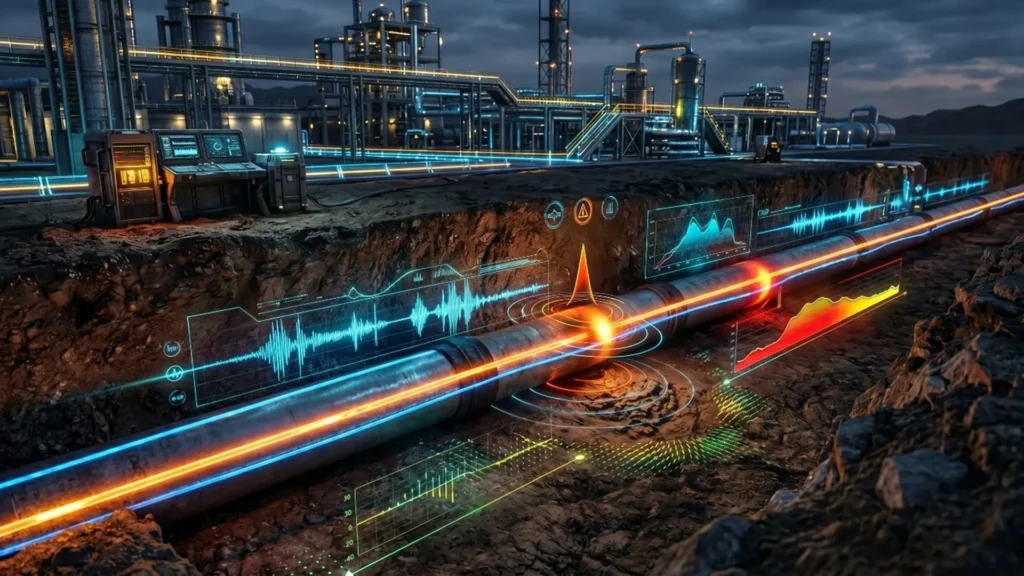
By measuring backscattered light variations, DFOS technologies capture acoustic, temperature, and strain signatures associated with pipeline behavior and external activities. The result is a continuous stream of spatially referenced data that complements inspection snapshots from ILI. Operators can detect early indicators of leaks, third-party interference, or abnormal flow conditions, significantly reduce detection latency, and improving response time.
In modern integrity programs, fiber optics does not replace ILI; it extends it—bridging the gap between inspection runs with persistent monitoring. When integrated into a digital workflow, DFOS supports alarm management, event classification, and geolocation, enabling faster triage and targeted field verification. This shift from episodic to continuous awareness is critical for assets transporting H₂ and CO₂, where small leaks or transient events can escalate quickly if not detected in time.
Fundamentals of Distributed Fiber Optic Sensing (DFOS)
DFOS systems operate by injecting laser pulses into an optical fiber and analyzing the light that is scattered back along the fiber length. Phenomena such as Brillouin, Raman, and Rayleigh scattering change in response to acoustic vibrations, temperature variations, and strain. By correlating these changes with time-of-flight, the system maps events to precise locations along the pipeline.
Distributed Acoustic Sensing (DAS), a core form of acoustic sensing, focuses on vibration and sound patterns, ideal for detecting digging, impacts, or flow anomalies. Distributed Temperature Sensing (DTS), a key temperature sensing technology, captures thermal profiles, supporting leak detection and thermal event identification. Distributed Strain Sensing (DSS) measures deformation, useful for geohazard monitoring. Together, these modalities provide a comprehensive, distributed sensing framework without installing discrete sensors at intervals.
Applications: leaks, intrusion, and operational events
In practice, DFOS enables early leak detection by identifying acoustic signatures of escaping fluid or temperature anomalies along the right-of-way. It also excels at third-party interference detection, recognizing patterns from excavation, vehicle movement, or unauthorized activity near the pipeline.
Operationally, fiber optics can detect flow regime changes, valve operations, and pump start/stop events, offering insights into transient conditions that may stress the system. With advanced analytics, events are classified and filtered to reduce false alarms, while geolocation pinpoints the exact segment requiring inspection. This continuous intelligence enhances situational awareness and supports faster, more targeted interventions.
Advantages over traditional point-based monitoring
Compared to point sensors, DFOS delivers continuous spatial coverage, eliminating blind spots between instruments. It reduces field hardware complexity, leverages existing fiber where available, and scales over long distances from a single unit. Most importantly, it shortens detection and response times, enabling proactive risk management and strengthening overall pipeline integrity.
How anomalies are assessed in difficult to inspect pipelines?
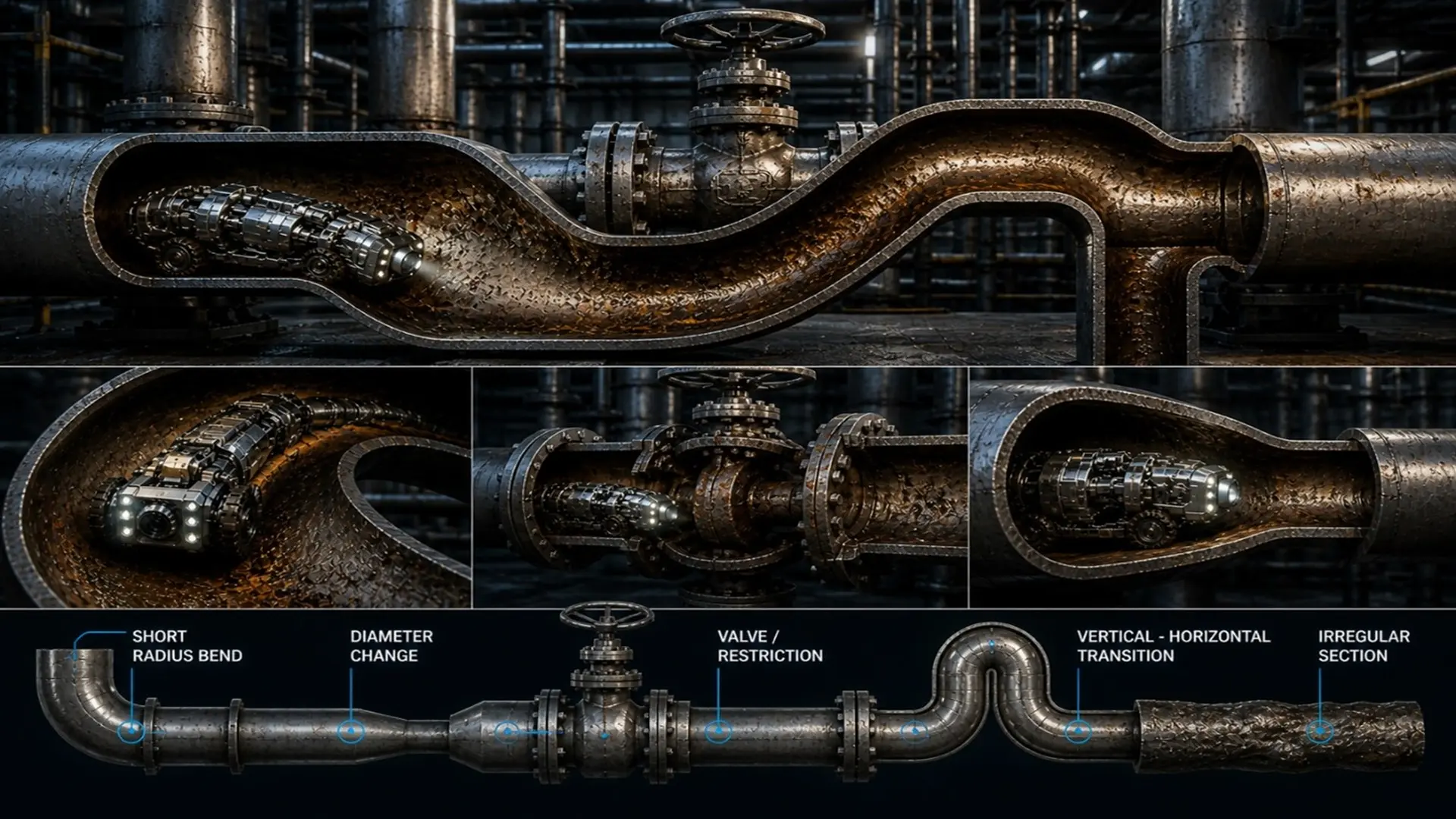
Pipeline Anomaly Assessment in segments classified as unpiggable demands a different mindset than conventional integrity programs. Here, the challenge is not only detecting defects but doing so under constraints that limit or prevent the passage of standard ILI tools. Bends with short radio, diameter changes, restricted valves, low flow conditions, and legacy configurations create blind spots where corrosion, cracking, or mechanical damage can evolve without reliable inspection coverage.
In these environments, operators must combine engineering judgment, alternative inspection technologies, and risk-based methodologies to achieve a defensible integrity assessment. Data from indirect methods, such as external corrosion surveys, pressure testing, and operational history, are often integrated with targeted internal inspection where feasible. The goal is to reduce uncertainty, prioritize critical segments, and establish credible anomaly sizing and growth rates despite incomplete datasets.
Classification of unpiggable pipelines and technical challenges
Unpiggable pipelines are typically defined by geometric, operational, or mechanical constraints that prevent the use of conventional inline tools. Common categories include pipelines with tight bends (short-radius elbows), reduced internal diameters, check valves or back-to-back fittings, and sections with insufficient flow to propel tools.
Each category introduces specific challenges. Geometric restrictions can trap or damage inspection tools, while variable diameters affect sensor standoff and data quality. In low-flow or dead-leg sections, propulsion becomes unfeasible. Additionally, older assets may lack design documentation, increasing uncertainty in anomaly localization and characterization. These factors complicate not only inspection execution but also data interpretation, requiring conservative assumptions and robust validation to maintain pipeline integrity.
Emerging technologies for complex pipeline geometries
To overcome these limitations, the industry has advanced toward specialized inspection technologies tailored for complex geometries. These include tethered inspection systems, robotic crawlers, and modular tools capable of adapting to internal variations. Some platforms combine ultrasonic and electromagnetic techniques to enhance detection capability even in challenging conditions.
Complementary approaches such as guided wave ultrasonic testing (GWUT) and external non-destructive evaluation (NDE) methods are also used to screen long segments from a single location. In this context, Guided Wave Testing (GWT) has evolved significantly, incorporating real-time monitoring capabilities and more proactive approaches to integrity management. Companies such as Guided Ultrasonics Ltd. (GUL) have played a key role in advancing this technology, demonstrating how it can be effectively applied in the field to address the challenges of complex and difficult-to-inspect pipelines. The following content illustrates how these solutions are transforming pipeline inspection practices. Video courtesy of Inspenet TV:
Meanwhile, digital modeling and simulation tools help predict anomaly behavior and prioritize inspection zones. The integration of these technologies enables operators to build a more complete integrity picture, even when full-length ILI is not possible.
Use of self-propelled tools in critical pipeline segments
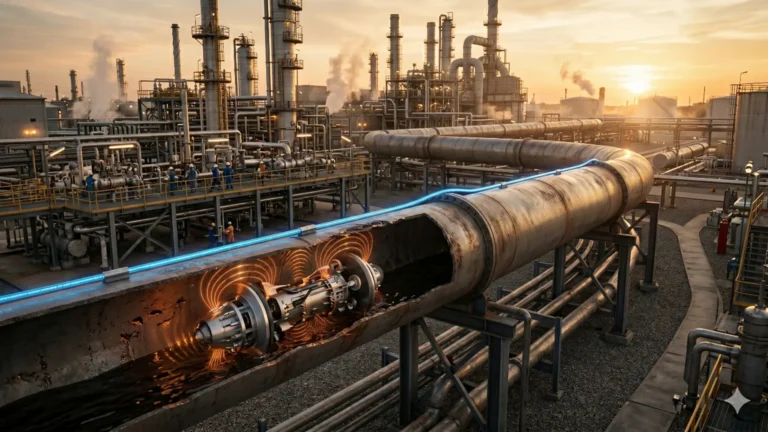
A notable advancement in this field is the deployment of self-propelled inspection tools designed to navigate previously inaccessible pipeline sections. These systems can operate independently of product flow, maneuver through short-radius bends, and traverse complex internal geometries with high stability.
For example, industry solutions such as those developed by ROSEN Group have demonstrated the capability to inspect pipelines traditionally considered unpiggable, delivering high-resolution data for anomaly detection and sizing. By expanding inspection coverage into these critical segments, operators can significantly reduce uncertainty, improve anomaly assessment accuracy, and strengthen overall pipeline integrity management.
Why integrating ILI and fiber optics improves pipeline integrity?
Integrating In-Line Inspection (ILI) with fiber optic monitoring is not just a technological upgrade, it is a shift in how pipeline integrity is actually managed in the field. ILI delivers detailed snapshots of the pipeline’s internal condition, but those snapshots are limited to specific inspection intervals. Between runs, conditions can change, sometimes rapidly.
Fiber optic systems address this gap by enabling continuous pipeline monitoring, capturing transient events such as leaks, ground movement, or third-party interference as they happen. But these systems also have limitations: they do not directly quantify defects or provide the level of detail required for precise anomaly sizing.
By integrating these technologies, operators gain not only visibility into existing anomalies but also the ability to detect emerging threats as they occur, significantly enhancing leak detection, anomaly tracking, and overall system reliability.
From periodic inspection to intelligent continuous monitoring
Traditional integrity programs have relied heavily on periodic inspection cycles, where ILI campaigns are conducted at defined intervals. While effective for identifying defects, this approach inherently leaves time gaps where degradation can progress undetected.
By incorporating fiber optic monitoring, operators transition toward intelligent continuous monitoring, where the pipeline is effectively “observed” at all times. Real-time data streams enable early detection of abnormal events such as leaks, ground movement, or third-party interference, allowing for faster intervention.
This shift transforms integrity management from a reactive or interval-based model into a proactive system capable of responding dynamically to evolving conditions, significantly reducing exposure to failure and minimizing overall operational risk.
Synergy between discrete (ILI) and continuous (fiber) data
The true value of integration lies in the synergy between discrete and continuous data sources. ILI provides detailed, high-accuracy information on anomaly type, size, and location, forming the baseline for integrity assessment. In contrast, fiber optic systems supply continuous monitoring data that captures transient events and evolving conditions.
When combined, these datasets enable advanced anomaly assessment, where operators can correlate detected defects with real-time operational behavior. For example, a corrosion feature identified by ILI can be continuously monitored through fiber optic signals to detect changes in flow conditions or external disturbances that may accelerate its growth.
This integrated approach becomes even more valuable in pipeline segments where advanced inspection solutions, such as those applied in previously unpiggable pipelines, have expanded the availability of high-quality internal data, enabling a more complete and reliable integrity assessment, aligned with advanced models such as digital twins.
Impact on decision-making and risk reduction
The integration of ILI and fiber optic monitoring has a direct impact on decision-making and risk reduction. With access to both high-resolution inspection data and continuous monitoring insights, operators can prioritize maintenance activities based on real-time risk rather than static assumptions.
This leads to more accurate integrity assessments, optimized inspection intervals, and better allocation of resources. Additionally, early detection capabilities reduce the likelihood of catastrophic failures, minimizing environmental impact, operational downtime, and economic losses.
Ultimately, this integrated approach strengthens pipeline integrity by enabling a predictive and resilient management framework, aligned with the increasing complexity of modern pipeline systems.
Use cases in H2, CO2 pipelines, and critical infrastructure
The deployment of advanced integrity technologies is becoming essential as pipeline systems evolve to support hydrogen (H₂) transport and carbon capture, utilization, and storage (CCUS) networks. These applications introduce new degradation mechanisms, operating envelopes, and safety considerations that demand higher levels of visibility and control. Integrating In-Line Inspection (ILI) with fiber optic monitoring enables operators to manage these risks more effectively, combining high-resolution defect characterization with continuous surveillance. This approach is particularly valuable in critical infrastructure, where failure consequences are significant and regulatory scrutiny is increasing.
Integrity challenges in hydrogen transportation pipelines
Hydrogen pipelines present unique integrity challenges due to phenomena such as hydrogen embrittlement, which can reduce material ductility and promote crack initiation and propagation. In addition, hydrogen’s small molecular size increases its tendency to leak through micro-defects that may not be critical under conventional service conditions.
ILI technologies adapted for crack detection, such as ultrasonic and EMAT-based tools, play a crucial role in identifying early-stage defects. When complemented by fiber-optic systems, operators can monitor transient events, pressure fluctuations, and external disturbances that may accelerate degradation. This dual approach is key to maintaining pipeline integrity in hydrogen service, where both detection sensitivity and response time are critical.
Monitoring CO2 pipelines in carbon capture systems
CO₂ pipelines, particularly those used in CCUS applications, operate under high pressure and may contain impurities that contribute to corrosion mechanisms, including internal corrosion driven by water content and chemical composition. Additionally, dense-phase CO₂ leaks can pose safety risks due to rapid depressurization and dispersion behavior.
ILI is essential for detecting corrosion-related metal loss and structural defects, providing baseline data for anomaly assessment. Fiber-optic monitoring enhances this capability by enabling real-time leak detection, temperature anomaly identification, and monitoring of third-party interference along the pipeline route.
Together, these technologies support a more robust integrity framework for CO₂ transport systems, ensuring safe operation while meeting the stringent requirements associated with carbon management infrastructure.
Conclusions
Pipeline integrity is entering a new phase where digitalization and hybrid monitoring architectures redefine how risk is understood and managed. The convergence of high-resolution ILI datasets with continuous streams from fiber optic sensing is laying the foundation for predictive integrity, where anomalies are not only detected but anticipated.
At the core of this evolution is the integration of artificial intelligence (AI) and advanced analytics. Machine learning models are increasingly capable of correlating inspection data, operational parameters, and environmental conditions to identify patterns that precede failure. This enables operators to move beyond static integrity assessments toward dynamic risk models that update in near real time.
In parallel, the adoption of digital twins is transforming asset management. By creating a virtual representation of the pipeline that continuously ingests field data, operators can simulate degradation scenarios, validate mitigation strategies, and optimize inspection intervals with greater confidence. This digital layer enhances decision-making by providing a contextual understanding of how anomalies evolve under real operating conditions.
Looking ahead, the combination of ILI, fiber optics, AI, and digital twins will define a resilient and adaptive integrity framework. In an environment shaped by energy transition, stricter regulations, and more complex assets, the ability to integrate and act on data will become the primary differentiator. Pipeline integrity will no longer be a periodic exercise—it will be a continuous, intelligent system designed to anticipate risk and ensure long-term operational reliability.
References
- American Petroleum Institute. (2021). API Standard 1163: In-line inspection systems qualification (3rd ed.). American Petroleum Institute.
- Fiber Optic Sensing Association. (2022). Utilizing distributed fiber optic sensing systems to detect leaks and ground movement and prevent damage to pipelines. Fiber Optic Sensing Association.
- Stajanca, P., Chruscicki, S., Homann, T., Seifert, S., Schmidt, D., & Habib, A. (2018). Detection of leak-induced pipeline vibrations using fiber-optic distributed acoustic sensing. Sensors, 18(9), 2841. https://doi.org/10.3390/s18092841
- DNV. (2026). DNV-RP-F123: Hydrogen pipeline systems. DNV.
- Pipeline Technology Journal. (2021). Selection criteria for pipeline leak detection methods using distributed fiber optic sensing. Pipeline Technology Journal.
Frequently Asked Questions (FAQs)
What does ILI contribute to pipeline integrity?
In-line inspection (ILI) provides a detailed assessment of the internal condition of a pipeline, enabling the identification and sizing of anomalies such as corrosion, cracks, and deformation. Its main value lies in delivering accurate data for integrity assessment, remaining life estimation, and risk-based decision-making within a structured risk analysis framework, without interrupting operations.
How does fiber optic monitoring work?
Fiber optic monitoring uses technologies such as Distributed Fiber Optic Sensing (DFOS) to transform a cable into a continuous sensing network. By analyzing optical signals, it detects acoustic, thermal, or strain changes along the pipeline, enabling real-time identification of leaks, intrusions, or operational events.
What anomalies can ILI detect in pipelines?
ILI can detect metal loss due to corrosion, longitudinal or circumferential cracks, deformations such as dents and ovalities, as well as manufacturing or welding defects. Depending on the technology used (MFL, UT, EMAT), it can also identify specific mechanisms such as stress corrosion cracking (SCC) or fatigue.
When should ILI and fiber optics be combined in a pipeline?
The combination of ILI and fiber optic monitoring is recommended for critical, high-risk pipelines or those operating under variable conditions. While ILI provides precise information about the pipeline condition at specific points in time, fiber optics enables continuous monitoring, improving early event detection and strengthening overall integrity management.
Why do H₂ and CO₂ pipelines require advanced integrity strategies?
Hydrogen and CO₂ pipelines present specific risks such as hydrogen embrittlement, high diffusivity, and corrosion associated with impurities. These conditions require advanced inspection and monitoring technologies capable of detecting anomalies at early stages and enabling rapid response, ensuring operational safety and regulatory compliance in demanding environments.