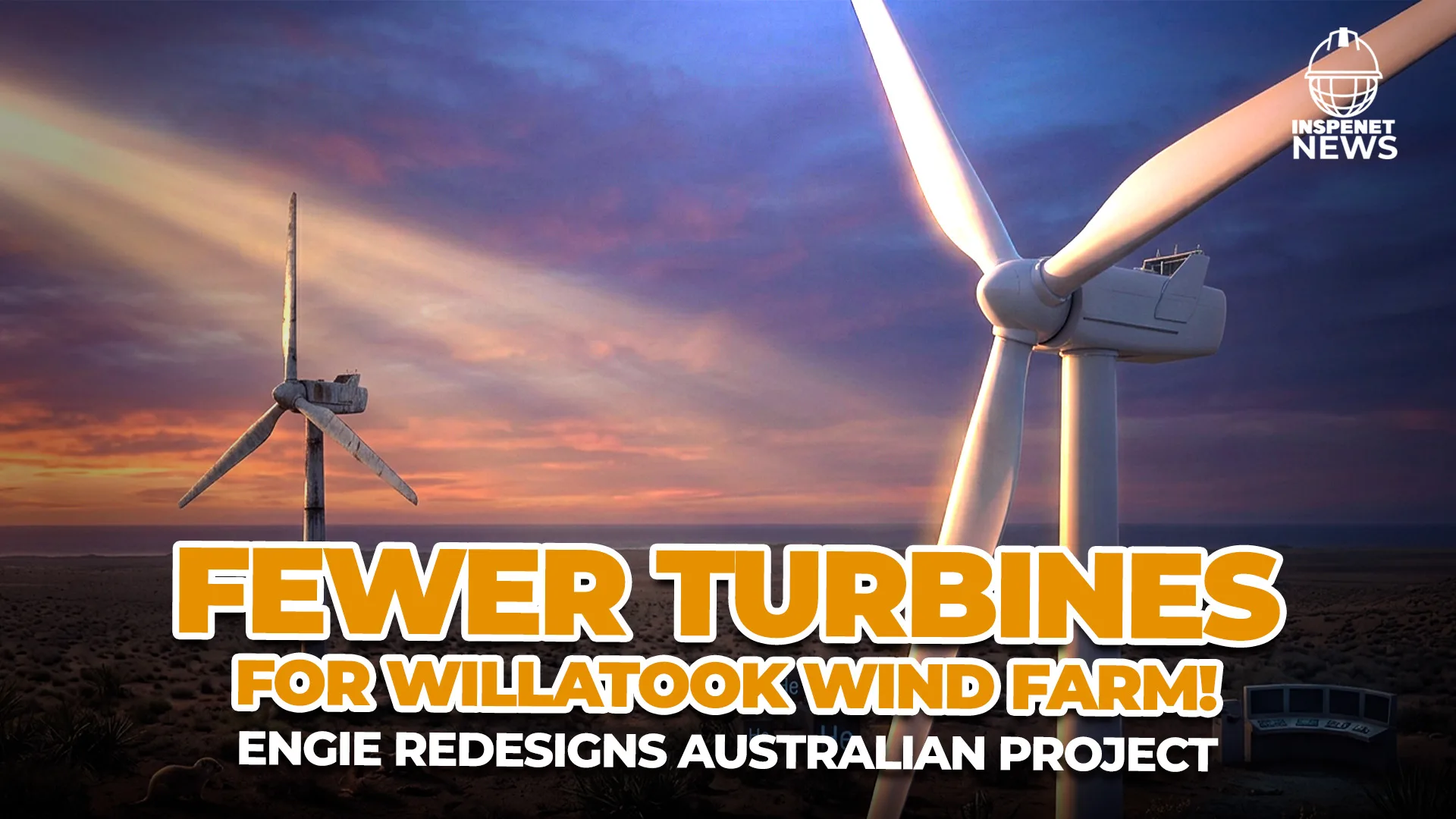
The Willatook wind project will have fewer turbines but they will be taller
The Willatook wind project in Victoria is moving forward with an updated design that reduces the number of turbines and modifies their dimensions. The proposal addresses environmental restrictions that have impacted the project's development in recent years.
Specifically, the developers plan to reduce the maximum number of wind turbines from 59 to 52 , and also propose changing the location of some units to move them away from wetlands and other areas considered sensitive for wildlife.
The complex would maintain a planned wind power capacity of 350 MW , and also includes a battery storage system of 200 MW and 400 MWh.
The Willatook wind farm project modifies the design of its turbines
The reduction in the number of wind turbines is part of a broader review of the project's configuration. The modifications also affect the rotor, turbine height, and the area occupied during construction.
According to the proposal, the maximum rotor diameter would decrease from 190 to 175 meters, while the minimum distance between the blade tips and the ground would increase from 40 to 60 meters.
Likewise, the maximum height of the turbine tips would increase from 250 to 254 meters, meaning that Willatook would have fewer wind turbines and smaller rotors, although some of its vertical dimensions could increase.
The developers also plan to reduce the length of the access roads and the trenches for underground electrical cabling . This includes adjustments to the facility's boundaries and a reduction in the affected area.
The protection of bats influences the new design
The changes primarily aim to reduce the potential interaction of wind turbines with local wildlife. One of the species receiving particular attention is the southern bent-wing bat, known in Australia as the Southern Bent-wing Bat.
According to Wind Prospect , the revised design reduces the potential risk of ecological interaction compared to the previously presented configuration.
To achieve this, the strategy includes several measures, among them separation from certain habitats, a greater distance between the blades and the ground, controls during operation and monitoring after construction.
Subsequently, the results of that monitoring would allow adaptive management measures to be applied when necessary.
Furthermore, the Brolga project is part of the environmental concerns related to development. The presence of these species has influenced the conditions imposed on the project and the debate surrounding its construction for years.
Willatook will combine 350 MW of wind power with a battery
The planned facility near Orford, in southwest Victoria, would maintain a wind power capacity of 350 MW despite the reduction in the maximum number of turbines.
The plan also includes a battery with 200 MW of power and 400 MWh of storage capacity. This way, wind power generation would be complemented by infrastructure designed to store electricity.
Furthermore, the Willatook Wind Project was selected in a tender under the Australian Federal Government's Capacity Investment Scheme . This provides significant support as those responsible continue working on the necessary permits and requirements to develop the facility.
Wind Prospect is behind the development of the project while Engie Australia is involved in its advancement and has an option to acquire it.
Environmental restrictions shaped the development of Willatook
Previously, the Victorian Government approved the project in 2023 subject to a number of conditions intended to manage its potential effects on the Brolga and the southern folded-wing bat.
Among those provisions were greater buffer zones and a five-month window during which no construction work would be allowed.
However, the conditions drew objections from both the project managers and the Clean Energy Council . Both parties felt that some of the requirements made it difficult to implement the project as originally planned.
Later, in May 2025, the Victorian Government published new guidelines to guide renewable energy projects in managing potential impacts on species such as bats and brolgas.
In this context, the updated design of Willatook incorporates additional environmental studies and new measures aimed at reducing its potential impact on wildlife.
What's needed for the Willatook Wind Project to move forward?
Currently, the developers have federal approval under the Australian environmental protection framework . However, they still need to proceed with the state planning process related to the proposed modifications.
Therefore, the design review will be crucial in determining under what configuration the installation can finally be developed.
The timeline will also depend on the progress of these authorizations; Engie Australia has indicated that it expects to reach financial close for the project in 2027 and complete its development in 2029.
Thus, Willatook is entering its next phase with a proposal that maintains the 350 MW of wind power while reducing the number of turbines. The new configuration also increases the clearance between the blades and the ground and decreases the rotor diameter in order to reconcile electricity generation with the area's environmental restrictions.
News of additional interest
Scotland gives new life to its first turbines
ScottishPower successfully recycled or reused 99.9% of the materials from the 26 original turbines at the Hagshaw Hill wind farm, Scotland's first commercial wind farm. The turbines had been in operation since 1995 and were decommissioned after approximately 30 years to upgrade the facility. Of the recovered material, 79.5% was recycled and another 20.4% was reused.
The old turbines were replaced with 14 larger, more efficient units, while their components found new uses. The blades, for example, are being converted by Plaswire into a polymer that can be used in posts, drainage systems, and other construction products. The process also involved at least 10 companies in the supply chain, many of which were located near the wind farm.
Petronas uses AI to accelerate oil investments
Petronas will incorporate artificial intelligence into its myPROdata platform to facilitate the evaluation of oil and gas projects in Malaysia. Through an agreement between Malaysia Petroleum Management and Iraya Energies, the tool will combine geological, geophysical, and engineering information. The AI will be able to correlate different data sources and help investors identify opportunities more quickly.
The oil company aims to attract between 50 and 60 billion Malaysian ringgit annually in exploration and production investments. It also intends to reduce the period between hydrocarbon discovery and first extraction from 100 to 50 months. The platform will support tasks ranging from identifying areas with potential to studying resources, development options, and commercial viability.
Santos gains ground in the Asian LNG business
additional 3.3% stake from TotalEnergies in Papua LNG, a liquefied natural gas project located in Papua New Guinea. The transaction would increase the Australian company's stake to 21% after the government reinvestment. Furthermore, it would increase its LNG allocation by approximately 19%, bringing it to around 1.2 million tons per year.
The move coincides with another major change at Papua LNG: ExxonMobil will take over operations of the project following an agreement with TotalEnergies. Santos expects that ExxonMobil's experience in the country and its management of PNG LNG will allow for infrastructure sharing and improved operations. The acquisition still requires regulatory approvals and is contingent upon Papua LNG's final investment decision, expected in the fourth quarter of 2026.
Optigrid jumps into large batteries in Australia
Optigrid secured its first major storage contract with Vena Energy to manage and optimize the 408 MW, two-hour Bellambi Heights battery, scheduled for commissioning in 2027. The Australian company, which until now has primarily worked with systems smaller than 5 MW, now has 1 GW of operational or contracted assets on its platform. It is also preparing to bring another large-scale battery online this month.
The agreement comes as Australia installs more industrial and residential batteries, increasing competition within the National Electricity Market. According to Optigrid, this expansion has helped reduce prices and the margins earned by large storage systems. This growth is also bringing the rules used for bidding electricity under closer scrutiny, with the Australian regulator reviewing practices such as bid changes near dispatch time.