Table of Contents
- What prevents a pipeline from being piggable?
- What conditions prevent pigging in offshore lines?
- ILI does not solely mean ultrasound
- Inspection options for non-piggable pipelines
- Tethered inspection
- When to use tethered solutions?
- Advantages of ultrasonic inspection
- How to inspect non-piggable offshore pipelines
- Trends in subsea pipeline inspection
- Conclusions
- Referencias
How to perform an offshore inspection when it cannot be evaluated using conventional pigging? This situation is common in offshore flowlines where geometric, operational, or design restrictions prevent the passage of traditional tools. Advances in in-line inspection (ILI) have made it possible to assess the integrity of complex pipelines without requiring extensive infrastructure modifications.
Currently, there are solutions that combine Ultrasonic ILI technologies, tethered systems, and hybrid tools to inspect non-piggable lines. This article explains how to select the most suitable technology based on operational conditions, geometry, accessibility, and system integrity requirements.
What prevents a pipeline from being piggable?
In the context of pipeline ILI, a pipeline is considered non-piggable when it does not allow the safe and continuous passage of internal inspection tools. This condition is typically identified through piggability studies that evaluate geometric configuration, operational conditions, and access facilities. Among the most frequent causes are:
- Internal diameter changes.
- Short-radius bends.
- Valves with restricted passage.
- Absence of launchers and receivers.
- Un-barrable tees and branches.
- Flow or pressure restrictions.
In these scenarios, alternative technologies are required to assess the internal condition without affecting system operation.
What conditions prevent pigging in offshore lines?
In subsea installations, limitations are usually greater due to the complexity of the infrastructure. Many offshore flowlines were designed without considering future internal inspection campaigns.
Among the most common causes are:
- Integration of multiple subsea tie-ins.
- Jumpers with complex three-dimensional geometries.
- Diameter variations associated with hydraulic design.
- Multiphase production with unstable conditions.
- Access restrictions in subsea systems.
These limitations increase the complexity of offshore inspection and require technologies capable of adapting to demanding operational and geometric conditions. Furthermore, retrofitting an existing line to allow the passage of conventional tools usually involves subsea modifications and interventions of high cost and technical complexity. As a result, more and more operators are opting for specialized technologies for non-piggable pipelines, which are capable of providing reliable asset integrity data without needing significant changes to the existing infrastructure.
ILI does not solely mean ultrasound
Within the field of pipeline ILI, selecting the right technology depends on the expected damage mechanisms, the strategy can include ultrasonic ILI, MFL tools, or hybrid solutions that combine multiple sensors for the specific damage mechanism to be identified and the system’s operational conditions.
The most widely used are:
- Ultrasound (UT): thickness and corrosion measurement.
- Magnetic Flux Leakage (MFL): metal loss detection.
- Geometric caliper: identification of deformations and ovalities.
- Crack detection tools.
- Internal video inspection.
- Hybrid systems with multiple sensors.
The current trend is to integrate several technologies into a single run to obtain a more comprehensive evaluation of the pipeline’s condition.
Inspection options for non-piggable pipelines
Technological advancements in pipeline ILI have significantly expanded the alternatives available for inspecting pipelines with operational restrictions, including:
- Compact tools: Designed to traverse tight bends, diameter changes, and complex configurations.
- Self-propelled systems: They do not depend on the flow of the transported product and are suitable for low-flow or out-of-service lines.
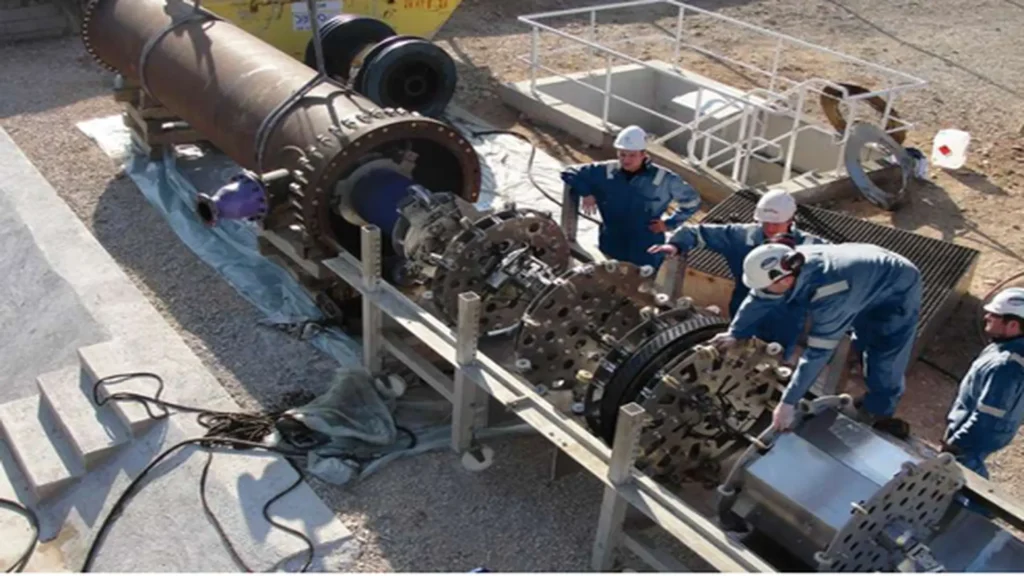
- Hybrid tools: Combine MFL, ultrasound, and geometric sensors to maximize inspection coverage.
(The following image shows a hybrid piping assembly installed by the Rosen Group.
- Smart tools: They incorporate inertial navigation, three-dimensional mapping, and advanced positioning systems.
Tethered inspection
They use an umbilical cable to supply power, communication, and real-time control. It consists of the use of inspection tools connected to the surface through an umbilical that transmits power, data, and control signals. The tethered inspection scheme allows real-time monitoring of operations, optimization of sensor performance, and reduction of risks associated with tool loss or sticking.
In offshore inspection applications, tethered inspection is widely used in non-piggable pipelines, where geometric constraints or the absence of launch and reception infrastructure limit the use of conventional ILI systems.
The following video demonstrates how tethered inspection using umbilical cables works for real-time monitoring of non-pig-accessible pipelines in offshore environments.
When to use tethered solutions?
Tethered inspection is especially useful when the autonomous movement of the tool is unreliable or there is a risk of entrapment.
Its most common applications include:
- Lines with complex geometries.
- Systems without pigging infrastructure.
- Short offshore pipelines.
- Assets with high operational risk.
- Inspections requiring continuous monitoring.
Permanent control of the tool allows for speed adjustments, stopping the inspection when necessary, and retrieving data in real time, which improves the quality of the gathered information.
Advantages of ultrasonic inspection
Ultrasonic ILI is one of the most widely used and accurate technologies within in-line inspection programs due to its ability to directly measure wall thickness and characterize corrosion processes with high precision. Its main advantages include:
- Direct wall thickness measurement.
- High resolution in localized corrosion.
- Early detection of material loss.
- High reliability for integrity assessments.
- Compatibility with remaining life analysis.
These features make it an especially valuable option for offshore lines subjected to internal corrosion mechanisms.
How to inspect non-piggable offshore pipelines
The application of ILI in offshore pipelines requires rigorous planning that considers the geometric, operational, and environmental restrictions of each asset. An effective strategy must follow a structured sequence:
- Piggability evaluation: identification of geometric and operational restrictions.
- Technology selection: definition of the most appropriate technique (UT, MFL, tethered, or hybrid).
- Operational simulation: validation of inspection feasibility.
- Field execution: implementation of the offshore campaign.
- Integrity evaluation: data analysis and decision-making.
This approach ensures reliable results even in systems with high operational complexity.
Trends in subsea pipeline inspection
Technological evolution is transforming how offshore pipeline integrity is managed. Among the most relevant trends are:
- Autonomous underwater robots.
- Integrity digital twins.
- Miniaturized high-resolution sensors.
- Multipurpose hybrid tools.
- Artificial intelligence applied to data analysis.
In complex offshore projects, implementing these solutions usually requires the involvement of specialized companies in subsea inspection and asset integrity. Organizations like Oceaneering have developed capabilities to support inspection campaigns on subsea pipelines through integrity assessment services, inspection data validation, and subsea intervention technologies, complementing the application of ILI tools in systems with operational or geometric constraints.
Conclusions
Pipeline ILI is a fundamental tool for integrity management in offshore systems, especially when dealing with non-piggable pipelines. Advances in offshore flowline technologies, such as ultrasonic tools, tethered inspection systems, and hybrid solutions, have expanded offshore inspection capabilities in complex environments.
The selection of the appropriate technique must be based on line geometry, operational conditions, and potential damage mechanisms. Applied within a data-driven integrity strategy, these technologies help optimize maintenance, reduce risks, and improve reliability.
Referencias
- American Petroleum Institute. (2016). API Standard 1163: In-line inspection systems qualification standard. Washington, DC: API Publishing Services.
- American Petroleum Institute. (2019). API Recommended Practice 1160: Managing system integrity for hazardous liquid pipelines. Washington, DC: API Publishing Services.
- American Petroleum Institute. (2019). API Recommended Practice 1176: Recommended practice for assessment and management of cracking in pipelines. Washington, DC: API Publishing Services.
- Det Norske Veritas (DNV). (2021). DNV-ST-F101: Submarine pipeline systems. Høvik, Norway: DNV.
- International Organization for Standardization. (2017). ISO 13623: Petroleum and natural gas industries — Pipeline transportation systems. Geneva, Switzerland: ISO.
- NACE International / AMPP. (2018). SP0102: In-line inspection of pipelines. Houston, TX: AMPP (formerly NACE International).
- Det Norske Veritas (DNV). (2021-12). DNV-RP-F116: Integrity management of submarine pipeline systems. Høvik, Norway: DNV.
- Rosen Group. (2022). Advanced in-line inspection technologies and applications for non-piggable pipelines. Rosen Inspection Technologies Technical Publication.