Table of Contents
- Batteries in the Energy Market and Grid Transformation
- Technologies That Are Transforming Network Storage
- Energy storage to stabilize the power grid
- Lithium-ion batteries: more power in less space
- Can sodium-ion compete with lithium?
- Flow batteries and longer storage times
- What if the battery needs to store energy for days?
- Software and Intelligence: The Other BESS Revolution
- Integration of Renewable Energy: When to Deliver the Energy
- Conclusions
- References
- Frequently Asked Questions (FAQs)
Five years ago, large-scale electricity storage was still viewed as a complement to renewable generation. Today, batteries in the energy market are beginning to compete for a much more important role: determining when energy enters the grid, how long it can remain available, and what electricity services it can provide while it remains connected.
The scale of the change can already be measured. In 2025, 108 GW of new battery storage capacity was added worldwide, 40% more than in 2024. Nearly 80% of this came from grid-scale installations, and global installed capacity is currently eleven times higher than it was in 2021, according to the International Energy Agency (IEA).
The most significant finding is not just the growth. Battery storage was the fastest-growing technology in the electricity sector in 2025, as projects begin to increase in duration, energy density, and capacity to participate directly in grid control.
Batteries in the Energy Market and Grid Transformation
A battery connected to the power grid does not produce primary energy. It receives electricity, stores it through an electrochemical process, and can return it when the grid or the market requires it. This capability makes it possible, within certain limits, to decouple the time of generation from the time of consumption.
Energy storage systems can charge during periods of high solar or wind generation and then discharge during periods of peak demand. They can also respond to operator instructions, participate in electricity markets, or maintain available capacity as a reserve.
For this reason, the economic value of a BESS project should no longer be assessed solely based on its installed MWh capacity. A single installation can participate in energy arbitrage, frequency regulation, and operational reserve, in addition to shifting renewable generation to periods of higher demand. Depending on its design and control architecture, it can also contribute to ramp control, congestion management, backup capacity, and voltage and frequency support.
Expansion is currently concentrated in several major markets. According to the International Energy Agency, China accounted for about 60% of new battery storage installations worldwide in 2025, followed by the United States and Europe. Australia and some countries in the Middle East are also accelerating the deployment of storage to strengthen energy security and integrate larger volumes of renewable generation.
Technologies That Are Transforming Network Storage
The transformation of BESS systems does not depend on a single innovation. Today, new battery chemistries, grid-forming inverters, systems with higher energy density, long-duration storage, and digital control platforms are converging. These technologies are expanding the capacity, duration, and responsiveness of storage, while also changing the way these assets contribute to the stability and operation of the power grid.
Energy storage to stabilize the power grid
The balance between generation and consumption must be maintained at all times. A sudden loss of generation, a fluctuation in demand, or a rapid drop in solar or wind power output can force the power system to adjust its output within seconds.
Here we see one of the greatest operational advantages of battery energy storage: its ability to respond quickly.
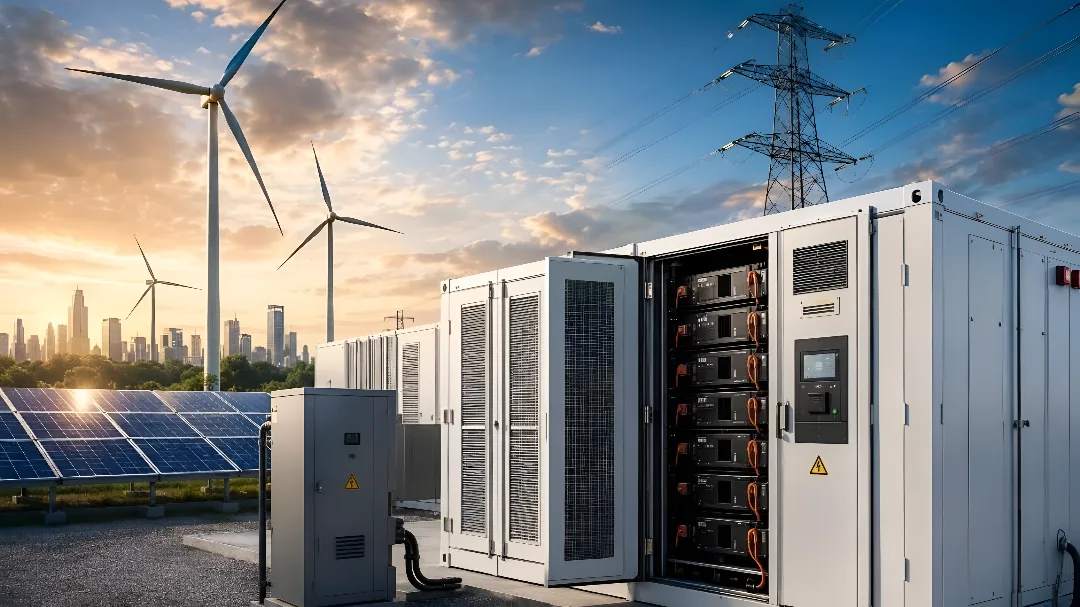
But installing batteries alone does not guarantee the stability of the power grid. A BESS integrates cells, modules, a BMS, a PCS, a thermal management system, protective devices, transformers, instrumentation, control systems, and an Energy Management System (EMS). The final performance depends on how all these components interact.
The most significant evolution is taking place precisely outside the cell.
From grid-following to grid-forming
Conventional grid-following inverters must track an existing voltage and frequency reference. Grid-forming technologies, on the other hand, can actively help establish those references and maintain specific electrical conditions in the grid.
The U.S. Department of Energy considers these technologies particularly relevant as the penetration of power-electronics-connected resources increases. Some systems can even be used in black-start strategies, provided that the grid and the facility have been designed for that purpose. This transition is already making its way into commercial projects.
Fluence, for example, is incorporating grid-forming capabilities into projects in the United Kingdom to provide active voltage and frequency regulation. In 2026, it also introduced a Smartstack configuration with a capacity of 10 MWh per system, designed to increase the energy density of grid-scale storage.
The battery, therefore, is gradually evolving from being merely a store of electricity to also becoming a system control asset.
Lithium-ion batteries: more power in less space
Lithium-ion batteries continue to dominate today’s BESS systems. Within this family, LFP has become the leading chemistry for stationary storage. In 2025, lithium iron phosphate batteries accounted for about 90% of new battery storage deployments, compared with a share of less than 50% five years earlier.
Recent innovations are aimed at storing more MWh in a smaller footprint and reducing the number of components, connections, and construction costs. In 2025, CATL introduced the TENER Stack, a 9 MWh solution with a claimed 45% improvement in volumetric utilization and a 50% increase in projected energy density compared to conventional 20-foot container systems.
Sungrow took the concept even further with PowerTitan 3.0. Its Plus configuration reaches 12.5 MWh per unit and up to 50 MWh per AC block, supports designs ranging from 2 to 12 hours, and incorporates a liquid-cooled PCS based on silicon carbide (SiC), with a claimed maximum efficiency of 99.3%.
Competition no longer occurs exclusively among cell manufacturers. It also extends to energy density per unit area, PCS integration, installation speed, thermal management, safety, and degradation—aspects directly related to failure analysis in BESS systems—as well as the software and operational strategies that determine the project’s technical and economic performance.
Can sodium-ion compete with lithium?
One of the technologies attracting the most attention is sodium-ion. Its energy density remains lower than that of the best LFP batteries. The IEA estimates that the latest sodium-ion cells have an energy density of up to approximately 175 Wh/kg, compared to about 205 Wh/kg for state-of-the-art LFP batteries. However, that difference matters much less in a stationary application than in an electric vehicle.
The appeal lies elsewhere: availability of raw materials, supply chain diversification, and potential performance in stationary applications.
This does not yet mean that sodium will replace LFP. It means that stationary storage is beginning to have an additional commercial alternative.
Flow batteries and longer storage times
When the goal shifts from responding for a few seconds or shifting energy for a few hours to sustaining power for longer periods, flow batteries offer a different architecture than conventional lithium-ion systems.
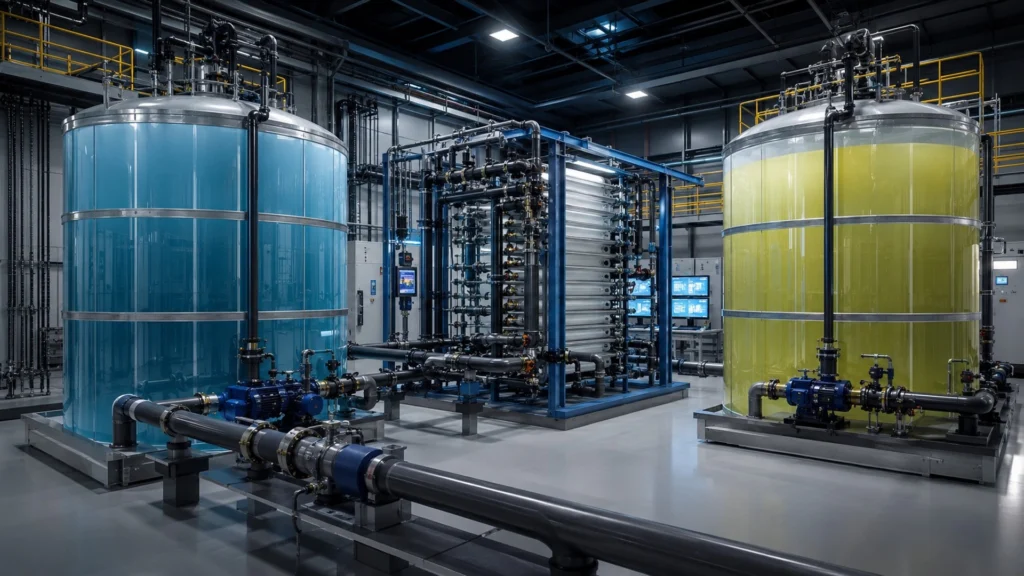
These batteries store energy in liquid electrolytes contained in external reservoirs and circulate them through a set of electrochemical cells, or a stack. This allows for greater independence in sizing the power output—which is determined primarily by the stack—and the energy capacity, which is associated with the volume of available electrolyte.
This separation can be advantageous in projects that require prolonged discharges, numerous cycles, and an increase in energy capacity without a proportional increase in installed power. Current developments include iron-based flow batteries designed for long-term storage.
ESS, for example, develops its Horizon platform for applications lasting approximately 16 to 48 hours or longer, using an iron-based electrolyte and a non-flammable architecture. This type of system is designed to meet needs that differ from those of a conventional BESS with a runtime of two to four hours.
Flow batteries are not generally a substitute for lithium-ion batteries. Their advantage becomes apparent when duration, cycle life, safety, and the ability to increase the amount of MWh stored take precedence over energy density per unit area.
What if the battery needs to store energy for days?
Here is one of the most interesting energy innovations in the industry.
Form Energy develops iron-air batteries capable of discharging energy for up to 100 hours. Instead of relying on lithium, they primarily use iron, water, and air through a reversible electrochemical reaction involving the oxidation and reduction of iron.
In 2026, the company also announced a proposed 300 MW / 30 GWh project with Xcel Energy in Minnesota and a first international deployment of 10 MW / 1,000 MWh planned for Ireland.
This type of development shows just how far the concept of grid-scale batteries is expanding: from response times measured in seconds and two to four hours of discharge to multi-day storage.
Software and Intelligence: The Other BESS Revolution
Innovation doesn’t stop at electrochemistry, either. When a project involves hundreds or thousands of modules, its performance depends on continuously monitoring variables such as state of charge, degradation, temperature, availability, and operating conditions.
The latest platforms incorporate advanced analytics, predictive maintenance, efficiency optimization, and artificial intelligence-based models to anticipate deviations, manage system aging, and improve loading and unloading decisions.
Fluence, for example, uses machine learning models to monitor assets and specialized software to optimize bids and dispatch in electricity markets. CATL has also incorporated digital monitoring, diagnostic, and smart management features into its energy storage platforms.
This introduces another variable into the economics of storage: two systems with the same nominal capacity can yield different economic outcomes depending on their operating strategy, level of degradation, and ability to respond to market conditions.
Integration of Renewable Energy: When to Deliver the Energy
The integration of renewable energy is changing the role of energy storage. In systems with high solar generation, there may be an abundance of electricity during the middle of the day and less availability several hours later. A battery makes it possible to shift part of that generation to other times of day, reduce curtailment, and take advantage of price differences.
In 2025, approximately 24 GW of new grid-scale storage capacity was installed alongside renewable generation, according to the IEA.
For the owner of a renewable energy plant, this means that not all of the energy necessarily has to be delivered at the exact moment it is available. Part of the output can be stored and released later, when it is most useful to the power system or commands a higher market price.
Conclusions
The next phase of batteries in the energy market will not be defined by a single winning chemistry. LFP will continue to dominate a large portion of short- and medium-duration installations, while sodium-ion, flow batteries, and iron-air systems seek to fill niches where material availability, operating cycles, or lifespan are more important than energy density.
At the same time, grid-forming inverters, higher-efficiency PCS units, systems with more MWh per unit area, and software capable of optimizing degradation and dispatch are changing the performance of these plants. The asset that is beginning to compete in the electricity market is no longer simply a battery: it is an electrochemical, electronic, and digital system capable of storing energy and making technical decisions about how to feed it back into the grid.
References
- International Energy Agency (IEA). Global Energy Review 2026 – Battery storage.
- International Energy Agency (IEA). Global EV Outlook 2026 – Electric vehicle batteries.
- U.S. Department of Energy (DOE). Powering Grid-Forming Inverters.
- Fluence Energy. Smartstack 10 MWh High-Density Energy Storage Platform.
- CATL. TENER Stack – High-density energy storage system.
- ESS Inc. Horizon – Long-Duration Energy Storage.
- Form Energy. Iron-Air Battery Technology.
Frequently Asked Questions (FAQs)
What technology currently dominates the BESS market?
LFP batteries accounted for about 90% of new battery storage installations worldwide in 2025.
What are the benefits of a BESS with grid-forming control?
“Grid-forming” primarily refers to the behavior of the inverter or system control, not to a “battery” in the chemical sense.
Will sodium-ion replace lithium?
Not necessarily. Its greatest initial opportunity lies in applications where density and weight are less of a constraint, such as stationary storage.
How long can a BESS store energy?
It depends on the design. There are systems that last only a few hours and long-lasting technologies capable of supplying electricity for dozens of hours.
What technology can store energy for several days?
Among the emerging alternatives are iron-air batteries, which are designed to last much longer than conventional lithium-ion BESS systems.