Table of Contents
- North Sea Well Abandonment Seeks a More Efficient Model
- Why Can Removing a Wellhead With a Vessel Cost Less Than Using a Rig?
- Sharing Vessels Could Change the Economics of Well Abandonment
- UK Spent a Record £2.6 Billion on Decommissioning
- 17 Operators Coordinate Resources to Accelerate Operations
- More Than 1,000 Wells Are Approaching the Next Stage of Abandonment
North Sea well abandonment is facing a challenge of growing scale. The North Sea Transition Authority (NSTA) and 17 industry operators have agreed on a collaborative strategy aimed at accelerating pending operations and reducing costs through information sharing, resource coordination, and greater joint use of specialized vessels.
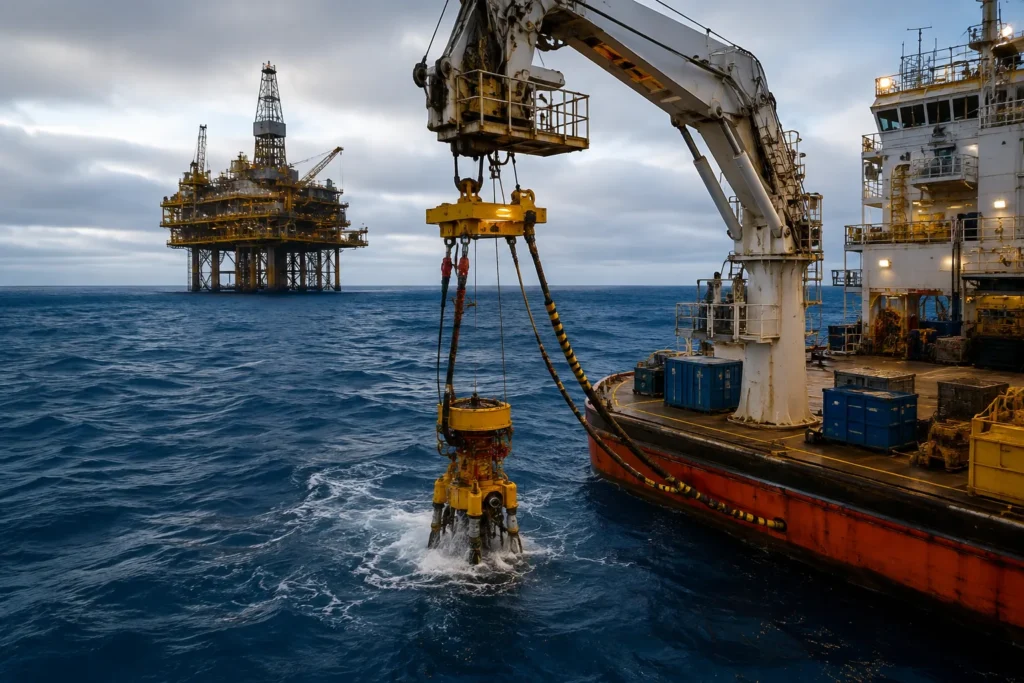
One of the main changes focuses on the final removal of subsea wellheads. Industry estimates suggest that using vessels instead of rigs for certain final operations could reduce the remaining costs of this activity by approximately 30%, generating potential savings of nearly £200 million (US$271 million).
The initiative comes as approximately 500 inactive wells are still awaiting final abandonment on the UK Continental Shelf. More than 1,000 additional wells could require abandonment over the next five years, increasing pressure on rigs, vessels, contractors, and other specialized resources.
The proposal is not intended to eliminate rigs from abandonment operations. They would continue to perform stages that require their capabilities, including plugging wells with cement. The proposal seeks to use available resources more efficiently during the final stages, particularly when a vessel can perform wellhead severance and removal while meeting technical and regulatory requirements.
North Sea Well Abandonment Seeks a More Efficient Model
The scale of the outstanding well inventory explains why reducing individual costs can have a considerable impact when viewed across the entire basin.
During 2025, work was carried out on 257 wells, compared with 238 in 2024. Of the total wells worked on last year, 114 progressed to final abandonment, compared with 103 during the previous year.
The increase shows that activity is accelerating, but it also highlights the gap between the pace of execution and the volume of work that remains outstanding. With around 500 inactive wells awaiting final abandonment and another 1,000 expected to require intervention over the next five years, improving the productivity of each campaign could become an operational necessity.
Collaboration among operators introduces an additional possibility. Instead of planning certain mobilizations exclusively around a single asset, several companies could identify opportunities to share vessels, coordinate campaigns, and make better use of the available time of specialized resources.
In a mature basin such as the North Sea, where numerous assets are progressively approaching the end of their productive lives, this type of coordination could become increasingly important.
Why Can Removing a Wellhead With a Vessel Cost Less Than Using a Rig?
The difference begins with the capabilities required at each stage of abandonment.
A drilling rig provides the systems and capabilities required to perform complex well interventions. During the initial stages of subsea abandonment, it will still be necessary for certain activities, including establishing the required barriers through cement plugging. But once those stages have been completed, the remaining work may involve different requirements.
The proposal backed by the operators specifically seeks to evaluate greater use of vessels during the final stage of removing wellheads located on the seabed. When technically feasible and regulatory requirements are met, assigning this operation to a vessel can avoid keeping a rig dedicated to a task that may not require all of its capabilities.
This redistribution would have a second effect: freeing rigs to continue working on other wells awaiting abandonment. Therefore, the potential savings should not be interpreted simply as a comparison between the daily cost of a vessel and that of a rig. Campaign duration, mobilizations, equipment availability, operational sequencing, and the ability to deploy each resource where its capabilities provide the greatest value also play a role.
The NSTA and operators estimate that this approach could reduce the remaining cost associated with subsea wellhead removal by around 30%. This does not mean that the total cost of abandoning each well would automatically decrease by the same proportion.
Sharing Vessels Could Change the Economics of Well Abandonment
North Sea well abandonment does not depend solely on having the right technology. It also requires coordinating a specialized supply chain in a market where numerous operators will need similar services during overlapping periods.
Sharing vessels introduces a campaign-based execution model. If different assets can be grouped within a compatible schedule, mobilizations can potentially be reduced and contracted resources can be utilized for longer periods. However, realizing these benefits requires operational compatibility, joint planning, and a clear definition of responsibilities.
This is precisely why the new initiative goes beyond a statement of intent. An industry workgroup will be established to develop a framework for AB3 wellhead severance activities while maintaining compliance with applicable regulatory requirements.
This component is fundamental because cost reductions cannot be achieved by lowering isolation, safety, or environmental protection requirements. Efficiency must come from how operations are organized and executed once the necessary conditions have been met to proceed with the final removal of the infrastructure.
UK Spent a Record £2.6 Billion on Decommissioning
The economic pressure behind the initiative can be seen in the overall figures for the UK Continental Shelf.
Decommissioning expenditure reached £2.6 billion (US$3.5 billion) in 2025, compared with £2.4 billion (US$3.2 billion) in 2024. The increase was associated with greater well abandonment activity and platform and infrastructure removal work.
Despite the amount invested, the estimated cost required to complete the remaining activities declined only slightly, from approximately £43.6 billion to £43.4 billion (US$58.8 billion).
The difference helps illustrate the scale of the challenge. Increasing annual expenditure alone is not enough. The objective is also to execute more work with the available resources and identify cost-reduction opportunities that can be replicated at scale.
In this context, potential savings of £200 million from certain wellhead removal operations alone become significant, although they represent only a fraction of the basin’s total remaining decommissioning cost.
17 Operators Coordinate Resources to Accelerate Operations
The strategy includes companies with a significant presence in the North Sea, including bp, Shell, Harbour Energy, EnQuest, Ithaca Energy, Serica Energy, Apache, CNOOC International, Eni, INEOS Energy Europe, and Perenco, along with other participants.
The diversity of operators is significant because the challenge extends beyond any single company. As different fields progress toward the final stages of their life cycles, demand for rigs, vessels, and specialized services may become concentrated. Competition for these resources can also affect costs and supply-chain availability.
The coordination initiative seeks to turn that situation into an advantage by identifying where different operators can share knowledge, data, and resources to execute campaigns more efficiently.
Not all wells will necessarily present the same conditions or be suitable for exactly the same strategy. Water depth, well design, subsea configuration, equipment condition, and specific abandonment requirements can alter the scope of each intervention.
For this reason, the value of the new model will ultimately depend on how many operations can be grouped without compromising the required technical criteria.
More Than 1,000 Wells Are Approaching the Next Stage of Abandonment
North Sea well abandonment will continue to grow even if the current inventory of approximately 500 inactive wells is reduced. Forecasts indicate that more than 1,000 additional wells will require abandonment activities over the next five years.
This makes operational efficiency a matter of future capacity.
If rigs remain occupied during stages that can be performed safely and in compliance with regulations using other resources, the system could lose capacity to advance work on the next group of wells. Greater task specialization, by contrast, could allow rigs to focus on operations that genuinely require their capabilities while vessels perform certain final activities.
North Sea well abandonment is therefore entering a stage in which engineering will need to be complemented by new approaches to planning and contracting.
The target of reducing the remaining cost of subsea wellhead removal by around 30% will still need to be demonstrated through campaign execution and the framework to be developed by the new industry workgroup. Nor does it mean that the overall remaining cost of £43.4 billion will decline by the same proportion.
However, with hundreds of wells awaiting final abandonment and more than a thousand approaching that stage, even targeted improvements can generate significant cumulative economic benefits.
The next test will be whether sharing vessels and reserving rigs for operations that genuinely require their capabilities can transform a specific efficiency improvement into a repeatable model for one of the world’s largest offshore decommissioning campaigns.
Source: World Oil