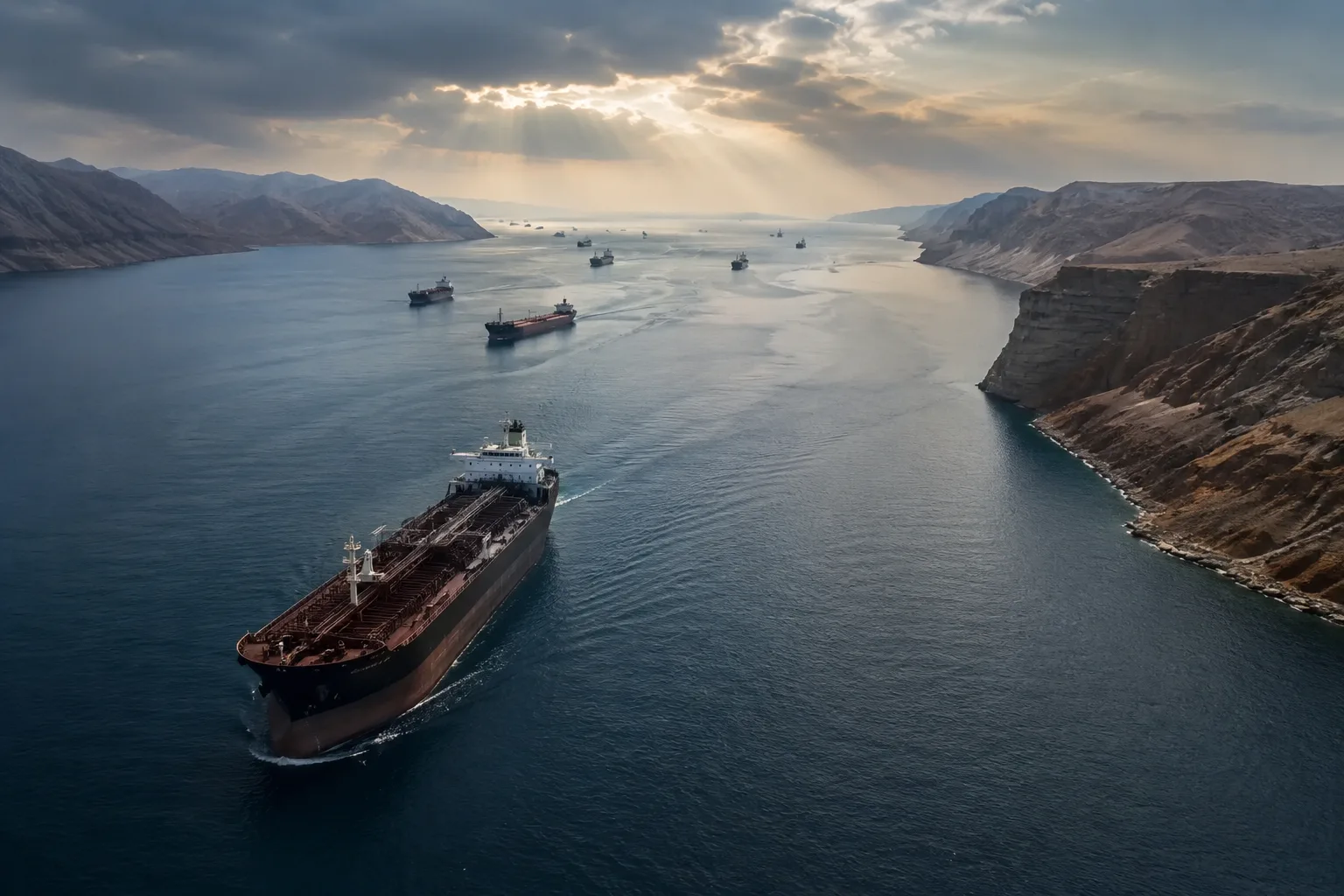
The maritime traffic in the Strait of Hormuz deteriorated once again amid persistent geopolitical tensions in the Middle East. Only seven vessels carrying commodities passed through the strategic maritime chokepoint on Thursday, a 50% reduction compared with the 14 recorded the previous day, according to maritime tracking data from Kpler.
The decline shows that navigation through one of the world’s most important energy arteries remains far from returning to normal levels. The situation continues to put pressure on operators, producers, and international markets, particularly given the corridor’s importance for oil and liquefied natural gas (LNG) exports from the Persian Gulf.
Maritime traffic in the Strait of Hormuz remains limited
Of the seven vessels recorded during the day, four entered the Strait of Hormuz and three completed outbound transits. However, the composition of the traffic is particularly significant for the energy market: none of the recorded transits involved very large crude carriers (VLCCs) or LNG carriers.
A large gas carrier transporting liquefied petroleum gases, specifically propane and butane, was detected leaving the Gulf via the route close to Iranian waters.
The absence of VLCCs and LNG vessels reflects the caution that continues to dominate commercial operations in the area. These vessels represent a fundamental part of international crude oil and gas transportation and require high levels of operational safety, insurance coverage, and certainty regarding navigation conditions.
The decline in traffic comes as political uncertainty between the United States and Iran continues and risks to commercial shipping in the Middle East persist.
Hormuz remains a critical point for the energy market
The importance of the Strait of Hormuz extends far beyond the number of vessels that pass through it each day. Before the disruptions caused by the regional conflict in 2026, the corridor was one of the world’s main energy export routes.
Data from the International Energy Agency indicate that approximately 20 million barrels per day of crude oil and petroleum products passed through Hormuz during 2025. That volume represented nearly 25% of global seaborne oil trade.
Dependence is particularly high among Gulf producers. Iran, Iraq, Kuwait, Qatar, and Bahrain use the strait as their main route for delivering a large share of their hydrocarbons to international markets. Saudi Arabia and the United Arab Emirates have some alternatives through pipelines, although the available capacity to bypass Hormuz is considerably lower than the volume that normally moves through the maritime route.
LNG faces an even greater vulnerability. Approximately 93% of Qatar’s LNG exports and 96% of those from the United Arab Emirates used this route, together representing nearly 19% of global LNG trade.
This explains why even small variations in the number of vessels passing through the strait are closely monitored by traders, shipping companies, producers, and energy consumers.
Bab el-Mandeb also records a decline in traffic
The deterioration in maritime activity is not limited to Hormuz. Commercial traffic also declined in the Bab el-Mandeb Strait, another strategic corridor for international supply chains.
Kpler data recorded 23 commodity vessels passing through Bab el-Mandeb on Thursday, compared with 34 recorded on each of the previous two days.
Of the total, 16 vessels entered and seven exited the corridor. Among the latter were the Suezmax tankers Stoic Warrior and Dokos, which were carrying crude oil bound for Vietnam and India, respectively.
As in Hormuz, no VLCCs or LNG carriers were recorded transiting Bab el-Mandeb during the day. This situation is particularly significant because both straits form part of an extensive network of routes connecting Middle Eastern production centers with Asian and European consumers.
The oil market maintains a geopolitical risk premium
The maritime situation is also unfolding at a time of renewed pressure on international oil prices.
Brent was heading on Friday toward its second consecutive weekly gain as the market assessed rising tensions between Washington and Tehran and the potential consequences for hydrocarbon supplies. Reuters reported prices of nearly $94 per barrel for Brent and around $87 per barrel for WTI during the session.
The disruptions experienced during 2026 have already demonstrated Hormuz’s ability to alter market fundamentals. The U.S. Energy Information Administration (EIA) noted that the restrictions experienced during the second quarter drove heightened Brent volatility and forced numerous international buyers to seek alternative sources of supply.
The International Energy Agency has also described the regional crisis as one of the most significant disruptions experienced by the global oil market, due to the combination of reduced vessel movements, logistical constraints, and lower production in several Gulf countries.
The normalization of Hormuz remains key to energy security
The decline to seven daily transits shows that the recovery of energy transportation through the Strait of Hormuz remains fragile.
Although some vessels continue to operate and certain cargoes are managing to pass through the corridor, the absence of large oil tankers and LNG carriers reflects a scenario that remains far from the commercial conditions that prevailed before the crisis.
The situation should also be interpreted with caution. Maritime tracking systems rely primarily on AIS signals transmitted by vessels. Ships that turn off their transponders, operate amid GPS interference, or use other practices intended to reduce their visibility may not appear in certain records.
The International Energy Agency itself has warned that spoofing, signal jamming, and vessels operating without transmitting their positions make it difficult to obtain a completely accurate picture of maritime movements in the region.
As long as geopolitical tensions and navigation restrictions persist, Hormuz will continue to serve as one of the main risk indicators for the international energy market. A sustained recovery in traffic would be a positive signal for security of supply; a further decline in transits, on the other hand, could once again increase pressure on oil, LNG, transportation costs, and global supply chains.
Sources: Reuters