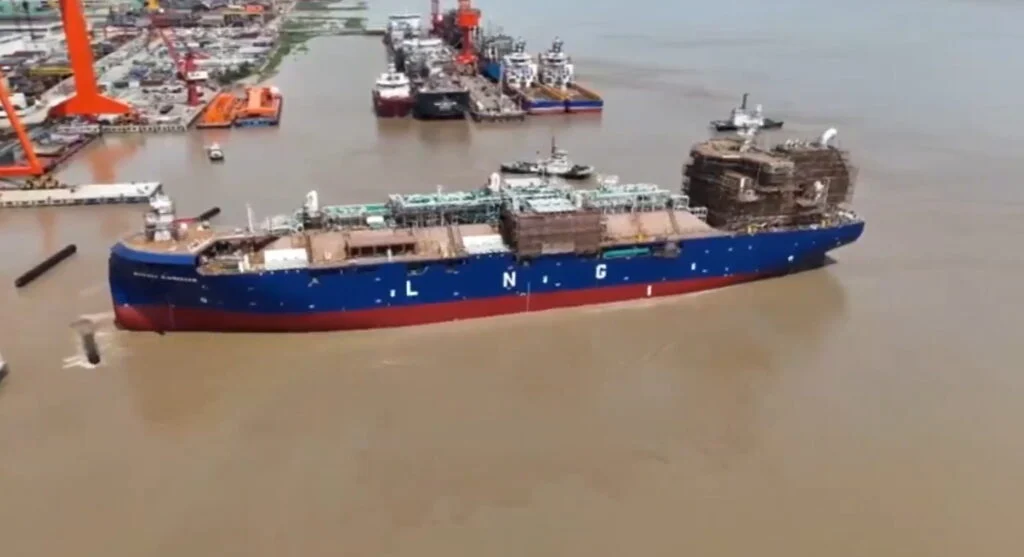
The British company Avenir LNG advanced its logistics capacity expansion with the launch of the Avenir Ambition, a new liquefied natural gas (LNG) supply vessel built at the Nantong CIMC Sinopacific Offshore & Engineering (CIMC SOE) facilities in China.
The vessel is the first of two new-generation units commissioned by the company and is part of its strategy to reinforce the international infrastructure for supplying lower-carbon marine fuels. The vessel’s delivery is scheduled for late 2026.
A New Asset for the LNG Bunkering Market
The Avenir Ambition will have a capacity of 20,000 cubic meters of LNG and will operate under a multi-year time charter agreement with Vitol International Shipping, a major player in global energy trading.
Designed for ship-to-ship bunkering operations and regional distribution, the new LNG carrier will expand Avenir LNG’s operational coverage in markets where the use of liquefied natural gas as a marine fuel is increasing.
The company also confirmed that a second vessel with the same characteristics will join the fleet during 2027.
Avenir LNG’s Fleet to Grow to Seven Vessels
With this addition, Avenir LNG continues to execute the construction program announced in 2024. Once both units are delivered, the company will increase its operational fleet from five to seven LNG supply vessels, strengthening its presence in the specialized bunkering segment.
During the launching ceremony, the company’s Chief Operating Officer, Michael Redpath, highlighted that the new vessel will play an important role in supporting clients in various international markets and consolidating the growth of the company’s logistics network.
Avenir LNG also acknowledged the participation of the CIMC SOE shipyard, the project management team, and Stolt Tankers, who were responsible for the technical supervision of the construction program.
Infrastructure Supporting the Growth of Marine LNG
While the focus of the news is the addition of a new vessel, the announcement reflects a broader trend within the maritime sector: the strengthening of the infrastructure needed to supply a growing fleet of LNG-powered vessels.
The availability of specialized bunkering vessels has become a strategic factor for the expansion of this fuel, as it allows LNG to be supplied directly to operating ships without relying exclusively on land-based terminals. This flexibility reduces port call times, improves logistical efficiency, and facilitates the adoption of the fuel in new ports and maritime corridors.
SOURCE and photo https://www.offshore-energy.biz/