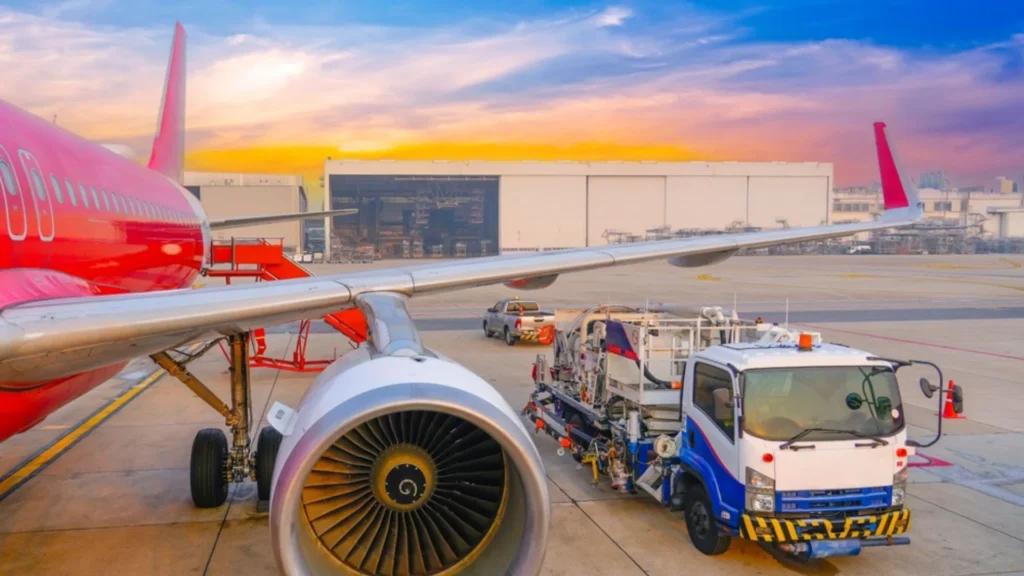
Israel will begin supplying jet fuel to Germany following a request for support received by its Ministry of Energy, at a time when the Strait of Hormuz crisis is putting pressure on the aviation fuel market in Europe.
According to official information, the measure was approved following a technical review by the Israeli Fuel Administration, which determined the existence of surpluses in local jet fuel production. The coordination of shipments will be carried out with refineries and will remain subject to the evolution of the security situation in the region.
Berlin seeks energy support amid Hormuz crisis
Furthermore, Israel’s Minister of Foreign Affairs, Gideon Sa’ar, communicated the decision to the German Minister for Economic Affairs and Energy, Katherina Reiche, during a recent visit to Berlin. The announcement comes as Germany strengthens its monitoring of energy supplies and the impact of the war with Iran on air transport.
For now, German authorities indicate that there is no immediate physical energy shortage. However, the Government remains in contact with the aviation industry to assess possible effects on costs, routes, and fuel availability over the coming months.
Jet fuel, refineries, and critical routes
Likewise, exports will depend on the commercial agreements negotiated by the companies involved. Israel did not report volumes or delivery dates, although it indicated that shipments will be coordinated with local refineries to avoid internal tensions in its own market.
In parallel, Israel’s Ministry of Energy and Infrastructure will also study options to support Germany with natural gas. This possibility reinforces the strategic nature of energy cooperation between both countries amidst an environment marked by geopolitical risks, sensitive maritime transport, and volatile prices.
Europe faces more pressure on aviation fuel
Meanwhile, the disruption of flows linked to the Middle East has raised concerns about aviation fuel supplies in Europe. The Strait of Hormuz remains a key route for energy trade, and any alteration in that area can affect both crude oil and refined products used by airlines.
Additionally, the European aviation sector faces higher operating costs due to rising fuel prices. Airlines must adjust route planning, supply purchases, and flight schedules during a high-demand season, increasing pressure on regional energy logistics.
German industry also feels the impact
On the other hand, the German chemical industry is showing signs of deterioration due to disruptions in the global supply chain. The Ifo Institute’s business climate index for the sector fell to -29.0 points in April, from -25.1 points in March, its lowest level in nearly three years.
Although orders have increased due to the market disruption itself, one in three companies reports material shortages. Companies expect further price increases to offset higher input costs and plan to reduce production in the coming months.
Energy cooperation in a tighter market
Finally, the Israeli supply of jet fuel offers Germany an additional backup route in a tighter European market. The operation does not eliminate underlying risks, but it helps diversify sources while the Hormuz crisis affects transport, refineries, airlines, and industrial chains.
The decision also shows how a regional conflict can quickly shift from the oil market to refined fuels, natural gas, and industrial sectors dependent on stable energy. For Europe, the priority will be to maintain security of supply without further increasing pressure on consumers, airlines, and manufacturers.
Source: The Jerusalem Post
Photo: Shutterstock