Table of Contents
- Reinforced concrete and chloride corrosion
- Concrete service life in marine environments
- Concrete coatings and durability
- Role of coatings in marine environments
- Evaluation of deteriorated reinforcing steel
- Techniques for measuring internal corrosion
- Strategies to extend durability
- Modern trends in reinforced concrete
- Conclusions
- References
- Frequently Asked Questions (FAQs)
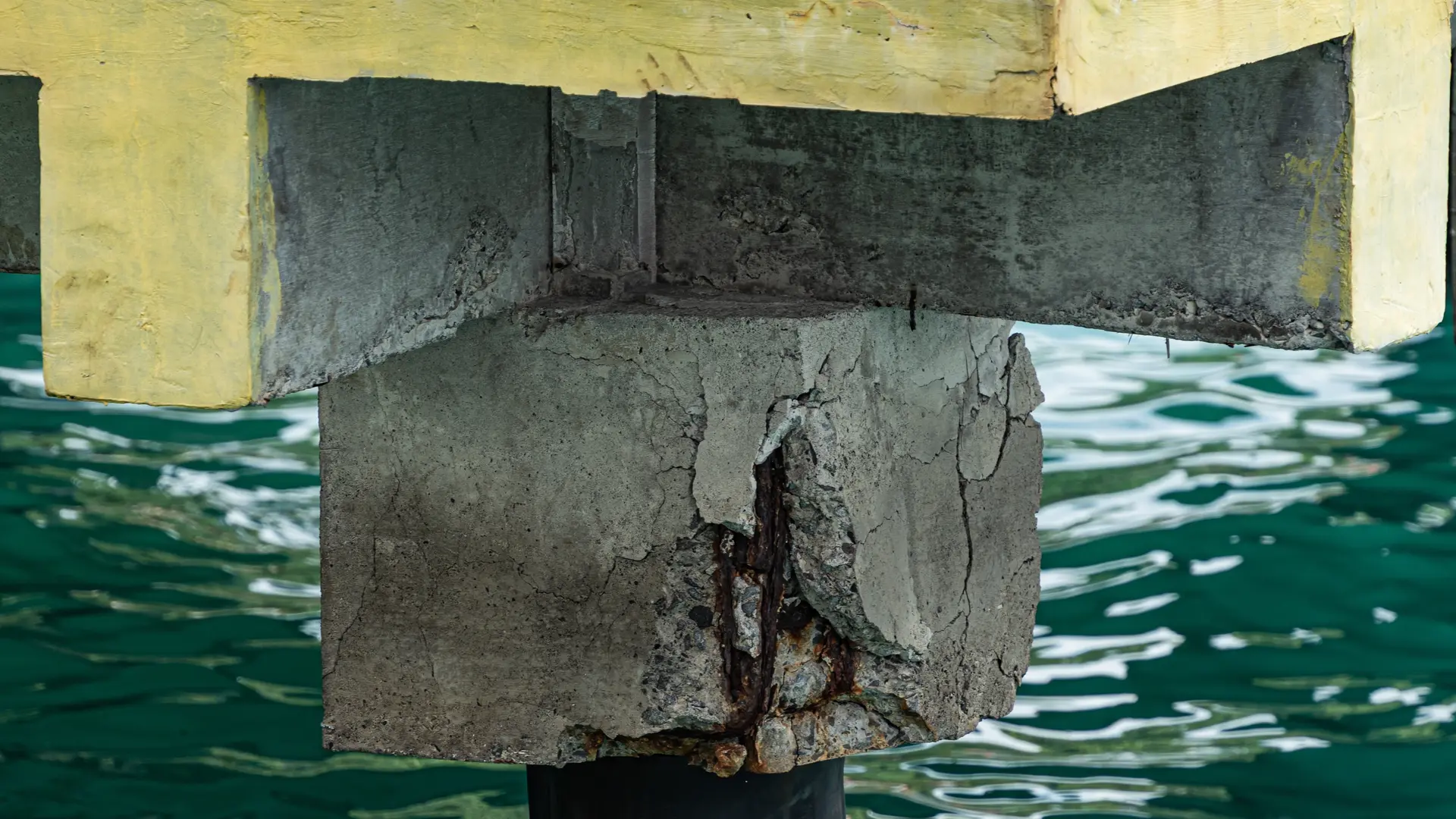
A reinforced concrete structure can deteriorate before showing cracks, rust stains, or visible spalling. Damage begins when chlorides permeate through the concrete, reach the reinforcing steel, and break down the passive layer that protects the material.
Chloride-induced corrosion in reinforced concrete is one of the most severe causes of durability loss in bridges, piers, parking structures, industrial plants, foundations, and structures exposed to salts.
The service life of concrete is not evaluated solely through compressive strength; it also requires analyzing ionic transport mechanisms, permeability, concrete cover thickness, moisture content, exposure-based design, surface protection, and electrochemical monitoring. In marine environments, this approach defines the difference between a durable structure and infrastructure requiring premature repair.
Reinforced concrete and chloride corrosion
Reinforced concrete combines the compressive strength of concrete with the mechanical properties of steel to resist tensile stresses. This mechanical compatibility depends on a chemical condition: the steel embedded in concrete remains passive due to the alkaline pH of the pore solution.
Under alkaline conditions, a passive film composed of iron oxides and hydroxides forms on the reinforcement. The problem appears when aggressive agents, especially chloride ions, penetrate the concrete and reach the steel, destroying the protective layer.
Chlorides generally originate from seawater, deicing salts, contaminated soils, industrial processes, aggregates, mixing water, or poorly controlled admixtures. Once inside the concrete, they advance through diffusion, capillary absorption, and wetting-drying cycles. Cracks, deficient joints, inadequate curing, or insufficient cover accelerate this ingress.
How do chlorides degrade reinforced concrete?
Degradation does not occur uniformly. Chloride corrosion in reinforced concrete usually manifests as localized corrosion or pitting corrosion due to the formation of small anodic and cathodic areas, creating differential concentration cells that are difficult to detect.
Chloride ingress is commonly modeled using Fick’s Second Law, which estimates how chloride concentration changes over time and depth until reaching the reinforcing steel:
∂C/∂t = Dapp · ∂²C/∂x²
Where C is the chloride concentration, x is depth, t is time, and Dapp is the apparent diffusion coefficient. Although it simplifies a more complex phenomenon, it helps estimate how long it takes for the chloride front to reach the reinforcement.
When the chloride concentration at the steel-concrete interface exceeds the depassivation threshold, chlorides promote electrochemical reactions that locally dissolve iron. Corrosion products occupy a larger volume than the original steel; this expansion generates internal pressure, microcracking, delamination, and concrete cover spalling.
Concrete service life in marine environments
The service life of chloride-exposed concrete is analyzed in two stages. Tuutti’s model separates the process into initiation period and propagation period. The first corresponds to the time required for chlorides to reach the steel and break passivity. The second extends from corrosion initiation to a limit state: cracking, section loss, spalling, reduced capacity, or unacceptable service condition.
The normative approach should begin with ACI 318 for design and durability, complemented by ACI 365 for service-life prediction, ACI 562 for repair of existing structures, and ASTM C876, C1152, C1218, and C1556 for corrosion diagnosis and chloride content evaluation. This framework connects design, inspection, repair, and maintenance under verifiable criteria.
A structure may remain in the initiation stage without visible damage while chlorides advance toward the steel. It may also be in active propagation even if the surface appears stable. Therefore, concrete service life must be evaluated using data, not only visual inspection.
Factors reducing structural service life
The durability of reinforced concrete depends on design, construction, and exposure variables. A high water-to-cementitious materials ratio increases capillary porosity and facilitates chloride ingress. Insufficient concrete cover reduces the protective distance between the surface and the steel; deficient curing leaves a permeable surface vulnerable to absorption and early cracking.
Compaction, cement type, mineral additions, temperature, relative humidity, carbonation, crack width, electrical resistivity, and oxygen availability also influence durability. In elements subjected to cyclic loading, fatigue, or vibration, microcracks can accelerate chloride transport and reduce the initiation period.
ACI 318 addresses durability through exposure categories associated with chlorides. For severe exposures, it requires low-permeability concrete, limits on water-to-cementitious materials ratio, and minimum strength requirements. ACI 365 and ASTM C1556, C1152, and C1218 complement service-life and chloride-content evaluation.
Concrete coatings and durability
Concrete coatings do not replace good mix design, adequate cover, or proper curing. Their function is to reduce the ingress of water, chlorides, carbon dioxide, and contaminants into the cementitious matrix. In new structures, they extend the initiation period; in existing structures, they may integrate into a mitigation strategy if the actual level of internal contamination is known.
System selection must consider exposure conditions, substrate moisture, vapor permeability, adhesion, UV resistance, abrasion, chemical compatibility, active cracking, and maintenance requirements. In marine environments, a poorly selected coating may fail due to blistering, adhesion loss, cracking, or moisture entrapment.
Role of coatings in marine environments
In marine environments, the most commonly used systems include hydrophobic impregnations, penetrating sealers, film-forming coatings, and polymer-modified cementitious mortars. Silanes and siloxanes penetrate the capillary network and reduce liquid water absorption without completely blocking vapor diffusion.
Epoxy coatings, polyurethanes, polyureas, and elastomeric membranes create continuous barriers with greater thickness. Their performance depends on surface preparation, anchor profile, moisture control, and compatibility with substrate movement. On decks exposed to salts, they must also resist abrasion and traffic.
Polymer-modified cementitious mortars can improve surface impermeability and abrasion resistance. In repairs, they must be compatible with the existing concrete to avoid differences in modulus, shrinkage, or electrochemical behavior.
Evaluation of deteriorated reinforcing steel
Evaluating reinforcing steel deterioration requires integrating inspection, non-destructive testing, and laboratory analysis. Concrete cracks, rust stains, spalling, and delaminations are late-stage indicators. A professional assessment seeks to identify active corrosion before section loss compromises safety, functionality, or repair costs.
Diagnosis begins with document review: drawings, age, exposure conditions, mix design, maintenance history, previous repairs, drainage, cracking, and loads. Visual inspections, cover measurement, crack mapping, delamination detection, moisture surveys, powder or core extraction, and electrochemical testing are then performed.
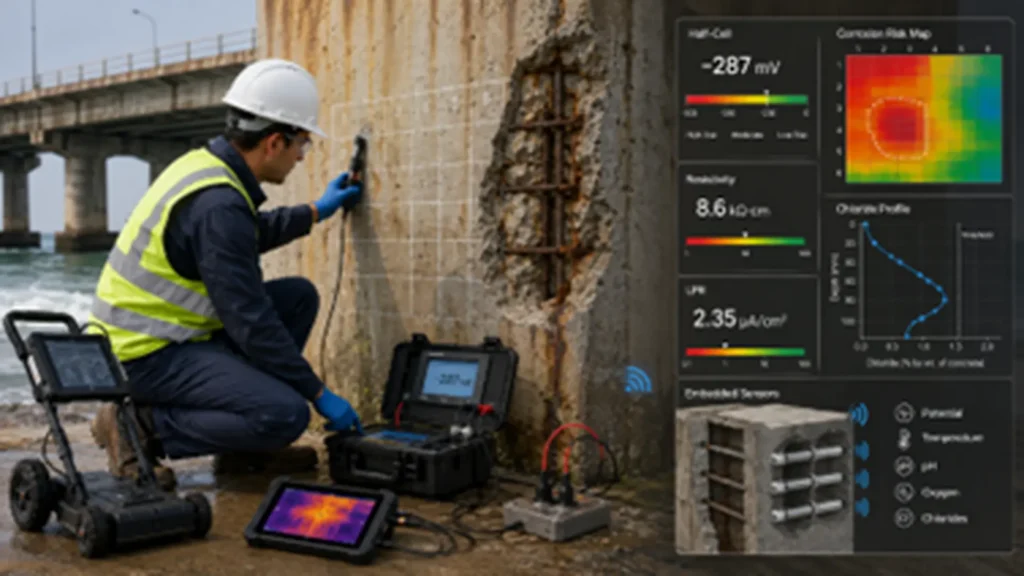
ASTM C876 is used for half-cell potential testing, a technique that helps identify areas with probability of active corrosion. Interpretation must be performed cautiously because moisture, resistivity, surface coatings, temperature, and electrical continuity can affect readings. Potential alone does not measure section loss; it indicates electrochemical tendency.
The following video shows the application of the half-cell potential test used to estimate the probability of active corrosion in reinforcing steel within concrete structures. Source: The Real Civil Engineer
Techniques for measuring internal corrosion
Concrete electrical resistivity allows estimation of how easily ionic current circulates through the matrix. Low values are generally associated with a greater probability of corrosion if chlorides and oxygen are available. It must be interpreted together with half-cell potential and corrosion rate because moisture can modify readings and generate partial conclusions.
Linear polarization resistance (LPR) allows estimation of corrosion current density and approximation of the instantaneous corrosion rate. It is useful for differentiating areas with corrosion probability from areas with truly active corrosion. Its application requires proper contact, defined steel area, electrical continuity, and qualified personnel.
Chloride profiles complement the analysis. ASTM C1152 determines acid-soluble chlorides, while ASTM C1218 is used for water-soluble chlorides. By comparing concentrations at different depths with steel location, it is possible to estimate whether the reinforcement is at risk of depassivation.
Reinforcing steel monitoring enables the transition from point measurements to continuous monitoring of potential, corrosion current, resistivity, moisture, temperature, oxygen, pH, and chloride presence. This information helps identify corrosion initiation in concrete structures, estimate its evolution, and correlate steel behavior with internal concrete conditions.
Spatial electrochemical mapping improves decision-making because it does not evaluate only one isolated point. By combining potential, LPR, and resistivity over a grid, it allows the construction of risk maps, prioritization of interventions, and detection of corrosive activity before visible delaminations or spalling appear.
Strategies to extend durability
Strategies to extend reinforced concrete durability must be defined according to whether the structure is in design, operation, repair, or rehabilitation stage. In new projects, the most effective measure is reducing permeability from the mix itself: low water-to-cementitious materials ratio, supplementary cementitious materials, proper curing, crack control, and sufficient cover.
Silica fume, ground granulated blast-furnace slag, fly ash, or metakaolin can refine pore structure and reduce chloride diffusion. There are also reinforcement solutions with higher corrosion resistance: stainless steel, galvanized steel, epoxy-coated bars, and fiber-reinforced polymers such as CFRP.
Each alternative has advantages, costs, and limitations. Stainless steel increases chloride resistance; CFRP avoids galvanic corrosion but requires specific design due to mechanical behavior and bonding characteristics. Selection must consider exposure, expected service life, maintenance, and asset criticality.
Cathodic protection and durable repair
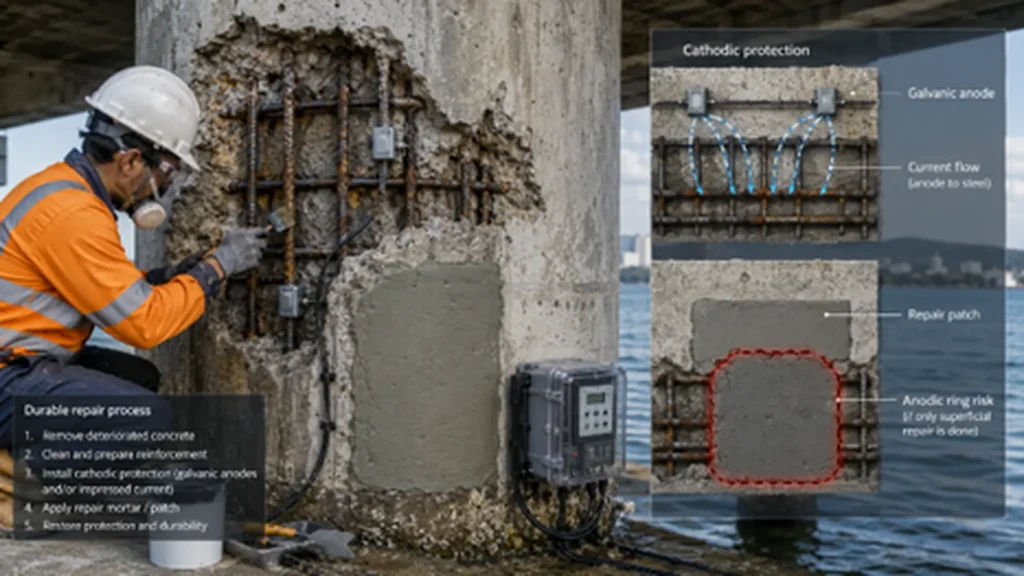
When corrosion exists, applying only a surface coating may be insufficient. In chloride-contaminated concrete, cathodic protection is one of the most effective technologies for controlling steel dissolution. It can be applied using galvanic anodes or impressed current systems according to AMPP/NACE and ISO 12696 criteria.
Repairs must address the root cause. Removing only delaminated concrete may leave chlorides around the patch and generate the so-called anodic ring effect, where corrosion shifts toward the repair perimeter. To avoid this, removal limits, steel cleaning, compatible mortars, reinforcement protection, and post-repair monitoring must be defined.
ACI 562 provides criteria for evaluation, repair, and rehabilitation of existing structures. Its approach helps organize decisions when there is damage, corrosion, section loss, design deficiencies, or need to extend service life.
Modern trends in reinforced concrete
Service-life management is migrating from reactive inspections toward predictive models. Embedded sensors, remote monitoring, digital twins, artificial intelligence, and asset-management platforms make it possible to correlate exposure, moisture, temperature, potential, resistivity, and chlorides with actual structural performance.
Artificial intelligence is already being used to estimate corrosion rates and predict risk areas from environmental variables and field data. Without reliable data, these models lose value. Therefore, they must be supported by traceable testing, calibrated inspections, and normative criteria.
Another relevant trend is the use of ultra-high-performance concrete (UHPC) as an overlay or rehabilitation material. Its low permeability, high strength, and dense microstructure can improve protection against chloride ingress, provided that proper surface preparation, adhesion, and substrate compatibility are ensured.
Coatings and structural service life
Coatings and structural service life must be evaluated using a life-cycle approach. A low-cost system may become more expensive if it fails prematurely, requires frequent shutdowns, or cannot tolerate actual exposure conditions. A high-performance system may be justified if it reduces chloride ingress, delays corrosion, and minimizes major interventions.
For companies operating bridges, terminals, piers, parking facilities, chemical plants, or coastal infrastructure, the best strategy combines durability-based design, risk-based inspection, electrochemical assessment, and compatible repair. Chloride corrosion in reinforced concrete should not be treated as inevitable deterioration, but as a measurable, modelable, and controllable phenomenon.
Conclusions
The durability of reinforced concrete exposed to chlorides depends on technical decisions made from design through operation. Chloride corrosion in reinforced concrete begins silently but can be measured through diffusion analysis, chloride profiles, electrochemical testing, risk mapping, and continuous monitoring.
In marine environments, concrete service life requires low permeability, sufficient cover, appropriate concrete coatings, compatible repair, and control of reinforcing steel degradation. Current technologies allow the transition from reactive repairs to predictive management, reducing failures, costs, and risks for critical infrastructure.
References
- https://www.mdpi.com/1424-8220/22/9/3421
- https://www.giatecscientific.com/education/corrosion-mapping-equipment-for-reinforced-concrete
Frequently Asked Questions (FAQs)
What causes chloride corrosion in concrete?
Corrosion occurs when chlorides penetrate the concrete, reach the reinforcing steel, and locally destroy its passive film. With moisture and oxygen available, an electrochemical cell is activated, generating localized corrosion.
How does concrete cover affect service life?
Concrete cover increases the distance chlorides must travel before reaching the steel. If it is dense, sufficient, and properly cured, it extends the initiation period. If it is porous, cracked, or insufficient, it reduces concrete service life.
What damage do chlorides cause to reinforcing steel?
Reinforcement may suffer pitting, localized section loss, reduced bond strength, longitudinal cracking, delamination, and concrete cover spalling.
How can the service life of reinforced concrete be extended?
It can be achieved through low permeability, proper curing, crack control, sufficient cover, supplementary cementitious materials, concrete coatings, monitoring, cathodic protection, and compatible repairs.
How is internal corrosion in concrete detected?
It is detected by combining half-cell potential, electrical resistivity, LPR, chloride profiles, cover measurement, GPR, delamination surveys, cores, and monitoring sensors.