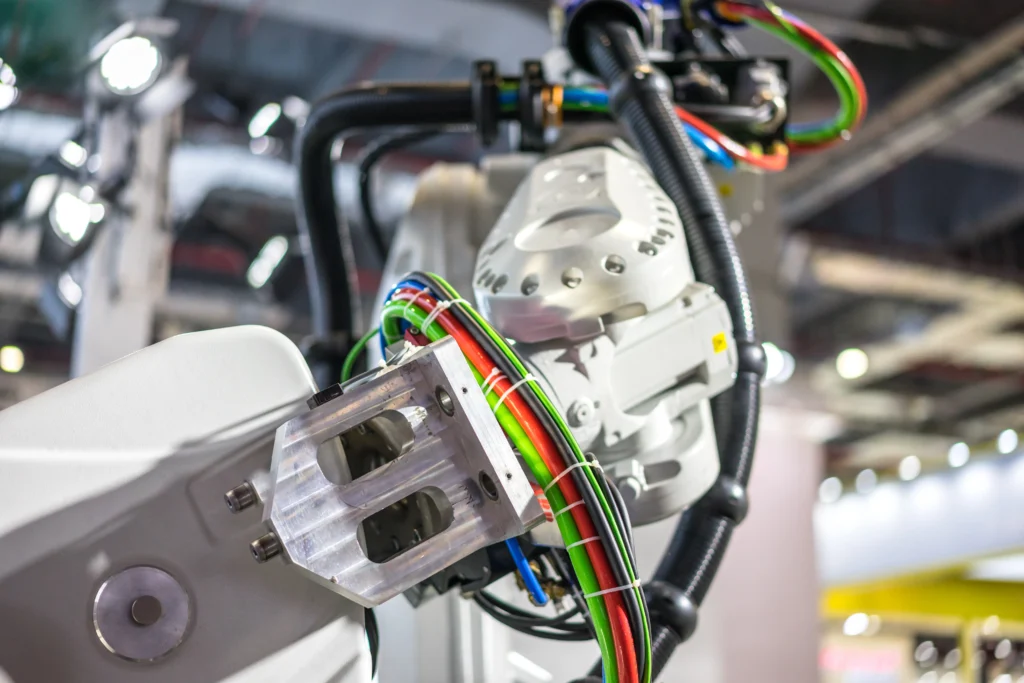
Industrial robotic automation could advance toward more complex applications thanks to a new imitation-learning framework that improves robots’ ability to perform precision manipulation tasks. The research presents a platform designed to train robotic systems capable of intervening in processes where manual dexterity remains a challenge for automation.
Currently, tasks such as cable laying, connector insertion, and component assembly require significant human intervention due to the challenges they present for conventional robotic systems. This study proposes replacing traditional modular architectures with a comprehensive approach based on artificial intelligence that learns directly from demonstrations performed by operators.
A platform to promote robotic automation
One of the main contributions of this work is the Industrial Dexterity Benchmark (IDB), a set of panels designed to replicate scenarios found in various industrial sectors. The platform includes applications related to cable management in data centers, the manufacturing of wiring harnesses for the automotive industry, and gearbox assembly operations.
The researchers complement this environment with DAG-ROS, a scalable framework for imitation learning, and AG-iDP3, a multimodal diffusion-based policy that integrates RGB images, three-dimensional point clouds, joint positions, and force and torque measurements captured from the robot’s wrist.
Improved performance in cable handling
The experimental tests focused on a representative data center infrastructure maintenance task consisting of identifying, holding, and correctly inserting an individual cable.
The best-performing configuration employed a broadcast policy enriched with visual information from multiple cameras and processed using an R3M encoder. Under these conditions, the system achieved a combined success rate of 78%, compared to 36% for the reference configuration based on a single RGB camera.
Each variant of the model was trained using approximately one hundred teleoperated demonstrations for each phase of the task, a relatively small amount for this type of industrial application.
Towards more robust automation
The results obtained indicate that multimodal imitation learning models can offer greater robustness against environmental variations and improve generalization capacity compared to classical approaches to machine vision and robotic control.
The research also suggests that these types of artificial intelligence policies can facilitate the deployment of robots in industrial processes where operational availability and repeatability are critical factors. This opens the possibility of automating tasks that, until now, have relied on manual intervention due to their complexity and the precision required.
Source: Arxiv.org
Photo: Shutterstock