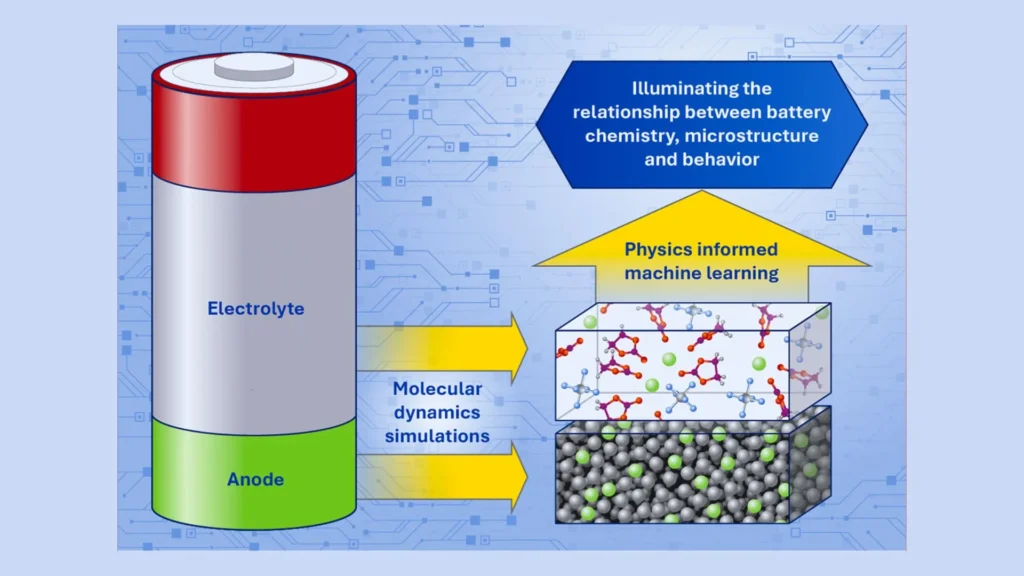
Lawrence Livermore National Laboratory (LLNL) implements methodologies based on physics-informed machine learning. Through this technical approach, scientists are able to evaluate the complex structural and behavioral relationships of materials used in advanced storage devices.
Machine learning and molecular dynamics in carbon anodes
A study published in the journal Energy Storage Materials addresses the optimization of sodium-ion batteries. Certainly, sodium represents a viable alternative due to its abundance and market availability. However, commercial anodes of this type use hard carbon, a disordered structure of crumpled sheets that complicates traditional engineering analysis. Hence, the LLNL team used high-performance computing to simulate the exact behavior of each atom over time.
Consequently, the researchers employed these detailed simulations to train advanced algorithms capable of projecting atomic interactions at large scale. Likewise, the tool classified the movement of sodium ions into two specific regimes determined by their interaction with carbon. In this way, a quantitative map was generated that connects microstructure with ionic transport, offering clear pathways to improve charging speed and thermal safety.
Three-dimensional electrochemical stability in lithium electrolytes
On the other hand, the research published in EES Batteries applies this same methodology to the refinement of liquid electrolytes for lithium-ion batteries. Traditionally, the design of an optimal electrolyte poses a complex challenge due to the enormous number of possible combinations among solvents, salts, and additives. Additionally, conventional analysis models often ignore the three-dimensional geometry of molecules by limiting themselves to flat textual representations.
To address this limitation, the experts generated three-dimensional molecular configurations through molecular dynamics integrated into machine learning models. In this way, the system evaluated the statistical stability of each complex structure. Finally, the analysis revealed that the overall electrochemical stability depends closely on the complete molecular ensemble, surpassing the simple sum of the individual components of the mixture.
Source and photo: LLNL