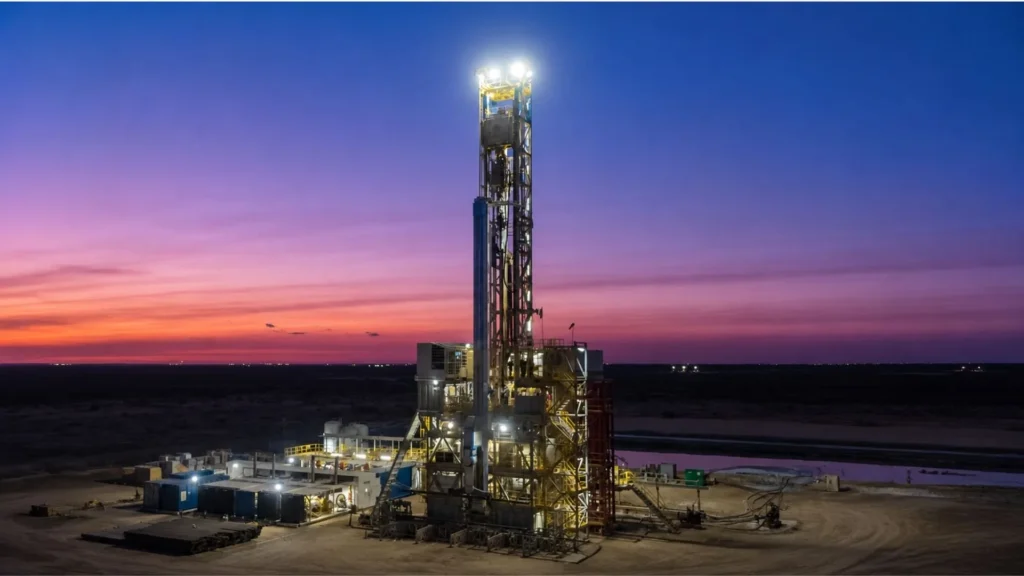
ExxonMobil accelerates automated drilling in the Permian Basin with robotic equipment designed to improve safety and increase oil production.
ExxonMobil is expanding its use of robotic platforms in the Permian Basin as part of its strategy to drill wells faster and reduce worker exposure to the most dangerous areas of these operations.
Currently, the company operates more than 30 drilling platforms in this region of Texas and New Mexico, two already have automated systems and robotic equipment capable of performing tasks that previously required workers directly on the drilling floor.
The goal is to rapidly expand that capacity, Exxon anticipates that about a quarter of its fleet will be automated next year and that the percentage will reach 50 % by 2028.
Exxon brings robotics to the drilling floor
In the automated platforms robotic arms and equipment can handle heavy steel pipes and perform operations within high-risk areas.
The change allows workers to be removed from the so-called red zone, where several of the most dangerous activities on a platform are concentrated. Nearly a third of the serious injuries historically associated with drilling have occurred on the floor of these platforms.
In addition, operators can control some of the machinery from protected areas while other specialists coordinate operations from remote centers.
Bart Cahir, senior vice president of unconventional operations at ExxonMobil, explained that removing personnel from the floor also allows more time to be spent preparing for the next stages of drilling.
When we remove people from the platform, those same people can anticipate and plan the next operation, and that combination gives us greater efficiency.
Bart Cahir, senior vice president of unconventional operations at ExxonMobil.
For the executive, this combination of automation and planning has a specific objective, which is the key to productivity.
An automated platform drilled more than 3 kilometers in 6 days
The performance of the first teams provides a benchmark for the potential of the technology, the first automated platform used by Exxon was supplied by Helmerich & Payne and started working last year.
That team managed to drill a horizontal section of more than 3 kilometers in just over six days, the result making it the third fastest platform recorded up to that point in the company’s operations.
Thus, automation aims to reduce the time between tasks and maintain a more continuous drilling process. It also allows for some control and supervision to be moved outside the areas where heavy equipment and high-pressure systems operate.
The Permian Basin is the focus of Exxon’s growth plans
The technological bet is linked to the weight of the Permian Basin within US production, the formation extends through Texas and New Mexico and constitutes the main oil-producing region in the United States.
Exxon maintains an extensive presence in the area and intends to increase its Permian production by about 40 % by 2030 to reach approximately 2.5 million barrels of oil equivalent per day.
Automation can become one of the tools to achieve that growth; drilling faster allows new wells to be put into production in less time as the company seeks to improve the efficiency of its operations.
However, there is another challenge: shale wells exhibit relatively rapid decline rates after reaching peak production levels. This characteristic compels operators to continue drilling and improving the techniques used to recover the available hydrocarbons.
Exxon seeks to recover more oil from underground
Furthermore, ExxonMobil is working on more than 40 technologies aimed at increasing the amount of recoverable hydrocarbons in its Permian assets.
The shale industry typically recovers around 10% of the oil present in these formations due to the rock’s low permeability. Therefore, increasing the recovery factor could have a significant impact on future production without relying solely on drilling in new areas.
The company aims to double its recovery rate by the beginning of the next decade through new technologies and operating methods.
Likewise, the combination of automated drilling, robotics, and recovery techniques aims to extend the yield of existing resources. The outcome will depend on Exxon’s ability to extend these systems from the initial automated platforms to a much larger portion of its fleet.
Source: Energy Digital
Photo: ExxonMobil