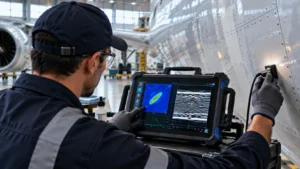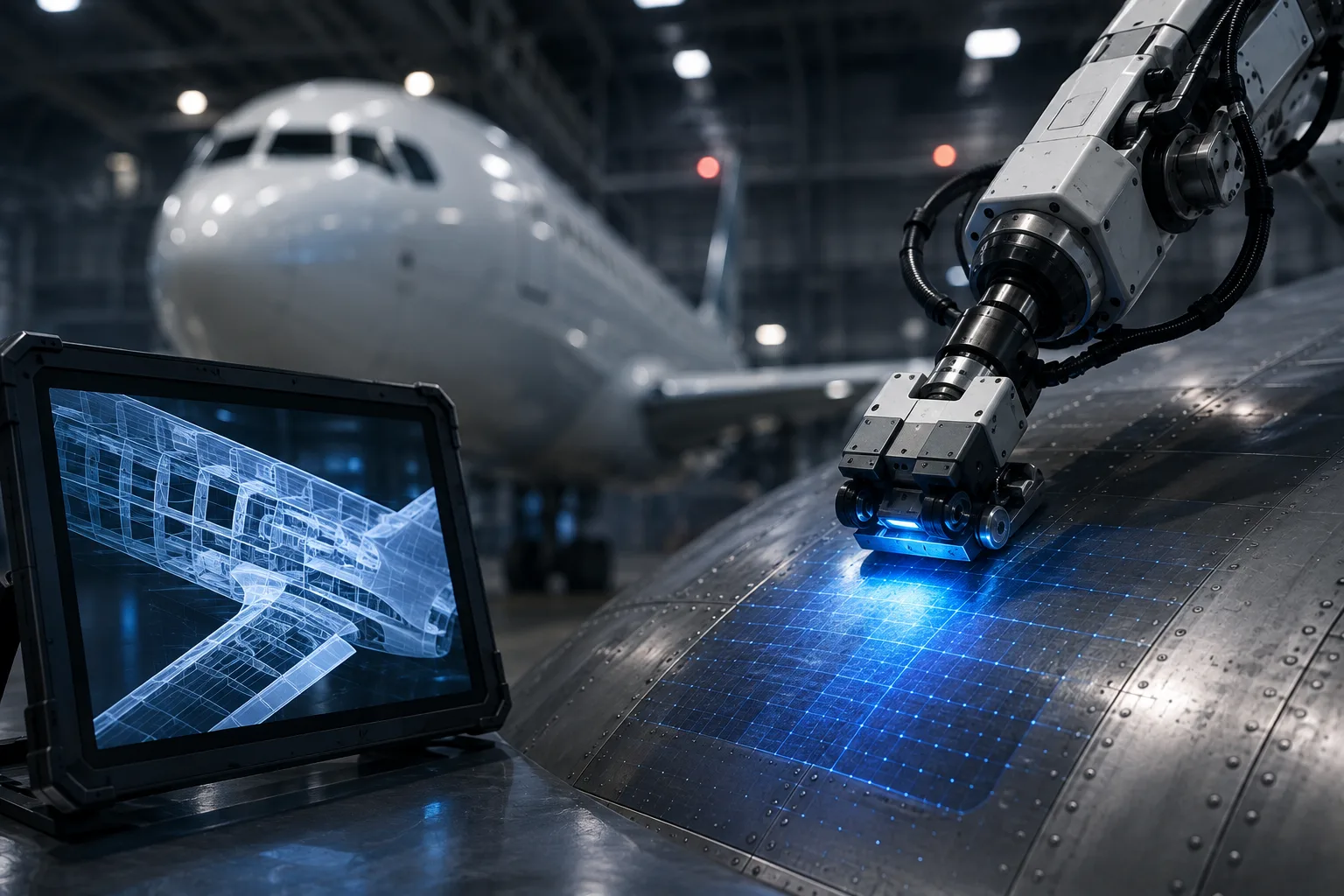
Digital NDT is advancing in the aerospace industry as an alternative for improving inspection repeatability and increasing the traceability of results. Digital radiography, phased array ultrasonic testing (PAUT), automated eddy current testing, robotics, and artificial intelligence are making it possible to transform information that traditionally depended heavily on manual processes into quantifiable, storable, and comparable data across inspections.
The trend addresses a significant challenge in aircraft maintenance: reducing certain variations associated with manual acquisition and evaluation without displacing the inspector’s judgment. A recent analysis by Aerospace Testing International specifically identifies digitalization, automation, and advanced data management as elements that are changing how components are inspected and how their condition is documented.
This shift is becoming increasingly important as aircraft incorporate increasingly complex structures and materials, while organizations need to preserve information that allows them to compare the condition of the same component throughout its service life.
Digital NDT seeks more repeatable inspections
Variability is one of the areas that digitalization seeks to control. In certain manual tests, differences in the path, coverage, or technique used by the inspector can produce results that are not exactly equivalent from one inspection to another. The source uses eddy current testing as an example, where variations in scan pitch or scan paths that do not overlap properly can lead to differences in coverage.
Digitalization introduces the possibility of recording results electronically and preserving quantifiable inspection information. In this way, data can be analyzed, visualized, and subsequently compared with previous records from the same component.
This changes the value of the NDT report. In addition to documenting the condition identified at a specific point in time, the digital history can help identify changes between inspections and provide greater traceability for future maintenance decisions.
Technology does not eliminate the variables inherent in an inspection, nor does it replace procedures, calibrations, or personnel competencies. Its contribution lies in making certain stages of acquisition and analysis more controllable and documentable.
AI and robotics expand NDT automation
This evolution can already be observed across different methods used by the aerospace industry. Digital radiography and PAUT make it possible to obtain and preserve high-resolution images for evaluation, while automation is expanding into UT, ECT, and VT. The Aerospace Testing International analysis highlights the use of robotic UT scanners on large composite structures, automated eddy current systems, and robots or crawlers designed to inspect difficult-to-access areas.
Artificial intelligence adds another layer to the process. Machine learning models can analyze large datasets to help identify discontinuities and classify indications. The applications described include identifying porosity, inclusions, and cracks in radiographic images, analyzing ECT signals, and differentiating between noise and potential defects in ultrasonic data.
However, the shift toward greater automation does not necessarily mean eliminating human involvement. The source presents these technologies as tools capable of supporting specialist-led recognition, an especially relevant aspect in a sector subject to strict safety and certification requirements.
Traceability opens the door to digital twins
The ability to preserve inspection results could become one of the main differentiators of digital NDT. Centralized systems make it possible to organize information from techniques such as radiography, UT, ECT, and VT and retrieve historical records for a component from a single platform. This facilitates the comparison of results and the tracking of condition changes across different inspections.
This information can also be integrated with digital twins and sensor data. Combined with structural health monitoring systems, these models can support more continuous condition monitoring and enable maintenance strategies with greater predictive capabilities.
The goal is to move from inspections that produce isolated results toward ecosystems where accumulated data can be used throughout the entire lifecycle of the component.
Adoption will depend on costs, training, and regulation
The advancement of digital NDT still faces significant barriers. Equipment, software, and data infrastructure require investment, while the industry needs personnel capable of combining traditional inspection competencies with new digital tools. Integration with legacy systems, information security, and the regulatory processes required to approve new methodologies can also slow adoption.
For this reason, the transformation will likely be gradual. The direction identified by the industry points toward greater integration of NDT techniques, automation, AI, robotics, and data platforms, but their implementation will need to demonstrate repeatability, reliability, and compliance with applicable requirements.
For the aerospace sector, the next step will not simply be to digitize what was previously done manually. The real transformation will lie in leveraging these data to achieve more repeatable inspections, greater traceability, and better decisions regarding component condition, while keeping specialists as a fundamental part of the process.
Source: Aerospace Testing International