Behind every space mission, NDT protects the systems that never leave Earth. When people think about space exploration, they picture rockets launching, spacecraft orbiting Earth, and missions reaching toward the Moon. It’s inspiring, unimaginable, challenging, and rewarding, as it should be. But in my experience, the real mission begins long before liftoff.
Not everything we build is meant to go into space. But everything we build on Earth has one purpose which is to make sure the hardware that does go to space gets there safely… and returns safely if that is the objective. That’s a responsibility I have carried throughout my career, and it’s one that every Non-Destructive Testing professional understands, whether they realize it or not.
The Hardware That Stays Behind—But Carries Everything Forward
There’s a side of spaceflight most people never see. It’s the ground support hardware which includes, test stands, lifting fixtures, pressure systems, structural weldments, and facility tooling. These systems don’t leave Earth, but they are built to run the flight hardware through tests that simulate flight conditions.
They are designed to replicate how components will exist and perform in:
- Spacecraft
- Habitats
- Lunar modules
- Rovers
- Other mission-critical systems
In many cases, this hardware is built and maintained to the same level of rigor as flight hardware. Because if we expect something to survive the extremes of space, we have to prove it under controlled conditions here first. In a way, this is where the mission is quietly won; on the ground before it ever reaches the sky.
The Role of NDT: The Quiet Guardian
If you’ve been in this industry long enough, you start to see NDT differently. It’s not just a process. It’s not just a requirement. It’s a form of protection or guardianship for those going into space.
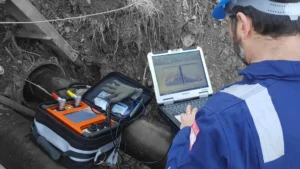
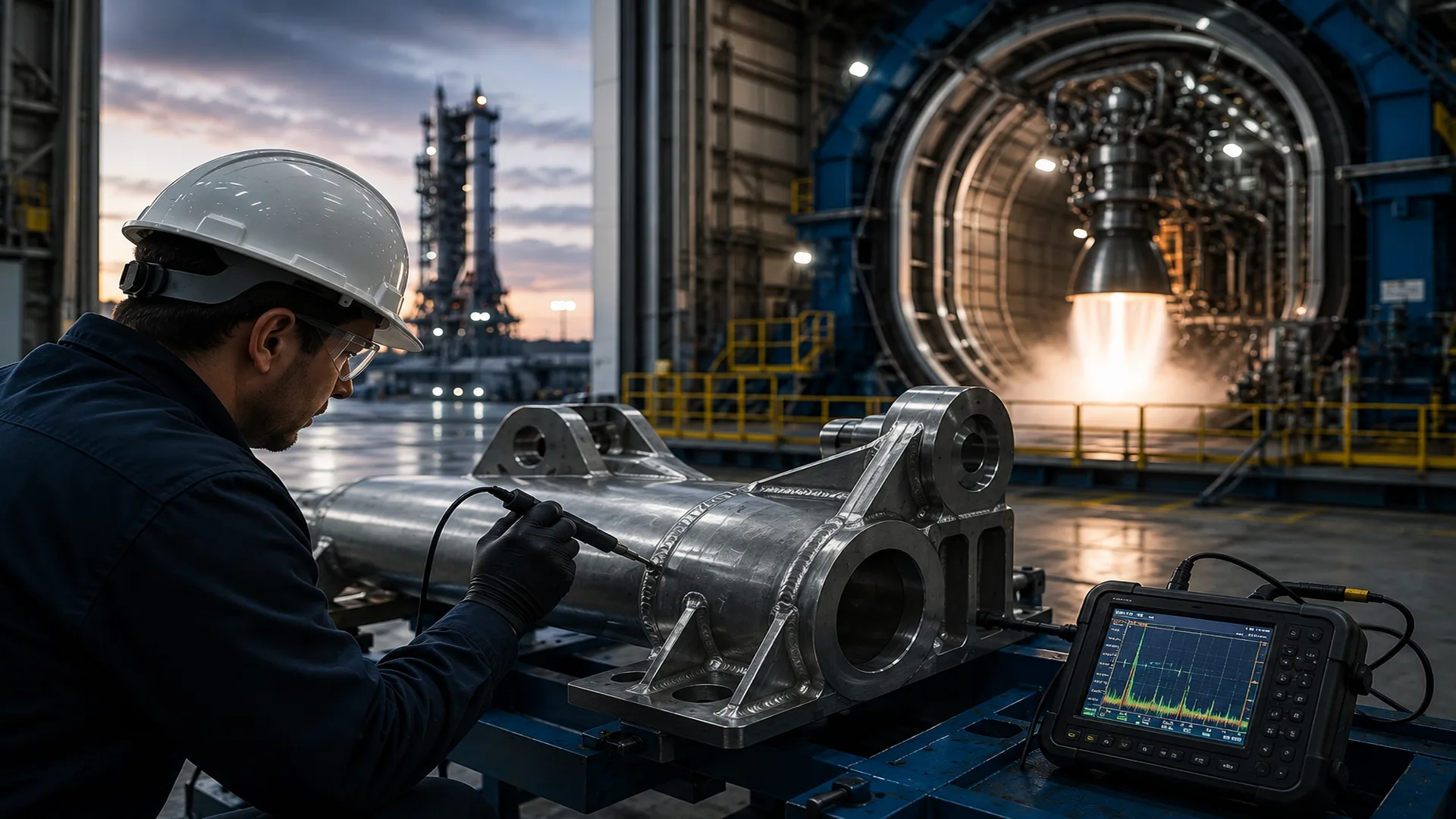
Before ground hardware is ever put into service, it goes through layers of inspection designed to uncover what the eye cannot see. We rely on proven industry standards to guide that work:
- Liquid Penetrant Testing (ASTM E1417) to reveal surface-breaking discontinuities.
- Radiographic Testing (ASTM E1742) to expose internal volumetric flaws.
- Ultrasonic Testing (ASTM E2375) to evaluate internal integrity of wrought material used to fabricate hardware.
Tied together with specific NASA requirements that go above and beyond these standards, in many cases, this hardware is built to withstand the challenges of fatigue testing, structural loading, vibration, extreme environments, or vacuum, to name a few. These methods are more than tools, they are part of a system that ensures nothing is left to chance.
Every indication tells a story. Every inspection is an opportunity to prevent failure before it ever happens. That mindset is something I’ve always tried to pass on, especially through my role as an educator of interns, and students, and through NDT Hero outreach events.
Built to Endure, Inspected to Protect
Ground support systems don’t have an easy job. They face repeated loading, pressure cycles, environmental exposure, and long-term wear. Unlike flight hardware, which may have a defined mission window, ground systems are often used repeatedly.
That means the risk doesn’t go away, it evolves. Fatigue, corrosion, cracking, these aren’t hypothetical concerns. They are real, and they develop over time. In many cases, hardware like this is needed as part of a facility modification and requires thorough inspections to ensure safe repeated use during installation and removal. This hardware may not be going into space but the equipment going inside the test chamber, but the equipment going inside the test chamber is.
The chamber itself must operate properly to complete the test safely, correctly, and on time. That’s why NDT isn’t just a one-time check; it becomes part of the lifecycle. We monitor, trend, reassess, and stay steps ahead of failure.
The Human Side of Inspection
At the heart of all of this is something even more important than the hardware, and that’s the people that perform these critical inspections. The technicians work under suspended loads. The engineers stand beside high-pressure systems. The teams depend on accurate test results to move forward safely.
As inspectors, we carry that responsibility with us every day. We’re trained under programs like NAS 410, SNT-TC-1A, and CP-189 before we begin applying a critical skill that makes the difference. Judgment.
- What does this indication mean?
- Does it meet acceptance criteria?
- Is this safe to operate?
Those decisions don’t stay on paper. They impact real people in real environments.
A Hero’s Work, Without the Spotlight
In the NDT Hero world, I often describe inspectors as guardians of integrity. Not because it sounds good, but because it’s true. We don’t wear capes. We don’t stand on launch pads. And most of the time, no one sees the work we do.
But we’re there, behind the scenes, making sure every piece of hardware is ready to perform when it matters most. Spaceflight may capture the spotlight. But ground systems carry the weight of proving it all works. And NDT professionals make sure those systems are worthy of that responsibility.
Final Thoughts: The Mission Starts Here
If there’s one thing I’ve learned over the years, it’s this: Not everything needs to go to space to be critical to the mission. Some of the most important work happens right here on Earth—ensuring that everything else has a chance to succeed. That’s the role of ground support hardware. That’s the role of NDT. And for those of us in this field, that’s the mission we show up for every day.
This article was developed by orge Eddie C. Pmpa from Four Point NDT, LLC and published as part of the eighth edition of Inspenet Brief magazine July 2026, dedicated to technical content of the energy and industrial sector.