
Table of Contents
- What is Multi-Skip PAUT and what does it involve?
- Equipment and examination setup
- How does Multi-Skip PAUT work?
- Where is Multi-Skip PAUT used on ASTs?
- How is a Multi-Skip PAUT examination performed?
- Who should perform Multi-Skip PAUT?
- What codes and standards apply?
- Benefits of Multi-Skip PAUT for ASTs
- When should Multi-Skip PAUT be considered?
- Limitations and interpretation criteria
- Implementation of Multi-Skip PAUT by HMT LLC
- Multi-Skip PAUT for tank integrity decisions
- References
- Frequently Asked Questions (FAQs)
Multi-Skip PAUT (Multi-Skip Phased Array Ultrasonic Testing) is an advanced Non-Destructive Testing (NDT) technique. It is primarily used on storage tanks to evaluate critical areas where geometry, welds, supports, or reinforcement plates prevent direct transducer placement.
In these areas, localized corrosion and wall thickness loss compromise structural integrity without being detectable through conventional ultrasonic testing. The Multi-Skip PAUT technique overcomes this limitation by using indirect ultrasonic sound paths to inspect hard-to-reach regions from accessible surfaces, supporting precise integrity decision-making.
What is Multi-Skip PAUT and what does it involve?
Multi-Skip PAUT is a specialized phased array ultrasonic testing application that uses multiple beam angles and reflected sound paths to examine metal where the probe cannot be positioned directly over the area of suspected corrosion or wall loss.
Unlike a direct ultrasonic thickness measurement, the beam can travel along planned acoustic paths within the material and use one or more reflections to reach regions partially hidden by geometry or physical obstructions.
This configuration supports localized volumetric examination for indications associated with corrosion, pitting, or metal loss beneath supports, reinforcing pads, and other areas with restricted direct access.
Equipment and examination setup
Multi-Skip PAUT is not a stand-alone instrument. It is a specialized phased array configuration that typically includes a PAUT instrument, multielement probe, wedge, acquisition software, calibration or reference blocks, and appropriate couplant.
The examination also requires a scan plan, parameters selected for the component geometry, and a procedure defining how the data will be acquired, evaluated, and documented.
How does Multi-Skip PAUT work?
The basic principle of Multi-Skip PAUT is to use phased array beam steering to send ultrasonic energy toward an area that cannot be examined through a direct sound path.
The beam enters the material at a selected angle, reflects from component surfaces, and continues toward the volume being evaluated.
Beam angles and skip paths
In Multi-Skip PAUT, the transducer introduces ultrasonic beams into the material at predefined angles. These beams reflect from component surfaces and continue along one or more skip paths until they reach the area of interest.
Each skip corresponds to the portion of the acoustic path that continues after a reflection. By combining different beam angles and sound paths, the NDE examiner can direct ultrasonic energy toward metal volumes that cannot be accessed through a direct ultrasonic measurement.
The signal returning to the transducer contains information about changes encountered along the acoustic path, allowing the examiner to identify indications associated with corrosion, pitting, or metal loss in areas with restricted access.
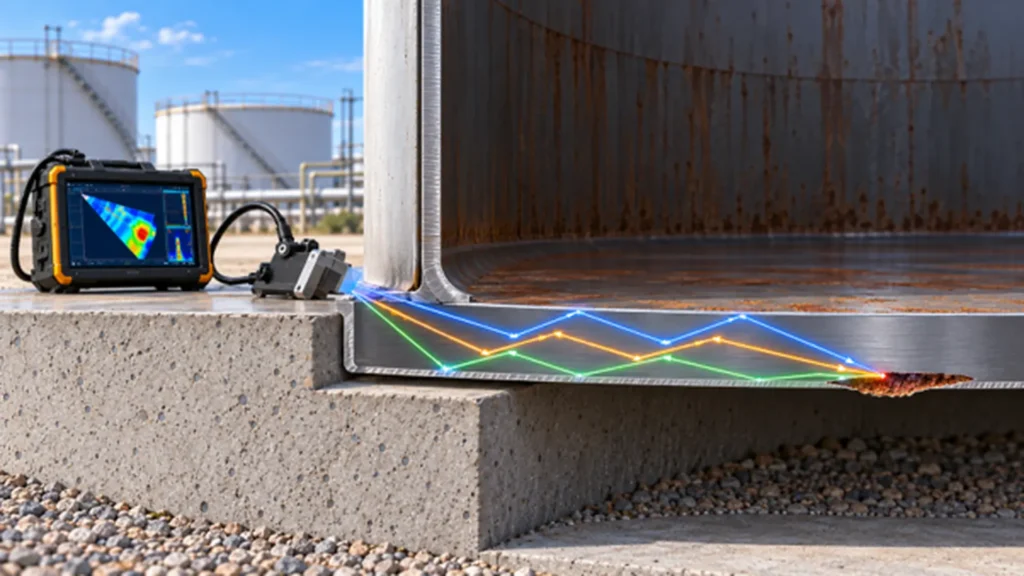
In this context, a skip is the portion of the acoustic path that continues after the beam reflects from a component surface before reaching the area of interest.
By programming different angles, the NDE examiner can establish beam paths capable of reaching metal volumes that are inaccessible to a direct ultrasonic measurement.
Detecting metal loss
Corrosion, pitting, and changes in remaining wall thickness alter the behavior of ultrasonic signals.
The system records these responses so the NDE examiner can determine whether an indication is consistent with metal loss.
Detecting an indication does not automatically mean it can be accurately sized under every condition. Characterization capability depends on component geometry, acoustic path, calibration, surface condition, equipment setup, and the examination procedure.
Where is Multi-Skip PAUT used on ASTs?
The technique provides the greatest value when a localized area of concern cannot be reached directly with an ultrasonic probe.
On ASTs, this situation may occur near the tank bottom, around the shell-to-bottom connection, beneath reinforcing components, or at other locations where geometry restricts direct access.
Tank bottom critical zone
API 653 defines the critical zone as the portion of the tank bottom or annular plate extending 3 in. (75 mm) inward from the inside edge of the shell.
This area is located inside the tank and should not be confused with the portion of the bottom or annular plate that projects beyond the shell to the exterior.
Because of its proximity to the shell and the shell-to-bottom weld, the critical zone is particularly important when evaluating tank-bottom integrity.
Shell-to-bottom fillet weld
API 650 uses the term shell-to-bottom fillet weld for the attachment between the bottom edge of the lowest shell course and the bottom or annular plate.
Depending on tank design, this connection may involve a standard bottom plate or an annular plate. Its geometry can make direct probe positioning difficult when the area of interest is located close to or beneath the shell.
A Multi-Skip configuration can therefore be planned from an accessible surface to direct sound toward the required metal volume.
Bottom plate projection beyond the shell
API terminology describes the projection of the bottom plate beyond the shell, commonly referred to in the field as the tank chime. Where an annular plate ring is used, the annular plate may form this exterior projection.
This accessible surface can provide a location for probe placement and for developing indirect ultrasonic paths toward areas near the shell-to-bottom fillet weld. Examination feasibility must always be confirmed from the actual geometry and the availability of a valid acoustic path.
Supports and reinforcing pads
The technique may also be used where supports, reinforcing pads, or other components prevent direct probe access to the metal being evaluated.
In these applications, the examination setup begins from an accessible surface and considers material thickness, geometry, and configuration before the ultrasonic path is selected.
How is a Multi-Skip PAUT examination performed?
The examination begins by identifying the area of interest, the expected damage mechanism, and the geometric restrictions.
The NDE examiner then determines whether a suitable acoustic path can be established from an accessible surface.
A scan plan is developed, and the probe, wedge, beam angles, and acquisition parameters are selected for the specific configuration.
After calibration and surface preparation, the area is scanned and the acquired data are stored for evaluation. Indications are then assessed in accordance with the applicable procedure and evaluation criteria before the results are incorporated into the tank integrity process.
Who should perform Multi-Skip PAUT?
API 653 distinguishes between an examiner and an authorized inspector.
The examiner performs the specific nondestructive examinations for which they are qualified and authorized. An API 653 authorized inspector has broader responsibilities within the overall inspection and tank integrity program.
Personnel performing Multi-Skip PAUT should have appropriate ultrasonic and phased array training and should understand component geometry, calibration, scan planning, and the applicable examination procedure.
Qualification and certification should follow the employer’s written practice and the contractual or regulatory requirements governing the work, which may reference ASNT SNT-TC-1A, CP-189, ISO 9712, or another applicable qualification scheme.
What codes and standards apply?
Multi-Skip PAUT can be incorporated into a tank inspection strategy when the procedure, geometry, personnel qualifications, and owner or code requirements support its use.
| Reference | Related scope |
|---|---|
| API 653 | Inspection, repair, alteration, and reconstruction of in-service storage tanks |
| API RP 575 | Inspection practices for atmospheric and low-pressure storage tanks |
| API 650 | Tank design, construction, and component terminology |
| ASME BPVC Section V | Nondestructive examination requirements and methods |
| ASNT SNT-TC-1A / CP-189 | NDT personnel qualification and certification frameworks when adopted |
| ISO 9712 | Third-party qualification and certification of NDT personnel where applicable |
The applicable edition, owner requirements, written practice, and examination procedure should govern the actual inspection program.
Benefits of Multi-Skip PAUT for ASTs
The primary benefit is the ability to extend ultrasonic examination into locations where direct probe access is restricted. From an accessible surface, planned ultrasonic paths can be used to investigate indications associated with corrosion, pitting, or metal loss.
The acquired information can support decisions involving additional examination, monitoring, repair, or engineering evaluation. Its value is not that it replaces other NDE methods, but that it can provide localized information where direct ultrasonic configurations have practical limitations.
When should Multi-Skip PAUT be considered?
The technique is particularly useful when there is a localized area of concern and component geometry prevents direct ultrasonic examination.
Potential applications include areas near the shell-to-bottom fillet weld and locations beneath supports, reinforcing pads, or similar obstructions.
It may also be performed from the tank exterior while the tank remains in service when operating conditions, safety requirements, geometry, and the approved procedure allow the examination to be performed effectively.
Multi-Skip PAUT vs. Other NDE methods
| Method | Primary application | Key consideration |
|---|---|---|
| Multi-Skip PAUT | Localized damage in areas with limited direct access | Requires suitable geometry and acoustic paths |
| Conventional UT | Direct thickness measurement | Requires direct surface access |
| SRUT / GWUT | Screening larger or difficult-access areas | May require follow-up characterization |
| PEC | Metal-loss assessment through compatible lift-off conditions | Resolution and depth depend on setup |
| MFL | Broad tank-bottom scanning | Requires suitable tank-bottom access |
Method selection should be based on the expected damage mechanism, area size, component geometry, accessibility, and the level of information required for the integrity decision.
Limitations and interpretation criteria
If an appropriate acoustic path cannot be established, Multi-Skip PAUT may not be technically viable. Surface condition, coupling, calibration, instrument configuration, and examination procedure also influence data quality and the ability to characterize indications.
The method does not automatically replace an internal inspection, a complete API 653 inspection program, or other NDE methods required to evaluate the tank.
Implementation of Multi-Skip PAUT by HMT LLC
Within its advanced phased array services, HMT LLC describes Multi-Skip Phased Array Testing as a full volumetric screening examination used to detect corrosion and pitting where deposits, supports, annular-ring geometry, or other obstructions restrict direct access.
For AST tanks, the company provides inspections focused on the critical zone and areas near the ferrule-bottom fillet weld by examining accessible exterior surfaces.
This industrial application does not imply that the cited codes prescribe this technique as a mandatory method.

The interview provides additional context on HMT’s advanced ultrasonic and phased array inspection capabilities. It should be treated as related technical content rather than as a specific Multi-Skip PAUT demonstration.
Multi-Skip PAUT for tank integrity decisions
This technique expands the range of evaluation options when the geometry prevents a direct ultrasonic examination. Its indirect acoustic paths can provide information about corrosion and wall thickness loss in areas near the bottom, supports, or gusset plates.
Application of the technique should be based on geometry, the expected damage mechanism, the examination procedure, and the level of information needed for the integrity decision. It should complement, not automatically replace, the other NDE methods and inspection activities required by the tank integrity program.
Does your tank have areas where direct ultrasonic access is restricted? An advanced examination can determine whether Multi-Skip PAUT is technically suitable for characterizing corrosion or wall loss and defining the next inspection steps.
Explore HMT LLC’s advanced inspection capabilities in the Inspenet Corporate Directory and evaluate the most appropriate option for your asset condition.
References
- API Standard 653, Tank Inspection, Repair, Alteration, and Reconstruction.
- API Standard 650, Welded Tanks for Oil Storage.
- API RP 575, Inspection Practices for Atmospheric and Low-Pressure Storage Tanks.
- ASME BPVC Section V, Nondestructive Examination.
- ASNT, SNT-TC-1A and CP-189.
- ISO 9712:2021, Non-destructive testing, Qualification and certification of NDT personnel.
- HMT LLC, Phased Array Ultrasonic Testing, Advanced Services.
- Inspenet TV, HMT Inspection at ASNT: Innovation in Non-Destructive Inspection.
Frequently Asked Questions (FAQs)
What is Multi-Skip PAUT?
Multi-Skip PAUT is a specialized phased array application that uses multiple beam angles and reflected ultrasonic paths to examine areas where the probe cannot be positioned directly. It can support the detection and characterization of indications associated with corrosion, pitting, or wall loss.
Can Multi-Skip PAUT Be Used While the Tank Is in Service?
Yes, an examination may be performed from the exterior while the tank remains in service when operating conditions, safety requirements, geometry, and the examination procedure allow it.
Feasibility must be established for each application rather than assumed solely because the method uses Multi-Skip PAUT.
What Areas of an AST Can It Examine?
The technique may be useful in selected portions of the critical zone, near the shell-to-bottom fillet weld, and beneath supports or reinforcing pads.
Coverage depends on the ability to establish a valid acoustic path to the area of interest.
Does Multi-Skip PAUT Replace an Internal Inspection?
The method provides information about specific areas and damage mechanisms, while the overall inspection strategy must still consider API 653 requirements, tank history, risk, operating conditions, and the examination scope established by the owner.
How Is Multi-Skip PAUT Different From Conventional PAUT?
Both use phased array ultrasonic technology. Multi-Skip PAUT is differentiated by the use of multiple planned reflections and acoustic paths to reach areas with restricted direct access. Other PAUT configurations may instead focus on weld examination, direct thickness measurements, or different component geometries.