
Table of Contents
- More NDT data does not always mean better decisions
- NDT data management: from results to decisions
- When inspection data retains its context
- What can AI do with inspection data?
- AI supports analysis; it does not make the decision
- From the algorithm to NDT specialist review
- Remote review without losing technical judgment
- Digital traceability: What happened to each data point?
- What do standards require for digital NDT data management?
- ASTM E2339 and digital NDT information
- Personnel competence remains necessary
- Ooga connects data, AI, and NDT expertise
- A documented application
- What should be required from a digital NDT platform?
- From inspection data to defensible decisions
- Referencias
- Frequently asked questions about NDT data management
NDT inspections generate increasing volumes of data, but their value depends on turning that data into useful knowledge. Software, AI, and expert review can shorten the path from inspection data to technical decisions.
NDT data management has become increasingly important in industrial inspection as the volume of information generated during asset evaluation continues to grow. Images, signals, measurements, records, and reports can provide valuable evidence, but having more data does not necessarily mean having better information for decision-making.
The challenge is to preserve context, facilitate analysis and review, and transform inspection results into technical knowledge that remains available to those responsible for assessing asset condition and making integrity decisions.
More NDT data does not always mean better decisions
Digitalization has increased the ability to acquire and retain information from UT, PAUT, digital radiography, and other NDT methods. The problem arises when that growth is not matched by an equivalent capacity to organize, review, and interpret the results.
An inspection may generate signals, images, files, reports, and records associated with different components and different stages in the life of an asset.
When this information remains scattered across equipment, applications, folders, or contractors, reconstructing its technical context can consume a significant portion of the time available for evaluation.
Volume does not replace judgment. More data does not necessarily mean greater knowledge of asset condition. To provide value, inspection data must remain connected to what was inspected, the method used, acquisition parameters, previous findings, and the evaluations already performed.
This is where the real challenge begins: preventing the ability to generate data from exceeding the ability to turn it into useful knowledge. From an integrity perspective, the objective is not to accumulate records, but to have reliable information available when a decision must be made.
NDT data management: from results to decisions
Managing inspection data goes beyond storing files. A result gains value when it can be related to the inspected asset, component, and location, as well as to the inspection method, acquisition parameters, and previous information needed for interpretation.
These relationships turn isolated records into organized information. They also make it easier to compare results, retrieve previous evidence, and determine which information supported a particular evaluation without relying exclusively on the person who originally performed the inspection.
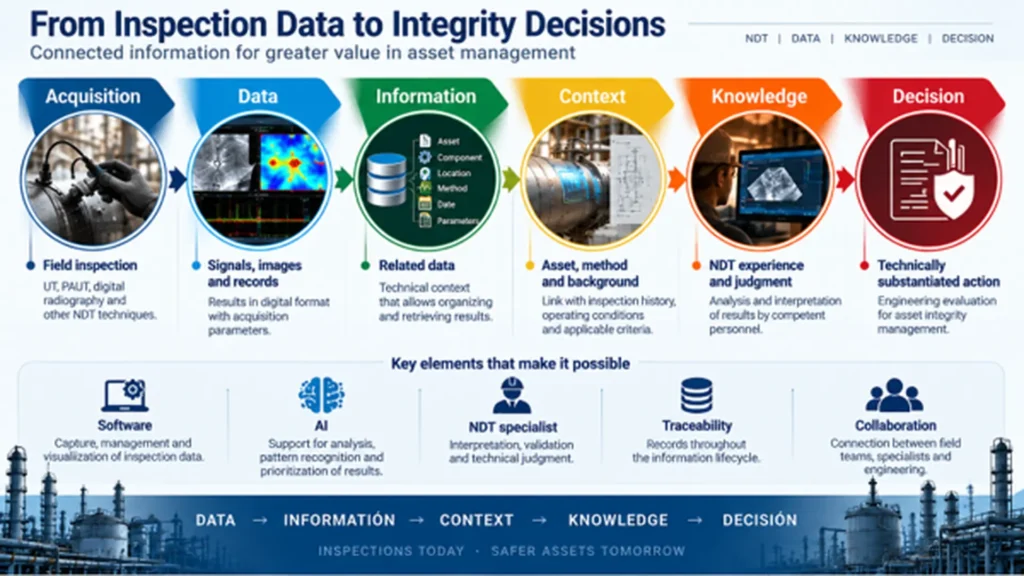
From a knowledge management perspective, the process can be summarized as:
DATA → INFORMATION → CONTEXT → KNOWLEDGE → DECISION
| Stage | What is available | What adds value | Expected outcome |
|---|---|---|---|
| Data | Signals, images, measurements, and records | Identification and organization | Available evidence |
| Information | Data linked to the inspection | Technical context | Interpretable result |
| Knowledge | Reviewed and compared information | NDT experience and judgment | Understanding of condition |
| Decision | Knowledge applied to the asset | Engineering evaluation | Technically substantiated action |
When inspection data retains its context
A signal, image, or measurement separated from its context can lose part of its technical value. Knowing what was inspected, where, when, how, and under what conditions allows the result to be interpreted and related to the component’s history.
Preserving those relationships also helps retain asset knowledge when inspectors, contractors, or engineering teams change. The inspection history then stops being merely a collection of files and becomes information that can be used to compare conditions and support future evaluations.
NDT data management fulfills its purpose when it creates a reliable path from the evidence obtained during inspection to a technically substantiated decision.
What can AI do with inspection data?
As information volumes grow, AI defect detection can support activities that require the review of large datasets. Depending on the method and application, algorithms can be used to recognize patterns, classify information, flag indications, or help prioritize results that require attention.
AI can also assist with repetitive tasks. Comparing records, organizing results, or highlighting specific features can reduce part of the preliminary review effort and allow specialists to focus their attention where technical interpretation adds greater value.
However, an algorithm-generated result should not automatically be treated as a conclusion about asset condition. An identified or classified indication still requires context: inspection method, data quality, geometry, inspection conditions, previous information, and applicable criteria.
| Activity | AI/software can support | NDT judgment required |
|---|---|---|
| Organize large volumes of data | Yes | Process supervision |
| Recognize patterns | Yes | Validate their meaning |
| Flag potential indications | Yes | Interpret the response |
| Prioritize data for review | Yes | Determine technical relevance |
| Compare results | Yes | Evaluate conditions and history |
| Determine asset condition | Provides supporting information | Yes |
| Make the integrity decision | Does not replace this function | Yes |
AI supports analysis; it does not make the decision
In NDT, distinguishing a relevant discontinuity from a response associated with geometry, component configuration, or acquisition conditions may require experience and additional information.
AI is therefore most useful when it operates as an analysis support tool, and its output can be reviewed by competent personnel. An algorithm can help find, organize, or prioritize information; interpretation must still consider what the data actually represents in the asset.
The application of AI in NDT was also discussed by Ajay Pasupuleti of Ooga Technologies during an Inspenet interview at PANNDT. The discussion provides context on how these tools can be incorporated into digital inspection workflows while retaining specialized technical knowledge within the process.

From the algorithm to NDT specialist review
Inspection data management software can facilitate access to NDT results, but having the data available does not mean that it has already been interpreted. An essential task remains between those two points: determining what the information represents and assessing its technical relevance.
The specialist contributes knowledge of the inspection method, its limitations, and the variables that can influence a signal, image, or measurement. This becomes particularly important when an evaluation must distinguish a relevant indication from responses associated with geometry, component configuration, or acquisition conditions.
Technology can therefore reduce distance and improve access to information while professional judgment remains part of the review process.
Remote review without losing technical judgment
Remote NDT review tools can make field-acquired data available to specialists who are not physically present at the inspection location. This can facilitate consultations, second reviews, audits, and technical support during an inspection.
This approach was also discussed by Dale Lynn of Ooga Technologies during an Inspenet interview at ASNT, where he addressed the use of digital environments to connect inspection information with specialized professionals.

Distance alone does not change the responsibilities associated with evaluation. Data quality, personnel competence, and applicable procedures continue to determine the reliability of the review.
Digital traceability: What happened to each data point?
A technical decision does not depend only on the final result. It may also be necessary to know where the information came from, who acquired it, under what conditions it was obtained, what review it received, and what evaluation was subsequently performed.
Digital inspection software can help organize NDT inspection data and preserve these relationships through records associated with the asset and with each stage of the process. Traceability makes it possible to recover the path of the information without having to reconstruct it later from scattered documents.
This continuity becomes increasingly important when an asset accumulates years of inspection history, multiple contractors become involved, or responsibility for follow-up changes between teams.
An organization should not have to reconstruct asset knowledge every time the person performing or interpreting the inspection changes. Preserving traceability also means preserving technical knowledge for future decisions.
What do standards require for digital NDT data management?
Digitalizing an inspection process does not remove the technical requirements that support the reliability of its results. The way information is stored, transferred, or reviewed may change, but data integrity, interpretation, and personnel competence remain relevant.
In this context, standards help separate two matters that should not be confused: how digital information is managed and who is technically competent to evaluate NDT results.
ASTM E2339 and digital NDT information
ASTM E2339-21 establishes the practice for Digital Imaging and Communication in Nondestructive Evaluation (DICONDE), supporting the organization and communication of digital NDE image data between conforming systems.
Its relevance to NDT data management lies in preserving the information required so that images, signals, and associated data can be communicated and used while maintaining their relationship with the inspection that generated them.
DICONDE does not turn data into a decision. Its contribution is to provide a framework for organizing and communicating digital NDE information so that its technical context can be preserved and retrieved.
Personnel competence remains necessary
Digitalization does not replace professional competence requirements. ISO 9712:2021 establishes requirements for the qualification and certification of personnel performing industrial NDT through a third-party certification scheme.
By contrast, ASNT SNT-TC-1A provides recommendations that employers can use to structure their written practice for the qualification and certification of NDT personnel.
This distinction is particularly important when AI tools or remote review are involved. Automating part of the workflow does not automatically transfer the specialist’s technical responsibility to software.
The availability of competent personnel is also part of the operational challenge. Inspenet has examined how the shortage of NDT Level III specialists is encouraging new models of collaboration and remote technical support.
Technology can change how information reaches the person responsible for evaluation. It does not eliminate the need for that evaluation to follow the applicable procedure, method, responsibilities, and competence requirements.
Ooga connects data, AI, and NDT expertise
This approach is embodied in the Ooga Platform, an integrated environment designed to connect digital inspection workflows, qualified NDT specialists, AI-enabled tools, and remote collaboration.
The platform allows inspection data to be organized, shared, and reviewed within a traceable digital workflow without replacing the NDT methods used to acquire the data or the judgment of the personnel responsible for interpreting it.
Within this ecosystem, the Remote Digital Inspection System can connect field teams with NDT specialists for remote data review, consultation, and auditing. It is complemented by the NDT Expertise & AI Tools Marketplace, which provides access to specialists and digital tools that can support selected analysis and review activities.
From a knowledge management perspective, the value of this architecture does not lie solely in centralizing information. Its greater value is in reducing the distance between data generated in the field, its technical context, specialist review, and the decision that engineering must ultimately make.
A documented application
In an interview with Inspenet, Ajay Pasupuleti of Ooga Technologies described an application in which an inspector located in Idaho collaborated remotely on a welding project being performed in Nevada.
As the field team moved to the next weld, the information associated with the previous weld could be made available for remote analysis. The example illustrates how connectivity can bring acquisition and review closer together without requiring every specialist to be physically present at the same location.
The value of this application is not in attributing a quantified outcome to the platform when the available information does not support one. Its value lies in demonstrating a way to connect field activity, inspection information, and specialized knowledge during an inspection program.
What should be required from a digital NDT platform?
Selecting NDT inspection software should not depend only on how many files a platform can store or whether it incorporates artificial intelligence. A more useful question is whether the platform helps preserve the quality and context of information throughout the process.
Its ability to work with the formats and systems already used by the organization should be evaluated, together with traceability, information security, historical data retrieval, and collaboration between those who acquire, review, and use inspection results.
It should also be clear where the function of the software ends and where professional responsibility begins. A platform can organize data, support analysis, and connect specialists; decisions concerning asset condition still require defined technical criteria and responsibilities.
| Stage | Technical need | Digital support | Primary responsibility |
|---|---|---|---|
| Acquisition | Obtain reliable evidence | Capture and recording | Inspector |
| Management | Organize and contextualize | Software/platform | NDT team |
| Analysis | Process and prioritize information | Software + AI | NDT specialist |
| Review | Validate interpretation | Digital collaboration | Competent personnel |
| Traceability | Preserve evidence and history | Digital records | Organization |
| Decision | Evaluate and act on the asset | Consolidated information | Engineering/Integrity |
When inspection information is subsequently integrated into broader digital asset integrity management processes, its usefulness can extend beyond NDT review into asset evaluation and condition follow-up. Inspenet has examined this broader relationship between inspection information, NDT, integrity software, and asset management.
A digital NDT platform should therefore be evaluated by its ability to connect data, people, and decisions, not simply by the number of technological functions it incorporates.
From inspection data to defensible decisions
NDT data management creates real value when information retains its context, can be retrieved and interpreted, and remains available to the people responsible for evaluating asset condition.
Software can organize large volumes of information; AI can support analysis and prioritization; and remote review can bring specialized knowledge closer to the point of need. None of these capabilities eliminate the requirement for technical competence or automatically turns a result into a decision.
Digital NDT creates value when it shortens that path without sacrificing traceability, evidence, or technical judgment.
If your organization needs to manage NDT data, facilitate specialist review, and preserve inspection information traceability, explore the capabilities of Ooga Technologies and connect directly with the company through Inspenet Corporate.
Referencias
- ASTM International.ASTM E2339-21: Standard Practice for Digital Imaging and Communication in Nondestructive Evaluation (DICONDE). ASTM International.
- International Organization for Standardization (ISO).ISO 9712:2021, Non-destructive testing, Qualification and certification of NDT personnel. ISO.
- American Society for Nondestructive Testing (ASNT).Recommended Practice No. SNT-TC-1A: Personnel Qualification and Certification in Nondestructive Testing. 2024 ed. ASNT.
- Ooga Technologies.Remote Digital Inspection System. Ooga Technologies.
- Ooga Technologies.NDT Expertise & AI Tools Marketplace. Ooga Technologies.
- Ooga Technologies.Ooga Platform. Ooga Technologies.
- Inspenet TV.Inspección END con IA: la apuesta de Ooga para el futuro del END. Inspenet.
- Inspenet TV.Ooga Technologies apuesta por la inspección remota para transformar el NDT. Inspenet.
Frequently asked questions about NDT data management
What is NDT data management?
NDT data management includes the organization, preservation, retrieval, and contextualization of information generated during inspections. Its purpose is not simply to store files, but to keep results connected to the asset, component, location, method, parameters, previous findings, and reviews required for later interpretation.
How can AI be used to analyze NDT data?
AI can support tasks such as pattern recognition, information classification, indication identification, result comparison, and prioritization of data for review.
Its applicability depends on the NDT method, data quality, the algorithm being used, and the specific purpose of the analysis.
Can AI replace NDT specialist review?
AI can support the specialist, but an algorithmic output should not automatically be treated as an evaluation of asset condition.
Interpretation requires consideration of geometry, inspection method, procedure, data quality, previous information, applicable criteria, and the responsibilities assigned to competent personnel.
What does DICONDE contribute to NDT data management?
DICONDE provides a framework for organizing and communicating digital information used in nondestructive evaluation.
Its application can help preserve images, signals, and related data together with relevant inspection information, supporting exchange, retrieval, and continued technical interpretation.
What should be evaluated when selecting NDT software?
In addition to storage and analysis functions, organizations should evaluate interoperability, traceability, security, compatibility, historical data retrieval, collaboration, auditability, and the ability to preserve data context.
It should also be clearly defined how specialists participate and who retains responsibility for technical interpretation and decision-making.