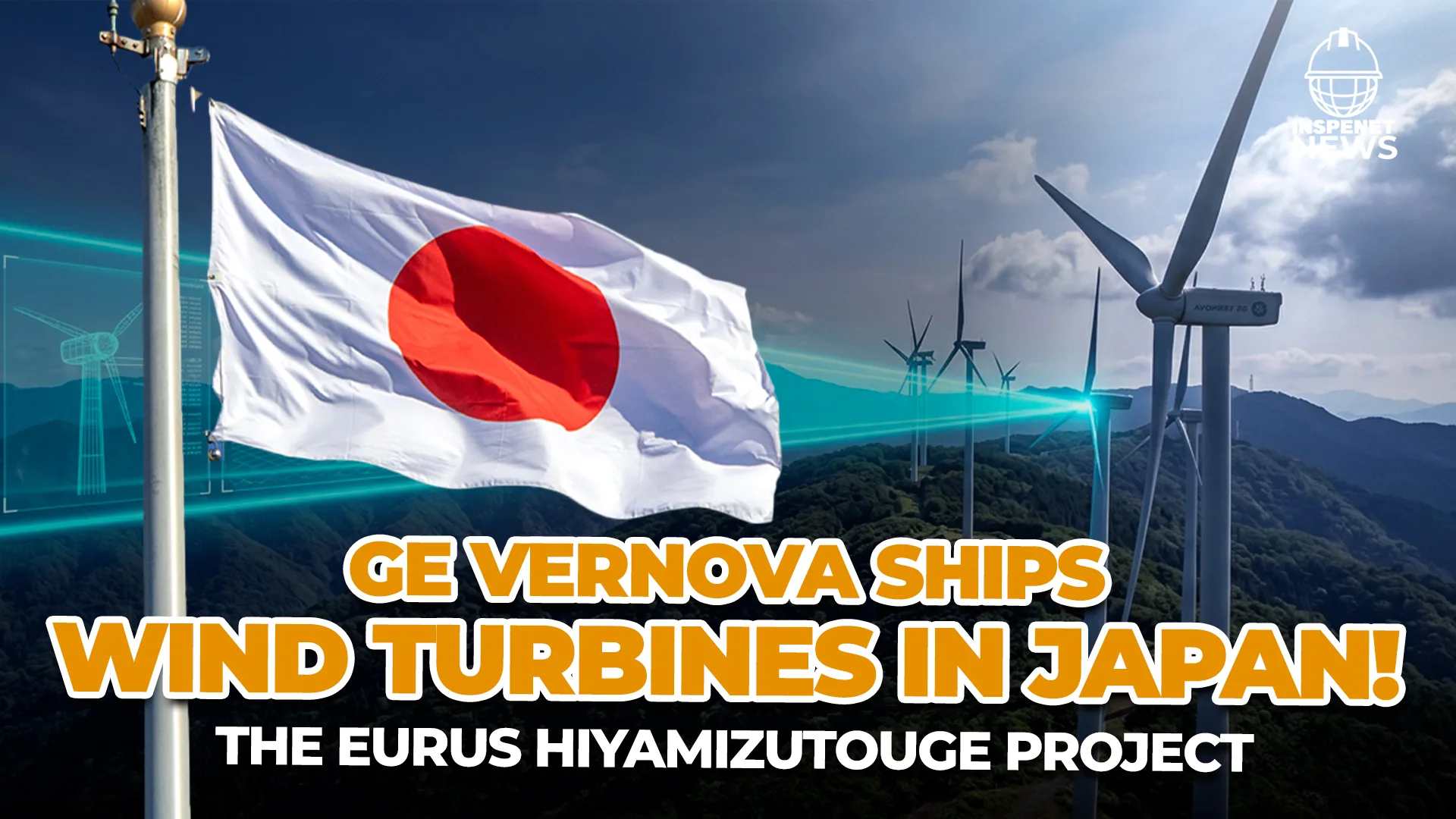
GE Vernova expands its wind energy presence in Japan with a new project
GE Vernova will strengthen its activity in the Japanese market after reaching an agreement with Eurus Energy Holdings to supply seven wind turbines for a new park in Aomori Prefecture.
Specifically, the turbines will have an individual capacity of 4.2 MW and will allow the Eurus Hiyamizutouge wind farm to reach a total capacity of 29.4 MW . The project will be located between the city of Mutsu and the village of Higashidori.
In addition, the agreement includes a two-year service contract, which the companies will have the option to extend for another two years, thus ensuring continued support for the wind turbines after their installation.
Seven GE Vernova turbines will equip the Hiyamizutouge wind farm
For its part, GE Vernova will use equipment from its 4 MW land-based platform; each of the seven turbines will have 4.2 MW of power and be 117 meters tall.
The platform has accumulated more than two million operating hours, according to data provided by the company. GE Vernova states that these wind turbines have been designed to offer performance and reliability under the wind conditions present in Japan.
In this way, the Hiyamizutouge project will expand the infrastructure designed to harness the wind resources of Aomori . This prefecture, located in the north of Honshu Island, is home to other projects related to wind power generation.
GE Vernova gains ground in Japan's wind energy sector
Furthermore, the agreement with Eurus Energy is part of GE Vernova's strategy to increase its activity within the Japanese energy market.
Currently, the company claims its technology accounts for approximately 25% of Japan's installed onshore wind power capacity . Its presence also extends to other areas of the country's electrical grid.
In particular, GE Vernova maintains that its technologies are present in approximately half of Japan's installed capacity of high-power gas turbines .
The manufacturer also reported that it secured orders totaling 339 MW through 2025 from various Japanese customers. The portfolio includes utility companies and independent power producers.
These figures place the Hiyamizutouge agreement within a broader business context. For GE Vernova, Japan represents a market where the company seeks to expand its presence in power generation and onshore wind energy.
GE Vernova and Eurus Energy are collaborating again
In turn, the project represents a new collaboration between GE Vernova and Eurus Energy , both companies having already worked on renewable energy projects within the Japanese market.
Gilan Sabatier, Commercial Director of Onshore Wind Energy for International Markets at GE Vernova, highlighted that the 4 MW platform is adapted to the country's conditions and noted that the company intends to continue supporting its energy transition.
From Eurus Energy, Masaru Akiyoshi, representative director and executive vice president, once again highlighted the cooperation with GE Vernova. He also expressed his gratitude for the support of the residents of Mutsu and Higashidori, as well as the authorities and other stakeholders involved in the development.
The company expects that the future Aomori park will contribute to the advancement of renewable energy in Japan through wind power generation.
Aomori reinforces Japan's renewable energy goals
Meanwhile, the construction of new wind power capacity comes at a time when Japan is seeking to increase the share of renewable sources within its electricity system.
The country aims for renewable energy to account for up to 38% of its electricity generation by 2030. Projects like Hiyamizutouge will add onshore wind capacity as part of that process.
In parallel, GE Vernova maintains an institutional relationship with the Japanese Ministry of Economy, Trade and Industry (METI). Both parties have established a joint working group focused on addressing opportunities and challenges related to energy security and technological development.
Finally, GE Vernova's international scale also supports its operations in Japan. The company's wind power segment has more than 59,000 turbines in operation across various markets worldwide.
With the supply of the seven new wind turbines, GE Vernova will expand its participation in Japanese projects while Eurus Energy moves forward with the development of an additional 29.4 MW of wind capacity in Aomori.
News of additional interest
Wison and Axens seek to accelerate e-SAF projects
Wison Engineering and Axens have signed an agreement to collaborate on selected e-SAF projects, a sustainable aviation fuel produced using the Fischer-Tropsch route. The alliance will combine Axens' process technologies with Wison's expertise in designing modular plants, managing global supply chains, and executing international projects.
The joint effort aims to reduce some of the obstacles hindering the commercial development of the e-SAF. The companies intend to offer greater certainty regarding construction costs and timelines, accelerate the initial stages of projects, and facilitate access to financing. Axens will contribute its Carboverseo™ and Gasel® technologies, while Wison will work on engineering and developing models that can be replicated in different markets.
Dangote takes its refinery public for $47 billion
Aliko Dangote has launched an offering of 4.1 billion shares of its Nigerian refinery at 525 naira per share. The offering could raise $1.6 billion and up to $2.1 billion with an over-allotment option. The offering, open until October 13, values the company at approximately $47 billion and allows small investors to participate with as few as 10 shares.
The money will be used to finance part of a $14.3 billion expansion that aims to double processing capacity from 700,000 to 1.4 million barrels per day by 2029. The refinery is also entering the stock market with improved results: it posted a net profit of $1.82 billion during the first half of 2026, after losing $476 million in all of 2025. Furthermore, ADNOC has expressed interest in investing in the company, although the terms of a potential transaction are not yet known.
Japan prepares ships to transport captured CO₂
Six Japanese companies received Approval in Principle from ClassNK for a standard vessel capable of transporting liquefied CO₂ at low pressure. The design, with a capacity of 42,000 m³, was developed by Mitsubishi Shipbuilding, “K” Line, MOL, NYK Line, Nihon Shipyard, and MILES. The companies conducted risk assessments to define safety measures for handling and transporting the CO₂.
The project aims to prepare a fleet capable of supporting the growth of carbon capture and storage (CCS) in Japan. With a common design platform, the companies hope to simplify engineering work and make the construction of future vessels more efficient. This approval is the first concrete result of the collaboration, launched in 2025, to standardize these vessels and facilitate their domestic supply.
Juniper adds 101 MW of wind power in three Indian states
Juniper Green Energy brought 101 MW of new wind capacity online in Gujarat, Maharashtra, and Rajasthan during the first half of September. These additions are part of projects that combine wind and solar power, as well as dispatchable renewable generation. With these developments, the company has increased its total operating capacity to 2,689 MW and also has 503 MWh of battery storage capacity.
Among the new assets are 85 MW of wind power from two phases of the GUVNL hybrid project in Gujarat. In Maharashtra, Juniper completed its contracted capacity with MSEDCL by bringing the final 10 MW of wind power at Chapalgaon online. This project combines 75 MW of solar with 25 MW of wind and was completed more than two months ahead of schedule.