Table of Contents
- How API 586 links damage and NDE technique
- API 586 applied to fixed equipment
- What NDE to use according to damage in fixed equipment
- Inspection according to the expected damage mechanism
- Criteria for selecting NDE techniques
- Benefits of API 586 for asset management
- Integration of API 586 into asset integrity programs
- API 586 and contact point corrosion
- Conclusions
- References
- Frequently asked questions (FAQs)
API 586 establishes a systematic approach for selecting Non-Destructive Examination (NDE) methods based on the damage mechanisms affecting fixed process equipment. Unlike traditional strategies based on routine inspections, this recommended practice directly relates the expected degradation type with the most appropriate inspection technique, improving early defect detection and strengthening the mechanical integrity of pressure vessels, piping, heat exchangers, and other static equipment.
The increasing complexity of industrial processes requires damage-based inspection programs, where the selection of NDE methods does not depend solely on the availability of a technique, but rather on its ability to identify the predominant deterioration mechanism. In this context, this standard provides technical criteria that complement other American Petroleum Institute standards focused on asset integrity management.
How API 586 links damage and NDE technique
One of the main contributions of API 586 is establishing a direct relationship between degradation mechanisms and the most effective inspection techniques for their detection. API RP 586 provides guidance on the use of optimized inspection techniques for high-temperature hydrogen attack (HTHA). Most of these are volumetric ultrasonic testing (UT) methods. Through these advanced methods, Fitness-For-Service (FFS) assessments can now be performed with greater reliability.
Each damage mechanism generates discontinuities with particular characteristics. While some produce uniform thickness loss, others generate surface cracks, localized corrosion, laminations, internal cavities, or volumetric defects. Therefore, no NDE technique is suitable for all scenarios.
The standard proposes that the NDE selection process should consider aspects such as:
- Expected damage mechanism.
- Defect morphology and orientation.
- Equipment material.
- Component geometry and thickness.
- Operating conditions.
- Accessibility for inspection.
- Limitations and sensitivity of each method.
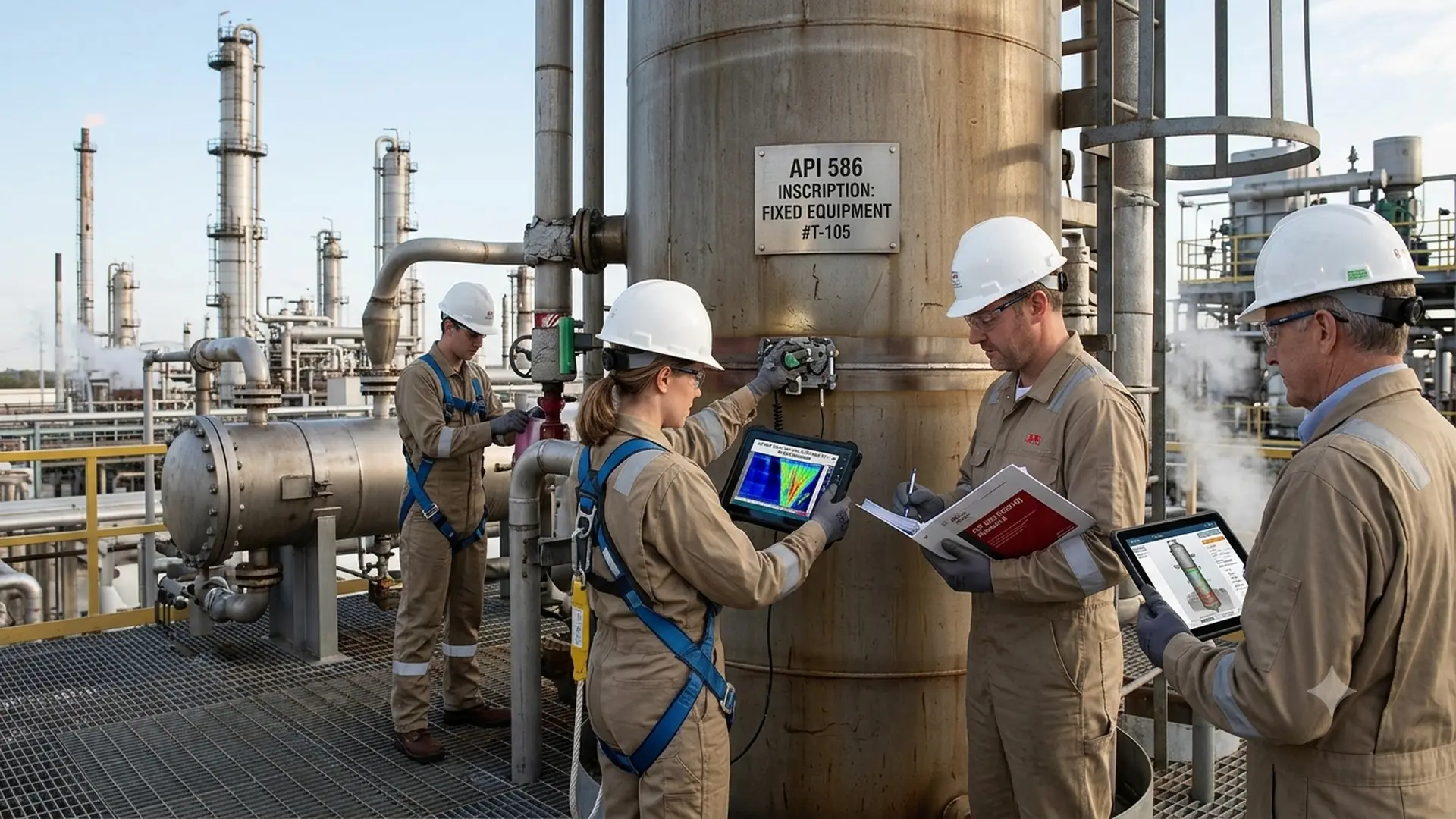
The following illustration shows a representative image of the procedures to be followed for the inspection of fixed equipment based on API 586.
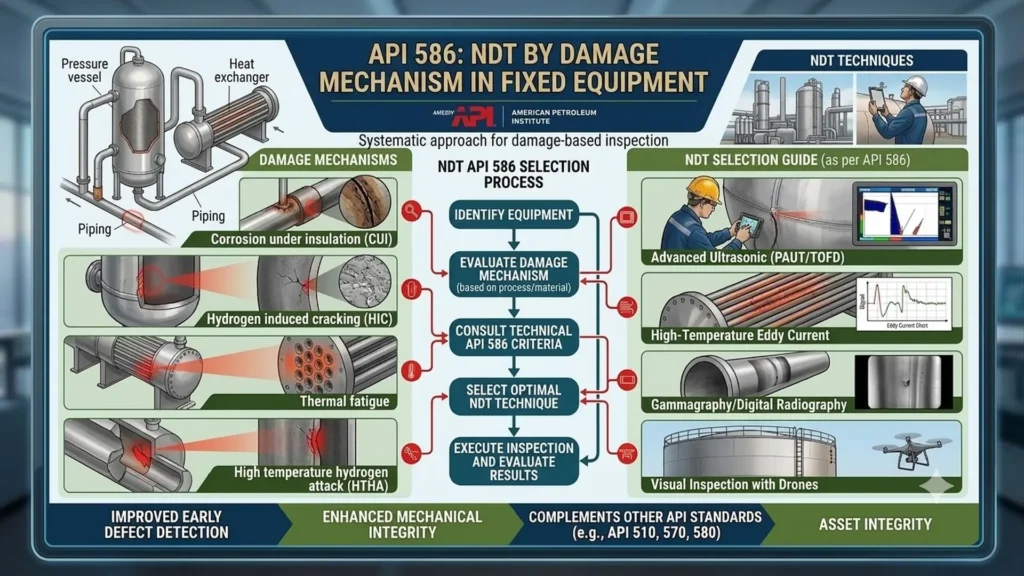
This approach allows inspections to be focused on the effective detection of expected damage, increasing the reliability of results and optimizing inspection resources.
API 586 applied to fixed equipment
Fixed equipment used in refineries, petrochemical plants, storage terminals, and other industrial facilities is simultaneously exposed to different degradation mechanisms throughout its service life.
The most common mechanisms include:
- General corrosion.
- Localized corrosion.
- Corrosion under insulation (CUI).
- Stress corrosion cracking (SCC).
- Mechanical fatigue.
- Erosion-corrosion.
- Hydrogen damage.
- High-temperature creep.
Each mechanism presents a different evolution pattern and requires specific techniques for its identification.
API 586 facilitates the selection of the most appropriate inspection method according to the nature of the damage, allowing maintenance programs to focus on the most critical degradation mechanisms. Initial inspections of heat exchangers are becoming increasingly common due to problems detected during the manufacturing process. Many refineries and chemical plants have incorporated a risk-based inspection (RBI) program governed by API RP 581, which establishes the guidelines to be followed when performing inspections on heat exchanger tubes.
What NDE to use according to damage in fixed equipment
One of the fundamental principles of API 586 is recognizing that inspection effectiveness depends on the correspondence between the damage mechanism and the technique or type of Non-Destructive Examination to be applied.
Some examples include:
| Damage mechanism | Commonly used NDE technique |
|---|---|
| General corrosion | Conventional ultrasonic testing (UT) |
| Localized corrosion | UT profiling, digital radiography |
| Corrosion under insulation | Guided wave ultrasonic testing (GWUT), digital radiography |
| SCC cracking | PAUT, TOFD, eddy current testing |
| Fatigue | PAUT, magnetic particle testing, liquid penetrant testing |
| Hydrogen damage | Advanced ultrasonic testing, PAUT |
Inspection according to the expected damage mechanism
Damage-based inspection is one of the fundamental pillars of modern mechanical integrity management. Unlike traditional programs, which apply the same methodology to all equipment, this approach first identifies the degradation mechanisms with the highest probability of occurrence and selects the Non-Destructive Examination (NDE) technique with the appropriate sensitivity to detect them.
Therefore, it is necessary to analyze variables such as construction material, pressure and temperature conditions, operating environment, failure history, equipment age, and estimated degradation rate. The combined evaluation of these factors allows prioritization of the highest-risk areas and significantly increases the probability of detecting defects before they compromise operational safety or asset availability.
Criteria for selecting NDE techniques
The correct selection of NDE methods requires understanding both the characteristics of the damage mechanism and the capabilities and limitations of each inspection technique. API 586 recommends evaluating aspects such as the minimum defect size to be detected, the orientation and depth of discontinuities, method resolution, component accessibility, and the conditions under which the inspection will be performed.
Practical factors must also be considered, such as the time required for evaluation, equipment availability, and application cost, always seeking a balance between technical reliability and operational efficiency. This process allows the development of technically supported inspection programs aligned with the mechanical integrity objectives of the facility.
Benefits of API 586 for asset management
The application of API 586 strengthens inspection programs by providing a structured methodology for selecting NDE techniques according to the expected damage mechanism. This approach improves the reliability of assessments, optimizes maintenance resources, and reduces the execution of unnecessary inspections.
In addition, it promotes the early detection of degradation processes, increases the operational availability of fixed equipment, and provides solid technical support for risk-based inspection (RBI) programs. Its integration with documents such as API 571, API 580, and API 581 allows the relationship between damage mechanism knowledge and inspection planning to be established, contributing to a more efficient and safer management of industrial asset integrity.
Integration of API 586 into asset integrity programs
The application of API 586 goes beyond being a standard for selecting a Non-Destructive Examination (NDE) technique; its main objective is to integrate inspection activities into an integrity management strategy based on knowledge of damage mechanisms. This approach establishes that inspection activities should be planned considering operating conditions, construction materials, service history, and degradation processes with the highest probability of occurrence.
By relating each damage mechanism to the most appropriate NDE method, it contributes to optimizing inspection planning, reducing uncertainties in equipment condition assessments, and improving the reliability of results. Likewise, it facilitates the prioritization of critical components, prevents the indiscriminate application of inspection techniques, and promotes more efficient use of resources allocated to maintenance.
The implementation of this standard is essential when integrated with risk-based inspection (RBI) programs and other recommended practices from the American Petroleum Institute, such as API 571, which identifies damage mechanisms, and API 580 and API 581, which establish criteria for risk evaluation and inspection frequency definition. In this way, API 586 becomes a key element for strengthening the mechanical integrity of fixed equipment, reducing the probability of unexpected failures, and supporting safer and more efficient management throughout the entire asset life cycle.
API 586 and contact point corrosion
It is important to mention that the standard addresses contact point corrosion (CPC), a damage mechanism that can affect the integrity of piping and fixed equipment when contact zones between materials exist in the potential presence of an electrolyte. This phenomenon requires special attention due to access difficulties and limitations of conventional inspection techniques; therefore, it is essential to apply appropriate Non-Destructive Examination (NDE) methods for its detection, evaluation, and monitoring.
The following video discusses the Non-Destructive Examination methods recommended by the API 586 standard for inspecting and monitoring corrosion at contact points.

Detection and control of localized damage
It recognizes contact point corrosion as a critical degradation mechanism in fixed equipment, especially in areas where piping and supports remain in contact under conditions that promote the presence of an electrolyte. This phenomenon can cause localized external material loss and compromise the primary containment of the system due to access difficulties and limitations of conventional inspection methods.
To address this challenge, API 586 establishes the importance of complementing visual inspection with Non-Destructive Examination (NDE) techniques capable of detecting, sizing, and monitoring damage evolution in confined areas. The proper selection of an inspection method according to the corrosion mechanism allows mechanical integrity programs to be strengthened, maintenance strategies to be optimized, and the risk of unexpected failures in piping and static industrial equipment to be reduced.
Conclusions
API 586 represents a fundamental tool for linking damage mechanisms with the selection of the most appropriate NDE methods for fixed equipment, allowing the development of more efficient and technically supported damage-based inspection programs. Its approach facilitates the early identification of discontinuities associated with different degradation processes, improving the reliability of integrity assessments and supporting decision-making based on the actual behavior of assets.
The application of these guidelines, together with other recommended practices from the American Petroleum Institute, contributes to reducing the probability of unexpected failures, optimizing maintenance resources, and extending the service life of industrial equipment. By selecting Non-Destructive Examination techniques aligned with the predominant deterioration mechanism, organizations can strengthen their integrity management strategies and improve the operational availability of their facilities.
The accurate identification of the damage mechanism is a determining factor in ensuring the effectiveness of any inspection program. An assessment based on the nature of deterioration allows the selection of examination methods with greater detection capability, avoiding unnecessary inspections and concentrating efforts on areas with a higher probability of degradation.
The incorporation of inspection methodologies focused on specific mechanisms promotes a transition from reactive approaches toward predictive maintenance strategies. This allows critical conditions to be anticipated, operational risks to be better managed, and fixed equipment to maintain reliable service conditions throughout its entire life cycle.
References
American Petroleum Institute. (2021). API Recommended Practice 586: Nondestructive Examination Methods for Damage Mechanisms in Fixed Equipment. API Publishing Services.
American Petroleum Institute. (2020). API Recommended Practice 571: Damage Mechanisms Affecting Fixed Equipment in the Refining Industry (3rd ed.). API Publishing Services.
American Petroleum Institute. (2016). API Recommended Practice 580: Risk-Based Inspection. API Publishing Services.
American Petroleum Institute. (2016). API Recommended Practice 581: Risk-Based Inspection Methodology. API Publishing Services.
Frequently asked questions (FAQs)
What does API 586 establish for fixed equipment?
It provides criteria for selecting the most appropriate Non-Destructive Examination (NDE) methods according to the damage mechanisms that may affect fixed equipment, improving inspection effectiveness and asset integrity management.
How should NDE be selected according to the damage mechanism?
The selection should consider the expected degradation type, component geometry, material, discontinuity orientation, required sensitivity, and the limitations of each inspection technique.
Which damages require specific inspection techniques?
Mechanisms such as corrosion under insulation, stress corrosion cracking, fatigue, hydrogen damage, erosion-corrosion, and localized corrosion require NDE methods with specific capabilities to detect each type of discontinuity.
Why does API 586 improve reliability?
Because it establishes a methodology that relates each damage mechanism to the most appropriate inspection technique, increasing the probability of early defect detection, optimizing inspection resources, and strengthening the mechanical integrity of fixed equipment.