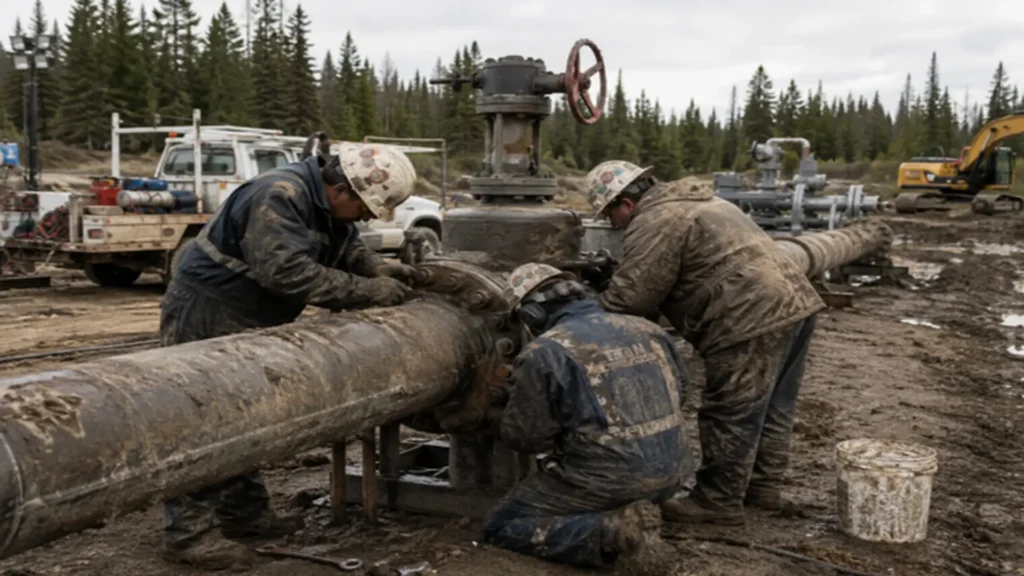
The gas pipeline operation and maintenance should treat every leak as an opportunity to eliminate its cause, not just to close out a work order. When a leak reoccurs at a valve, a flange, a weld, or a corroded section, the team needs to examine the pattern, assess the risk, select the appropriate repair, and verify the result. This guide proposes a field procedure to reduce recurring failures in gas pipelines through traceable decisions, targeted inspection, and operational follow-up.
Gas pipeline operation and maintenance in the event of failures
The first step in gas pipeline operation and maintenance is to separate an isolated event from a repetitive condition. Before mobilizing major resources, gather the history of leaks, repairs, pressure, temperature, alarms, cathodic protection, and operational changes of the affected point. If two or more events share location, geometry, material, or probable mechanism, treat the case as a trend that demands root cause analysis rather than a routine repair.
Confirming if a pattern exists
To recognize system recurrences, the supervisor can initiate a quick review of the last twelve to twenty-four months. The objective is to find coincidences that guide inspection and avoid repeating the same treatment.
- Exact location: station, valve, fitting, weld, or section chainage.
- Operating condition: pressure, temperature, flow rate, and maneuvers prior to the event.
- Suspected mechanism: external corrosion, internal corrosion, fatigue, SCC, vibration, or external damage.
- Subsequent evidence: new leak, wall loss growth, deformation, or change in indications.
If the evidence shows recurring failures in pipelines, record the dominant mechanism and the affected component. That classification will be the basis for deciding which inspection technique to use and what information must be captured during the intervention.
In gas pipeline operation and maintenance, also confirm whether twin components subjected to the same environment exist. Review those points before closing the analysis.
Classifying the threat before intervening
- External corrosion: review coating, cathodic protection potentials, drainage, and interference.
- Internal corrosion: review free water, gas composition, low points, velocity, and cleaning programs.
- Mechanical or geotechnical damage: check excavations, settlements, external loads, and ground movement.
Prioritizing with a field rule
Gas pipeline operation and maintenance must leave an explicit priority, a responsible party, and a review date. Without those three pieces of data, the anomaly remains technically open.
- Red: active leak, severe deformation, critical indication, or loss of containment with high consequence; control operation and escalate immediately.
- Amber: confirmed but stable degradation; define repair window, operating limits, and frequent verification.
Leak detection and pipeline inspection
Locating the leak before expanding the scope
Pipeline leak detection must begin by confirming the point of emission and distinguishing a real leak from an alarm caused by operational changes. In stations and surface equipment, combine observation, portable instruments, and process variables.
- Confirm whether the signal is continuous, intermittent, or associated with a maneuver.
- Record pressure and temperature at the moment of detection.
- Delineate the component or zone before dismantling or excavating.
To close pipeline leak detection, mark the point, record the instrument used, and repeat the reading after stabilizing the process.
Choose the inspection according to the mechanism
Pipeline inspection should not be a fixed list of techniques. Select the method based on the question it needs to answer. For wall loss, the priority is to size thickness and extent; for cracks, to characterize orientation and depth; for geometry, to confirm deformation and loads; and for welds or components, to evaluate the specific discontinuity with qualified NDT procedures.
- Wall loss: ultrasound, corrosion mapping, or ILI data compatible with the mechanism.
- Coating and external corrosion: cathodic protection surveys and coating system evaluation.
- Accessible components: detailed visual inspection, thickness measurements, NDT, and checking of bolts or seals.
Pipeline inspection must end with a decision: accept, monitor, evaluate with engineering, or intervene. A report without a defined action loses operational value, backed by traceable evidence.
Integrate detection and inspection with TEAM Inc.
When the need is to locate emissions in valves, flanges, and other components without shutting down the installation, TEAM Inc. offers Optical Gas Imaging and QOGI services within Detect360. Their published information indicates the use of high-sensitivity infrared cameras, GPS logs, and emission quantification; for direct measurement, it also describes Hi-Flow samplers, hot-wire anemometers, and acoustic detectors. This capability can support pipeline leak detection prior to defining the intervention.
When greater coverage is needed, pipeline leak detection can combine OGI with direct measurement and georeferenced records. Pipeline inspection complements this finding by characterizing the physical damage.
On-stream repair and remote monitoring
Deciding between repairing, reducing, or isolating
Pipeline repair must be selected after evaluating the mechanism, defect dimensions, material properties, pressure, temperature, loads, and failure consequences. ASME PCC-2-2022 provides methods for repairing in-service equipment, piping, and pipelines, and clarifies that repairs can be temporary or permanent depending on the circumstances and the applicable evaluation.
The operational decision must be documented, including limits and conditions of use.
- Repair in service when the method is qualified and operating conditions are within its envelope.
- Isolate the segment when integrity cannot be guaranteed with acceptable temporary controls.
Before approving a pipeline repair, validate that the vendor received consistent data and that the actual condition of the asset matches the design basis.
Using on-stream repair with clear limits
TEAM Inc. describes on-stream leak repair, hot tapping, line intervention, valve repair, controlled bolting, and engineered composite repair solutions within Repair360. Its online repair service indicates that solutions must be designed for the particular conditions of the system and that its composite repairs follow ASME PCC-2 and ISO 24817. This offering can respond to a real pipeline repair need when a complete shutdown has high impact and engineering evaluation allows working in service.
- Before: confirm design data, defect, pressure, temperature, and access restrictions.
- After: verify leak-tightness, mechanical condition, repair marking, and as-built documentation.
Pipeline repair must be linked to a re-evaluation criterion. That date prevents a temporary solution from remaining indefinitely due to operational inertia.
Verifying with data after intervening
In Gas pipeline operation and maintenance, follow-up begins upon restoring service. Remote pipeline monitoring must compare the new baseline with pre-event behavior.
Remote pipeline monitoring serves to confirm stability after a repair and detect changes that warrant review. Pressure, temperature, flow rate, valve states, and alarms can show deviations, but must be interpreted together with physical condition. A stable system in SCADA does not prove by itself that a crack or localized corrosion has stopped growing.
- Define baseline values immediately after restoring operation.
- Escalate any persistent change to field inspection before normalizing it as habitual behavior.
Use remote pipeline monitoring to identify persistent changes and confirm whether they coincide with known maneuvers. If no operational explanation exists, schedule a field check.
Practical response and follow-up plan
Applying a seven-step sequence
To standardize Gas pipeline operation and maintenance in the face of repeated events, the team can use a simple sequence that forces the closure of each stage before moving forward. This prevents the pressure to restore service from eliminating activities necessary to prevent recurrence.
- Detect: confirm signal, location, and operating condition.
- Contain: establish safety controls and temporary operating limits.
- Inspect: select NDT or measurement according to the suspected mechanism.
- Evaluate: determine severity, probable growth, and consequence.
- Repair: apply a solution compatible with code, design, and actual condition.
- Verify: check leak-tightness, stability, and procedure compliance.
- Learn: update threat, review frequency, and preventive actions.
Gas pipeline operation and maintenance needs a simple rule: no work order is closed without a probable cause, repair evidence, and a defined next action.
Closing the order with evidence
Gas pipeline operation and maintenance improves when order closure requires minimum evidence rather than just an execution signature. The file must allow a different engineer to reconstruct what happened, what was found, why the solution was chosen, and what must be monitored afterward.
- Before and after photographs, with asset identification and scale where applicable.
- Inspection results, method uncertainty, and defect dimensions.
Pipeline inspection must be incorporated into the asset’s history with location and date. Remote pipeline monitoring completes traceability by preserving subsequent trends.
Conclusions
Applied in this way, Gas pipeline operation and maintenance turns every intervention into useful information for the next integrity decision.
Gas pipeline operation and maintenance is more effective when each leak triggers a sequence of diagnosis, evaluation, repair, and verification. The practical objective is not to accumulate inspections, but to prevent the same mechanism from reappearing. Combining detection, pipeline inspection, in-service intervention, and follow-up makes it possible to prioritize resources according to risk and maintain technical evidence. When recurring failures in pipelines persist, the scope must be expanded toward similar assets and systemic causes before closing the order again.
References
- American Society of Mechanical Engineers. (2022). ASME PCC-2-2022: Repair of pressure equipment and piping. ASME.
- American Society of Mechanical Engineers. (2025). ASME B31.8-2025: Gas transmission and distribution piping systems. ASME.
- International Organization for Standardization. (2017). ISO 24817:2017: Petroleum, petrochemical and natural gas industries—Composite repairs for pipework—Qualification and design, installation, testing and inspection (2nd ed.). ISO.
- Pipeline and Hazardous Materials Safety Administration. (2024, August 6). Safety of gas transmission pipelines: Repair criteria, integrity management improvements, cathodic protection, management of change, and other related amendments, RIN 2. U.S. Department of Transportation. PHMSA – 2022 Gas Rule
- Pipeline and Hazardous Materials Safety Administration. (2025, August 22). Gas transmission integrity management. U.S. Department of Transportation. PHMSA – Gas Transmission Integrity Management
- TEAM, Inc. (s. f.). Pipeline360: Pipeline integrity solutions. TEAM, Inc. https://www.teaminc.com/industry-solutions/pipeline360/
- TEAM, Inc. (s. f.). Pipelines, methane and the new emissions playbook. TEAM, Inc. https://www.teaminc.com/resource/pipelines-methane-and-the-new-emissions-playbook/
- TEAM, Inc. (s. f.). Leak sealing and on-stream repair solutions. TEAM, Inc. https://psp.teaminc.com/leak-sealing-and-repair-request/
FAQs: Frequently Asked Questions
What to do when a leak reappears?
Treat it as a potential recurrence rather than an identical event to the previous one. Review the prior repair, mechanism, operating conditions, and similar assets. Recurring failures in pipelines require expanding the analysis until finding which condition remains active.
How to choose a detection technique?
In periodic programs, pipeline leak detection must maintain the same recording criterion to compare campaigns and recognize real changes. Pipeline leak detection must be chosen by location, accessibility, expected magnitude, product, necessary sensitivity, and survey objective. On surface components, OGI can be useful; on extensive lines, sensors, patrolling, process data, and aerial technologies can be combined.
When should an inspection be carried out?
Pipeline inspection must be executed when a threat exists that needs sizing, a leak requires explaining its origin, a condition occurs following extreme events, or an interval is defined by the integrity program. The method must respond to the threat rather than team habit.
Can a pipeline be repaired without shutting it down?
Yes, some situations allow in-service pipeline repairs using designed solutions and specific procedures. The possibility depends on the defect, material, pressure, temperature, product, and applicable code. Avoiding a shutdown must never replace engineering evaluation or safety controls.
What are the benefits of monitoring after repairs?
What Remote monitoring of gas pipelines allows for the observation of operational stability, the detection of deviations, and the correlation of these deviations with the intervention performed. It should be supplemented with physical verification when the mechanism can proceed without causing visible changes in pressure or flow rate.does monitoring contribute after repairing?