Table of Contents
- Operational fundamentals and cleaning strategies
- Chemical cleaning methods
- Operational frequency and criticality by equipment type
- Causes of fouling by industrial sector
- Stages and technical protocol of chemical cleaning
- Analytical testing during cleaning operations
- Industrial safety and risk control
- Importance of chemical cleaning in corrosion control
- Conclusions
- References
- Frequently asked questions (FAQs)
- Why is the use of hydrochloric acid (HCl) prohibited in stainless steel equipment?
- What is the specific function of the neutralization stage in chemical cleaning?
- How is autoignition from pyrophoric iron sulfide (FeS) prevented during cleaning?
- How does the field team determine the exact moment to conclude the acid stage?
In the continuous process industry, including oil refineries, petrochemical plants, and basic chemical plants, the uninterrupted accumulation of deposits and scale on metallic surfaces represents one of the most critical challenges to mechanical integrity and operational efficiency. Fouling increases pressure drop in piping, creates thermal barriers that reduce heat transfer, and promotes severe under-deposit corrosion phenomena.
Unlike conventional mechanical methods, chemical cleaning allows the treatment of complex geometries, internal tube bundles, and piping runs in-situ without the need for costly structural dismantling. Below is a detailed technical analysis based on the causes of fouling by sector, application methods, the essential three-stage metallurgical protocol, real-time analytical testing, and industrial safety protocols required to guarantee a successful operation.
Operational fundamentals and cleaning strategies
When to perform cleaning of process equipment and piping?
Fouling occurs inevitably during normal operations and, on occasion, prior to them during the construction and installation phase. The fundamental reasons for executing chemical cleaning are divided into two operational categories:
- Pre-operational cleaning: Removes mill scale, surface oxides, welding slag/debris, manufacturing oils, and loose residues that entered the system during construction or hydrostatic testing. Its omission can cause clogging of small-bore piping in hydraulic or lubrication systems, filter plugging, damage to rotating mechanisms, and initiate localized galvanic corrosion.
- Operational / periodic cleaning: Restores flow capacity and heat transfer efficiency. Likewise, it allows deactivating unwanted catalytic metallic surfaces, removing catalyst fines and biological growths, neutralizing hazardous chemicals prior to personnel entry during plant turnarounds, absorbing toxic vapors, and removing flammable or pyrophoric deposits before inspection or application of protective coatings.
Chemical cleaning methods
The selection of the chemical method depends on the equipment geometry, loop volume, physical nature of the foulant, and accessibility. The most commonly used methods in the industry include:
- Circulation: Continuous pumping of the chemical solution at controlled velocities to ensure turbulence and constant renewal of the reactant at the interface. Applicable to heat exchangers, process lines, and piping systems.
- Filling and soaking: Complete flooding of the equipment and holding at rest for a specified period to allow dissolution or softening of deposits. Used in pressure vessels, towers, and ducts.
- Foaming: Generation of chemical foam using surfactants, which drastically reduces the required liquid volume and the structural weight exerted on the equipment. Ideal for large vessels and process towers.
- Vapor phase cleaning: Injection of volatile reagents or solvents into a carrier steam stream that condenses on the cold walls of the equipment. Applied in large vessels and overhead piping.
- Tank immersion: Submersion of removed components (such as disassembled tube bundles) in basins with agitated or heated chemical solutions.
- Other specific methods: Cascading (gravity application over internal trays), chemical slugging (injecting interleaved chemical plugs), and solvent brushing or high-velocity chemical flow.
Operational frequency and criticality by equipment type
Certain categories of equipment foul more rapidly or are more sensitive to efficiency loss. In decreasing order of industrial cleaning frequency, they are:
- Shell and tube heat exchangers: Top the list because any loss in the overall heat transfer coefficient is immediately reflected in the thermal balance and an increase in furnace fuel consumption.
- Fired heater tubes (furnaces): The formation of scale or coking generates “hot spots” that raise the tube wall temperature, increasing the risk of failure due to deformation or creep.
- Process piping and ducts: Fouling increases roughness and reduces cross-sectional area, increasing pressure drop and pumping or compression costs.
- Rotating machinery: Deposit accumulation on rotors or blades produces dynamic unbalance, excessive vibrations, and catastrophic bearing damage.
- Storage vessels and tanks: Cleaned mainly during scheduled maintenance turnarounds or when sludge accumulation at the bottom promotes under-deposit corrosion.
Causes of fouling by industrial sector
Fouling is any insoluble material that contaminates or deposits on process surfaces. Its consequences include flow restriction, increased pressure drop, creation of thermal barriers, and acceleration of under-deposit corrosion and erosion-corrosion mechanisms.
Basic chemical plants
In chemical processing, fouling is characterized by:
- Inorganic scale: Precipitation of insoluble calcium and magnesium salts (carbonates, phosphates, silicates, fluorides) due to changes in solubility, temperature, or pH in evaporators and crystallizers.
- Sediment and silt: Finely divided particles forming loose deposits.
- Crystallization products: Progressive accumulation of soluble salts deposited in lines and storage tanks.
- Corrosion products: Iron or copper oxides, hydroxides, sulfates, and fluorides detached from equipment.
- Viscous adherences: High-viscosity product residues such as liquid polymers, resins, paints, or syrups.
Oil refineries
Fouling in refining is complex due to high temperatures and the presence of sulfur, chlorine, and organic nitrogen in crude oil:
- Corrosion products: Dominated by iron sulfide (FeS), originating from high-temperature sulfur corrosion or wet H2S corrosion.
- Coke and carbonaceous matter: Severe thermal degradation of heavy hydrocarbons in furnace tubes, transfer lines, and reboilers.
- Organic polymers and gums: Condensation of unsaturated compounds (olefins/diolefins) in preheat trains.
- Deposited inorganic salts: Ammonium chloride (NH4Cl) and ammonium bisulfide (NH4HS) in cold zones of fractionator overheads and hydrotreating reactors.
Petrochemical plants
Reaction and degradation polymers: Formation of gums (“soft coke”) or heavy organic cross-links in extractive distillation towers, pyrolysis gas compressors, and ethylene, styrene, or butadiene reactors.
Catalytic deposits: Sludges and acidic precipitates derived from organometallic catalyst residues or Lewis halogens (such as AlCl3 or BF3).
Stages and technical protocol of chemical cleaning
Chemical injection methods
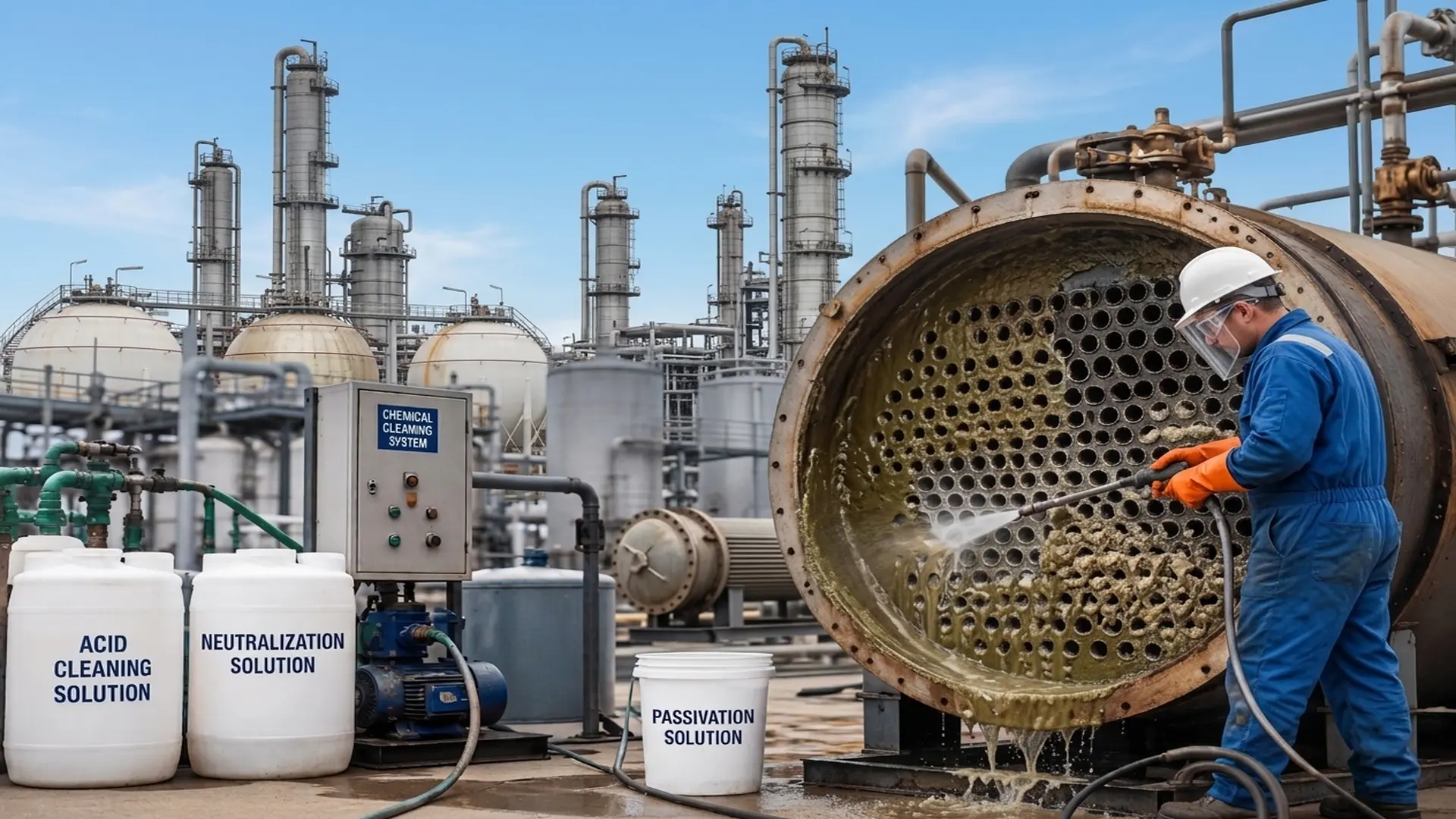
Injection of cleaning solutions must be carried out through auxiliary connection points installed at battery limits. Chemical pumping skids equipped with mixing tanks, return manifolds, and in-line injection systems are employed to maintain turbulent circulation velocities that favor both chemical action and mechanical sweeping.
Stages of the chemical cleaning process
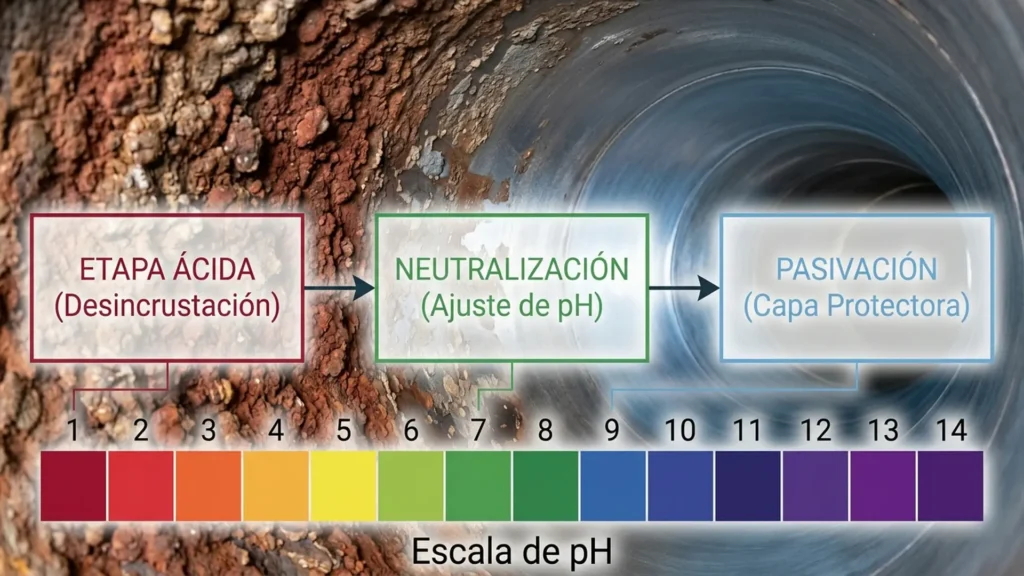
To execute safe chemical cleaning without compromising the structural integrity of the asset, the intervention must be strictly structured into three consecutive stages: Acid stage (descaling/pickling), Neutralization stage, and Passivation stage.
1. Acid stage (descaling and pickling)
- Objective: Solubilize inorganic scale (carbonates, iron oxides) and remove adhered deposits.
- Carbon steels: Hydrochloric acid (HCl) at 5%–10% mass concentration is frequently used, always combined with a specific organic corrosion inhibitor and at controlled temperatures (typically < 60°C) to prevent inhibitor degradation. Mixtures of citric acid or ammoniated citric acid are also used.
- Stainless steels and nickel/copper-base alloys: The use of hydrochloric acid (HCl) is strictly prohibited. Chloride ions (Cl–) cause severe pitting and trigger environmentally assisted stress corrosion cracking / chloride stress corrosion cracking (ESCC / SCC). Instead, organic acids such as citric acid, formic acid, sulfamic acid, phosphoric acid, or chelating agents such as EDTA (ethylenediaminetetraacetic acid) adjusted to a slightly acidic pH are used.
2. Neutralization stage
- Objective: Eliminate any acid residue trapped in crevices, micropores, or dead legs of the equipment and raise the pH of the metallic surface.
- Mechanism: After draining the acid solution and performing a displacement rinse with quality-controlled water, an alkaline solution (typically 1% to 2%) of sodium carbonate (Na2CO3), trisodium phosphate (Na3PO4), or ammonia (NH3) is circulated. The neutralizing solution raises the surface pH to values between 8.5 and 10.0, immediately halting acid attack and preventing the “flash rusting” phenomenon (instantaneous oxidation upon contact with air).
3. Passivation stage
- Objective: Induce the formation of a dense, continuous passive film on the clean metallic surface so that the equipment is protected against atmospheric corrosion or immediate recontamination when put into service.
- Mechanism in carbon steels: The formation of a stabilized layer is induced at temperatures in the range of 600 °C to 80 °C.
- Mechanism in stainless steels: Reconstitution of the natural passive layer rich in chromium oxide (Cr2O3) is favored using dilute solutions of nitric acid or citrates with strict control of redox potential.
Analytical testing during cleaning operations
- Field laboratory analytical control during the procedure determines cleaning effectiveness and prevents over-attack of the base metal:
- Cleaning agent concentration (acid/alkaline): Periodic measurement (every 15–30 min) via volumetric titration. Stabilization in reagent consumption indicates that foulant dissolution is complete.
- Dissolved iron (Fe2+ / Fe3+) and copper concentration: Its quantification allows plotting the deposit dissolution rate. When the level of iron in solution reaches a plateau, chemical cleaning has reached its endpoint. An unusual subsequent increase would indicate unwanted attack on the base metal.
- pH and temperature monitoring: Real-time control to maintain chemical kinetic activity and protect corrosion inhibitor integrity.
- Corrosion testing or thousandths of an inch per day.
Industrial safety and risk control
Handling chemical reagents at an industrial scale and deposit decomposition entail severe risks for personnel and facilities:
- Gas generation (CO2): It is mandatory to install alkaline gas scrubbing systems and maintain a closed circuit.
- Control of pyrophoric iron sulfide (FeS) deposits: In refineries, accumulated FeS can react highly exothermically upon contact with atmospheric oxygen during draining, causing spontaneous fires. A preliminary inactivation stage with oxidizing agents or specific surfactants must be applied to convert pyrophoric sulfide into safe, soluble salts.
- Chemical incompatibility: Accidental mixing of strong acids with unforeseen oxidizing solutions or chlorinating agents that release chlorine gas or cause violent exothermic reactions must be prevented.
- Personal protective equipment (PPE): Use of airtight chemical protective suits, full face protection, respirators with acid vapor cartridges, and the immediate presence of emergency showers and eyewash stations.
Importance of chemical cleaning in corrosion control
Chemical cleaning is an important step in corrosion control programs for process equipment and piping systems. Throughout operation, internal surfaces can accumulate deposits of oxides, corrosion products, mineral scale, hydrocarbon residues, and other contaminants that alter operating conditions and promote material degradation mechanisms.
The presence of these deposits can generate localized corrosion cells, reduce heat transfer efficiency, obstruct lines, and alter the physicochemical conditions at the metal surface. In certain systems, deposits can also retain moisture, aggressive species, or microorganisms, increasing the risk of under-deposit corrosion and microbiologically influenced corrosion (MIC).
For this reason, chemical cleaning should not be considered solely an activity intended to restore operational efficiency. When properly designed and performed, it helps remove agents that contribute to material degradation and prepare surfaces for subsequent protection strategies, such as inhibitor application, coatings, or passivation treatments.
However, the cleaning process itself can introduce corrosion risks if variables such as cleaning-agent concentration, temperature, contact time, circulation velocity, and compatibility between the cleaning product and equipment materials are not properly controlled. An excessively aggressive formulation or prolonged exposure can result in metal loss, localized attack, or deterioration of metallic components.
Therefore, the cleaning method should be selected considering the material, the nature and thickness of the deposits, the prevailing corrosion mechanism, and the operating conditions. Where applicable, corrosion inhibitors compatible with the cleaning system should be incorporated, along with appropriate controls to verify that the treatment removes contaminants without adversely affecting the metallic substrate.
From an asset integrity perspective, chemical cleaning should be integrated into a broader corrosion prevention, monitoring, and control strategy. Its effectiveness depends not only on removing deposits but also on achieving a clean surface without introducing a new degradation mechanism.
Conclusions
Chemical cleaning of process equipment and piping is an indispensable maintenance engineering discipline to preserve energy efficiency, operational capacity, and mechanical integrity in industrial plants. A successful procedure is not limited to injecting an acid solution; it demands a rigorous diagnosis of the deposit’s chemical nature, the correct selection of the chemical reagent respecting system metallurgy, and strict compliance with the three-stage protocol: acid, neutralization, and passivation.
Likewise, implementing real-time quantitative analytical testing and proactive risk management, such as addressing toxic gases (H2S) or pyrophoric deposits (FeS), ensures an efficient, safe, and profitable plant turnaround.
Consequently, a properly designed chemical cleaning process can help extend the service life of equipment and piping, maintain operational performance, and reduce the likelihood of failures associated with corrosion mechanisms.
References
- Documento Principal: Limpieza de Equipos de Proceso y Tuberías. Manual Técnico sobre Métodos Mecánicos, Químicos y Diagnóstico de Ensuciamiento.
- AMPP / NACE SP0193: Application of Chemical Cleaning to Industrial Process Equipment.
- ASTM Committee G01: Standard Practice for Preparing, Cleaning, and Evaluating Corrosion Test Specimens (ASTM G1).
- API Recommended Practice 652 / 653: Tank Inspection, Repair, Alteration, and Reconstruction / Linings for Aboveground Petroleum Storage Tanks.
Frequently asked questions (FAQs)
Why is the use of hydrochloric acid (HCl) prohibited in stainless steel equipment?
Hydrochloric acid provides chloride ions (Cl-) that locally destroy the passive layer of stainless steel, causing deep pitting and initiating chloride stress corrosion cracking (ESCC). For stainless steel, organic acids (such as citric or sulfamic acid) or chelating agents such as EDTA must be used.
What is the specific function of the neutralization stage in chemical cleaning?
The neutralization stage uses alkaline solutions (such as sodium carbonate or trisodium phosphate) to raise the pH of the metallic surface to values between 8.5 and 10.0. This eliminates acid residues trapped in porosity and prevents the “flash rusting” phenomenon (instantaneous oxidation of newly cleaned metal).
How is autoignition from pyrophoric iron sulfide (FeS) prevented during cleaning?
Prior to opening the equipment or allowing air ingress, a chemical decontamination treatment is applied through flushing with soluble surfactants and oxidants that convert FeS into non-reactive soluble sulfates, eliminating the pyrophoric risk.
How does the field team determine the exact moment to conclude the acid stage?
Through continuous quantitative analysis in field laboratories. Free acid concentration and the accumulation of dissolved iron/copper in solution are monitored. When the dissolved metal content reaches a plateau and the acid concentration remains constant across several consecutive readings, total deposit dissolution is confirmed.