Table of Contents
- Why Industrial Inspection Is Evolving
- What is AI assisted inspection?
- Where does AI create value in mechanical integrity?
- Benefits for industrial operations
- How to evaluate an AI assisted inspection solution?
- Leading AI assisted inspection solutions
- Current challenges and limitations
- The future of A assisted inspection
- Conclusion
- Reerences
- Frequently Asked Questions
- What is AI-assisted inspection for mechanical integrity?
- Can AI replace human inspectors?
- Where can AI-assisted inspection be applied?
- What are the primary benefits of AI-assisted inspection?
- What should organizations evaluate before selecting an AI solution?
- Does AI-assisted inspection ensure compliance with industry standards?
- Which industries are adopting AI-assisted inspection?
- What is the future of AI-assisted inspection?
Artificial intelligence is reshaping how industrial organizations analyze the vast amount of information generated through inspections, non-destructive testing (NDT), condition monitoring, and asset integrity programs. As industrial facilities become increasingly connected, transforming data into reliable engineering decisions has become one of the greatest challenges facing mechanical integrity professionals.
Understanding how AI-assisted inspection solutions work, where they deliver the greatest value, and which technical criteria should be evaluated before implementation is becoming essential for organizations seeking to improve reliability, optimize inspection strategies, and strengthen asset integrity programs. This practical guide explores the technologies behind AI-assisted inspection, its most relevant industrial applications, key implementation considerations, and the role these solutions are expected to play in the future of mechanical integrity.
Why Industrial Inspection Is Evolving
Industrial inspection has evolved alongside the increasing complexity of industrial assets and the growing demand for safety, operational reliability, and regulatory compliance across industries such as oil and gas, petrochemicals, power generation, chemical processing, and advanced manufacturing.
Today, every inspection activity—including non-destructive testing (NDT), thickness measurements, corrosion monitoring, and condition monitoring—generates valuable information that must be transformed into timely engineering decisions capable of protecting critical assets throughout their operational life.
Modern industrial facilities already generate more inspection and operational information than engineering teams can realistically analyze using traditional methods. The real challenge lies in extracting meaningful insights, identifying relationships between multiple data sources, and converting that information into actions that reduce risk, optimize inspection intervals, and improve maintenance planning.
For decades, these decisions relied primarily on spreadsheets, inspection reports, isolated databases, and engineering expertise. While these resources remain essential, the growing volume, variety, and complexity of industrial data increasingly limit their ability to provide a comprehensive view of asset conditions.
At the same time, digital transformation has accelerated the adoption of Risk-Based Inspection (RBI), Asset Integrity Management (AIM) platforms, digital twins, online monitoring systems, and predictive analytics. These technologies are creating highly connected industrial environments where engineering decisions depend on integrating information from multiple sources rather than evaluating individual datasets in isolation.
Within this context, AI-assisted inspection is not intended to replace inspectors or mechanical integrity engineers. Instead, it serves as an advanced decision-support capability that enhances data analysis, improves consistency, identifies hidden patterns, and provides engineers with deeper insights to support safer, faster, and more informed decisions throughout the asset lifecycle.
What is AI assisted inspection?
AI-assisted inspection for mechanical integrity encompasses a new generation of engineering solutions that use artificial intelligence to analyze the information generated during industrial inspection activities. Their primary objective is to transform large volumes of inspection data into reliable technical insights that support engineering decisions.
These solutions process information from non-destructive testing (NDT), condition monitoring systems, visual inspections, and Asset Integrity Management (AIM) programs. Rather than replacing engineers, they improve the speed, consistency, and quality of technical analysis throughout the inspection process.
AI in industrial inspection
Unlike conventional software, artificial intelligence can identify hidden patterns, correlate historical inspection data, and detect anomalies that may be overlooked during manual reviews. This enables engineering teams to prioritize inspections more effectively and improve the evaluation of asset conditions.
By integrating information from multiple sources, AI provides a broader understanding of how pressure vessels, piping systems, storage tanks, heat exchangers, and other critical assets perform throughout their service life.
Beyond automation: Intelligent analysis
Automation follows predefined rules to execute repetitive tasks. Artificial intelligence goes a step further by learning from historical information, recognizing trends, and generating evidence-based recommendations that support engineering evaluations.
This capability makes AI a valuable decision-support tool for mechanical integrity programs, particularly when inspection data exceeds the capacity of traditional manual analysis.
Technologies behind AI assisted inspection
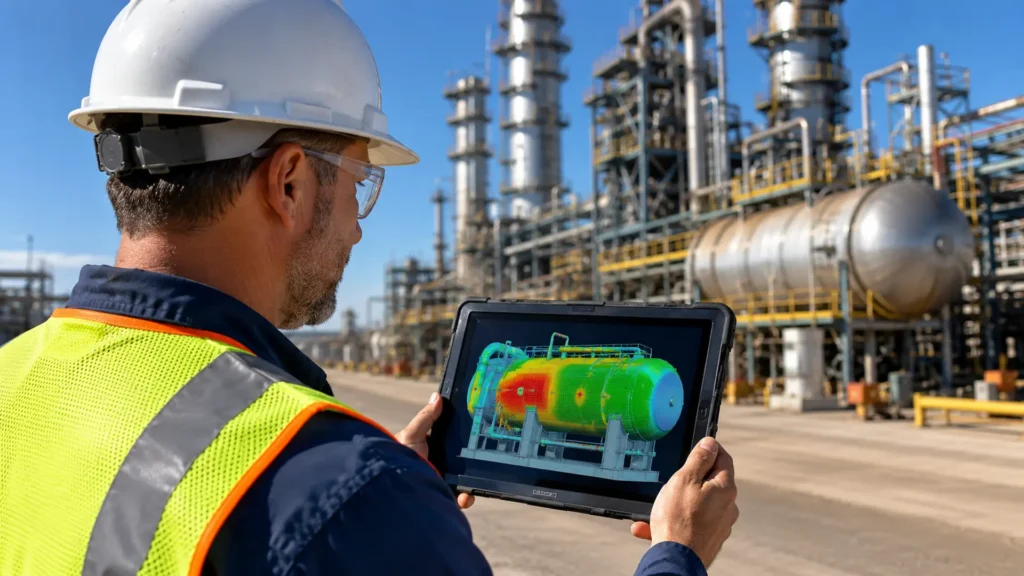
Most AI-assisted inspection platforms combine Machine Learning, Computer Vision, Predictive Analytics, Digital Twins, and Generative AI to interpret complex inspection data. When integrated with Asset Integrity Management (AIM) platforms, these technologies provide deeper visibility into asset conditions and strengthen engineering decisions throughout the entire asset lifecycle.
Where does AI create value in mechanical integrity?
Artificial intelligence is expanding the capabilities of mechanical integrity programs by helping engineering teams analyze growing volumes of inspection and operational data. Its greatest value is found in established methodologies such as Risk-Based Inspection (RBI) and Fitness-for-Service (FFS), while also supporting inspection, maintenance, and asset integrity workflows.
Risk-Based Inspection (RBI)
AI-assisted inspection platforms analyze inspection history, operating conditions, damage mechanisms, and process variables to identify assets with the highest probability of degradation.
This enables organizations to prioritize inspections based on risk, optimize resource allocation, and continuously refine inspection strategies using historical and real-time information.
Fitness-For-Service (FFS)
During Fitness-for-Service assessments, AI helps engineers organize technical documentation, analyze historical trends, and consolidate inspection data from multiple sources.
Rather than replacing engineering evaluations performed in accordance with standards such as API 579-1/ASME FFS-1, AI accelerates information analysis and improves the efficiency of technical reviews.
Non-Destructive Testing (NDT)
Artificial intelligence is increasingly supporting ultrasonic testing (UT), radiographic testing (RT), eddy current testing (ECT), visual inspection (VT), and other NDT methods.
By comparing historical inspection records, recognizing recurring indications, and identifying subtle variations, AI assists inspectors in detecting conditions that may require additional engineering evaluation.
Corrosion Monitoring
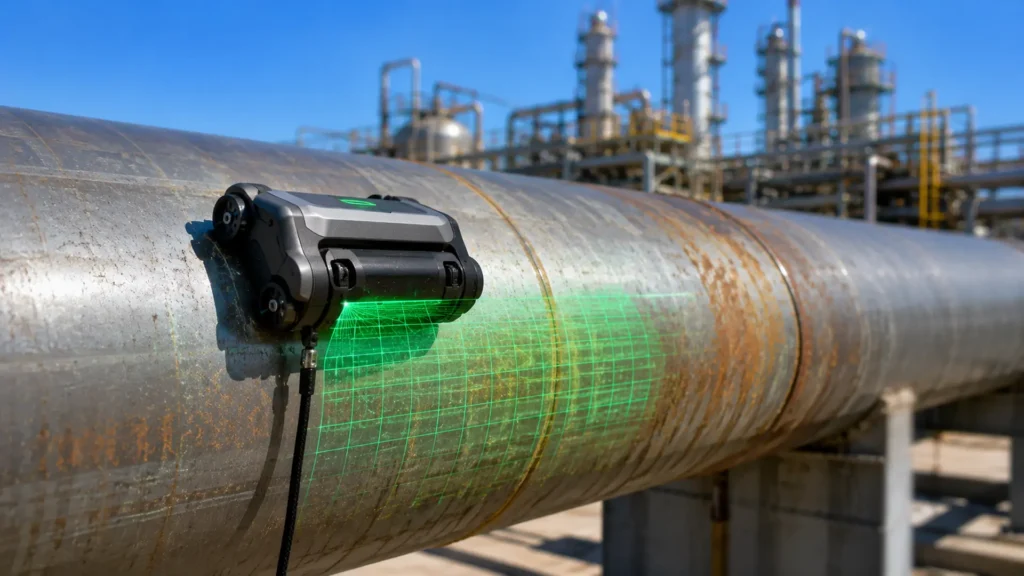
When integrated with online corrosion monitoring systems, AI can identify changes in corrosion rates, recognize degradation trends, and generate early warnings before significant damage develops.
This improves maintenance planning, supports risk reduction strategies, and provides better visibility into asset conditions throughout the inspection cycle.
Asset Integrity Management (AIM)
Integrated with Asset Integrity Management (AIM) platforms, AI connects inspection, operations, maintenance, and engineering data within a unified digital environment.
This holistic view enables engineers to better understand asset conditions, improve lifecycle management, and make more informed technical decisions based on connected information rather than isolated datasets.
Although implementation varies according to asset type, inspection methodology, and operational objectives, every AI-assisted inspection solution pursues the same goal: transforming technical data into faster, more consistent, and better-informed engineering decisions. The following table summarizes the primary areas where AI is creating value within modern mechanical integrity programs.
| Application Area | How AI Contributes | Operational Benefit |
| Risk-Based Inspection (RBI) | Analyzes inspection history, damage mechanisms, and operating conditions to prioritize assets according to risk. | Optimizes inspection planning and improves resource allocation. |
| Fitness-for-Service (FFS) | Organizes engineering data and analyzes historical trends to support fitness-for-service assessments. | Reduces evaluation time and strengthens engineering decision-making. |
| Non-Destructive Testing (NDT) | Assists in interpreting inspection indications, comparing historical results, and identifying anomalies. | Improves analytical consistency and supports earlier defect detection. |
| Corrosion Monitoring | Processes continuous monitoring data to identify changes in corrosion rates and degradation trends. | Enables proactive maintenance planning and reduces operational risk. |
| Asset Integrity Management (AIM) | Integrates inspection, operations, and maintenance data into a single engineering platform. | Provides a comprehensive view of asset health and strengthens lifecycle management. |
As these examples demonstrate, the value of AI extends far beyond the algorithms themselves. Its true strength lies in integrating with existing inspection, maintenance, and asset integrity processes to provide engineers with a broader understanding of equipment condition and operational performance.
Rather than replacing established engineering practices, AI enhances the quality, consistency, and speed of technical decision-making across the entire asset lifecycle.
This evolution is already visible in commercial solutions developed by specialized technology companies, where artificial intelligence is being applied to strengthen industrial inspection workflows and support mechanical integrity programs.
One example was showcased during the API Inspection & Mechanical Integrity Summit, where Inspenet spoke with representatives from Massachusetts Materials Technologies (MMT) about how AI is being incorporated into real-world industrial applications.
Case study
Artificial intelligence is no longer a future concept in industrial inspection.
During the API Inspection & Mechanical Integrity Summit 2024, Inspenet interviewed Aaron Crowder, Director of Commercialization at Massachusetts Materials Technologies (MMT), to discuss how advanced AI algorithms are being used to evaluate the mechanical properties of pipelines, pressure vessels, and storage tanks without relying on destructive testing methods.
The interview illustrates how AI-assisted inspection is evolving from experimental research into practical engineering solutions that support mechanical integrity, non-destructive testing, and asset reliability programs.
Watch the full interview:
MMT Advances AI-Enhanced Inspection Technology at the API Summit

Benefits for industrial operations
The value of AI-assisted inspection extends well beyond automating repetitive tasks. Its greatest contribution lies in transforming large volumes of inspection and operational data into actionable engineering intelligence that supports faster, more consistent, and more traceable technical decisions.
When integrated into mechanical integrity programs, these solutions help organizations optimize inspection planning, strengthen risk management strategies, and maximize the value of information collected throughout the asset lifecycle.
The table below summarizes some of the most significant benefits AI-assisted inspection can deliver across industrial operations.
| Benefit | Technical Impact | Business Impact |
| Faster Data Analysis | Processes large volumes of inspection and operational data in significantly less time. | Shortens engineering evaluations and improves overall productivity. |
| Improved Inspection Prioritization | Identifies high-risk assets and supports risk-based inspection planning. | Optimizes resource allocation and reduces operating costs. |
| Earlier Anomaly Detection | Recognizes degradation patterns and abnormal conditions that may be difficult to identify manually. | Reduces the likelihood of unexpected failures and unplanned downtime. |
| Enhanced Data Traceability | Consolidates inspection records, historical data, and operational information into a unified environment. | Simplifies audits, strengthens documentation, and supports regulatory compliance. |
| Better Engineering Decision Support | Provides engineers with analytical insights based on multiple sources of information. | Increases confidence in technical decisions and reduces operational uncertainty. |
| Integrated Asset Information | Connects inspection, maintenance, and operational data across a single digital platform. | Improves asset lifecycle management and enables more informed business decisions. |
The benefits outlined above are only realized when artificial intelligence is implemented as part of a comprehensive Asset Integrity Management strategy rather than as an isolated technology.
AI contributes speed, analytical capability, and deeper visibility into asset conditions. However, engineering judgment, regulatory compliance, and operational experience remain essential for interpreting results and making final decisions.
Successful mechanical integrity programs combine the analytical power of artificial intelligence with the expertise of inspectors, corrosion specialists, reliability engineers, and asset integrity professionals.
Only through this collaboration can organizations improve reliability, optimize maintenance strategies, and make more informed decisions throughout the entire lifecycle of industrial assets.
How to evaluate an AI assisted inspection solution?

Selecting an AI-assisted inspection solution involves much more than comparing software features or technical capabilities. Before implementing any platform within a mechanical integrity program, organizations should evaluate how well it integrates with existing engineering workflows, the quality of available data, and the long-term value it can deliver.
The following considerations can help engineering teams identify solutions that improve inspection performance while supporting safe, reliable, and compliant operations.
- Data Quality and Availability: Artificial intelligence is only as reliable as the data it analyzes. Incomplete inspection records, inconsistent data formats, or outdated information can significantly reduce the accuracy of AI-generated insights and limit the effectiveness of engineering recommendations.
- Integration with Existing Systems: An effective solution should integrate seamlessly with Asset Integrity Management (AIM) platforms, Computerized Maintenance Management Systems (CMMS), inspection databases, historians, and other engineering applications. Strong system integration eliminates duplicated information, improves data continuity, and supports more efficient engineering workflows.
- Transparency and Explainability: Engineers need to understand how an AI system reaches its conclusions. Recommendations should be supported by traceable evidence that allows users to validate results, understand underlying assumptions, and maintain confidence in engineering decisions.
- Scalability and Cybersecurity: An AI platform should be capable of growing alongside the organization’s mechanical integrity program while protecting sensitive industrial information. Scalability, secure system architecture, and compliance with industrial cybersecurity requirements are essential for long-term deployment.
- Regulatory Compliance: AI-assisted inspection solutions should support, not replace, established engineering practices governed by industry codes and standards. Platforms that facilitate compliance with standards such as API, ASME, and ISO while maintaining complete technical traceability provide greater value for regulated industrial environments.
Selecting the right AI-assisted inspection solution is not simply a technology decision, it is an engineering decision. The most effective platforms combine advanced analytics with industry standards, integrate naturally into existing inspection processes, and support engineers without disrupting established workflows. Ultimately, artificial intelligence creates value when it enhances engineering expertise, strengthens asset reliability, and addresses the operational challenges faced by mechanical integrity teams.
Leading AI assisted inspection solutions
The AI-assisted inspection ecosystem has evolved rapidly in recent years. Today’s platforms combine data analytics, asset integrity management, inspection automation, and engineering decision-support capabilities to help organizations improve reliability and optimize inspection programs. Although each solution addresses different operational needs, they all share a common objective: enabling better engineering decisions through more effective use of inspection and operational data.
The following examples represent some of the platforms currently supporting mechanical integrity and asset integrity management programs across the process industries.
| Solution | Primary Focus | Typical Applications |
| AsInt Edge | Mechanical Integrity & Asset Integrity Management | Fitness-for-Service (FFS), Risk-Based Inspection (RBI), Asset Integrity Management (AIM), and data-driven engineering decisions. |
| IMS PEI | Fixed Equipment Integrity | RBI programs, inspection planning, compliance management, and fixed equipment integrity. |
| Antea | Asset Integrity Management | Corrosion management, inspection planning, maintenance optimization, and risk assessment. |
| PCMS – MISTRAS | Corrosion Management | Corrosion monitoring, damage assessment, integrity evaluations, and inspection planning. |
| e2G | Integrity Engineering | RBI, FFS, corrosion engineering, damage mechanism reviews, and specialized integrity consulting. |
Each platform offers different capabilities in data management, analytics, visualization, and enterprise system integration. Selecting the right solution depends on factors such as asset type, operational complexity, digital maturity, regulatory requirements, and the specific objectives of the organization’s mechanical integrity program.
Current challenges and limitations
Despite rapid advances in artificial intelligence, AI-assisted inspection continues to face several technical and organizational challenges that should be considered before implementation. The quality of AI-generated insights depends directly on the quality of inspection data, effective integration with existing engineering systems, and continuous oversight by experienced mechanical integrity professionals.
Trust also remains a critical factor. In mechanical integrity applications, engineering decisions can directly affect personnel safety, asset reliability, environmental protection, and regulatory compliance. For this reason, AI recommendations must always be validated by qualified engineers.
Additional challenges include interoperability between software platforms, industrial cybersecurity, data governance, and workforce readiness. Organizations must also ensure that engineering teams develop the skills required to effectively interpret AI-generated recommendations. Ultimately, AI should be viewed as an engineering decision-support technology, not as a replacement for professional expertise.
The future of A assisted inspection
Artificial intelligence is expected to become an integral component of industrial inspection programs as digital transformation continues across the process industries. The convergence of online monitoring systems, Industrial IoT (IIoT), non-destructive testing, digital twins, predictive analytics, and Asset Integrity Management platforms will enable increasingly accurate models for predicting degradation mechanisms and supporting risk-informed engineering decisions.
As these technologies mature, AI-assisted inspection will evolve from a data analysis tool into a core component of integrated asset integrity strategies. Organizations that adopt these capabilities strategically will be better positioned to improve reliability, optimize maintenance resources, extend asset life, and strengthen mechanical integrity programs while maintaining engineering oversight and compliance with industry standards.
Conclusion
AI-assisted inspection represents a significant step forward in the evolution of mechanical integrity management. By transforming large volumes of inspection and operational data into meaningful engineering insights, these technologies enable organizations to improve inspection planning, strengthen risk management, and support more informed technical decisions throughout the asset lifecycle.
However, technology alone does not improve asset integrity. The greatest value is achieved when AI is integrated into established engineering processes, supported by recognized industry standards, and combined with the expertise of qualified inspectors, reliability engineers, corrosion specialists, and mechanical integrity professionals.
Artificial intelligence does not replace engineering judgment. It enhances the ability of engineering teams to make faster, more consistent, and better-informed decisions while maintaining technical accountability. As industrial operations continue to digitalize, AI-assisted inspection will play an increasingly important role in building safer, more reliable, and more sustainable industrial facilities.
Reerences
- American Petroleum Institute. API Recommended Practice 580: Risk-Based Inspection (3rd ed.). API Publishing Services.
- American Petroleum Institute. API Recommended Practice 581: Risk-Based Inspection Methodology (3rd ed.). API Publishing Services.
- American Petroleum Institute, & American Society of Mechanical Engineers. API 579-1/ASME FFS-1: Fitness-For-Service (2nd ed.). API Publishing Services.
- American Petroleum Institute. API Standard 510: Pressure Vessel Inspection Code: In-Service Inspection, Rating, Repair, and Alteration (12th ed.). API Publishing Services.
- American Petroleum Institute. API Standard 570: Piping Inspection Code: In-Service Inspection, Rating, Repair, and Alteration of Piping Systems (5th ed.). API Publishing Services.
- American Petroleum Institute. API Standard 653: Tank Inspection, Repair, Alteration, and Reconstruction (5th ed.). API Publishing Services.
- American Society of Mechanical Engineers. ASME Boiler and Pressure Vessel Code, Section V: Nondestructive Examination. ASME.
- American Society of Mechanical Engineers. ASME PCC-3: Inspection Planning Using Risk-Based Methods. ASME.
- Association for Materials Protection and Performance. AMPP Corrosion Control and Integrity Management Resources.
- Deloitte. (2024). Industry 4.0 and Smart Manufacturing Survey.
- Institute of Electrical and Electronics Engineers. (2022). IEEE Standards Activities on Artificial Intelligence
- International Organization for Standardization. (2014). ISO 55000: Asset Management — Overview, Principles and Terminology. https://www.iso.org
- International Organization for Standardization. (2014). ISO 55001: Asset Management — Management Systems — Requirements. https://www.iso.org
- International Organization for Standardization. (2018). ISO 55002: Asset Management — Management Systems — Guidelines for the Application of ISO 55001. https://www.iso.org
- International Organization for Standardization. (2018). ISO 17359: Condition Monitoring and Diagnostics of Machines — General Guidelines. https://www.iso.org
- McKinsey & Company. (2023). The State of AI: How Organizations Are Rewiring to Capture Value. https://www.mckinsey.com
- National Institute of Standards and Technology. (2023). Artificial Intelligence Risk Management Framework (AI RMF 1.0). U.S. Department of Commerce. https://www.nist.gov/itl/ai-risk-management-framework
- World Economic Forum. (2023). The Future of Industrial Operations: Digital Transformation and Artificial Intelligence. https://www.weforum.org
- Inspenet. (2024). MMT Advances AI-Enhanced Inspection Technology at the API Summit [Video]. MMT’s AI-Enhanced Non-Destructive Technology at API Summit
Frequently Asked Questions
What is AI-assisted inspection for mechanical integrity?
AI-assisted inspection uses artificial intelligence to analyze information collected from industrial inspections, non-destructive testing (NDT), condition monitoring, and Asset Integrity Management (AIM) systems to support engineering decision-making.
Can AI replace human inspectors?
Artificial intelligence is designed to support inspectors by accelerating data analysis, identifying patterns, and highlighting potential issues. Final engineering evaluations and inspection decisions remain the responsibility of qualified professionals.
Where can AI-assisted inspection be applied?
AI-assisted inspection supports Risk-Based Inspection (RBI), Fitness-for-Service (FFS), non-destructive testing (NDT), corrosion monitoring, Asset Integrity Management (AIM), and condition-based maintenance programs.
What are the primary benefits of AI-assisted inspection?
Key benefits include faster data analysis, improved inspection prioritization, earlier anomaly detection, enhanced data traceability, and stronger engineering decision support.
What should organizations evaluate before selecting an AI solution?
Organizations should assess data quality, system integration, explainability, regulatory compliance, cybersecurity, scalability, vendor expertise, and long-term support capabilities before implementation.
Does AI-assisted inspection ensure compliance with industry standards?
Artificial intelligence does not certify compliance with API, ASME, ISO, or other engineering standards. Compliance depends on how AI is implemented within established mechanical integrity programs, supported by qualified engineering oversight and documented procedures.
Which industries are adopting AI-assisted inspection?
AI-assisted inspection is being adopted across oil and gas, petrochemical processing, refining, power generation, mining, infrastructure, chemicals, and advanced manufacturing, where organizations seek to improve asset reliability and operational performance.
What is the future of AI-assisted inspection?
The future of AI-assisted inspection will be driven by greater integration with digital twins, Industrial IoT (IIoT), predictive analytics, real-time condition monitoring, and Asset Integrity Management platforms, enabling increasingly proactive and data-driven approaches to managing industrial assets.