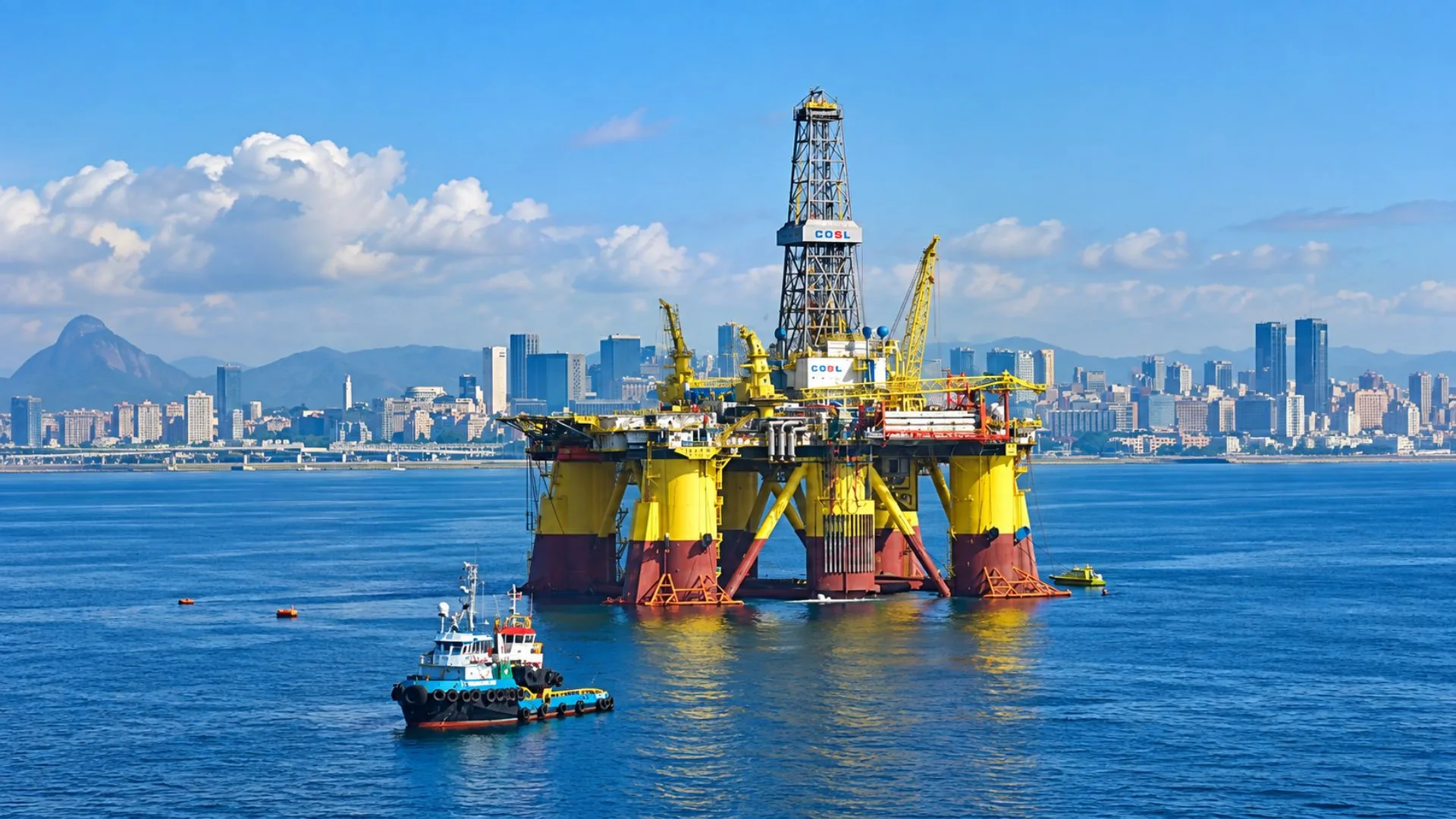
Vallourec Petrobras expanded its offshore project portfolio with new contracts for two energy developments in Brazil and Greece. The company will supply tubular solutions for Sepia 2, Petrobras’s oil project located in the ultra-deep waters of the Santos Basin, and will also participate in the first phase of Prinos CO2, an initiative that aims to transform a depleted oil field off the Greek coast into a permanent carbon dioxide storage facility.
Vallourec will supply 130 kilometers of pipes for Sepia 2
On one hand, Vallourec obtained a contract with Subsea7 to supply seamless carbon steel pipes for Petrobras’ Sepia 2 project, located in the Santos Basin off the coast of Brazil. The scope includes approximately 130 kilometers of risers and rigid flow lines, equivalent to more than 15,000 tons of carbon steel pipe prepared to operate in corrosive environments and under the demanding conditions of offshore developments.
In addition to supplying the pipes, Vallourec will provide the thermal insulation cladding associated with the system, manufacturing will take place at the Jeceaba plant in Minas Gerais, while the coating will be applied at Vallourec Coating Solutions’ facilities in Serra, Espírito Santo, this combination will allow the manufacturer to leverage an integrated industrial chain within Brazil to serve a project located in one of the country’s most important offshore oil fields.
Philippe Guillemot, Chairman of the Board and CEO of the Vallourec Group, highlighted that the contract combines the company’s ability to manufacture seamless pipes with its thermal insulation technologies for underwater applications.
Sepia 2 will operate in ultra-deep waters of Brazil
On the other hand, Sepia 2 it is located in the pre-salt zone of the Santos Basin, approximately at 280 kilometers of the Brazilian coast the project includes the development of 15 wells, in addition to an export pipeline that will be connected to a new floating production, storage and offloading (FPSO) unit.
The infrastructure will be installed in an area where the water depth reaches approximately 2,170 meters this condition requires equipment and solutions capable of responding to the high pressures and operating conditions characteristic of developments in ultra-deep waters. These characteristics make the supply of pipes and insulation systems relevant elements to maintain the reliability of fluid transport from underwater wells to the production infrastructure.
Vallourec enters the first phase of Prinos CO2 in Greece
Meanwhile, Vallourec was also selected by EnEarth, a subsidiary of Energean, to participate in the first phase of the project Bring CO2 located off the coast of Greece, the contract comprises approximately 3,000 tons of casing pipes and fittings, including solutions manufactured from seamless carbon steel and corrosion-resistant alloys (CRA).
The pipes will incorporate premium VAM connections and the supply will also include CLEANWELL, Vallourec’s solution developed for tubular connections without the need to use certain additives during installation. In this project, the products will be intended to preserve the integrity of the wells during injection operations and permanent storage of carbon dioxide underground.
Prinos will store CO2 in a former oil field
Unlike the Brazilian contract, which focuses on hydrocarbon production, Prinos seeks to repurpose a depleted oil field as a permanent geological storage facility for CO2. The project anticipates achieving a injection capacity of up to 2.8 million tons of CO2 per year, while its total tested and probable storage capacity amounts to 51.5 million tons.
Prinos has also been recognized by the European Union as a Project of Common Interest and is supported by European and Greek funding programs aimed at developing infrastructure related to emissions management. Nikolas Rigas, Director of Carbon Storage at EnEarth, noted that safety, reliability, and long-term integrity are essential factors for a CO2 storage facility of this scale.
The project aims to provide infrastructure capable of receiving carbon dioxide from industrial activities and permanently storing it in geological formations, thus contributing to emissions reduction strategies. With contracts in Brazil and Greece, Vallourec will apply its tubular solutions in two distinct segments of the offshore energy market: ultra-deepwater oil production and permanent geological CO2 storage.
Source: Offshore Energy
Photo: Shutterstock